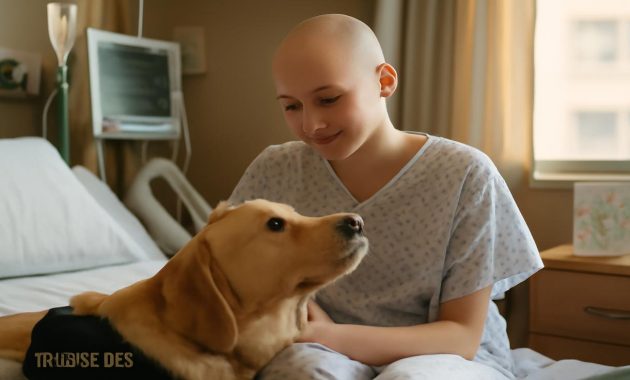
The first time Maya saw the dog, she thought the morphine was playing tricks on her.
It was late afternoon, that blurry in-between hour when hospital light feels like dishwater and time has no edges. Shadows were long, the hallway humming its usual sterile chorus—beeping monitors, squeaking wheels, the whisper of rubber soles. Her room smelled like lemon disinfectant and the faint metallic tang of the IV line taped to her arm.
Then the door nudged open, and a golden-brown face appeared at floor level. A wet black nose. A pair of amber eyes that looked somehow older than the muzzle around them. A dog in a blue vest, framed by the doorway light like some small, shaggy miracle.
“Maya,” the nurse said softly, “there’s someone I’d like you to meet.”
The dog stepped in, careful and deliberate, each paw placed as if the linoleum might crack beneath her weight. Her tail gave a slow, uncertain wag, and Maya saw that one side of the dog’s flank had been shaved, the pink skin traced by a neat ladder of stitches. IV tape peeked from under the vest, close to where Maya’s own bandages ended.
The dog looked at Maya. Not at the tubes, not at the machines, but at her. Straight and steady, as if they were the only two people in that room.
“This is Clover,” the nurse said. “She’s… well, she’s a patient here too.”
A Dog with a Chart
Clover had a medical chart. That was the first thing that made Maya sit up, despite the ache that rippled through her ribs when she moved. Not just a little folder with vaccination records, but a full, thick file with clipped pages and color-coded tabs. The same kind of chart that lived at the foot of Maya’s own bed.
“Wait,” Maya said, her voice raspy from days of too little use and too many breathing treatments. “She’s sick? But she’s a therapy dog.”
The volunteer who’d come in with Clover—an older woman with silver hair and kind, sharp eyes—nodded. “She is a therapy dog. She’s also being treated. Just like you.”
Maya had leukemia. She knew the word well now, could spell it even when half-asleep. She knew the shapes of it on the faces of adults when they thought she wasn’t looking. She knew its taste: plastic masks and sharp antiseptic and the tinny aftertaste of pills that seemed too big for her throat.
But she’d never thought about a dog having something like that. Being “gravely ill,” as one doctor had said when he thought the curtain was drawn.
“What’s wrong with her?” she asked, eyes locked on Clover, who was watching her just as closely, as if waiting for permission.
“She has cancer too,” the volunteer said gently. “Lymphoma. She just had a treatment this morning. Is it okay if she comes a little closer?”
Maya hesitated. It had been weeks since she’d touched anything not made of plastic or covered in vinyl. The hospital had become a world of “Don’t” and “Careful” and “We’ll have to see.” Her own body felt foreign, a fragile collection of bruises and tape and purple pinpricks where needles had searched for veins.
But Clover’s gaze didn’t waver. There was something in it—tiredness, yes, but also an alert, quiet focus. A question, almost.
“Yeah,” Maya said at last. “She can come.”
Clover stepped forward, her claws clicking softly on the floor, and rested her chin on the edge of the bed. Up close, Maya saw the gray at the dog’s temples, the subtle trembling in her front legs as she held herself there, polite and patient. There was a small bandage taped to one paw.
“Hey,” Maya whispered, reaching out. Her hand hovered for a second, unsure, then settled into the fur between Clover’s ears. It was warm, dense, the opposite of cold plastic. Clover exhaled, a deep, satisfied sigh, and the room seemed to shift around them, like someone had opened a window and let real air in.
The Day the World Shrunk to Four Walls
Before this hospital, before the word “leukemia” became the axis of her family’s orbit, Maya’s world had been loud and bright and wide. Soccer cleats; sticky ice cream afternoons; the smell of her father’s burnt toast on Saturday mornings. She’d been the kind of teenager who moved fast and talked faster, always late, always running—never imagining her own body could become something unreliable.
The fever had started on a Thursday. By Sunday, she was in a bed surrounded by machines that blinked and chimed, while her parents spoke in hushed, knotted sentences with strangers in white coats.
Days bled into each other. Nurses came and went with needles and charts and gentle jokes that sometimes made her smile, sometimes made her want to scream. Friends texted at first, then less, then the messages thinned to emojis and “how r u?” that she didn’t know how to answer.
The hospital tried, in its way, to soften the isolation. There were coloring books on the shared cart, a clunky old game console, a window that looked out onto a slice of the parking lot and, if she craned her neck just right, half of a tree. But more and more, it felt like the world existed out there, moving on without her, and she was stuck in a paused moment.
Until Clover walked in and made the room feel suddenly alive, as if some small piece of the outside had wandered innocently past the security desk and gotten lost on her floor.
Two Patients, One Room
Clover’s visits weren’t supposed to be long. Ten minutes, maybe fifteen, the volunteer explained. The dog tired easily these days. Her own treatments left her shaky and nauseous; some days her fur lay flat and dull, as if even shining took too much energy.
But the first visit stretched. Ten minutes became twenty, then thirty. Nobody seemed in a hurry to end it. Nurses passed by the open door and slowed, their faces softening at the sight of Maya with her fingers buried in Clover’s coat, both of them half-asleep in the late-day quiet.
Clover, it turned out, had been doing therapy work for years. She’d visited nursing homes, schools, disaster shelters, and now, pediatric wards like this one. She was a veteran of sorrow and recovery, a small, four-legged expert in how to be present in rooms where words often failed.
“Does she know?” Maya asked once, when Clover had finally settled onto the chair beside the bed, her body curled carefully around the plastic tubing that snaked to her IV port.
The volunteer tilted her head. “Know what?”
“That she’s… sick.” The word felt jagged in her mouth.
The woman smiled, but it was a sad, thoughtful smile. “She knows she’s tired. She knows some days hurt. She knows there’s a routine to all this—needles, scans, funny-smelling rooms with big machines. But she doesn’t think about it like we do. She just knows: this is today. These are my people. This is what I do.”
Maya watched Clover’s chest rise and fall, slow and steady. A patch of fur on her side had been shaved for an ultrasound, and the skin there was freckled, the stitches small and precise. A dog with a battle map, just like the constellation of bruises blooming along Maya’s arms.
“So she just… keeps going,” Maya said.
“She just keeps going,” the volunteer echoed.
It was an infuriatingly simple answer, and yet, looking at Clover, it was also the only answer that made sense.
Quiet Battles and Small Victories
In the days that followed, their schedules slowly wove together. On Mondays and Thursdays, when Maya had her chemo, Clover usually did too. The hospital had arranged it deliberately, a quiet experiment in mutual morale. A girl and a dog, both gravely ill, both tethered to beeping machines, their charts tagged with the same bold, urgent codes.
On those mornings, the oncology wing had two kinds of footsteps: the hurried, clipped stride of doctors and the soft, measured rhythm of Clover’s paws.
Maya began to measure time not just in doses and drips, but in Clover’s arrivals. She’d lie awake, watching the clock, listening for the faint jingle of the dog’s collar down the hall. Her stomach might be roiling from the chemo, her bones aching as if they’d been hollowed out, but the thought that Clover was fighting through the same chemical storm gave the pain a strange, shared shape.
Once, when the nausea was too much and she’d curled around the plastic basin, furious at her own weakness, Clover nudged her elbow with a wet nose. Maya looked up to see the dog’s face level with hers, eyes soft and rimmed with red, the way they got on her worst days.
“You too?” Maya whispered.
Clover blinked slowly, then rested her head on Maya’s lap. Her body was warm and solid, the weight of her a grounding anchor in the churning sea of side effects. For a long time, they stayed that way—just breathing, just being, just surviving the next minute together.
The nurses noticed the difference. Maya’s vital signs steadied faster when Clover was around. Her heart rate settled, her breathing deepened; sometimes her pain numbers slipped, just a notch or two, as if someone had dialed down the volume. On days when Clover didn’t feel well enough to visit, the room felt louder, sharper-edged. But the knowledge that the dog was somewhere on the same floor, hooked up to her own IV, gave Maya a sense that she wasn’t fighting alone.
When the Fighter Falls Quiet
There was a week when Clover didn’t come at all.
It started with a simple explanation: “She’s resting,” the volunteer said, her voice calm but her hands twisting the strap of her bag. “Her counts are low. Like yours get sometimes. She just needs to stay in her room for a bit.”
Maya nodded, but the absence hit harder than she expected. The room felt emptier, the beeping of the machines more insistent. The little clock on the wall seemed to smirk at her slow, dragging days.
On the third day, a nurse brought an update, as if reporting on a fellow soldier’s condition.
“Clover had a rough night,” she said, pulling Maya’s blanket up a little higher. “They adjusted her meds. She’s sleeping a lot. But the oncologist says she’s a tough girl.”
Tough. The word people always used for Maya. For kids in wards like this. For anyone forced to endure more than their share of needles and fear. It sounded different when applied to a dog who wagged her tail at children even when her own legs trembled.
On the fifth day, Maya sat by her window, watching the thin slice of tree sway outside. Her own counts had dropped; she was on isolation precautions, a sign on her door warning visitors to mask and sanitize. The loneliness pressed against her ribs in a new, suffocating way.
She found herself talking aloud, voice barely more than a mumble.
“You’re not allowed to give up, okay?” she said to the ceiling, to the IV pole, to the faint scent of dog that still clung to her blanket. “You started this thing with me. We’re supposed to finish it.”
Her mother, sitting in the corner chair, looked up from her book but said nothing. Instead, she crossed the room, adjusted the IV line with the practiced care of someone who’d been doing it for months now, and kissed the top of Maya’s head.
“She won’t give up,” her mother said quietly. “You won’t either. That’s the deal, right?”
The Day of Two Leashes
Clover’s return was unceremonious, which made it somehow more miraculous. No fanfare, no announcement. Just the soft knock of the volunteer on the doorframe and the now-familiar shape of a golden head peering around the corner.
Maya’s breath hitched. For a heartbeat, fear flashed through her—was this it? A goodbye visit? Had someone decided she was old enough to understand certain finalities?
But then Clover stepped inside, slower than before, perhaps, her fur thinner around her hips, but her tail wagging with unmistakable determination. She made a beeline for the bed, resting her head where she always did, on the same worn patch of blanket. She sighed, as if finally home.
“Hey, warrior,” Maya whispered, her hand shaking slightly as she reached out. “You scared me.”
Clover’s eyes glimmered. She tilted her head, as though trying to understand the quaver in Maya’s voice, then did what she did best: nothing grand, nothing dramatic—just being there, firmly, insistently alive.
That day, a physical therapist came in with an idea. Maya’s legs had grown weak from too many days in bed; walking even to the bathroom left her breathless. Clover also needed gentle movement to keep her muscles from stiffening.
“What if,” the therapist suggested, “you took a walk together? Just to the end of the hall and back.”
They found two leashes. One clipped to Clover’s vest, the other offered to Maya, not as a necessity—Clover walked beautifully off-leash—but as a symbol.
In the fluorescent-lit corridor, lined with identical doors and identical posters of smiling cartoon organs, a girl with a hospital bracelet and a dog with a bandaged paw walked side by side. IV poles rolled along like awkward chaperones. Nurses glanced up from their charts and smiled. A toddler in another doorway pointed with a delighted gasp.
Maya’s legs trembled by the halfway mark. Sweat beaded under the tape on her chest. But Clover kept her pace slow, matching Maya’s faltering steps. When the girl paused to catch her breath, Clover paused too, one paw lifted mid-stride, patient as a statue.
It was, by any athletic measure, an unimpressive journey: maybe forty yards total. But inside that distance was everything—fear, effort, pain, stubbornness, and something else that tasted like possibility.
| Moment | Maya | Clover |
|---|---|---|
| Before treatment | Active teen, soccer, school | Experienced therapy dog, visiting many people |
| Diagnosis | Leukemia, long hospital stay | Lymphoma, regular chemo |
| Weakest days | Nausea, fatigue, fear | Shaking legs, low energy, extra rest |
| Together | Lower anxiety, more courage | Calmer, focused on comforting |
| Small victory | Walks the hallway again | Returns to visits, tail still wagging |
What Healing Really Looked Like
Healing, Maya learned, wasn’t a straight line. It wasn’t a single triumphant moment when everything snapped back into place and the world looked exactly as it had before. It was quieter than that. Messier.
It looked like a teenager throwing up into a basin at 3 a.m., then lying back, drained but breathing, while a golden head pressed against her hip as if to say, still here.
It sounded like lab results that were “better, but not perfect,” and the rustle of nurses changing out IV bags, and the soft thump of a dog’s tail against the side of a chair whenever a child entered the room.
Some days, healing meant simply enduring. Other days, it meant tiny, almost invisible gains: a slightly better appetite, a shorter nap, a walk that didn’t require a wheelchair backup. On all those days, Clover was a witness—and a participant.
Scientists could explain the benefits, if you asked them. They’d talk about lowered cortisol levels, reduced blood pressure, endorphin surges triggered by touch. They’d show you charts and graphs and heart rate monitors that proved, in numbers, that therapy animals mattered.
But if you asked Maya, she’d explain it differently.
“She made it not just about me,” she’d say. “When you’re sick, everyone stares at you like you’re made of glass. But with Clover, we were just two tired fighters hanging out. I didn’t have to be brave for myself. I could be brave for her.”
And if you could ask Clover, maybe she’d offer no explanation at all, just her steady gaze and warm, patient presence. For her, there was no separation between “therapy” and “friend.” There was only the next visit, the next small life she stepped into, paws careful on the cold floor.
After the Hospital
Stories like this rarely end in a single, cinematic scene. There was no grand discharge party with balloons and banners. Instead, there were incremental steps: fewer overnight stays, more outpatient visits, a slow tapering off of the monitors that had once seemed to govern Maya’s every breath.
The day she walked out of the hospital without an IV line attached, the air felt almost too big in her lungs. The parking lot smelled like exhaust and rain and freedom. Her parents hovered, uncertain whether to celebrate or protect her from every other human within a twenty-foot radius.
Before they left, though, they made one last stop.
Down a quieter hallway, past a small sign that read “Staff and Authorized Visitors Only,” there was a side room that had, over time, become almost as important to Maya as her own. Inside, on a soft blanket, Clover slept, her body curled into a question-mark of fur and breath.
She woke when they entered, of course. That tail, even on her tired days, had its own determination. She stretched, shook, and trotted over as if to say, Right. What’s next?
Maya knelt, feeling the strange new sturdiness in her legs. She pressed her forehead to Clover’s, fingers sinking into the familiar warmth of her coat.
“Thank you,” she murmured. “For fighting with me.”
Clover’s tongue swiped her cheek in a single, efficient kiss. Then she did something she hadn’t done much in all their visits: she turned away first, padding back to her blanket. She circled twice, then settled with a soft groan, eyes half-lidded.
“Is she… okay?” Maya asked, a familiar panic flickering in her chest.
The volunteer, who had watched this quiet exchange from the doorway, nodded. “She’s tired. She’ll have good days and hard days, just like you. But today? Today she saw you walk in here on your own two feet. That’s a very good day.”
Maya understood. Healing wasn’t the same for everyone. For some, it meant leaving. For others, it meant staying, doing the work again tomorrow. Clover’s future was a series of maybes and ifs, but that didn’t diminish the reality of what she’d done—day after day, room after room, paw by steady paw.
As they left, Maya turned back one last time. Clover’s eyes were already closed, her chest rising and falling, the rhythm of someone who had earned her rest.
Outside, the world was noisy and raw and vividly alive. Trees. Cars. A boy on a skateboard. A woman on her phone, laughing. The sudden, overwhelming abundance of unsanitized life.
Maya stepped into it cautiously, carrying, somewhere beneath her shirt and scars, the unshakable knowledge that she had not faced the darkness alone.
What Their Fight Teaches Us
The story of a gravely ill dog and a gravely ill teenager sharing a hospital corridor isn’t the kind of tale that wraps itself up with a perfect bow. That’s precisely why it lingers.
It reminds us that healing is rarely heroic in the glossy, movie-poster sense. Most of the time, it’s made of small, ordinary acts: a hand reaching out to fur, a dog’s head resting quietly on a blanket, two patients taking ten shaky steps down a too-bright hallway.
It shows us that courage is contagious. A girl finds strength in the way a sick dog still wags her tail. A dog finds purpose in the way a sick girl’s shoulders unclench when she walks into the room. That loop of mutual bravery becomes, in its own small way, a medicine no chart can fully capture.
Most of all, their shared fight reminds us of this: even in the most clinical, fluorescent-lit corners of our world, life has a way of smuggling in warmth and wildness. In the quiet companionship between a therapy dog and a teenager, in their side-by-side battle to stay, to mend, to go just one more day—there is something fiercely, stubbornly hopeful.
Not every story like theirs ends the way we wish. Not every patient, human or animal, walks back out into the parking lot. But every time they meet, every time they fight together, they bend the shape of the hospital day a little away from fear and a little closer to love.
And if you listen closely, down those long, polished corridors of medicine and machinery, you can still hear it: the faint, steady rhythm of paws and bare feet, moving forward—always forward—side by side.
Frequently Asked Questions
Do therapy dogs in hospitals ever have illnesses themselves?
Yes. Therapy dogs are usually carefully screened for health, but they can still develop illnesses like cancer, arthritis, or heart disease, just as people do. When that happens, some hospitals and handlers adjust their schedules or limit visits, while others, as in this story, gently integrate the dog’s own treatment with their therapy work—always with the dog’s comfort and well-being as the priority.
How do therapy dogs help patients who are seriously ill?
Therapy dogs can lower stress hormones, reduce feelings of loneliness, ease anxiety, and sometimes even lower blood pressure and heart rate. For many patients, especially children and teens, the dog provides nonjudgmental companionship, distraction from pain and procedures, and a reason to smile or get out of bed, even on very hard days.
Is it safe to bring animals into hospital rooms?
Hospitals that use therapy animals follow strict hygiene and safety protocols. Dogs are bathed frequently, vaccinated, temperament-tested, and kept away from highly vulnerable areas if necessary. Patients usually sanitize their hands before and after contact, and visits are supervised. If a patient has allergies, a weakened immune system, or specific restrictions, the medical team decides whether a visit is appropriate.
Can a bond with an animal really affect someone’s recovery?
While a therapy dog is not a cure, strong emotional support can positively influence recovery. Studies have shown that patients who feel less stressed and more hopeful often cope better with treatment, participate more in rehabilitation, and report lower pain levels. The bond with an animal can give patients a sense of purpose, comfort, and motivation during long, exhausting treatments.
How can someone get involved with therapy dog programs?
People interested in therapy dog work usually start by training and socializing their own dog, then seeking certification through a recognized therapy animal organization. After passing health, behavior, and obedience evaluations, they can apply to volunteer at hospitals, nursing homes, schools, and other facilities. Those without pets can still support programs through volunteering, fundraising, or helping coordinate visits.