The first time the bees arrived, they sounded like distant rain. Stan stood at the edge of his field, boots sinking into the soft April mud, watching the beekeeper swing open the back of his pickup. White wooden boxes—hives—were stacked like small, orderly apartment buildings. The air buzzed, a low, living hum that made the hairs on his arms rise. Somewhere in his chest, a quiet hope hummed along with them. He thought, maybe this is it—maybe this is how the land finally starts paying for itself again.
The handshake that started it all
It had begun, as these things so often do, with a coffee shop conversation and a handshake that felt honest enough at the time.
Stan had owned his five-acre plot on the edge of town for twelve years. The soil there had known better days. His grandfather had grown vegetables and hay, kept a few cows, and always, it seemed, had enough to sell at the Saturday market and enough left over to give away. But times changed. Water got more expensive, labor harder to find, and the whispers of “development potential” started showing up in real estate mailers like crows on a fence.
By the time the beekeeper walked into the café that winter morning, Stan had already stopped planting most of the fields. The land sat mostly idle: a scatter of scrub grass, a patch of stubborn clover, and the old barn groaning in the wind. It still cost him, though—property tax, maintenance, and that special sting: the agricultural tax he kept hoping he might no longer have to pay once the county realized he wasn’t really “farming” anymore.
The beekeeper’s name was Ray. Mid-forties, sun-browned skin, hands nicked and scarred. He wore the casual calm of a man who spent most of his time outdoors. He’d heard, through a friend of a friend, that Stan had unused land.
“Bees don’t need much,” Ray had said, stirring his coffee. “Just space for the hives and some forage nearby. Your place looks perfect from the road.”
“I’m not really farming anymore,” Stan replied. “The taxman hasn’t figured that out, but once they do, maybe I catch a break.”
Ray had smiled, the kind of half-smile that could be read as sympathy or opportunity. “Actually, if we put hives there, you’ll probably keep that agricultural classification. The county loves bees right now. ‘Pollinators,’ you know? They see hives, they see agriculture.”
Stan blinked. “So… I keep paying the agricultural tax?”
“Well, yeah,” Ray shrugged. “But that keeps your overall property tax lower, doesn’t it? It’s better than having it reclassified as residential land. That’d cost you a fortune.”
The conversation moved on, light and easy. They settled on a modest rent: a yearly payment from Ray for using a corner of the field, out by the old fence line. It sounded fair, even cooperative. The bees would help the wildflowers, the clover, even the neighboring orchards. Ray would make honey and sell it at the market. Stan would get a little cash and the satisfaction of knowing his land was still alive with work.
They shook hands. No lawyer. No formal contract, just a short note scribbled on a napkin and later transcribed into a simple one-page agreement: “Rent of land for bee hives.” No mention of taxes, no talk of who counted as “the farmer” in the county’s eyes, and certainly no discussion of who, in the end, would really be profiting from the partnership.
The buzz that grew louder
By midsummer, the sound of bees had become part of the landscape. The hives—fifteen of them at first—sat in neat rows on raised pallets. When the clover bloomed after the June rain, the field shimmered, alive with motion. Neighbors drove by, rolled down their windows, and said things like, “Beautiful to see real agriculture back there again,” even though Stan hadn’t so much as turned the soil that year.
Ray worked quietly. He came early in the mornings or late in the afternoons, lifting frames, checking queens, watching the health of thousands of tiny workers. He sometimes waved to Stan, who watched from the porch, coffee in hand, and tried to convince himself this was partnership. When Ray offered him a couple of jars of honey at the end of the season—amber, thick, fragrant—Stan felt a small glow of pride.
Then, right after the new year, the county envelope arrived. Often a simple letter can land heavier than any storm.
Inside was the annual assessment notice. Stan unfolded it at the kitchen table, the soft crackle of paper loud in the quiet house. There, in blunt print, were the words he had half-expected and half-dreaded:
Property classification: Agricultural.
Assessment based on continued agricultural use.
Tax due: …
The number at the bottom felt like a slap. It wasn’t that the agricultural rate was higher than residential—in fact, on paper, the agricultural classification still benefited him. But what bothered him, more than the math, was the sudden, sharp sense of unfairness: he was being treated as though he were running a farm, but the only actual income-producing activity on his land—the bees—belonged entirely to someone else.
He paid the agricultural tax because the land was “in use.” But whose use? His? Or Ray’s?
When tax language meets real life
Tax codes are rarely written with coffee-shop handshake deals in mind. They’re dry, full of phrases like “primary use” and “qualifying activity,” built for neat categories and clear lines. But out on the land, life is always fuzzier.
In many regions, maintaining an agricultural tax classification means the property must be used for farming, ranching, or similar productive activity. Beekeeping, increasingly, qualifies. A certain number of hives per acre. Some minimum period of use. Proof that something more than grass and weeds is happening out there.
In practice, that meant this: as soon as Ray’s hives settled onto Stan’s property, the county saw “agricultural use.” On their map, that parcel was no longer drifting toward some future as a vacant lot ready for subdivision. It was a “farm” again. Not because of cows or corn, but because of the quiet, relentless work of tens of thousands of bees.
But here’s the twist that soured the arrangement: the county didn’t send the assessment notice to the bees. They didn’t send it to Ray, whose hives, honey, and pollination work were the proof of ongoing agriculture. They sent it to Stan, whose name sat on the deed.
This wasn’t illegal, nor even all that unusual. Most agricultural tax systems hold the landowner responsible, not the user. Yet when you stand in a field buzzing with insects that someone else profits from, while you shoulder the paperwork and the tax status that makes it all possible, the fairness of it all begins to feel… elastic.
Stan stared at the notice for a long time. He wasn’t being charged a penalty. The number was roughly what he paid last year. But something had changed inside him. He now understood that the bees didn’t just bring honey and a pleasant hum; they brought a commitment he hadn’t quite realized he was making.
He walked the field that afternoon, boots pushing through the winter-stunted grass, and stopped by the hives. The boxes were quiet in the cold air, lids strapped down against the wind. It looked peaceful, but under those lids, the colonies clustered and pulsed, storing heat, living off the honey they’d collected when the world was green.
“I’m paying for this,” he muttered, breath puffing white in front of him. “And I’m not the one selling the honey.”
The conversation that cracked
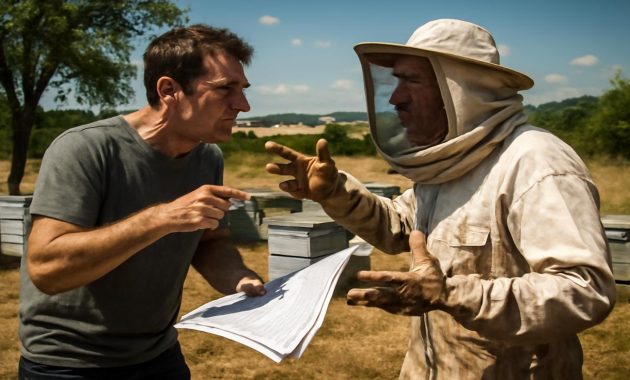
It didn’t take long for the simmer inside him to reach boiling point. The next time Ray’s truck rolled up the gravel lane, Stan was waiting.
“We need to talk,” he said, before the engine even stopped.
Ray climbed out, sensing something different in the air. “Everything okay? Did you get your tax notice?”
“Exactly,” Stan said. “I did. And it still lists my property as agricultural. Because of these.” He gestured stiffly toward the hives. “And that means I’m still paying agricultural tax.”
Ray frowned, squinting slightly. “Yeah. That’s what we talked about. The hives help you keep that classification, don’t they?”
“They help me keep it,” Stan replied, “but I’m the one carrying the whole burden. You’re running your operation, making your honey, maybe getting pollination contracts with the orchards down the road, and the county looks at my land and says, ‘Farm.’ So I pay that bill, and you pay me… what? A little rent and a couple jars of honey?”
Ray shifted his weight. “You’re not paying more because of me. If anything, the bees protect you from getting reclassified and hit with a bigger tax.”
“That’s not the point,” Stan snapped. “The point is: who’s the farmer here? Who’s profiting from all this ‘agricultural use’ that I’m officially responsible for?”
For a moment, only the low wind answered.
“Look,” Ray said slowly, “the hives are my livelihood. I take on the risk, the work, the costs. You were barely using this land. I made you an offer. You agreed.”
“I agreed before I understood how locked in this makes me,” Stan shot back. “If I wanted to step away from agriculture, I can’t—not without telling the county that the bees are gone, the land’s idle, and then waiting for them to decide what I pay next. You’re the one whose business depends on this being rural, farm-like, bee-friendly. Yet I’m the one stuck with the agricultural status that makes it all possible.”
“So what do you want?” Ray asked, jaw tightening. “More money? A cut of the honey sales?”
Who really profits from the hives?
In that raw winter afternoon exchange, something fundamental surfaced—a question bigger than one field, two men, and a cluster of wooden boxes.
When land and life intertwine, profit is rarely a simple ledger. There are visible gains—jars of honey lined up on a market table, the cash that changes hands—and there are invisible ones: tax classifications preserved, soil kept active, ecosystems supported.
From one angle, Ray was clearly the primary profit-maker. The bees were his, the honey his, the pollination deals his. He chose where to place his hives, how many to run, when to pull them out. The land was his resource, but not his responsibility, at least not on paper.
From another angle, Stan benefited too. He got rent. He kept his agricultural classification, which might have spared him from a potentially higher tax bill if the county ever decided his land was just “vacant.” He could tell himself the place was still, in some small way, a working landscape, not just a forgotten patch waiting to be carved into lots.
Yet the feeling of imbalance was real. The law saw only one party as the “official” bearer of agricultural status: the landowner. The system wasn’t built to acknowledge the more nuanced reality where the economic engine driving the agricultural use belonged to someone else entirely.
As the argument between them grew sharper, the questions multiplied:
- Should the beekeeper contribute toward the agricultural tax, since his operation was what justified it?
- Or was the agricultural classification itself a benefit to the landowner, one that already offset the imbalance?
- Should the rent be higher, pegged to the productive use of the land rather than its sleepy condition before the hives arrived?
- And, more quietly: would any of this have become so heated if they’d spelled it out from the start?
When a handshake isn’t enough
The dispute that erupted between Stan and Ray wasn’t just about a tax bill; it was about expectations never spoken aloud. It was the cost of relying on good faith where clarity was needed.
In the weeks that followed, they circled each other warily. There were phone calls, then silences. At one point, Stan talked to a neighbor, who shook his head and said, “You should’ve drawn up a contract that included the tax angle. My cousin rents pasture to a rancher. The lease spells out who gets the ag benefit and who pays what.”
Stan consulted a local accountant, who explained, in careful, neutral language, that:
- The county tied the agricultural classification to land use, not ownership of livestock or hives.
- The beekeeper wasn’t obliged to pay any portion of the tax unless a private agreement required it.
- If the bees left and no other qualifying activity replaced them, the property could eventually lose its agricultural status, potentially changing the tax bill.
“So I’m legally stuck as the one who pays,” Stan said, “while he keeps his honey money.”
“Legally, yes,” the accountant replied. “But morally, or practically? That’s something you two have to negotiate. You both benefit from the arrangement—just in different currencies.”
That phrase—different currencies—stayed with him.
A table of invisible trade-offs
One evening, trying to make sense of it, Stan sat at his kitchen table with a pen and drew two columns: what he got from the bees, and what he gave.
| For Stan (Landowner) | For Ray (Beekeeper) |
|---|---|
| Rent income from land | Honey sales revenue |
| Agricultural classification preserved | Pollination contracts and bee products |
| Landscape kept “in use” and ecologically active | Access to suitable rural land without owning it |
| Ongoing responsibility for property and ag tax | Operational cost of managing hives and bee health |
| Limited flexibility if he wants to change land use | Business dependence on land access and landowner’s decisions |
Looking at the table, things still weren’t “fair” in any simple way, but they were at least legible. Each had something at stake. Each was exposed to a different set of risks.
Rewriting the agreement
Spring came again, and with it, the bees. The clover thickened, the air warmed, and once more, Ray’s truck appeared on the lane. They couldn’t avoid each other forever.
This time, the conversation started quieter.
“I’ve been thinking,” Stan said, standing between the hives and the old fence. “We did this backwards. We pretended we could just rent a corner of land and keep everything else separate. But the county, the tax system, the reality—they all see us as more entangled than that.”
Ray nodded, hands in his pockets. “I’ve been thinking too. You’re right that I’m getting a lot of value out of this land. I pay you rent, but that rent doesn’t reflect the full picture.”
Between them, the low murmur of bees rose and fell like breath.
They started, cautiously, to talk about sharing more of the responsibility. Maybe the rent would increase, pegged in part to honey output. Maybe Ray would contribute a set amount each year toward the property’s tax, acknowledging that his agricultural use was what kept that classification in place. Maybe they’d put clear language in a new written agreement about who carried what risk if the county ever changed its rules.
It wasn’t easy. The first draft of their new deal fell apart. So did the second. Old resentment flared: “You knew what you were signing” versus “You knew I didn’t understand the full cost.” But each time, they came back to the same stubborn truth: the bees were thriving here, and neither of them really wanted to walk away.
In the end, their solution was less a perfect balance and more a truce built on clarity. The revised agreement:
- Spelled out that the property would remain classified as agricultural as long as hives were present or other qualifying activity took place.
- Increased the rent to better reflect that this wasn’t just an empty field, but productive space contributing to a commercial operation.
- Required Ray to pay a fixed annual “ag use” contribution—a modest but meaningful acknowledgment of the tax framework that made his operation viable on this land.
- Set review points every few years, in case tax laws or honey prices shifted.
Was it perfect? No. But it was honest. And honesty, written down and signed, has a way of cooling the kind of anger that grows in the shadows of assumption.
Lessons from a humming field
Out beyond their particular story, the field remained what it had always been: a patch of earth under an open sky, a place where wildflowers and insects moved through their own, indifferent cycles. The bees did not care who paid the tax bill. They flew to the blossoms, gathered nectar, and returned home to the hive, repeating the ancient arithmetic of survival.
But for people—landowners, beekeepers, small farmers—the lesson clung to the air like the scent of clover:
If land is going to be shared, the invisible threads need as much attention as the visible fences.
Who profits, who pays, who carries which label in the eyes of the law—these are not side notes. They’re the structure that either supports or strains a partnership. Modern rural life is full of these quiet arrangements: ranchers grazing cattle on someone else’s pasture, market gardeners leasing a corner of a bigger spread, solar developers installing panels over former hayfields, and yes, beekeepers setting hives on land they don’t own.
Every one of those arrangements can hum along beautifully—until someone opens an envelope, sees a number they didn’t expect, and realizes they’ve been playing by different rulebooks.
Out here, under the changing sky, money, law, and nature are always in conversation. When people fail to join that conversation openly, conflict steps in to translate.
Frequently Asked Questions
Can a landowner be required to pay agricultural tax if only a beekeeper is using the land?
In most regions, the property tax bill goes to the landowner, not the person using the land. If hives on the property qualify it as “agricultural use,” the landowner is usually the one officially responsible for the tax tied to that classification, unless a private contract says otherwise.
Does hosting bee hives always mean a property is classified as agricultural?
Not always. It depends on local laws. Some jurisdictions recognize beekeeping as an agricultural activity if certain conditions are met (such as a minimum number of hives or acreage). Others may not. Local tax authorities or agricultural extension offices can clarify how bees factor into land classification.
Should a beekeeper contribute to the landowner’s tax if their hives keep the land agricultural?
Legally, this is usually optional. Ethically and practically, many landowners and beekeepers choose to address it in a lease or written agreement. They may adjust rent or add a specific contribution so that both parties share the benefits and burdens more fairly.
What should be in an agreement between a landowner and a beekeeper?
A solid agreement typically covers: number and location of hives, duration of placement, rent or compensation, liability and insurance, access rights, how tax and agricultural classification issues are handled, and what happens if either party wants to end the arrangement.
Can disagreements over bees and taxes be avoided?
They can’t always be avoided, but they can be reduced. Clear communication before the first hive arrives—about money, taxes, benefits, and risks—combined with a written agreement, makes it far less likely that a surprise tax bill or shifting expectation will turn a quiet field into a battleground.