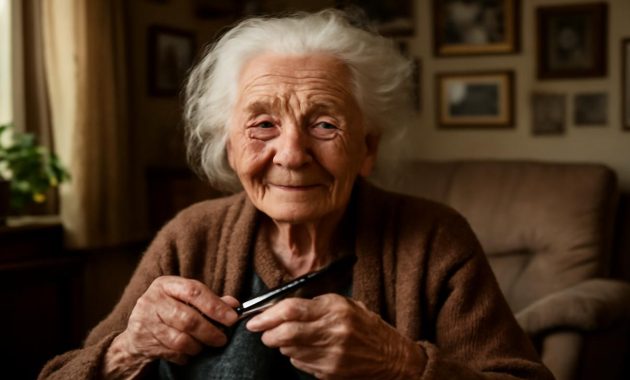
The first thing you notice about her is the pace. Not the kind of slow, shuffling rhythm you might expect from someone who has lived through a century of winters, but a deliberate, unhurried steadiness—like a person who has learned that rushing steals days from your life one heartbeat at a time. She is standing by her kitchen window when I arrive, hands sunk into a bowl of dough, the smell of yeast and warm flour curling around the room. Outside, rain freckles the glass. Inside, the world feels held in the pause between her movements.
“You’re on time,” she says, turning slightly, blue eyes alert and assessing. “Good. Punctual people live longer. They’re not always chasing themselves.”
This is Nora, who turned one hundred last spring and insisted on climbing the small hill behind her cottage to stand beside the wild hawthorn and blow out a single candle on a plain lemon cake. The cake she baked herself, of course. She lives alone in a stone house that looks as if it has grown naturally from the hillside. She cooks, she sweeps, she tends a small garden where parsley and thyme elbow into the cracks of old paving stones. Most of all, she repeats a sentence so often it has become a kind of spell: “I refuse to end up in care.”
The Quiet Rebellion of Staying at Home
“It’s not that I don’t like people,” she says as we sit at a small wooden table overlooking a field that glows green even in the dull light. “I just don’t want to be put away with a television on all day and strangers deciding when I should eat my pudding.”
Outside, a blackbird picks at the damp grass. The kettle clicks off behind us, and she rises with a faint crackle in her knees that she ignores with a practiced ease. The room is warm with the heat from the oven and the faint sweetness of baking bread. There’s no clutter here, only what is used often enough to earn its place: a chipped mug, a radio with a worn volume knob, a neat row of spices.
“People say I’m stubborn,” she continues as she brings over two cups of tea, strong enough to float a spoon. “They’re right. Stubbornness is very useful for living a long time. So is curiosity. But what keeps you out of a care home is habits. Tiny, dull, ordinary habits that you do every single day until they become more natural than breathing.”
She wraps both hands around her mug, fingertips slightly knotted but steady. On her left wrist, a thin watch ticks quietly. On the wall behind her, there is a calendar covered in small, tight handwriting: walks, calls, shopping, windows, beans, dentist, “phone Lily,” “check smoke alarm,” “look up constellations.”
“My life is not exciting,” she says. “It is deliberate. There’s a difference.”
The Morning Ritual: “I Get Up for the Sky”
Nora wakes every day at six, not because she has to, but because the sky asks her to. “If I’m still alive to see another sunrise, it would be rude not to,” she jokes. But there is no drama to her routine, just a gentle, insistent structure.
| Time | Habit | Her Reason |
|---|---|---|
| 06:00 | Wake, sit up slowly, drink water | “I tell my body we’re starting gently, not with a shock.” |
| 06:15 | Stretching by the window | “If I want to live at home, I must be able to reach the top shelf.” |
| 06:30 | Light breakfast, strong tea | “I eat to move, not to sit.” |
| 07:00 | Short walk outside | “I check if the world is still there. It always is.” |
Her morning stretches are not graceful. She laughs about this. “I wobble,” she says, demonstrating, one hand lightly resting on the back of a chair. “But I insist on bending and turning. If I stop going to the floor, one day I’ll fall and not be able to get up. So I practice getting down. And getting up. The carpet and I are on very familiar terms.”
She eats the same breakfast most days: a slice of wholegrain toast, an egg, half a tomato, sometimes a handful of berries if they’re on sale. “Routines are a kindness to yourself,” she says. “They mean your older brain doesn’t have to make so many decisions. Decision fatigue makes people careless, and carelessness leads to broken hips and burned pans.”
Outside, the rain has softened to a mist. Nora pulls on a coat that has been repaired at least three times, threads visible but neat. “I go out, even if I only walk to the gate,” she says as we step into the damp morning. “Inside is for resting. Outside is for living. If you reverse that, the house becomes your world and then a care home is not a big jump. I will not let my world shrink without a fight.”
Moving Through the Day: Little Muscles, Big Freedom
On the path, wet leaves shine like coins. She walks with a cane, but it seems more like a companion than a crutch, tapping in rhythm with her steps. Her boots are sturdy, soles slightly worn down from decades of similar walks.
“The trick,” she says, “is to make every room of your life just a bit inconvenient. I keep the kettle on one side of the kitchen and the tea on the other. I could move them together, but then I’d walk less. I want my life to nudge me into movement.”
Inside, she demonstrates how she uses the back of a chair to do slow heel raises. In the hallway, she has placed a small basket of books at floor level that she moves from one shelf to another, just for the practice of bending. At the bottom of the stairs—a short, steep set leading to her bedroom—there is a small note taped to the wall: “Hold the rail. Lift your feet. No heroics.”
“I like living alone,” she says, “but it means I must respect the laws of physics. Gravity is always waiting to make trouble. So I don’t rush, I don’t carry more than I should, and I never pretend I’m younger than I am when it comes to steps and ladders. Vanity is the enemy of longevity.”
She does not go to a gym. She has never taken a fitness class. But she makes housework into what she calls “my domestic training plan.” Dusting means reaching overhead. Changing the bedsheets means lifting, pulling, balancing. Hanging laundry outside is a mini yoga session of bends and stretches. “The day I stop being able to peg my own washing is the day I will worry,” she says. “So I practice for that day never coming.”
I ask her whether she ever just rests. She gives me a sideways look. “Oh, I rest,” she says. “But rest feels better after exertion. A nap after a walk tastes different to a nap after scrolling through pictures on a screen. One feeds you; one drains you while pretending to soothe.”
The Food Philosophy: “I Eat Like Someone Who Plans to Be Here Next Year”
In the kitchen again, she pulls open a cupboard. It is not full of expensive superfoods or elaborate supplements. Instead, there are jars of beans, tins of tomatoes, oats, lentils, bags of frozen vegetables stacked like colored bricks in the small freezer. On the counter, an onion waits with stoic patience.
“I eat very ordinary food,” she says. “I simply eat it on purpose.”
Her rules are simple. She cooks almost everything from basic ingredients, not because she is a purist, but because chopping and stirring are part of her daily movement. She eats vegetables with every meal “for my joints and my bowels, which must both keep working if I’m to stay here.” She chooses colors on her plate like an artist selecting paints. “Brown, green, something bright. If my food looks like it has seen the sun at some point in its life, I’m happy.”
There is sugar in her house—she bakes, after all—but her relationship with it is respectfully distant. “Cake is for sharing,” she says firmly. “If I will eat it alone, I don’t bake it. Sweet things taste best when someone else’s eyes light up.”
She drinks plenty of water, though she still prefers to measure it in teacups. Alcohol appears rarely, a small glass of red wine at Christmas, a thimble of sherry if an old friend visits. “I like to be certain that when I fall, and one day I will, it’s not because I was tipsy,” she explains. “I want to give my bones the best odds.”
Yet she is no ascetic. There is a small bar of dark chocolate in her fridge, broken into tiny squares. “Pleasure is not the enemy,” she says. “Carelessness is. I refuse to live a joyless life just to make it longer. But I also refuse to trade many future evenings for ten minutes of sugar fog.”
The Social Web: “I Live Alone, Not Lonely”
At eleven, the telephone rings. Nora glances at the clock and smiles. “That’ll be Lily,” she says. “Every Tuesday.” She answers with a brisk, “Still alive,” which sends a burst of laughter crackling through the receiver.
They talk about small things: a neighbor’s new dog, the changing price of bread, the stubbornness of their own knees. They share complaints the way some people share recipes—lightly, without letting them dominate the table. When she hangs up, her face is softer.
“People think living alone means being alone,” she says. “They’re different things. I’ve built a net of people around me. They know I want to stay here, so we all do our part.”
Her “net” is simple but intentional. On Mondays, she calls a former colleague who now lives two towns away. Wednesdays, she walks to the post office and greets the same clerk who always pretends to complain about the weather. Fridays, a neighbor drops by to swap surplus vegetables. Sundays, she attends a small community gathering down the lane when her legs allow, and when they don’t, she stands in her doorway and waves at people passing by after the service.
“You must be visible,” she says. “If no one expects to see you, no one will notice when you’re gone from the street. I have made it everyone’s business to know that I am here.”
She has also accepted help, strategically. A local teenager comes once a fortnight to do the heavy lifting—turning the mattress, cleaning the gutters, shifting boxes. In exchange, Nora helps him with his homework and teaches him how to cook lentil soup. “Independence does not mean doing everything yourself,” she says, eyes sharp. “It means organizing your life so that you can keep directing it.”
The Mind Garden: “I Never Retired from Wonder”
In the living room, a bookshelf takes up an entire wall. The spines are faded, some titles nearly rubbed away, but they span decades: poetry, astronomy, history, cookbooks, a thick volume on bird identification. On the coffee table lies a pair of reading glasses and a slim notebook filled with lists of words she likes: “murmuration,” “penumbra,” “brindle,” “solace.”
“I have outlived my career, my parents, my husband, some of my friends,” she says quietly. “If I let my mind also grow old and sit in a corner, I would be lost. So I keep it busy with things that do not depend on my body.”
Every afternoon, she reads for at least an hour. Sometimes novels, often nonfiction. She keeps a small atlas by her chair and looks up places she encounters in stories. In recent years, fascinated by the night sky she sees from her bedroom window, she began learning the constellations. “There is something comforting about knowing that the same stars stared at me when I was a girl,” she says. “They have watched entire empires disappear. My little worries do not scare them.”
She also practices small mental drills that would not look out of place in a therapist’s workbook. Each morning, she names five things she can see, four she can touch, three she can hear, two she can smell, one she can taste. “It keeps me here, not wandering too far into the past,” she explains. “The past is a lovely place to visit but a terrible place to live.”
Television is not banned but rationed. She watches the news once a day, no more. “Fear is bad for the immune system,” she says, almost offhand. “And outrage makes people old before their time. I prefer stories that remind me the world is beautiful as well as broken.”
The Nighttime Pact: “Sleep is My Most Loyal Doctor”
By eight-thirty most evenings, the house has grown quieter. Outside, the field darkens to a single shade. At nine, almost always, a light clicks off upstairs and Nora’s silhouette passes briefly in front of the window.
“I do not negotiate with my bedtime,” she tells me earlier. “I’ve seen what happens to people who treat sleep as optional. They start dropping things, forgetting things, feeling frayed. Then someone decides they cannot manage alone. I guard my sleep like treasure.”
Her bedtime ritual is much like her morning one: precise, repetitive, soothing. She makes a cup of herbal tea, turns off bright lights, and switches the radio to low, calming music. She spends ten minutes stretching again, this time slower, listening for any complaint from her joints that might signal the need for gentler walking the next day.
She does not bring screens into the bedroom. A small lamp, a book, a glass of water, and the familiar weight of blankets are her only companions. Before turning off the light, she runs through a quiet gratitude inventory: “three things that did not go wrong today.” Sometimes they are small—“did not slip on the leaves,” “remembered to defrost the soup,” “the postman smiled.”
“Old age can make you notice only what you’ve lost,” she says. “I try to notice what I still have. It helps me relax. A relaxed body sleeps better. A well-slept mind copes better. A person who copes does not scare their family into packing them off somewhere ‘for their own good.’”
Before we part, I ask her if she ever feels afraid of the future—of the possibility that, despite everything, she might one day need the very care she’s determined to avoid.
She considers this for a long time, gaze drifting to the window where the sky is now clearing, a pale band of blue edging along the horizon.
“I’m not afraid of needing help,” she says finally. “We all need help. I’m afraid of giving up the conversation between me and my own life. In care, they decide when you wake, when you eat, when you turn off the light. Here, even if I’m slow, I am still the one who chooses. That is what these habits are for. Not immortality. Authority.”
Then she smiles, sudden and bright. “Anyway, I’ll probably die in the garden, yelling at the weeds. There are worse endings.”
Living on Purpose, One Small Habit at a Time
As I leave, the air smells of wet earth and baking bread. Nora stands at her gate, hand resting lightly on the wood, coat buttoned all the way to her throat. Behind her, the house looks exactly as it did when I arrived: modest, tidy, quietly alive. A place not of resistance against age, but of partnership with it.
Her life is not a miracle or a secret formula. It is a series of choices repeated so often they have become her second nature: wake early, move often, eat simply, stay curious, weave your own social safety net, sleep deeply, and never fully hand over the reins of your days. It is not an argument against care homes so much as a love letter to the stubborn, daily work of staying capable for as long as possible.
“I refuse to end up in care,” she says again as I open the gate, the words now sounding less like defiance and more like a vow to herself. “So every day, I do something my future self will thank me for. I am one hundred years old. That is one hundred years of future selves I’ve been preparing for. Turns out, they were all me, standing right here, still in my own doorway.”
She lifts a hand in farewell, then turns back toward the house, where the kettle is probably already on and a new page of her well-worn calendar waits for another neat line of ink: walk, call, stretch, bake, live.
Frequently Asked Questions
Does Nora follow any special longevity diet?
No. She eats simple, mostly home-cooked food: vegetables with every meal, whole grains, beans, lentils, modest portions of meat or fish, and very few highly processed foods. Her “rule” is that her meals should look like they came from the earth, not a factory.
How much exercise does she actually do each day?
She doesn’t do formal workouts. Instead, she builds movement into everything: walking daily, using housework as exercise, doing light stretching morning and night, and creating small “inconveniences” (like spacing out kitchen items) to keep herself moving.
Is living alone safe for someone her age?
For Nora, it works because she prepares carefully: she uses rails and supports, moves slowly, keeps floors clear, accepts help with heavy tasks, and maintains close contact with neighbors and friends who check in regularly.
How does she cope with loneliness?
She distinguishes between being alone and being lonely. She keeps a regular schedule of phone calls, short visits, local walks, and community activities when she can. She has built a “social net” of people who expect to hear from or see her each week.
What is the most important habit behind her long, independent life?
According to Nora, it’s not one habit but an attitude: treating each day as preparation for the future. The small daily choices—moving, eating well, sleeping, staying curious, and keeping connections alive—are how she protects her independence and avoids ending up in care.