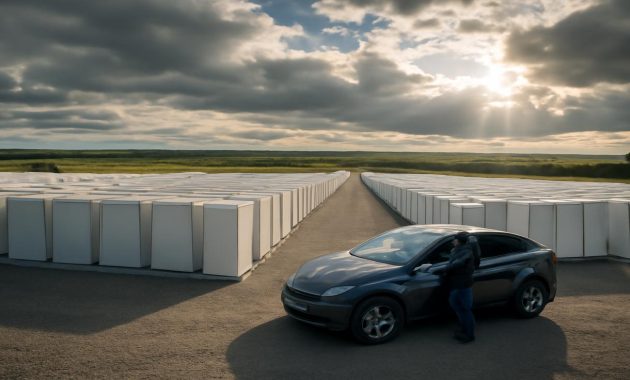
The night trains leaving Paris still hum past the dark silhouettes of cooling towers and wind-swept fields of turbines, but lately there’s a new kind of electricity in the air—nervous, expectant, almost theatrical. Somewhere behind the glow of apartment windows and the soft tick of old electric radiators, a quiet experiment is beginning. It starts in garages and driveways, in suburban cul-de-sacs and village lanes: a wall box, a cable, and the discreet outline of a car with a small, bright T on its hood. On a paper no one can see, an energy gamble has just been signed, and if it works, it could rattle the very bones of the French grid.
When a Car Becomes a Power Plant
Imagine walking home from the local bakery at dusk, a warm baguette under your arm, and hearing the faint click of a relay somewhere in your building. You don’t see it, but on the seventh floor, your neighbor’s Tesla is quietly switching roles. All day it has been a car; now, in the evening surge of television sets and induction stoves, it’s about to become something else entirely—a small, responsive power plant.
This is the core of the gamble: turn thousands, then hundreds of thousands, and eventually millions of electric cars into a living, breathing extension of the grid. Tesla’s bet in France is not just about selling more vehicles. It’s about persuading a country deeply shaped by its energy choices—coal, then nuclear, now renewables—that the car in the driveway can help keep the lights on in Paris, the ovens hot in Lyon, and the hospital ventilators running in Toulouse.
It’s called “vehicle-to-grid,” or V2G, and on the surface it sounds almost magical. When there’s too much power—say, during a windy night in Brittany or a sunny spring afternoon in Occitanie—cars plugged in at home or in office parking lots soak up the surplus. Later, when the grid is hungry and everyone is cooking dinner or cranking up electric heating, those same cars can feed electricity back to the system, like a flock of battery-powered bees returning nectar to the hive.
The French grid operator, RTE, has long known the stakes. With nuclear reactors aging, consumption patterns changing, and renewables blooming wherever wind and sun permit, flexibility has become as precious as generation capacity. Enter Tesla, sliding into the conversation not only as a carmaker but as an ambitious orchestrator of electrons. The signature on the gamble is not only ink on contracts with utilities, regulators, and eager early adopters—it’s also a promise whispered to the grid itself: “Let me help you breathe.”
The Sounds and Smells of a Changing Grid
To understand why this matters, you have to stand in a French village on a particularly sharp winter morning. The air smells faintly of woodsmoke and diesel; somewhere a heat pump hums, its fan slicing the cold. Up on a distant hill, a line of wind turbines whip the air into a low moan. Down in the valley, a substation sits behind its chain-link fence, humming softly like a hive buried in concrete.
France’s grid—one of the most sophisticated on Earth—is also fragile in the way that all intricate things are fragile. It must balance, second by second, supply and demand across a country where energy is almost a matter of identity. Nuclear plants, for decades the proud backbone of national independence, run like great metronomes of power output. Hydroelectric dams sigh open and shut with alpine snowmelt and mountain storms. Rooftop solar arrays wink awake with the sun, then fade by dinner time.
This dance is already complex. Now add millions of electric cars that, in theory, could all plug in at the same moment after work—a sudden, invisible surge of demand. Or, under a different kind of regime, those same cars could become dancers in the choreography of the grid: storing when there’s too much, giving back when there’s not enough. That’s the territory Tesla is trying to enter, and in France, the stakes are amplified by a history of bold, sometimes stubborn energy decisions.
The company’s French experiment doesn’t arrive in a vacuum. It sits on top of a cultural foundation where people still remember the “contrat heures pleines / heures creuses” (peak and off-peak electricity tariffs), the glow of night-storage radiators, the national push to electrify everything in the late twentieth century. Tesla’s signature, in that sense, is inked over decades of policy, engineering, and kitchen-table conversations about power bills.
How Tesla’s Energy Gamble Works in Practice
Strip away the romance and it comes down to a simple question: when you plug your Tesla into the wall, who’s actually in charge of that energy? You, with your next morning commute in mind? Or the grid, with its thousands of competing demands?
Tesla wants to make the answer “both.” The company is rolling out software and hardware designed not just to charge cars efficiently, but to weave them into the grid’s daily heartbeat. The idea is something like this: you plug the car in at home, maybe around 7 p.m., when the sky outside your apartment is streaked pink and orange. You open an app, set a departure time for the next morning, and tell the system how much range you need. After that, the car and Tesla’s servers begin a long, quiet conversation with the French grid.
During a windy night, when turbines along the Atlantic coast are overproducing and nuclear plants are still humming, the Tesla drinks deeply at a low tariff. At four in the morning, if a nuclear unit unexpectedly trips or a cold front sends heaters whirring across the country, your car’s battery might pause its charging or even send a little power back out, stabilizing the system. For this, you’re not just thanked—you’re paid.
Here’s where the gamble has teeth. Aggregated across thousands of vehicles, this behavior turns Tesla from a simple car manufacturer into a kind of distributed utility, a flexible asset that grid operators can call on to cushion shocks. France, with its heavy base-load nuclear generation and growing renewables, was almost built for such a system. But turning potential into practice requires navigating a thicket of rules, tariffs, consumer habits, and deep-seated skepticism.
| Aspect | Traditional Grid | Grid with Tesla V2G |
|---|---|---|
| Main Power Sources | Large plants (nuclear, gas, hydro) | Large plants + distributed car batteries |
| Flexibility | Limited, slow response | High, near-instant response |
| Role of Consumers | Passive energy users | Active participants and energy providers |
| Handling Peaks | Start expensive peaker plants | Draw power from parked vehicles |
| Integration of Renewables | Challenging, risk of curtailment | Easier, use cars as temporary storage |
The French Resistance—and Curiosity
Turn on a radio debate in France and, sooner or later, someone will say, “Ce n’est pas si simple” — it’s not that simple. That phrase might be the unofficial motto of the country’s energy transition. When Tesla’s energy gamble is discussed, you hear variations of it in café conversations, policy panels, and family dinners.
Some people worry about battery degradation. They imagine their expensive car drained overnight for the sake of some far-off grid stability, waking up to a half-charged vehicle and a vague promise of “compensation.” Others picture hackers, storms, or corporate mismanagement turning a fleet of interconnected cars into a networked liability. And sitting behind all this is a very French question: How much power—literal and political—do we want to hand to a foreign tech company?
Yet there is curiosity, too. Talk to a young engineer in Grenoble working in energy systems, and her eyes light up: “If Tesla can aggregate enough cars, they can provide frequency regulation, peak shaving, even help delay investment in new gas plants.” Speak with a farmer in the Drôme who has installed solar panels and is eyeing an electric pickup; he likes the idea that his truck could back up the farmhouse when storms knock lines down, or even earn a little money on sleepless, windy nights.
The French state, never shy about shaping markets, is watching this carefully. Regulators are sketching out the rules of engagement: how a car becomes a resource, how it gets paid, what protections its owner enjoys. Utilities like EDF see both a competitor and a potential partner in Tesla’s energy moves. Local distribution operators wonder how to handle millions of small, reversible power flows on lines that were designed for one-way electricity.
Nature, Nuclear, and the New Electric Commons
Step away from the technicalities for a moment and picture the broader canvas: the hills of the Massif Central, the mist over the Loire River, the Atlantic storms shoving walls of cloud over Brittany. France’s energy story has always been entangled with its landscapes. The great hydroelectric dams carve up mountain valleys. Nuclear power stations sit along rivers, their warm-water plumes an invisible signature on migratory fish and local microclimates. Offshore wind farms sprout from seabeds that have felt only tides and fishing nets for centuries.
Tesla’s gamble doesn’t drop a new structure on the land. Instead, it slips into the interstices of daily life—into parking lots shaded by plane trees, into underground garages beneath Haussmannian boulevards, into suburban carports where ivy clenches the posts. It is infrastructure hiding in plain sight, using the existing web of homes and streets as its scaffold.
In a way, this is a return to a more intimate relationship with energy. Before centralized power plants, people lived with their energy sources—wood stacks against the house, a millwheel on the stream, a barn full of hay for the horses that moved everything. Centralized electricity distanced us from that interaction. Now, with every Tesla that plugs into a home circuit, the link tightens again. Your battery, your schedule, your habits—these become part of a new electric commons.
The French grid, already a marvel of coordination, becomes more organic. It gains a kind of nervous system at the edges, responsive and sensitive. Weather forecasts, traffic flows, commuting patterns, even school holidays start to matter more. A sunny, windy public holiday might be perfect for charging fleets of cars; a freezing Monday morning in January becomes a drill in careful battery management.
Risk, Reward, and the Future of the French Grid
No gamble is without risk, and Tesla’s move is no exception. There is the technical risk: the systems may not scale, or they may prove too complex for ordinary consumers to manage. There is market risk: if power prices stay stable, or if regulations move slowly, the economic incentives may look too thin to tempt widespread participation. And there is the cultural risk: French citizens may decide they don’t want their cars moonlighting as grid assets, no matter how elegantly the software works.
Yet the potential reward is immense. If Tesla’s experiment succeeds, it could delay or eliminate the need for new, carbon-intensive backup power plants. It could make it easier to insert more wind and solar into the mix, smoothing out their natural variability. It might help France ride out the bumpy years of nuclear reactor upgrades and replacement, keeping the country’s climate goals within reach even as old plants are retired.
More subtly, it could change how people think about what a car is. For over a century, the automobile has been a symbol of independence, of escape from schedules and infrastructures. Plugging that symbol back into a shared grid is a delicate psychological move. But if done right—transparent, well-compensated, easy to control—it could feel less like a surrender and more like joining a neighborhood watch for the climate.
Somewhere in all of this, a teenager in Marseille is watching his parents’ Tesla through the kitchen window. The headlights are dark; the house is bright. On his phone, he can see the battery level, the next scheduled charge, the few euros the car earned that week by leaning into the needs of the grid. For him, cars that quietly trade electricity with the city while everyone sleeps may feel as normal as Wi‑Fi.
What It Feels Like When the Grid Breathes with You
On a late summer evening, you walk along the Seine. The river swallows the last of the daylight; the bridges turn to strings of light. Somewhere behind the facades of stone and glass, thousands of Teslas are plugged in, their batteries listening. A gust of wind drums over distant turbines. In a control room on the outskirts of Paris, a grid operator watches a line on a screen dip and rise, then smooth itself out as distributed batteries respond in unison.
The city feels the same. Cafés murmur; metro trains squeal into stations; street lamps blink calmly one by one. But under that familiar skin, something has shifted. The grid is no longer just a one-way river of power flowing from big, distant sources into small, anonymous sockets. It’s more like a tide, moving back and forth, with citizens’ cars as its moon.
This is the real heart of Tesla’s gamble in France: not just the technology, not just the profit, but the possibility of an electricity system that feels less brittle, less remote, more attuned to the lives it supports. It’s a bet that people will accept a new intimacy with the grid, that they will lend their batteries to the collective, that a foreign company can weave itself into the deeply national story of French power without breaking the spell.
There will be debates. There will be missteps. There will, inevitably, be a blackout somewhere that prompts headlines and finger-pointing. But if the experiment holds, if the software is robust and the incentives are honest, then one day not far from now the question of whether your Tesla should help stabilize the French grid will feel as simple—and as everyday—as choosing when to run your dishwasher.
And on some quiet winter morning, when frost edges the windows and the radiators tick to life, you may feel a small, private satisfaction knowing that the car sleeping in your garage is not just waiting for the next journey. It is already traveling, invisibly, through wires and transformers, helping an entire country keep its balance.
Frequently Asked Questions
What exactly is Tesla’s “energy gamble” in France?
It’s Tesla’s move to turn its electric cars into active players in the French power system. Using vehicle-to-grid technology and smart software, Teslas could charge when electricity is cheap and abundant, then potentially feed power back to the grid during peak demand, helping stabilize the system and earning money or bill credits for owners.
Will this drain my car and leave me without enough range?
The concept relies on owners setting limits: desired charge level, departure time, and minimum range. Within those boundaries, the system can shift charging times or, where allowed, send small amounts of power back to the grid. The goal is to ensure your car is ready when you need it, while still supporting the grid in the background.
Does using my battery this way damage it faster?
V2G operations do add charging and discharging cycles, which theoretically can contribute to wear. However, they typically use shallow cycles and controlled power levels. Tesla and regulators will need to prove, with data, that the impact on battery life is modest and offset by financial or service benefits for drivers.
How could this help the French grid specifically?
France relies heavily on nuclear and is rapidly adding renewables. That combination needs flexibility: capacity that can ramp up and down quickly. Distributed car batteries can offer that flexibility, helping absorb excess wind and solar, stabilizing frequency, and reducing the need for fossil-fuel backup plants.
Do I have to participate if I own a Tesla in France?
No. Participation in such programs is expected to be voluntary. Owners would opt in via software, choose their preferences, and could opt out at any time. The system only works if drivers trust that their mobility needs come first.
Who controls my car’s charging when I’m plugged in?
Day to day, you remain in control through your settings: minimum charge, departure time, and whether you allow grid services. Tesla’s algorithms then operate inside those limits, in coordination with grid signals and market prices, to optimize charging and any power exports.
Could this model be used outside of France?
Yes. The same idea can work in many countries, but each has its own grid regulations, market rules, and pricing structures. France is a particularly interesting testbed because of its strong grid, high share of nuclear, and growing renewables—all of which make flexibility from EVs especially valuable.
Originally posted 2026-03-05 00:00:00.