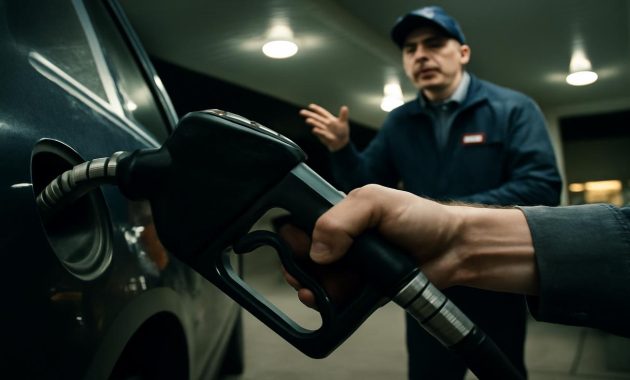
The first thing you notice is the smell.
It hangs in the thick heat of late July—gasoline and hot asphalt mingling with the faint sweetness of spilled soda. Cars rumble through the lot, cicadas scream in the tree line, and the air shimmers over the concrete like a mirage. You step out of your car at the pump, already thinking about the long road ahead, the playlist you’ll put on, the drive-thru you’ll hit a few exits down. You don’t notice the nozzle hanging wrong until someone points it out. Or, more likely, you don’t notice it at all.
“That’s how they get you,” the station manager says, wiping his hands on a grease-smudged towel. “The nozzle isn’t hooked back—and that’s the whole trick.”
The Slow Creep of a Summer Scam
The manager’s name is Luis, and this is his gas station: four double-sided pumps, a flickering LED sign that never quite tells the exact truth about prices, and a parking lot that always feels about five degrees hotter than the air around it.
He’s been here long enough to watch entire cars go out of style, long enough to recognize regulars by the way they brake at the entrance. This summer, though, something else has become regular—too regular. Complaints. Confusion. People swearing they were overcharged, or that the pump kept running when they weren’t looking, or that the gallons didn’t match what they knew their tank could hold.
When he first heard about the scam, it sounded almost too simple. No high-tech card skimmers, no hacking, no sleight of hand with bills. Just a nozzle. A lever. And a distracted driver in a hurry.
“It’s always the same,” Luis says. “Someone pulls in, sees a pump that looks like it’s ready to go, and never stops to ask why.”
The Nozzle That Never Really Stopped
On a blistering Tuesday afternoon, you stand with him at Pump 3. A silver SUV has just pulled away, and the hose swings gently, like a lazy pendulum. The nozzle looks normal enough—except it’s not fully seated in its cradle. The metal hook that should be snug against the holder is slightly out of place, and the handle is angled just enough to make a careful person frown, but not enough to make a rushed person pause.
“Here’s how it works,” Luis says, setting the nozzle back in its slot. “Somebody finishes filling up. They’re distracted—kids screaming, phone ringing, late to work, whatever. They don’t fully click the nozzle back. Maybe they even leave the pump slightly engaged without realizing.”
He shows you the handle, demonstrating the half-click. You hear the soft internal shift of a mechanism that sounds like it’s settling down, resting. But it’s not rest—not quite.
“Now, that alone usually wouldn’t do much,” he continues. “But if someone wanted to take advantage of it? Well, that’s when we’ve got a problem.”
The scam, as he explains it, unfolds not with a dramatic moment but with a series of tiny oversights—each one small, each one easy to justify, especially when the sun is bright and the line of cars behind you feels like pressure.
The Quiet Hand-Off at the Pump
Imagine it like this: You pull in behind another car. They’re taking forever. You see the driver set the nozzle back, or you think you do. They hop in, drive away. The screen on the pump looks reset. It might even flash zeroes. There’s no warning sign, no alarm, nothing to tell you that the last transaction wasn’t properly cleared, or that the line between “finished” and “still active” is thinner than you think.
Now imagine there’s someone else involved—someone who knows how to use the slightest sloppiness to their advantage.
“A scammer might park nearby, pretending to wait or check their phone,” Luis says. “They watch for the right moment. When the previous driver doesn’t hook the nozzle all the way, or doesn’t hit ‘end transaction’ properly, that’s their opening.”
The next driver—you, maybe—swipes a card and starts pumping. Or at least, you think you do. In some variations of this scam, your card pays for your gas plus the tail end of the previous, still-active line of fuel, if the pump’s system is malfunctioning or manipulated. In other versions, the scammer takes over the pump after you think you’ve finished, siphoning off extra gas that still billows through a transaction that never quite shut down. You’ve walked inside to get a drink, trusting that the automatic click of the nozzle means finality.
By the time you drive away, your receipt looks normal enough unless you really study it. The gallons might be off by a few. Or more. The problem with fuel is that you don’t measure it with your eyes. You measure it with trust.
“I Thought I Paid for My Gas”
On another day, a woman named Erin pulls up to the station, cheeks flushed from the heat, kids slipping out of their seatbelts before the engine’s even off. She’s heading to a rented lake house, two hours away, a promised escape from deadlines and emails. Gas is just one more chore in the choreography of getting away.
She starts the pump, hits the automatic latch, and turns to referee an argument over who gets the “good” seat. Somewhere in her peripheral awareness she hears the pump click. The nozzle rests. The kids are still arguing. A text buzzes in. The sky is white with haze.
She doesn’t notice that the nozzle never really hooked back into its cradle, not fully. Doesn’t notice that the pump screen doesn’t quite change the way it used to. She’s done this a thousand times. Routine is, unfortunately, one of the scammer’s best friends.
When the charge hits her card later, it feels wrong. Too high. She scrolls through her mental math—the price on the sign, the size of her tank, the last time she filled all the way. She calls the station. She’s angry and embarrassed and certain she’s been cheated.
“Most of the time, it’s not us,” Luis says. “Our systems are inspected, and when something’s off on the meter, it’s usually by a fraction of a cent, a tiny calibration issue. But what I’m seeing more now? It’s people taking advantage of moments just like that.”
He’s talking about a blend of human error and opportunism: drivers who don’t fully hang up the nozzle, scammers who linger, and a culture of constant distraction in which nobody watches the numbers like they used to.
The Anatomy of a Moment
Inside the convenience store, the hum of refrigerators, the beep of the lottery machine, and the chime of the door all layer together into a soundscape of small commerce. On the screen behind the counter, Luis can see each pump. Tiny pixelated numbers climb as fuel flows. When something looks strange, he knows it—not by any single anomaly, but by the feel of it.
“Look here,” he says, replaying a segment of footage. “See Pump 4? Watch the nozzle.”
You see it: a driver finishes, pulls the nozzle halfheartedly into place, then hustles back into the car. The hose hangs with a slight outward tension. The driver pulls away. Before the next car even lines up, a second driver—a different car, different angle—slides in. Almost too fast. Almost like they were waiting.
They pick up the same nozzle, glance once at the store, then begin. Their transaction is fast, a few gallons, maybe less. When they finish, the nozzle is hooked back tight, clean. Their tank is fuller. The receipt looks normal to them. But the charges across those two interactions? That’s where the murkiness creeps in, especially if any part of the previous transaction didn’t officially “end” in the system.
“This isn’t a single script everyone’s following,” Luis admits. “It’s more like a family of little tricks. Sometimes it’s people stealing a few gallons from someone else’s tab. Sometimes it’s a pump that doesn’t fully stop when you think it has. Sometimes it’s just a perfect storm of inattention.”
How Summer Makes Everyone Easier to Fool
There’s a reason this scam, and ones like it, blossom in summer. Warm months stretch the country wide open. Road trips. Family visits. College kids heading home or away. Rental cars driven by people who don’t know how the buttons work, travelers fumbling with unfamiliar pumps in unfamiliar states.
Summer is a season of being in a hurry while pretending you’re not.
At Luis’s station, the line of cars is longest on Fridays, the day people start chasing distance—away from work, toward lakes and mountains and borrowed cabins. They show up with coolers and flip-flops, sunglasses and half-drunk iced coffees sweating onto the console. They are not at their sharpest.
“People are relaxed, but also distracted,” Luis says. “They’ve got kids in the back, navigation on, music up, and this idea that gas is just a quick stop on the way to the real story. That’s when they miss the little things.”
Little things like:
- A nozzle not hung all the way back on its hook.
- A pump screen that doesn’t clearly reset to zero.
- A receipt total that feels off by “just a little.”
- A stranger loitering near the pumps without actually filling up.
In the heat of summer, your attention is stretched thin. Your mind is already three exits down the highway. That’s the exact space a scam fits into: the crack between what you assume and what is actually happening.
Simple Habits That Close the Gap
By now, the question is clear: What can you actually do? You’re not going to disassemble a pump on the spot, and you can’t audit the last ten transactions while your kids ask where the snacks are. But you can build a set of small, stubborn habits—rituals that close off some of that exploitable in-between.
| Habit | What to Look For | Why It Helps |
|---|---|---|
| Check the nozzle before you pay | Is it firmly seated, hook fully engaged, handle relaxed? | A mis-hung nozzle can signal an incomplete previous use or tampering. |
| Watch the screen reset | Price and gallons both return to zero before you swipe your card. | Ensures you’re starting a fresh transaction, not continuing someone else’s. |
| Stay near the pump | Within arm’s reach; avoid walking inside until pumping stops. | You can respond immediately if gallons or dollars jump unexpectedly. |
| Hang the nozzle deliberately | Push until you feel and hear the distinct click of it locking in. | Prevents your transaction from lingering in a half-finished state. |
| Glance at your receipt | Do the gallons roughly match your tank size and what you expected? | You can catch problems quickly, while you’re still on-site. |
None of this requires paranoia. It asks for presence. To treat fueling up not as background noise but as a small, important task deserving a full moment of your attention.
What It Looks Like to Push Back
On a humid afternoon, storms building on the horizon, a regular named Dan rolls in. He’s an early-retired mechanic with forearms like old oak roots. He’s seen enough of the world to be suspicious of things that pretend to be simple.
As he steps out of his truck, he spots it instantly: Pump 2, nozzle crooked, hanging just slightly wrong. The previous car is already gone. The screen flickers, then goes dark, then shows the station logo again. The reset takes a moment too long.
Dan doesn’t just shrug and start pumping. He walks inside.
“Hey,” he tells Luis, nodding toward the cameras. “Pump 2 looks like it’s still thinking about something.”
They step outside together. Luis checks the screen, taps a button sequence only staff can access, making sure the last sale is fully closed. Dan watches the numbers blink and clear.
“There you go,” Luis says. “Now it’s really ready.”
“Thing’s half my truck’s age,” Dan grumbles, then smiles. “But we’re still watching it.”
That’s what pushing back looks like. Not heroics. Just cooperation. A driver willing to pay attention. A manager willing to double-check. A tiny moment reclaimed from the blur of errands and highway miles.
What Station Managers Wish You Knew
For all the stories that swirl around gas stations—skimmers, hacks, schemes—most managers are not your enemy. Many are like Luis: frustrated, proud of their business, caught between corporate policies and the daily mess of human behavior in a transient place.
“I wish people knew we’re on their side on this stuff,” he says. “When someone tells me, ‘I think something was off at Pump 1,’ I don’t roll my eyes. I go check it. I’d rather have ten false alarms than let one bad situation keep happening.”
He’d also like you to know:
- If something looks off—nozzle angle, weird beeping, screen frozen—pause and ask before you use that pump.
- If your total seems wrong, bring your receipt inside. It’s much easier to help you right away than days later.
- Station cameras aren’t just for catching shoplifters. They can verify whether someone hopped on “your” pump after you left.
- Not every glitch is a scam, but every scam hides inside the space we give to glitches.
“The nozzle isn’t hooked back,” he repeats, as if it’s a line from a story he’s been telling all summer. “That’s such a small thing. But it’s where a lot of bigger problems start.”
Driving Away With Your Eyes Open
Later, as the sun drops behind the trees and the lot cools from scorching to merely warm, you fill up your own tank. You do it slowly, deliberately. You watch the zeros appear. You watch the gallons climb and the price tick along beside them.
You stand still in the growing dusk instead of scrolling your phone. The smell of fuel is sharper in the cooler air. A breeze finally arrives, carrying distant thunder and the faint chatter of someone buying scratch tickets inside.
When the nozzle clicks, you don’t assume the job is done. You lift it free, tilt out the last drops, and guide it back into the cradle. This time, you push until you feel the firm, final lock. No half-settlement. No lazy rest. An honest stop.
It’s such a small motion you could almost laugh at the idea that it matters. But it does. Because the frontier where scams live isn’t a dark alley or a secret backroom. It’s the unclaimed inches of your attention. The routine you perform without really being there.
A gas station in summer is many things at once: a necessary pause, a liminal space, a heat-shimmered strip of concrete where journeys begin and end. It’s also a place where people like Luis are watching, trying to keep the flow of fuel honest while the world rushes past in a hurry.
The scam about the unhooked nozzle isn’t a fairy tale meant to scare you. It’s a reminder. The next time you step out into the heat, card in hand, music still playing through an open door, give that moment the full weight of your attention. Watch the zeros. Watch the numbers. Watch the way the nozzle rests when you’re done.
In a summer of long roads and longer days, one of the simplest ways to protect yourself is also one of the oldest: be fully present in the small, ordinary acts that carry you from one place to the next.
Frequently Asked Questions
How does the “nozzle isn’t hooked back” scam actually cost me money?
It can happen when a previous transaction isn’t fully ended and the nozzle isn’t properly returned to its cradle. In some cases, a scammer or careless user can continue fuel flow under the same transaction, or exploit a glitch between resets, causing extra fuel to be billed to you or to the wrong driver. Even if it’s just a few extra gallons, it adds up over time.
How can I tell if a pump is properly reset before I start?
Before inserting your card, look at the screen. Both the price and gallon counters should clearly read zero. If there are any lingering numbers, flickering values, or half-cleared screens, cancel the process or ask the station attendant to check the pump.
What should I do if I think I was overcharged at a pump?
Save your receipt and go back inside immediately. Calmly explain the discrepancy and show your receipt. Ask the staff to review the pump records and camera footage if necessary. If you can’t resolve it on-site, contact your card issuer and dispute the charge, providing as much detail as possible.
Is it safer to pay inside instead of at the pump?
Paying inside can reduce some risks, such as certain types of card skimmers, but it doesn’t automatically protect you from issues related to an unreset pump or an improperly hung nozzle. The key is to watch the pump reset, stay near your vehicle while fueling, and confirm the final total matches what you expect.
Are all odd-looking nozzles a sign of a scam?
No. Sometimes a nozzle is simply set back carelessly or the holder is worn. But a crooked or half-hung nozzle is a red flag that something might not have fully finished. Take it as a nudge to double-check that the screen is reset and the transaction is starting fresh before you begin fueling.
Originally posted 2026-03-05 00:00:00.