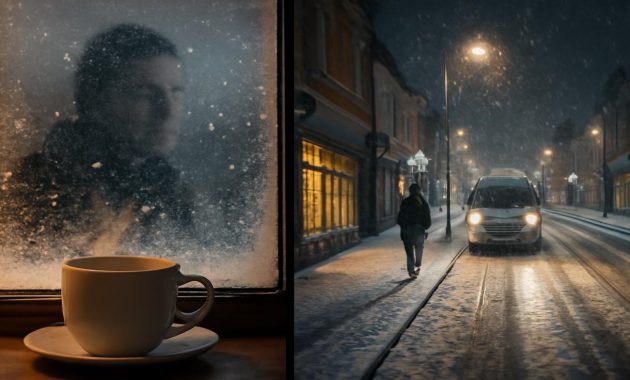
The first snowflake lands on your windshield at the same moment the traffic light turns green. It hangs there for half a second—perfect, crystalline—before it melts into a clear teardrop and vanishes. By the time you reach the next intersection, the sky has thickened into a slow, white tumble, and the world feels like it has tilted into another season entirely. On the radio, a calm voice says the phrase you’ve half been waiting for, half dreading: “Heavy snow expected tonight. Authorities are urging residents to stay off the roads unless absolutely necessary.” Then, as if on cue, a chirpy commercial breaks in, reassuring you that a nearby store will be “open regular hours, no matter the weather.” And in that small, odd contrast—the warning and the invitation—tonight’s story begins.
When the Sky Closes In
By late afternoon, the color drains from the day faster than usual. The low gray lid of cloud presses down, and the streetlights flicker on early, casting halos in the thickening air. The snow is no longer polite or tentative. It sweeps across parking lots in gusty veils, racing past office windows and blurring the edges of the familiar.
Inside cars snaking their way home, heaters sigh and wipers thump. Brake lights glow soft red through the storm, and the whole town feels as if it’s moving inside a shaken snow globe. On local news, the scroll along the bottom of the screen grows longer by the minute: school districts announcing early closures, community centers canceling evening programs, city officials repeating the same, simple plea—stay home if you can.
Another voice enters the chorus. Business owners, interviewed in hurried stand-ups outside storefronts and warehouse bays, speak about customer expectations, revenue targets, and the need to keep the lights on. “We’re planning to operate as normal,” one manager says, her breath steaming in the cold. “People still need groceries. They still need their prescriptions. And we still need to pay our staff.” In the background, a plow rumbles past, orange lights flashing like a slow, urgent heartbeat.
If you stand at a busy intersection and just listen, you can hear the conflict in the air as clearly as the wind: a city trying to decide how seriously to take a storm that hasn’t fully arrived yet, and who bears the risk when the snow comes down in earnest.
The Forecast No One Can Ignore
The numbers sound abstract at first. Six to ten inches, possibly more in higher elevations. Wind gusts up to thirty-five miles per hour. Visibility reduced to a quarter mile or less during heavier bands. Phrases like “rapid accumulation,” “flash freeze,” and the one that turns seasoned commuters quiet: “near whiteout conditions possible.”
These are not the poetic words of winter postcards. They are line items in the kind of forecast that leaves emergency managers staring at maps long after the cameras switch off. At the city’s operations center, a wall of monitors glows with real-time radar, color bands blooming from pale green to electric blue to deep purple. Each shift in hue is a promise of thicker snow, slicker roads, tighter margins.
“Our main concern is the overnight hours,” says a transportation official, leaning forward in his high-visibility vest. “That’s when the heaviest snow coincides with dropping temperatures. Once those wet roads freeze over, conditions can deteriorate very quickly.” He has said some version of this a hundred times in his career, but the weight of repetition never quite lessens. Somewhere out there, he knows, someone will decide they can beat the storm. Someone will decide that their errand, their shift, their social plans are worth just one more trip.
Meanwhile, city plows idle in a line in the yard, steel blades leaned forward like resting shoulders. Crews sip coffee from paper cups, watching the flakes thicken through the open bay doors. They’ve memorized the routes, know exactly which hills ice first, which overpasses funnel the worst of the wind. There is nothing dramatic about their anticipation—only the quiet readiness of people who understand that, tonight, an inch of snow is never just an inch of snow. It’s a series of choices made by thousands of strangers, playing out in real time on slippery asphalt.
Open Signs and Closed Roads
Across town, another set of lights burns late. In strip malls and small brick storefronts, in warehouse offices with humming fluorescent bulbs, managers make phone calls and send group messages. The forecast sits on their screens in one tab. The weekly sales report sits in another.
“We’ll stay open as long as it’s safe,” a café owner writes to her staff, fingers hovering over the word “safe” as if there were a universal definition. For her, staying open means regulars can walk over for hot soup and bread, and she can afford next month’s rent. For her baristas, it means navigating unplowed side streets in compact cars with balding tires.
Not all businesses have the luxury of debate. Hospitals, fire stations, shelters, and utility companies don’t close when the flakes fall harder; they double down. Grocery stores know from experience that the hours before the storm are a kind of controlled chaos—lines at the register, carts stacked with milk and bread and batteries, the murmur of people who have one eye on their lists and one on the windows.
Somewhere in the midst of this, a quiet table of trade-offs begins to form—unwritten but very real.
| Perspective | Primary Concern | Tonight’s Dilemma |
|---|---|---|
| Public Safety Officials | Reducing accidents and emergency calls | How strongly to push people off the roads |
| Business Owners | Keeping revenue and services flowing | Whether to close, shorten hours, or operate “as normal” |
| Workers | Balancing income with personal safety | Do they brave the drive or risk lost wages? |
| Drivers & Residents | Protecting family, fulfilling obligations | What truly counts as “essential” tonight? |
We love the idea that life goes on no matter the weather—that we are steadfast, resilient, unflappable. But the same stubbornness that keeps businesses running can also fill icy roads with cars that don’t really need to be there. Somewhere between panic and denial lies a quieter choice: to accept that a single stormy night is allowed to interrupt our plans.
The Sound of Tires on Powder
Step outside after dinner, and you’ll hear it. Under the muffled hush of falling snow—a hush that seems to swallow distant highway noise and soften the barking of neighborhood dogs—there’s the intermittent crunch of tires rolling over fresh accumulation. It’s a sound that speaks of determination, or impatience, or necessity, depending on who’s behind the wheel.
In one driveway, a nurse in navy scrubs clears off her windshield, breath puffing in little clouds as she brushes the rapidly piling snow. Her shift starts at 11 p.m., and there is no stay-home option for people who monitor ventilators and respond to midnight emergencies. “The roads are bad,” her neighbor calls out. She just nods and keeps scraping, internal calculus already done: her presence at the hospital outweighs the risk of the drive.
On the next street over, a young delivery driver loads insulated bags into the back of a compact sedan. Online orders haven’t slowed; if anything, they’ve surged. For every person who decides to heed the warnings and stay home, there’s often someone else making that choice comfortable, carrying bags or boxes to their doorstep through the swirling snow. Convenience runs on wheels, even when the wheels spin helplessly at an icy intersection.
For every necessary journey, there are also frivolous ones. A late-night craving, a last-minute errand that could wait till morning, a trip “just to see what the roads are like.” Emergency responders know those drivers too. They see them in the ditches and on the shoulders, flashers blinking weakly beneath a softening blanket of white.
Inside the Storm’s Quiet Center
Yet for all the risk and tension, there is another side to a heavy snow night—one that has nothing to do with commerce or traffic counts. Stand at a window around midnight and look out. The street that seemed busy and conflicted at dusk might now appear almost abandoned, transformed into something gentler and more ancient.
Snowflakes dance in the cone of a streetlamp like tiny meteors slowing to land. Branches bow under the weight, each twig frosted to delicate thickness. The world glows, not from the sun but from the way light bounces off millions of tiny white surfaces. Sound changes, too. The usual clatter and hum are swallowed, leaving only the occasional distant growl of a plow or the whisper of wind sliding around houses.
Inside, there is a pocket of stillness that feels rare in a life of notifications and schedules. You can hear the radiator ticking, the murmur of a kettle simmering in the kitchen. The urgency that dominated the news earlier has given way to something slower: a realization that, for this one night, the most responsible thing you can do might simply be to stop moving.
For the businesses that made the hard call to close early, this is when second-guessing can creep in. Each hour of darkness feels like lost opportunity. Yet, the view from this quiet window offers another measure of value: empty roads that emergency vehicles can navigate more easily, fewer skid marks leading off into snow-filled ditches, a pause that might, in its own small way, keep someone alive.
The People Who Don’t Get to Stay Home
Of course, “stay home if you can” carries an unspoken truth: many people cannot. Long before the first flake fell, schedules were written and expectations set for the overnight crews—the ones whose work happens when most of the town sleeps.
In a grocery store on the edge of town, stockers move pallets down aisles that glow under harsh white lights, the view outside the windows a soft blur of gray and white. They’ve driven in on half-plowed backroads, tires slipping just enough to keep their heart rates elevated. They know that by morning, customers will assume the shelves simply refilled themselves. Few will think about who was out there at 2 a.m. when the roads were at their worst.
At the power company’s control room, technicians watch grids and numbers instead of clouds. Heavy, wet snow can coat power lines and tree limbs, pulling them down with sudden, wrenching snaps. One downed line becomes a flicker, then darkness, then a call center lighting up with questions. Somewhere, someone’s careless slide off the road might take out a transformer box, plunging a neighborhood into cold, quiet vulnerability. On nights like this, crews sleep in their boots, if they sleep at all.
The storm doesn’t negotiate: it only offers conditions. The people inside this web of responsibility—nurses, EMTs, lineworkers, transit operators, plow drivers, and more—accept that reality as part of their job. But their burden grows considerably lighter when the rest of us take the simplest advice to heart and stay where we are, leaving the fragile white roads to those who truly need them.
Choosing to Pause
By dawn, the world is altered again. Cars that pushed their luck are frozen in half-cleared driveways, hoods buried to the grille. Sidewalks vanish under a smooth, unmarked sheet of snow that glows peach in the first light. Children press their faces to windows, eyes wide, already spinning dreams of snowmen and forts and the improbable thrill of a bonus day off.
The local news runs looping footage of spinouts and jackknifed trucks from the night before. A police spokesperson stands beside a busy interchange, now choked with slush and the impatient growl of returning commuters. “We asked people to stay home,” he says, the frustration in his voice softened only by exhaustion. “Some listened. Not enough.” The tally of overnight incidents scrolls below him—fender-benders, stranded motorists, a handful of serious injuries. Numbers that could have been lower. Numbers that almost always could be lower.
And what of the businesses? Some will count lost revenue; others will count themselves fortunate that everyone made it in and out alive. A few will quietly reconsider their policies for the next storm, realizing that insisting on “normal operations” during abnormal weather places hidden costs on workers, emergency services, and the community as a whole.
Snowstorms like this one reveal the invisible threads that tie a town together. They show us whose decisions ripple out onto the roads, whose risks are quietly absorbed, and how much of our relentless pace is truly non-negotiable. Heavy snow does not shut down a city on its own. People do—or don’t.
Tonight, another storm will form somewhere on a distant radar screen, swirling itself into existence long before it touches a highway or a storefront window. When the alerts begin to ping again, when the forecast grows bolder and the news anchors adjust their tones, we’ll face the same choice: push through in the name of productivity, or step back in the name of collective care.
In the end, it comes down to something deceptively simple. Heavy snow expected tonight. Authorities urge drivers to stay home. Businesses push to keep normal operations running. Somewhere between those lines, each of us has room to decide what kind of story we want the next storm to tell.
Frequently Asked Questions
Why do authorities urge drivers to stay home during heavy snow?
Authorities ask people to stay off the roads because heavy snow drastically reduces visibility and traction, increasing the risk of accidents, road blockages, and emergency calls. Fewer cars on the road mean plows and emergency vehicles can move more freely and safely, and it lowers the chance of serious injuries.
Are businesses required to close during severe winter storms?
In most places, businesses are not legally required to close unless there is a specific emergency order. Many are left to make their own judgment, balancing employee safety with financial pressures and the need to provide essential goods and services. That’s why you often see a mix of closures, reduced hours, and “open as usual” messages during storms.
What counts as an “essential trip” in heavy snow?
Essential trips typically include medical needs, work for critical services (such as healthcare, utilities, emergency response, and some retail like pharmacies and groceries), and urgent family responsibilities. Shopping, social visits, and non-urgent errands can usually wait until roads are cleared and conditions improve.
How can I prepare if I must drive during a snowstorm?
If travel is unavoidable, slow down, increase following distance, use gentle braking and steering, keep your lights on, and avoid sudden maneuvers. Make sure your vehicle has good tires, a full tank of gas, an ice scraper, warm clothing, water, and a small emergency kit with a flashlight and blanket. Let someone know your route and expected arrival time.
Why do some people still drive even when warnings are issued?
People keep driving for many reasons: job requirements, fear of losing wages, underestimating the storm, overconfidence in their driving skills, or simply not wanting to disrupt their plans. Often, it’s a combination of economic pressure and habit. That’s why clear communication from authorities and empathetic policies from employers are so important during severe weather.
Originally posted 2026-03-05 00:00:00.