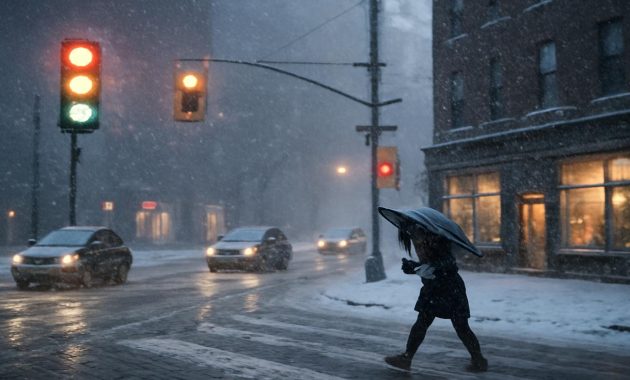
The first flakes arrived the way secrets are told—quietly, tentatively, as if checking to see who was listening. By late afternoon, the sky had settled into that heavy, woolen gray that makes colors drain from the world. Storefronts glowed warmer against the encroaching dusk, brake lights bloomed red along the avenues, and there was a faint, anticipatory hum in the town that said: something is coming.
When the Sky Lowers and Everyone Starts Talking
By five o’clock, the forecast was no longer just talk. It was everywhere—on the television screens playing silently above bar counters, on the phones glowing in palms at bus stops, woven into conversations over grocery carts and scattered between keyboard clicks in office chat windows.
“Heavy snow expected tonight,” the local meteorologist mouthed beneath scrolling captions. “Travel could become dangerous. Authorities urge residents to stay off the roads unless absolutely necessary.” The radar map glowed in thick swirls of blue and purple, an animated storm inching steadily toward the town like a slow, certain tide.
Outside, the first serious curtain of snow began to fall. It came with a new density, a confident stride. Flakes that had started as delicate, airy specks thickened into heavier clumps, the kind that clung to eyelashes and turned coats instantly damp. Streetlights activated early, crowns of halogen glare scattering through the storm, illuminating the snow in spiraling, illuminated cones.
Inside a small coffee shop on Main, the air smelled of espresso and wet wool. People hovered over their screens, watching the storm warnings intensify. A barista, towel slung over their shoulder, refreshed a weather app with a thumb that had done this a dozen times already.
“They’re saying eight to twelve inches now,” they announced to no one in particular, eyes still on the screen. “Starting around nine, peaking after midnight.”
The man at the corner table wearing a company fleece—logo stitched neatly over his heart—shook his head. “My boss just emailed,” he said with a short laugh. “We’re ‘monitoring the situation’ but we’re still expected in tomorrow. ‘Normal operations.’” He made quotation marks in the air, then reached for his cooling coffee.
“Of course you are,” the barista replied, rolling their eyes with practiced gentleness. “Storms don’t apply to revenue targets.”
Warnings on the Airwaves, Demands in the Inbox
By early evening, the language from officials sharpened. The town’s emergency alert system pushed out a message that buzzed through pockets and purses, a digital shiver that rippled through the community.
Severe winter storm warning in effect from 9 p.m. to 11 a.m. tomorrow. Heavy snowfall and hazardous travel expected. Residents are advised to stay home and avoid non-essential driving.
Local police posted photos of salt trucks being loaded, plows lined up like a quiet battalion in the orange sodium light of the municipal lot. The fire department shared reminders about clearing hydrants, checking on elderly neighbors, and keeping generators away from windows. The highway department urged people to “let crews do their work” and keep the roads clear of unnecessary traffic.
And yet, almost simultaneously, a different chorus chimed in.
Inboxes filled with emails wrapped in bright brand colors. “We’ll be open!” one chain restaurant announced in bold, cheerful letters. “Snow or shine, we’re here for you.” A retail store promised a “Snow Day Sale” for anyone “brave enough” to come out. Several offices sent their own version of the same line: “We plan to maintain normal operations tomorrow, as long as conditions allow.”
“As long as conditions allow,” Elena repeated under her breath as she scrolled through her work email at her kitchen table. The phrase tasted slippery, vague. She looked up at the window, where the glass had already turned into a shifting watercolor of white. Her old sedan sat in the driveway beneath a thin frosting of snow, the wipers lifted like surrendering hands.
Her phone buzzed again—a text this time, from the town’s public safety account.
Road conditions are expected to rapidly deteriorate after 10 p.m. Strongly consider completing essential travel early and remaining home until the storm passes.
Elena stared at the two messages—the corporate email insisting on “business as usual” and the hard-nosed, almost pleading alert from the town—and felt the quiet tug-of-war that had become so familiar in winter storms: stay home, but show up; be safe, but don’t disrupt; avoid risk, but meet expectations.
On the Road Between Caution and Obligation
By seven, the roads had shifted from damp to slick. A thin, glassy sheen of ice began to form beneath the accumulating snow. Drivers found themselves pressing pedals more carefully, hands migrating instinctively to ten and two on their steering wheels, eyes scanning for taillights glowing brighter than usual in the white swirl.
Tom, a delivery driver for a regional food distributor, eased his van along the highway, the windshield wipers thumping a slower, more labored rhythm with each swipe. His supervisor had called that afternoon with the same affectionate but immovable tone he always used before bad weather.
“We’ll keep an eye on it, but for now everything’s on,” he’d said. “Customers are counting on us. If the state closes the roads, we’ll shut it down. Until then, we run our routes.”
Now, as the storm built around him, Tom watched a snowplow grind past in the opposite direction, a roaring animal with a blade that tossed snow into glittering arcs. Behind the plow, the road looked briefly clearer, abruptly darker and wet. Within minutes, snow blurred it again.
He thought of the radio warning he’d heard just moments earlier.
Authorities strongly advise against travel unless absolutely necessary. Conditions will worsen rapidly overnight. If you can stay home, please do.
Tom snorted softly. “If,” he muttered. He thought of the restaurant owners on his delivery docket, the ones who’d already called to ask if he’d still be coming. He could hear the anxiety in their voices—snow storms meant lost tables, empty dining rooms, staff hours cut short.
In the quiet of his van, with only the hum of the heater and the rattle of snow on the chassis for company, the contradictions felt loud. The police wanted the roads empty. His company wanted them full, at least for a little while longer.
The Subtle Pressure of “Normal Operations”
Across town, in a glass-front office building whose reflective windows now showed only swirling white, a handful of employees stayed later than they wanted, finishing end-of-day reports and clearing inboxes “just in case.” The email from HR had been pointed but polite: “We understand some employees may face challenges traveling in inclement weather. However, we anticipate maintaining normal operations and expect employees who are able to safely commute to do so.”
“Safely commute,” Maya repeated, closing her laptop. “As if I can predict what a sheet of black ice will look like at seven in the morning.” Her coworker, Darren, zipped up his winter coat and glanced uneasily toward the windows.
“I feel like if I don’t come in tomorrow, I’ll be ‘choosing’ not to,” he said. “Like it’ll be on me, not the storm.”
They rode the elevator down together, briefcases and backpacks slung over padded shoulders, boots squeaking faintly on the polished floor. In the lobby, the security guard, who had already been told he was “essential personnel” and should plan on reporting no matter what, watched the snow with a neutral expression that disguised a quietly rolling calculation: how early he’d have to leave, how long the drive might take, which back roads drifted worst.
Out in the parking lot, a thin powder already hid the painted lines. Engines coughed to life in clumps of sound, headlights punched weak tunnels into the blowing snow, and one by one, vehicles dissolved into the storm, each driver privately testing the balance between fear, duty, and the stubborn hope that maybe the forecast was wrong.
A Town Bracing for the Night
As the evening advanced, the town shrank inward. Houses that had seemed separate in daylight now felt like islands floating in a common white sea. Curtains glowed yellow and amber. The air outside grew muffled, that familiar snowstorm hush that swallows sound and amplifies every crack of a branch, every distant scrape of a plow blade.
Emergency crews checked equipment—flashlights, shovels, chains, fuel. Volunteers at a nearby shelter made sure cots were ready and coffee pots were full, preparing for those who might lose power or had nowhere warm to sleep. At the hospital, night-shift nurses dug out spare blankets from home and left them in their cars, just in case they couldn’t get back in the morning and needed to sleep at the hospital between shifts.
Inside a small grocery store that planned to open “as usual” in the morning, the manager walked the aisles, counting pallets of bottled water and crates of bread, knowing full well that if the roads were bad, the first customers to arrive would be staff whose cars had slid in the lot, who now had no choice but to stay and help. He felt torn between the pride of being “reliable” in a storm and the gnawing awareness that reliability came at a human cost—cold hands on metal carts, long commutes, anxiety masked by polite greetings.
On local radio, a calm, practiced voice read off school district updates. The closures started as a trickle—one rural district here, a small private academy there—then gathered into a flood as more and more superintendents weighed the risk of buses on unplowed roads. Parents pressed phones to their ears, fingers crossing invisibly in the air.
“Our office is open even if schools are closed,” one mother read from her company’s internal portal, her jaw tightening. She looked at her two kids sprawled on the living room floor, already building makeshift snow-day forts from cushions. The forecast crawled along the bottom of her TV screen. The storm, it said, was “significant.” Her boss, it seemed, disagreed.
Numbers in the Snow: Risks and Realities
Snowstorms tell one story outside the window and another in data. While the wind rearranged drifts against doors and fences, spreadsheets and reports told of previous winters and the patterns they leave behind.
| Winter Storm Impact | Average Per Storm | What It Often Means |
|---|---|---|
| Road Accidents in Heavy Snow | Hundreds to thousands regionally | Spinouts, fender-benders, highway closures |
| Commute Time Increase | 1.5× to 3× normal | Exhausted drivers, later arrivals, longer shifts |
| Business Revenue Change | From -40% to +20% | Some lose walk-ins; others gain “storm shoppers” |
| Emergency Response Times | Delayed by 20–50% | Ambulances and fire trucks struggle through drifts |
| Employee Absenteeism | Rises 10–30% | Parents home with kids, cars stuck, safety concerns |
Those numbers never appeared in the upbeat internal memos. They didn’t trend on social media the way storm photos did. Yet they hovered invisibly over every decision—every “we’ll see how it looks in the morning,” every “we expect business as usual,” every “please, if you can stay home, stay home.”
Between the statistics and the snowfall lived the people who had to decide how much risk was acceptable—for profit, for reputation, for the illusion that no weather could bend the modern schedule.
The Night Deepens, and the Choices Do Too
By nine, the storm had fully arrived. The world beyond front porches and apartment stairwells disappeared behind thick sheets of snow, turned into an echo chamber of soft impacts—snowflakes on roofs, on power lines, on the shoulders of the few shapes that still moved outside.
On one side of town, a small restaurant owner stood in her darkened dining room, staring at the neatly set tables and the handwritten sign propped against the door: We’ll be open at 11 a.m. tomorrow—weather permitting. She knew that “weather permitting” really meant “staff permitting,” and that staff permitting meant car permitting, and that all of those things together depended on whether the roads would be passable, whether a plow would come through her street before lunchtime.
She thought about closing for the day, sending a late-night text to her crew: Stay home tomorrow. We’re calling it off. But then she thought about the rent, about the delivery already on its way in a van like Tom’s, about her own inbox, which had recently filled with “reminders” from suppliers and lenders whose own operations, somewhere far away, existed in climate-controlled spaces removed from storms like this.
Across town, a city official sat in a room lit only by the glow of multiple screens. He watched the storm’s progress through traffic cameras that now showed little more than faint halos of light and intermittent ghostly shapes of passing snowplows. Beside him, a list of prepared messages sat ready to be sent if things worsened: Road closure. State of emergency. Power outage advisory.
He had already done one interview on local TV, where he’d repeated the same phrase three times: “If you don’t need to be on the roads tonight or tomorrow morning, please stay home.” Every time he said it, he pictured the people who would still go out anyway—not to joyride, but to stack boxes in warehouses, to staff front desks, to stand at retail counters under flickering fluorescent lights.
“We can ask,” he said quietly to a colleague as the snow hammered harder against the windows. “But we can’t compete with paychecks.”
That Thin Line Between Courage and Compulsion
In the stories people tell later, there is almost always a small moment that decided it: a phone call, a text, a feeling. A nurse deciding to pack a bag and drive in early to sleep at the hospital so she wouldn’t risk the roads at dawn. A warehouse worker choosing to call out, heart pounding as he left a voicemail, rehearsing the words “unsafe to drive” over and over. A manager waking in the night to the sound of wind and snow thudding against the house, finally composing the message they were reluctant to send: We’re closed tomorrow.
For some, staying home would feel like relief. For others, it might feel like defiance. For still others, it wasn’t a choice at all—they were labeled “essential” in job descriptions and schedules long before the clouds rolled in, their presence at work assumed to be as dependable as the ticking of the clock.
And then there were the drivers, the ones the warnings were most palpably about. They knew how a plowed road could turn treacherous in the span of a single wind gust, how a bridge that looked merely wet could be a veil over ice. They knew the particular, terrifying helplessness of a vehicle losing traction, the slow-motion slide that turned the entire world into a stomach-dropping tilt.
These were the people who had to weigh the gravity of “Please don’t drive” against the gravity of “We expect you here,” fully aware that the storm itself cared about neither.
Morning Will Tell the Story
Eventually, the evening hours slipped away, swallowed by the continuous white. Windows darkened as households gave up watching the accumulating snow and turned instead to glowing screens, board games, sleep. Somewhere beyond, the storm continued its work, layering the town in inches of quiet insistence.
On some streets, cars would not move at all come morning—buried, plowed in, wheels frozen to the ground. On others, engines would roar to life in the predawn gloom, drivers shoveling stubborn paths to the road, muttering silently about supervisors and cancellations that never came.
Snowstorms have a way of making our priorities visible. They reveal which work we declare “essential” and which we are willing to pause, which risks we accept because we’ve normalized them and which we respond to with alarms and alerts. They turn the abstract tension between safety and productivity into something you can feel beneath your tires, see in the curve of a plow’s blade, hear in the thin, tired edge of a dispatcher’s voice at three in the morning.
As the town slept under its new, deep blanket, the same question unfolded in hundreds of bedrooms, on couches and cot mattresses and worn recliners: Will I go out there tomorrow?
The storm did not answer. It only kept falling, indifferent and steady, while officials drafted new advisories and businesses queued up new emails promising, once again, that everything would proceed “as normal”—even as the world outside the window made it abundantly clear that nothing about this night was normal at all.
Frequently Asked Questions
Should I drive if authorities urge people to stay home but my workplace is open?
If officials are explicitly advising against travel, safety should come first. Contact your employer, explain local conditions, and document official advisories. When possible, ask about remote options, adjusted hours, or using paid time off. No job is worth risking a serious accident.
How can businesses balance staying open with keeping people safe during heavy snow?
Businesses can offer remote work where possible, staggered start times, and flexible attendance policies. Clear communication, early decisions about closures, and coordination with local weather and road updates help reduce pressure on employees to take unnecessary risks.
What preparations should I make at home before a major snowstorm?
Have enough food, water, and medications for a couple of days, charge devices, locate flashlights and blankets, and fuel your car in case of emergencies. Move your vehicle off the street if plows need access, and check on neighbors who may need assistance.
Why do some services remain open even when authorities discourage driving?
Certain services—hospitals, emergency response, utilities, some public transportation, and critical supply chains—are essential even in storms. Other businesses remain open due to financial pressure, customer expectations, or corporate policy, sometimes without fully weighing local risks.
What can local governments do to reduce conflict between safety advisories and business expectations?
Clear, early communication helps: declaring states of emergency, setting specific travel restrictions, and coordinating with major employers. Providing guidance on safe staffing levels and encouraging remote or delayed operations can align public safety messages with business decisions.
Originally posted 2026-03-05 00:00:00.