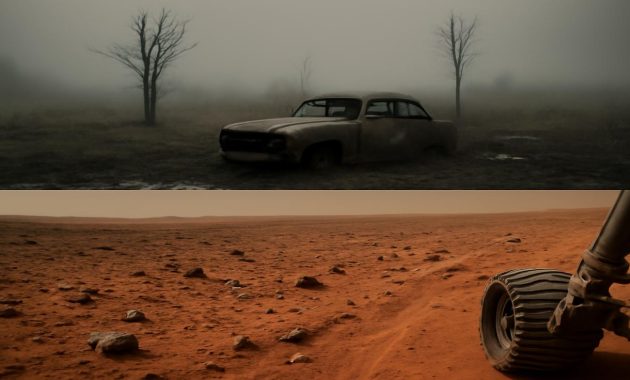
The first time I heard an astrophysicist say, “Even after a nuclear apocalypse, Earth would still be paradise compared to Mars,” I actually laughed out loud. It sounded like a punchline, some dark cosmic joke at Elon Musk’s expense. But the room went quiet, and the scientist didn’t crack a smile. He just let the sentence hang in the air, heavy and undeniable, like a truth we’d been too dazzled by rockets and red-planet romance to face.
The Red Mirage
Picture Mars the way it’s usually sold to us: a rust-colored frontier beneath a salmon-pink sky, a place of heroism and reinvention. In glossy animations and breathless keynotes, the red planet is framed as a backup Earth, humanity’s insurance policy against extinction. Asteroids, pandemics, climate collapse—whatever we do to this blue world, the story goes, we’ll always have Mars.
But slip out of the marketing haze for a moment and stand, in your mind, on the Martian surface. The air around you is thin—less than one percent of Earth’s atmospheric pressure. You can’t breathe it; it would boil the moisture from your lungs. The wind picks up a fine, copper dust that gets into every seal, every hinge, every human pore it can find. Overhead, the sky is dim, the Sun a small distant disc, barely warming your gloves. Temperatures swing wildly, from a daytime chill that would freeze your eyelashes to a nighttime plunge that could crack steel if it’s not engineered just right.
Now, side by side, imagine a ruined Earth. Let’s say something terrible has happened: cities shattered, forests burned, radiation lingering in ugly pockets. It’s a haunting picture. But the astrophysicist’s voice rides over that imagined wasteland with an unflinching clarity: “Even then… this is still the best planet we will ever have.”
That’s not a failure of imagination. It’s physics. It’s biology. It’s the staggering, often ignored privilege of living on a world that already knows how to cradle life.
Earth After the End vs. Mars on Its Best Day
To understand what that astrophysicist meant, you have to peel away the romance and look at the raw conditions. The comparison is not between a ruined Earth and some utopian, terraformed Mars of the far future. It’s between a broken Earth and the Mars we actually have—and will likely still have for a very long time.
Start with the air. Earth’s atmosphere, even badly damaged, is thick enough to breathe with minimal equipment. Maybe you need filters, maybe certain zones are uninhabitable for centuries, but the sky itself is still heavy with nitrogen and oxygen. Gravity holds that envelope of air snug around our planet, and it presses on us in a way our bodies have evolved to love—we don’t notice atmospheric pressure, the same way we don’t notice a loving hand that’s always been on our shoulder.
Mars does not have this grace. Its atmosphere is so thin that stepping onto the surface without a pressure suit is not a death sentence; it’s an execution. The air is mostly carbon dioxide with wisps of other gases, not nearly enough to fill your lungs. There is no “outside” you can simply stumble into, like you might, dazed and coughing, on an after-war Earth. You don’t get to throw open a door and just breathe.
Radiation, too, plays favorites. A post-apocalyptic Earth would suffer zones of intense radiation, yes—but our thick atmosphere and magnetic field still do their quiet work overhead, shielding life from the full cosmic barrage. Mars, with its weak magnetic field and stripped-down sky, sits nearly naked before the universe’s harshest rays. Every walk on the surface is an exposure; every window has to be a compromise between seeing the alien landscape and not slowly frying the people inside.
The astrophysicist who challenged Elon Musk wasn’t saying that Mars is worthless. He was saying: let’s not confuse desperation with destiny. Let’s not imagine that fleeing our problems to a place so hostile it wants to kill us every second we’re there is any kind of rescue, let alone an upgrade.
The Hard Numbers of a Harsh Planet
Sometimes the romance of Mars evaporates quickest when you put the basics into a simple side-by-side view.
| Condition | Post-Apocalyptic Earth | Present-Day Mars |
|---|---|---|
| Air | Breathable in many regions with filtration and gear | Mostly CO₂; unbreathable, requires full life support |
| Pressure | Close to normal; can move outdoors with basic protection | Less than 1% of Earth; vacuum-like, lethal without a suit |
| Temperature | Extreme in places, but liquid water can exist widely | Often far below freezing; liquid water unstable on surface |
| Radiation | Increased in some regions, still partly shielded by atmosphere and magnetosphere | High; thin atmosphere and weak magnetic field mean constant exposure |
| Food & Ecosystems | Surviving soils, seeds, wild species; damaged but living biosphere | No native life known; all food must be grown artificially |
What that table doesn’t show is the one thing that matters most: on Earth, even after catastrophe, nature is already on our side. We might bruise it, burn it, poison it—but given time, it fights its way back. Shoots push through ash. Moss softens the edges of abandoned concrete. Frogs return to radioactive forests we thought nobody could inhabit. On Mars, there is no such ally. There is only the blank, indifferent face of a world that never asked for us and offers nothing for free.
A Love Letter Wrapped in a Warning
At a conference one year, during a Q&A after a talk on planetary habitability, a young engineer stood up and asked, with unguarded excitement, “So is Mars basically our Plan B?” There was a rustle of amusement and eye-rolling among the older scientists in the room. The astrophysicist paused, looked at the audience, and replied, “If you treat Mars as Plan B, you have already decided to let Plan A burn.”
The room fell into a hush that felt almost devotional. The idea of Mars as a shiny escape hatch is seductive because it lets us keep behaving as if Earth were disposable. Like a teenager convinced there’s always another apartment to crash in, we treat our home like it’s temporary, a little fragile, a little boring. We want the high drama of the frontier, not the quiet work of repair.
But this isn’t really about Elon Musk, not at the core. Musk is a symbol of our age’s wild ambition: reusable rockets, interplanetary dreams, the promise that humans will stretch beyond the cradle of Earth. That ambition is thrilling—and useful. Space travel has given us perspectives and technologies almost no one expected. The problem is the story that sometimes rides along with it: that if we ruin this world, we can always just move.
The astrophysicist’s call-out is not a scolding of exploration; it’s a love letter to the only place we have ever known life. Earth is not just a rock in a habitable zone. It is a self-repairing, self-regulating miracle. Break the climate, and the planet will eventually find a new balance—lifeless, perhaps, or wildly different from the one that made us, but still governed by the intricate physics of energy, water, and air. It is we who may not survive that transition. Mars won’t save us from that. It might, for a few thousand or million lucky pioneers, extend the story of our species. But the story of most humans, of birds and whales and birch trees and coral reefs, will still be written here.
So when someone says Earth after a nuclear war would still be better than Mars, what they’re really saying is: this planet is so good at being home that you can shatter it, scorch it, poison it, and it will still outshine every other option we know.
The Gravity of Sentience
There’s another thing the astrophysicist pointed out, almost offhand, but it landed like a small asteroid: “On Mars, you are never more than a gasket failure away from death.” He wasn’t talking about cinematic disasters; he meant the ordinary drudgery of living in a sealed habitat. Every screw is an existential variable. Every weld is a question of survival. The air you breathe is a machine’s gift, not a planetary one.
Imagine years—decades—of that. You wake up to the soft hiss of scrubbers, to the low rumble of pumps. Outside your habitat wall: cold, vacuum-thin air; toxic dust; radiation. Inside: carefully engineered climate, rationed water; a garden under LEDs instead of a tree under the sun. No rain. No wind on your bare skin. No night sounds of insects or rustling leaves. Every part of your existence is negotiated with geometry, technology, and time.
Could humans do this? Absolutely. We’ve done versions of it in submarines, Antarctic bases, and space stations. But those places are always meant to be temporary. A mission. A tour. A stint. Even astronauts circling Earth, wrapped in the safest machines we can build, talk endlessly about their longing for rivers, for weather, for the simple extravagance of stepping outside without a pressure suit.
On a broken Earth, you could still, in many regions, step outside with little more than rugged clothing and a gas mask. You might have to walk far to find clean water, to find untainted soil, but you could walk. You could feel gravity the way your bones expect to feel it. You might watch clouds form overhead, the same physics of condensation slowly reclaiming what war tried to break. You would still be woven into a living sky.
On Mars, you would be a permanent guest. A careful intruder. Nothing about the place says, “Welcome, build a nest.” Instead, everything says, “Tolerate me if you dare.” This doesn’t mean we shouldn’t go. It means we shouldn’t mistake “possible” for “preferable,” or confuse a brave outpost with a better world.
Mars as Mirror, Not Escape
There’s a quiet, almost poetic irony in Mars mania: the more we study the red planet, the more we understand the razor-thin line that separates a world like ours from a world like that. Mars may once have had rivers, lakes, perhaps even oceans. Today it is arid, cold, stripped. Some scientists look at it and see a warning of what can happen to a planet’s climate over eons. It is less a promised land than a mirror of vulnerability.
And yet, Mars also stirs something essential in us—the urge to explore, to push outward, to test the limits of human ability. That urge has carried us across oceans, into deep forests, up mountains we had no rational need to climb. It’s the same hunger that sends rovers trundling over Martian sand and drives engineers to calculate trajectories by the slimmest of margins.
So maybe the healthiest way to hold Mars in our imagination is not as an ark, but as a teacher. It shows us what life looks like without a protective atmosphere, without a global ocean, without a breathing skin of forests and grasses. It reveals the fragility of those things by their absence.
When Elon Musk talks about making humanity multi-planetary, he is tapping into a deep survival instinct. The astrophysicist who pushes back is tapping into an older, quieter truth: you don’t abandon the safest harbor because you’ve built a very fast boat. You use the boat to learn more about your harbor, to understand the storms that may come, to gather wisdom from distant shores. But you still come home.
And if, one day, we do walk under a pressurized dome on Mars and look up at the tiny distant star that is our Sun, maybe the strongest feeling won’t be triumph, but homesickness. A longing for an atmosphere thick enough to paint the sky blue, for rain clouds stacked like mountains, for a horizon softened by humidity and haze. For an Earth that, even scarred, is lush beyond anything the red desert can offer.
The Real Stakes Back Home
It’s tempting to treat all of this as a philosophical argument, a kind of cosmic thought experiment. But it has teeth. Every dollar, every headline, every schoolkid’s dream that leans into the fantasy of “We’ll just go to Mars” is a tiny weight on the scale away from the hard, less glamorous work of healing the world we stand on.
This doesn’t mean we should stop building rockets or studying other planets. Quite the opposite. Space science gives us irreplaceable knowledge about climate, radiation, planetary systems—the very tools we need to understand and protect Earth. Weather satellites, GPS, global observations of ice and ocean circulation: all of that comes from putting our machines into the sky.
The danger isn’t exploration. The danger is escapism.
When that astrophysicist called out Elon Musk, he wasn’t mocking him. He was setting a boundary in the story we tell ourselves. Yes, let’s go to Mars. Let’s dig into its history, search for traces of lost water and maybe lost life, build habitats in its dust. But let’s stop pretending that any of that lets us off the hook here.
Because at the end of the day, when the last rocket plume fades and the last steel tank cools, this is still the only world where you can lie on your back in the grass, breathe without thinking, and feel the weight of an atmosphere pressed gently against your skin. This is the only world where forests exhale for us, where oceans remember our climate, where soil is not just ground but a crowded, writhing civilization of its own.
Even after we’ve hurt it—perhaps especially after—we owe it something more than the fantasy of running away.
Frequently Asked Questions
Is Mars really that much worse than a post-apocalyptic Earth?
Yes. A damaged Earth would still have a thick, largely breathable atmosphere, a functioning gravity level suited to human biology, liquid water in many regions, and a surviving biosphere. Mars, by contrast, has an ultra-thin, unbreathable atmosphere, extreme cold, high radiation, and no known native life. Surviving on Mars requires full life-support systems at all times; on Earth, even after catastrophe, many areas could be habitable with far less technology.
Does this mean we shouldn’t try to colonize Mars?
Not at all. Exploration and even long-term settlements on Mars can teach us a great deal about engineering, biology, and survival in harsh environments. The problem arises when Mars is framed as a replacement for Earth rather than a scientific and exploratory frontier. Colonizing Mars is an ambitious project, but it will not solve the problems we create here.
Could we terraform Mars to make it more Earth-like?
Terraforming Mars is a fascinating idea but faces immense scientific and ethical challenges. It would require vast amounts of energy and time to thicken the atmosphere, raise temperatures, and possibly introduce life. Even optimistic scenarios suggest centuries or longer, and current evidence indicates Mars may not have enough accessible resources (like CO₂ in its polar caps) to make large-scale terraforming feasible with near-future technology.
Why do some scientists criticize Elon Musk’s Mars vision?
Many scientists admire Musk’s ability to push rocket technology forward. The criticism is usually about the narrative that Mars can serve as a fallback planet if Earth becomes uninhabitable. Experts point out that protecting and restoring Earth is far easier and more humane than attempting to move a significant fraction of humanity to an extremely hostile world.
How does studying Mars help us protect Earth?
Research on Mars deepens our understanding of planetary climates, atmospheric loss, geology, and the conditions required for life. Comparing Earth and Mars—two neighboring but very different planets—helps scientists refine models of climate change and planetary evolution. That knowledge feeds directly into better climate predictions, environmental policy, and strategies for preserving Earth’s habitability.