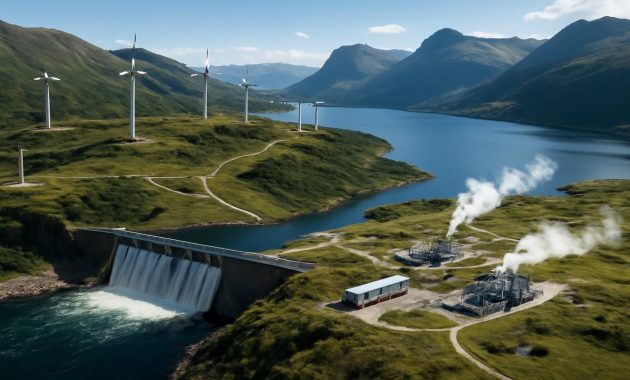
The train slid out of the station just as the sun began to pull itself up over the horizon, turning the sky the color of soft apricot. Through the window, fields flashed by in a blur of dark soil and silver frost, stitched together by neat rows of turbines. Their blades moved slowly, almost lazily, but the digital display over the carriage door told a different story: the train was racing along at nearly 300 kilometers per hour—smooth, quiet, electric. No diesel hum. No soot. Just a low, steady whisper on the rails. Somewhere between the sleepy villages and the first sight of the sea, it hit me: this country isn’t just talking about the green transition. It’s living inside it.
Where the Air Smells Different
When you step out of Copenhagen’s central station on a chilly morning, the first thing that stands out isn’t the architecture or the cyclists—though there are a lot of those. It’s the air. There’s a crispness to it, a softness inside your lungs that you notice if you come from a city where exhaust and impatience are part of the daily atmosphere.
Denmark, a small country stitched between the North Sea and the Baltic, has become something of an overachiever in the world of green records. It repeatedly hits renewable energy milestones that other European nations talk about as distant targets. On some stormy winter days, the country generates more electricity from wind than it actually needs, exporting the surplus to neighbors who are still catching up.
I didn’t come here for a conference, a policy summit, or to wade through charts and acronyms. I came because I wanted to feel what a “climate-leading” country is like from the ground. What does it sound like? Smell like? How does it shape the way people move, eat, heat their homes, or choose their careers? And why, as Europe wrestles with stalled climate targets and political backpedaling, does this modestly sized kingdom keep breaking records that make headlines only briefly before the news cycle moves on?
The answers turned out to be scrawled not just in government reports or sleek sustainability brochures, but in ordinary routines: the way a teenager in Aarhus hops on a cargo bike without thinking twice, or how an offshore engineer in Esbjerg talks about turbine blades the way a carpenter might talk about oak.
The Wind That Turned Into an Export
On a clear day off the Danish west coast, the horizon looks like it’s grown a forest of white stems. Turbines stand rooted in the sea, blades cutting slow arcs through the air. The boat bucks under your feet as you head out toward them, and the closer you get, the more they cease to be abstract icons on a climate slide deck and become something almost absurd in scale—steel giants humming with captured wind.
Denmark started betting on wind power decades before it was fashionable. After the oil crises of the 1970s, while much of Europe doubled down on fossil fuels or nuclear power, this small nation began experimenting with wind cooperatives. Farmers pooled money to raise turbines on their land. Small workshops started tinkering with designs. That tinkering became an industry; that industry turned into global leadership.
Today, the country regularly covers more than half of its electricity consumption from wind alone. On some particularly gusty days, production can exceed 100%, meaning Denmark becomes a net exporter of green electricity while others still rely heavily on gas and coal plants to keep their grids stable. As Europe grapples with energy security, price shocks, and slow permitting for renewables, Denmark quietly keeps pushing the envelope.
The story you hear in the ports and the control rooms is not just about percentages, though. It’s also about pride and identity. Ask a technician who spends winters maintaining offshore turbines why they chose this path, and they’ll rarely talk first about climate targets. They talk about craftsmanship, about the satisfaction of seeing blades come to life, about knowing that the energy powering a thousand homes is flowing through cables they helped install.
Green, for them, is not a slogan. It’s a job that smells like sea spray and metal, sounds like the rhythmic thump of waves hitting the jack-up vessels, and feels like the sting of rain on your cheeks as you clip your harness to a ladder that leads up, up, up into the nacelle where the generator sits like a mechanical heart.
How Denmark Stacks Up in Numbers
It’s easy to get swept away by the poetry of turning wind into light, but the statistics tell their own story about why Denmark keeps setting new records while parts of Europe stall or backtrack. Consider the rough comparison below:
| Indicator | Denmark | EU Average |
|---|---|---|
| Share of electricity from renewables | Well over 70% in recent years, with wind as the main source | Around 40%, with large variation between countries |
| Per-capita climate targets | Legally binding goal of cutting emissions 70% by 2030 (from 1990 levels) | EU-wide goal of –55% by 2030 |
| Onshore wind and solar permitting speed | Among the fastest in Europe, supported by streamlined rules | Often slow and fragmented, with multi-year delays |
| Public support for climate action | Consistently high, embedded in mainstream politics | Strong in some countries, weakening or polarised in others |
| Green technology exports | A major share of national exports, especially wind tech and energy solutions | Growing, but often less central to national economies |
These figures are approximate and constantly shifting, but the pattern is clear: where many of its neighbors struggle to turn ambition into infrastructure, Denmark has gotten very good at execution. It has also learned to turn its climate policies into a competitive edge rather than a perceived burden.
The City That Moves on Two Wheels
Stand at an intersection in central Copenhagen at 8:30 in the morning and just listen. There’s the faint ding of bike bells, the soft grind of tires rolling over wet asphalt, murmured conversations in Danish and English, the hiss of a bus pulling up to the curb. What you don’t hear much is the growl of engines stuck in traffic. There are cars, of course, but they share the city with swarms of cyclists who glide past in dedicated lanes wider than some sidewalks in other capitals.
A cold wind spreads across your face as people flash by in wool coats and bright rain capes, some with kids tucked into cargo bikes shaped like miniature wooden boats. It’s not a “cycling culture” as an add-on to daily life; it’s the backbone of it. For many Danes, driving into the city center during rush hour is about as appealing as trying to park a truck in a living room.
Years of urban planning have carved out a city designed for movement without emissions. Elevated bike bridges loop gracefully over canals, and traffic lights are timed to create what cyclists affectionately call the “green wave”: if you ride at a comfortable, human pace, you hit a cascade of greens that carry you across neighborhoods without stopping.
This isn’t just about emissions reductions on a spreadsheet. It’s about a type of daily freedom that seeps into the way people feel. A commuter from the neighborhood of Nørrebro told me that her 20-minute bike ride to work is the mental buffer between home and office: “I don’t sit in a metal box yelling at the radio. I watch the light on the lakes, I feel how the wind changes from day to day. It makes me want to protect this place.”
While cities across Europe sketch out ambitious cycling plans and low-emission zones, many still find their streets politically and physically clogged. In Denmark, the long, sometimes contentious work of redefining public space has already happened. The result is an urban choreography where low-carbon living is not a sacrifice but a smoother way to move through the day.
More Than Bikes: The Quiet Heat Beneath the Streets
There’s another piece of infrastructure you don’t see but you feel, especially on a January night when the wind howls in from the sea and the sky leans low and gray. Down under the pavements of Danish towns and cities, hot water is circulating in insulated pipes—district heating networks that tie thousands of homes into shared, increasingly green heating systems.
Instead of each house wrestling with its own boiler, these networks tap into a mix of sources: biomass, industrial waste heat, large heat pumps powered by renewables, and, increasingly, geothermal projects. The result is a steady, reliable warmth that doesn’t depend on every individual homeowner making a heroic investment in technology.
Across Europe, heating remains one of the biggest climate headaches—expensive to change, politically charged, and often invisible in the public imagination compared to shiny solar panels or sleek electric cars. Denmark’s district heating systems are a reminder that some of the most transformative climate solutions happen quietly, humming under our feet, changing the baseline of what “normal” looks like.
How Policy Became Personal
It’s tempting to chalk up Denmark’s green streak to a cultural storyline about Nordic exceptionalism, but that flattens the complexity and overlooks something more interesting: the way policy choices have seeped into everyday life and, in turn, how everyday habits have shaped policy back.
Climate laws here aren’t just lofty documents. A legally binding framework commits the government to steep emission cuts by 2030, and there is a cross-party recognition that failing to deliver is not just politically embarrassing but socially unacceptable. Citizens, media, and businesses have learned to treat climate progress as a regular checkpoint, not a vague promise for 2050.
In a small café in Odense, I overheard two students voicing concern not about whether climate change is real—they had already moved past that—but whether the country would manage to electrify ferries to the islands fast enough, whether the buses would all be zero-emission by the time they have kids. That level of expectation doesn’t appear overnight; it’s the result of years of visible progress redefining what’s reasonable to demand.
This is precisely where much of Europe is currently stuck. Ambitious targets have been enshrined in EU strategies and national roadmaps, but on the ground, competing crises—war, inflation, political backlashes—have slowed or even reversed climate measures. A coal plant extended here, a wind farm delayed there, a subsidy rolled back after a change of government. The narrative has shifted from “Can we move fast enough?” to “Can we afford to keep moving?”
Denmark faces the same geopolitical headwinds, yet its climate ambition has, so far, held more steady. Not because the country doesn’t feel economic pain or political disagreement, but because the green transition has grown deep roots in business models and local pride. Green energy is not a luxury line item; it’s a core export, a source of jobs across generations.
When the Sea Is Both Threat and Opportunity
Rising seas and harsher storms are not abstractions along the Danish coast. Harbors have seen the water line creep higher. Beaches and dunes are constantly defended, reshaped, and monitored. The same waters that make Denmark a wind power hub also remind it what’s at stake if the world fails to curb emissions.
Standing on a blustery pier, you can watch container ships move slowly in the distance, their hulls heavy with goods bound for ports across the world. Next to them, specialized vessels tend to the wind farms, shuttling crews and components back and forth like bees pollinating a metallic meadow. The contrast is striking: fossil-fueled global trade gliding past the very infrastructure meant to help decarbonize the future.
For Danes working offshore, climate change isn’t a distant storyline told by scientists on television. It’s an everyday tension woven into their landscape. The ocean that feeds the turbines also threatens to swallow low-lying stretches of coastline. The wind that powers homes can turn savage in winter storms. That duality—threat and opportunity, vulnerability and advantage—creates a kind of sober urgency. There’s no time for denial when your country’s highest point is only modestly taller than some European skyscrapers.
Why Europe Is Struggling to Keep Up
All across the continent, governments declared “green deals” and “net zero” goals with great fanfare. Yet on the streets of many capitals, the choke of traffic still overpowers the scent of wet leaves after rain. In politicians’ speeches, the climate issue suddenly shares the stage with a list of competing emergencies. Some leaders call for “realism,” a word that often hides a retreat from earlier promises.
The reasons Europe is stumbling are complex: energy crises triggered by geopolitical conflict, cost-of-living struggles that make households wary of investments, rising populist movements suspicious of what they call “green diktats from Brussels.” In some places, climate policies are sold as painful obligations rather than opportunities for better air, more stable energy bills, or new industries.
Denmark shows a different narrative is possible. Instead of framing the transition purely as sacrifice, it has linked climate ambition to tangible gains: clean jobs across provincial towns, export revenue, less dependence on imported fuels, smoother urban mobility. The country also benefits from scale; being smaller makes it easier to coordinate planning, and a long tradition of social trust smooths the path when tough decisions must be made.
That doesn’t mean the Danish story is flawless. Critics point out that the nation still consumes more than a fair global share of resources, that aviation and imported goods leave significant footprints, that biodiversity is under pressure in many landscapes. Yet even those debates often start from a higher baseline of progress than you find elsewhere, turning the conversation from “Should we act?” to “How can we act better and faster?”
Meanwhile, across Europe, the gap between talk and action has opened wide enough to feel like a chasm. Wind and solar queues lengthen in permitting offices. Heat pump regulations are passed, then watered down. Climate activists chain themselves to buildings; farmers block highways in protest over environmental rules they see as stacked against them. The transition feels less like a shared project and more like a tug-of-war.
What Other Countries Can Learn—Without Copying
No country can wholesale import Denmark’s model. Geography, history, politics, and economics matter. Not every nation has shallow windy seas perfect for turbines, nor the same level of social cohesion. Yet there are lessons that travel well beyond Denmark’s borders.
One is the power of visibility. When change is tangible—wind turbines on the horizon, bike lanes under your wheels, district heating humming silently—you no longer talk about climate action as a vague burden. It becomes part of everyday infrastructure that people can see, use, and critique. That creates a feedback loop: the more you build, the more people expect you to keep building.
Another is consistency. Policies here have shifted with governments, but the overarching trajectory has been surprisingly stable. Businesses have trusted that investing in green technology wasn’t a political fad but a long-term bet. That stability has lured capital and talent, allowing Denmark to stay ahead while other countries hesitate.
Finally, there’s the subtle but profound role of story. In Denmark, the green transition is often told not only as a tale of crisis and sacrifice but as a story of ingenuity and national pride: a seafaring people turning wind and waves into their next chapter. It’s a narrative that invites participation, not paralysis.
The Evening Light and the Road Ahead
On my last night in Denmark, I walked along the harbor as the sun slid down behind a scatter of turbines on the horizon. The water mirrored a smudged watercolor sky—pinks, bruised blues, the faint glow of the first stars. The air smelled of salt and something faintly metallic from the shipyards. Somewhere nearby, an electric bus hummed past on its final route of the day.
From this quiet vantage point, it was easy to imagine a future in which Europe had kept pace with countries like this one: where ports across the continent buzzed with floating offshore platforms, where city mornings sounded more like Copenhagen’s soft chorus of bicycle bells than the blare of idling engines, where district heating and smart grids made the idea of a cold, expensive winter feel almost archaic.
But the truth, at least for now, is that Europe’s path is jagged—two steps forward, one and a half back. Some nations are sprinting toward renewables, others stumble, a few turn around entirely. The continent that once led global climate diplomacy is suddenly questioning whether it can afford its own ambition.
Denmark, for all its imperfections, offers a stubborn counterexample: a reminder that momentum is possible, that green records can be broken and then broken again, that the distance between policy and lived reality doesn’t have to be so great. Walking back through the dim streets, past windows glowing with the soft light of efficient bulbs and radiators warmed by shared heat, I realized that what moved me most here wasn’t the numbers, impressive as they are.
It was the feeling that the future we keep talking about in reports and summits has already arrived in pieces—and that in this windy, sea-wrapped country, those pieces have clicked together just enough to form a picture worth protecting. The challenge now is whether the rest of Europe is willing to see it not as an outlier, but as a starting point.
Frequently Asked Questions
Why is Denmark considered a leader in green energy?
Denmark invested early and consistently in wind power, both onshore and offshore, and built strong policy support around renewables. It now generates a large share of its electricity from wind and has developed a world-leading green technology export sector. Climate targets are legally binding, which keeps pressure on governments to deliver.
How does Denmark’s approach differ from other European countries?
While many European nations have ambitious climate goals, Denmark has focused heavily on execution: faster permitting for renewables, strong public support, stable policy signals for investors, and integrated planning for heat, power, and transport. The green transition is visible in daily life, from extensive cycling infrastructure to district heating networks.
Is Denmark completely carbon neutral?
No. Denmark still emits greenhouse gases and has work to do in sectors like agriculture, aviation, and industry. However, it has set one of the most ambitious short-term targets in the world—cutting emissions 70% by 2030 compared with 1990 levels—and is making rapid progress toward that goal.
Can other countries simply copy the Danish model?
Not directly. Each country has different geography, politics, and economic structures. But many elements are transferable: clear long-term climate laws, streamlined permitting for renewables, investment in public transport and cycling, and support for district heating and electrification. The deeper lesson is the value of consistency and visible, everyday benefits.
Why is Europe as a whole falling behind on climate action?
Europe faces overlapping crises—energy security, war, inflation, and social tensions—that have slowed or reversed some climate policies. In some countries, climate measures are framed as economic burdens rather than opportunities, leading to political resistance. Fragmented permitting systems and policy instability also discourage rapid investment in green infrastructure.