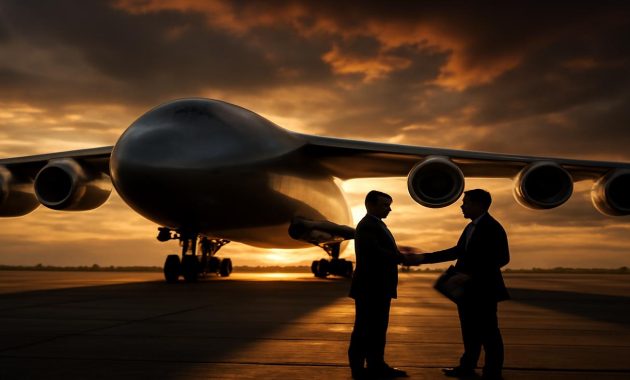
The runway lights were still fading into the misty dawn when the world’s would‑be largest aircraft rolled out of its hangar, its colossal wings slicing the sky with a quiet, unnerving confidence. The camera drones hovered just far enough away to make it feel mythical—like watching a blue whale breach from the deep. But the real story that morning was not the size of the plane. It was the signature of ink on paper somewhere in a closed glass conference room: a heavyweight alliance—part engineering marvel, part corporate power play—that might crush rivals, redraw flight maps, and ignite a global argument about who really owns the sky.
The Day the Sky Got Smaller
You could feel the unease in the terminal before the announcement even hit the news feeds. Travelers hunched over departure screens, gate agents tapped nervously on keyboards, and a few sharp-eyed aviation nerds were already whispering about a mysterious “Project Atlas” that airline insiders had been hinting at for months.
Then the alert chime spread across phones like a digital shockwave. News apps flashed the headline: the future largest plane in the world—still officially just a prototype—had signed a historic alliance with a coalition of major airlines and cargo giants. That single partnership would promise unprecedented capacity, fuel efficiency (at least on paper), and a new kind of long-haul dominance. It would also hand a staggering amount of power to a very small group of companies.
In seconds, social media lit up: praise, fear, outrage. Some called it the most important leap in commercial aviation since the first wide-body jet. Others compared it to building a floating fortress that would patrol the skies, squeezing competitors out of the airways.
The world had been dreaming about bigger, cleaner, farther-flying aircraft for decades. But no one expected that dream to arrive wrapped in this much corporate muscle—and this much controversy.
The Beast That Wants to Own the Horizon
The aircraft itself has already earned a set of nicknames—“The Leviathan,” “Sky Trawler,” “The Quiet Giant.” On paper, it’s a masterpiece of engineering ambition. Longer than a football field and tall enough that a person could stand inside its engine intake without bending, it makes yesterday’s jumbo jets look almost modest. Its double-deck cabin is designed to move a stunning number of people and cargo in a single flight, while new composite materials slash structural weight.
Its wingspan stretches so far that some existing airport gates simply cannot handle it. Specialized taxi routing, new gate designs, extended runways—those are all part of the whispered planning documents making the rounds at aviation conferences. The plane’s designers insist that despite its size, it will sip fuel more efficiently per passenger than many smaller jets currently circling the globe.
But specs alone don’t cause outrage. Power does.
The alliance that now surrounds this aircraft isn’t merely an agreement to buy a few dozen airframes. It’s a sweeping pact between a global manufacturing consortium and several of the world’s largest airlines and logistics companies—a joint strategy to reshape how, where, and by whom long-distance travel is done.
A Table of Winners and Losers
Behind the glossy promotional videos and dramatic rollout photos, the implications of this alliance become clearer when you look at who gains—and who could lose.
| Stakeholder | Potential Gain | Potential Risk |
|---|---|---|
| Mega‑Airlines in the Alliance | Dominance on key long‑haul routes, lower per‑seat costs, branding coup. | Regulatory scrutiny, backlash over monopoly fears, massive financial exposure. |
| Rival Airlines | Pressure to innovate, possible niche opportunities on secondary routes. | Route displacement, reduced bargaining power, pricing wars. |
| Passengers | Potentially lower fares on high‑volume routes, new long‑range connections. | Less competition, fewer airline choices, risk of “mega‑hub” bottlenecks. |
| Airports & Cities | Status as global super‑hubs, infrastructure investment, job growth. | High upgrade costs, noise and traffic concentration, dependence on a few carriers. |
| Environment & Communities | Lower emissions per passenger if flights replace older fleets. | Overall traffic growth, more concentrated flight paths, climate concerns. |
On one side of the ledger: incredible efficiency, the possibility of cheaper intercontinental tickets, and new direct city pairs once considered too far or too thinly served to sustain daily giant-jet service. On the other side: the very real chance that this configuration of size plus alliance power squeezes competitors from the market and locks travelers into fewer real choices.
The Alliance That Feels Too Big to Fail
In a quiet hotel ballroom far from the runway cameras, lawyers and executives huddled over the documents that would formalize this new bloc. Representatives from airlines across three continents signed their names, somewhere between excitement and calculation. For them, this aircraft is a tool—a lever to pry open new profit margins in a business defined by razor-thin ones.
They talk about “network optimization” and “capacity maximization,” phrases that sound dry until you realize what they mean in human terms. Entire routes might vanish if they don’t fit the new model. Smaller carriers that can’t fill or match the economics of such a giant aircraft could be shoved toward less profitable, more fragmented corners of the market. The alliance isn’t just reserving planes; it’s reserving influence.
In this vision of the future, a handful of mega‑hubs become the gravitational centers of global air travel. The Leviathan lands there, disgorges thousands of passengers in one shot, and lifts off with another wave. Smaller airports feel like branch offices feeding a headquarters: necessary, but never in charge.
Consumers might see cheaper fares between those super‑cities, at least initially. But what happens to the traveler whose life is defined less by global capitals and more by the smaller cities between them? What happens to regions where infrastructure can’t—or won’t—be scaled to welcome aircraft of this size?
Rivals on the Ropes
In boardrooms of competing airlines, the mood is somewhere between alarm and defiance. Some had bet on smaller, more flexible jets that could serve point-to-point routes, avoiding increasingly jammed hubs. Others were still nursing fleets of aging wide-bodies and had quietly shelved dreams of a new generation of giants after past attempts struggled.
Now, they face a super‑aircraft backed not by a single airline, but by a coalition wealthy enough to order it by the dozen, influence flight schedules, and pressure suppliers on everything from engine maintenance to airport gate leases. That scale advantage could push aircraft manufacturers to favor the alliance’s demands over the needs of smaller customers.
Imagine walking into a car dealership and learning that one customer has just pre‑ordered ten thousand cars. Whose preferences are going to shape the lineup for the next decade—yours, or theirs?
This is where the outrage gains traction. Critics argue that the alliance risks turning the open sky into a kind of vertically integrated super‑corridor controlled by a powerful few. In a market already marked by consolidation, such a move feels to some like the final step toward a sky where “choice” becomes a branding exercise rather than a real competitive option.
Outrage at 35,000 Feet
The backlash didn’t take long to ignite. Environmental groups argue that unveiling a colossal new airliner at a time of escalating climate anxiety is like launching a mega‑cruise ship in the middle of a drought. Even if the Leviathan burns less fuel per passenger than older jets, a surge in long‑haul capacity could spur more demand—and more overall emissions.
On radio shows and podcasts, voices cracked with frustration. Why, they asked, are we still doubling down on ever‑larger metal machines instead of rethinking mobility altogether? Why build a future where crossing continents depends on such massive, centralized infrastructure instead of resilient, distributed networks of transport solutions?
Some communities near planned super‑hub airports worry that noise, traffic, and pollution will concentrate even more intensely over their homes. For them, the alliance’s promise of progress sounds less like opportunity and more like living under a busier, louder highway that happens to float overhead.
Consumer advocates joined the chorus from another angle: power. Once a critical mass of long‑haul traffic shifts to this bloc of airlines flying one type of mega‑aircraft, passengers may have fewer alternative carriers to choose from on key routes. Loyalty programs, codeshares, schedule coordination—all become threads in a web that’s harder and harder to escape without cost or inconvenience.
Regulators in the Crosswinds
Regulators, already juggling antitrust concerns over past mergers and alliances, suddenly find themselves staring up at a larger, more complex structure. Do they treat this as a normal aircraft order—just bigger—or as a new form of structural dominance that needs special oversight?
Approving the alliance without conditions could accelerate the concentration of power. Over‑regulating it could stall what might genuinely be a more efficient, lower‑emissions way to move large numbers of people and goods. The tightrope has never looked thinner.
Some policymakers whisper about caps on market share over certain routes, about mandating access to slots for smaller carriers, about ensuring that maintenance, parts, and training ecosystems remain open and not locked behind exclusive agreements. They want the benefits of innovation without the toll of monopoly.
Yet the alliance’s negotiators are savvy. They drape their project in the language of sustainability, connectivity, and “serving the global community.” And to be fair, there is truth in some of it. The question isn’t whether this giant can be efficient. It’s who it will be efficient for—and at what cost to everyone else.
Inside the Cabin of Tomorrow’s Giant
If you step inside the imagined interior of this aircraft, the picture gets more intimate, and more complicated. Designers promise wide, quiet cabins with adaptive lighting that mimics sunrise and sunset, gently nudging your circadian rhythm across time zones. They talk of lounge spaces and flexible seating zones, of whisper-quiet engines that hum more like distant wind than roaring thunder.
On future flights, you might cross an ocean in a cabin that feels strangely like a small floating city: families, business travelers, students, tourists, all folded into a shared space that arcs over the dark ocean thousands of meters below. For some, that promise is intoxicating—a democratization of long‑haul comfort. For others, it’s claustrophobic, a reminder that the more capacity you pack into a single tube of metal and carbon fiber, the more each traveler becomes a data point in a yield‑management algorithm.
Seat maps will be battlegrounds of their own. The alliance’s airlines will experiment with new hierarchies of privacy and privilege: mini‑cabins within cabins, tiered access to quiet zones, subscription-based perks delivered through apps mid‑flight. If the aircraft is the body, the alliance controls the nervous system—every signal, every upgrade, every cross‑sell.
The sensory experience of flight could genuinely improve: cleaner air, smoother rides, less noise, better lighting. But the power dynamics behind that experience—who gets what, and why—will be shaped not just by engineering, but by the calculus of a small group of executives charting routes and prices on screens you’ll never see.
The Nature of a Crowded Sky
There’s an irony in all this. As the aircraft grows larger, the sky itself can feel smaller. Migration routes of birds, jet streams, contrails stitching patterns across the stratosphere—these natural and human-made flows intersect. Environmental scientists already track how high-altitude emissions influence cloud formation and, in complex ways, climate itself.
With the Leviathan, each flight becomes a concentrated pulse of people and energy. If regulations and design push it toward cleaner fuels, sustainable aviation fuel blends, or even future hybrid systems, that pulse could be gentler than today’s patchwork of smaller jets. If not, we’re simply trading one form of fragmentation for another kind of intensity.
Stand in a quiet field under a major transcontinental airway and you can hear the distant hiss of modern flight—a faint, constant ocean of sound. Larger, more consolidated fleets could mean fewer separate flights, but each one carrying far more of us and our hopes, fears, cargo, and carbon footprints.
That’s the paradox at the core of this story: the alliance between airlines and their monster machine may indeed create a more efficient way to move through the air, even as it narrows the corridors through which that movement happens.
Can the Rules Be Rewritten Fairly?
Every technological leap in aviation has forced a rewrite of the rules. The first jets shattered not just time zones but regulatory frameworks. The early wide-bodies reorganized global trade and tourism. Low-cost carriers rewired ideas about who “gets to fly.”
This time, the rewrite is happening in a world more conscious of inequality and ecological limits than ever before. People are asking not just “Can we do this?” but “Who benefits when we do?” and “What are we losing along the way?”
The alliance behind the future largest plane insists it will expand access, lower costs on major routes, and drive older, dirtier planes out of service faster. Some of that may prove true. History, however, suggests that when power concentrates, it tends to protect itself. Once the Leviathan becomes the backbone of a few mega‑carriers’ long‑haul networks, unwinding that model—should it prove harmful—will be like trying to turn an aircraft carrier in a canal.
There is still room to shape this future. Regulators can demand transparency in pricing and routes. Citizens can push for serious climate obligations—a hard cap on emissions growth, not just better efficiency per flight. Local communities can insist that economic gains from new hub status be balanced with protections against noise, pollution, and unchecked expansion.
And travelers, ultimately, can remember that choice is a form of power. Choosing airlines that invest in fair labor practices, genuine environmental commitments, and real competition—even when a mega‑alliance offers eye‑catching introductory fares—sends a signal that giants do not get to rule the sky unchallenged.
In the dim light of the hangar, where the Leviathan rests between test flights, its vast wings curve with a kind of predatory grace. It is beautiful in the way that all high-functioning machines are beautiful: precise, purposeful, indifferent. The story of whether it becomes a symbol of progress or of overreach won’t be written in its engineering diagrams.
It will be written in policy documents and fare rules, in noise complaints and climate pledges, in boardroom debates and late‑night discussions over plastic coffee cups at distant gates. It will be written by all of us who inhabit the thin, fragile layer of atmosphere that this giant intends to slice through, day after day, for decades.
The future’s biggest plane has signed its heavyweight alliance. The engines are warming. The rivals are bracing. The outrage is real. The question now is not whether it will fly—but what kind of sky it will leave behind.
Frequently Asked Questions
Why is this new aircraft causing so much controversy?
The controversy comes from the combination of size and power. The aircraft itself represents a huge technical leap, but the real disruption is the alliance behind it—a coalition of major airlines and cargo players that could dominate key routes, reduce competition, and concentrate economic and political power in a few hands.
Will passengers actually benefit from this mega‑aircraft?
Possibly, but unevenly. On major long‑haul routes between big cities, passengers may see lower fares, more seats, and better onboard comfort. However, travelers in smaller markets could face fewer choices, reduced competition, and more dependence on connecting through large hubs controlled by the alliance.
Is this new plane better or worse for the environment?
Per passenger, it may be more efficient than older wide‑bodies due to new materials, aerodynamics, and advanced engines. The concern is that by dramatically increasing capacity on long‑haul routes, total demand for air travel could grow, raising overall emissions unless strong climate policies and cleaner fuels are aggressively deployed.
How might this alliance affect smaller airlines?
Smaller airlines could be squeezed off profitable long‑haul routes where they cannot match the cost per seat of the mega‑alliance. They may be pushed into niche markets, regional services, or forced into partnerships on less favorable terms, reducing their independence and bargaining power.
Can regulators stop this from becoming a monopoly in the sky?
Regulators can impose conditions: limits on market share, requirements to share airport slots, transparency in pricing, and environmental obligations. Whether they will do so strongly and consistently depends on political will, international coordination, and public pressure to keep the benefits of innovation from turning into unchecked dominance.