The rain was doing that very British thing again—falling just hard enough to blur the edges of the runway, but not quite enough to justify calling the exercise off. At the end of the tarmac, an RAF Eurofighter Typhoon waited under the low, pewter sky, canopy beaded with water, lights winking in the dimness. A ground crew member slapped the fuselage twice, a kind of ritual farewell, as the pilot throttled up. The noise hit first in the chest, then in the teeth, a rising roar that swallowed the wind and the rain and the quiet anxieties that had been dogging Britain’s defence planners for two full decades.
Twenty years. That’s how long people in uniforms and suits have been talking about what the Eurofighter should become next—and how long they’ve collectively failed to move fast enough. Now, as the United States and Russia pour money and momentum into the skies, Britain has decided it can’t afford to keep watching from the observation tower. A €525 million shot of funding has been pushed into the veins of the Eurofighter program, an attempt to sprint through two decades of delay in one sharp, jolting injection.
The jet disappeared into the low cloud, and the sound trailed off toward the North Sea. On the ground, you could almost hear something else rising with it: urgency.
The Long Pause: How a World-Class Fighter Fell Behind
Walk into any RAF operations room and you’ll see it—maps, screens, a scattering of coffee mugs, the faint smell of paper and electronics. Somewhere up on those walls is the Eurofighter Typhoon, pinned not as a sleek weapons system, but as a problem to be solved, an equation thick with dates and acronyms.
When the Typhoon first roared into service in the early 2000s, it was cutting-edge: fast, agile, devastating in the air-to-air role it was born to dominate. But the world changed faster than the funding did. Conflicts shifted from pure air superiority to complex, mixed missions—surveillance, precision strikes, electronic warfare—while the Typhoon was still being argued over in committee rooms across Europe.
There was always another priority. Another budget review. Another set of industrial negotiations between the partner nations—Britain, Germany, Italy, and Spain—each fiercely protective of its own factories, jobs, and pride. Modernization plans piled up like aircraft waiting for a landing slot that never came. And all the while, across the Atlantic, the United States pushed its F‑35 and stealth bombers forward; to the east, Russia and then China leapt ahead with new fighters, new missiles, more aggressive postures.
By the time Russia’s war in Ukraine snapped Europe fully awake, the Typhoon was at risk of becoming the veteran that never quite made it to its second act. Capable, yes. Impressive, yes. But not fully adapted to the harsher, more electronic, more contested skies of the 2020s.
The €525 million decision is, in many ways, an admission: the pause went on too long.
Between Superpowers: Britain’s Awkward Skyward Balancing Act
Defence, at its core, is about perception. You don’t want to be seen as weak, but you don’t necessarily want to look reckless either. Britain finds itself in a strange place—part loyal ally to the United States, part independent European military power, and part balancing force facing a resurgent Russia.
On one hand, Britain flies the American-built F‑35, a stealth marvel thick with classified technology. On the other, the Eurofighter Typhoon is, in some sense, the symbol of European industrial sovereignty: a jet designed, built, and evolved on this side of the Atlantic. To allow that aircraft to stagnate is not only a military risk; it’s a strategic statement.
Meanwhile, Russia throws its own message into the sky: Su‑35s and Su‑57s circling over Ukraine and patrolling the edge of NATO airspace, backed by long-range missile systems designed to make Western pilots think twice before getting too close. Radar beams and radio chatter spill invisibly across the Baltic and the Black Sea, where British and Russian aircraft occasionally see each other through the narrow, cold clarity of cockpit glass.
It is in this layered atmosphere—literal and political—that Britain’s decision lands. The new funding is more than a budget line; it’s a reply. A quiet but firm way of saying: we are still here. We are still capable. We can still build sharp teeth of our own.
A Jet That Needs to Live Two Lives at Once
The Eurofighter now has to do something difficult. It must be both the fighter Britain needs today and the bridge to whatever comes next. The future is already visible: the Generation 6 concept aircraft that Britain is developing with Italy and Japan under the Global Combat Air Programme (GCAP). But the GCAP jets won’t be flying in squadrons for many years.
Until then, the Typhoon carries the burden.
The €525 million is aimed at dragging the jet fully into the digital, networked age. That means more powerful radar—able to peer deeper into cluttered airspace, track more targets, and resist the fog of modern electronic warfare. It means avionics that aren’t just updated, but open, ready to connect with drones, satellites, and command centres in a way older jets simply can’t.
And it means weapons. Faster missiles with longer reach, smarter bombs that talk back to their launch platforms, defensive systems that can sense and shrug off hostile radar like a seasoned boxer slipping a jab. All of this, packed into an airframe that originally rolled out when many of today’s junior officers were still in primary school.
Inside the €525 Million Gamble
To understand what’s being bought, you have to imagine the Typhoon not as a single machine, but as a flying ecosystem. Software, sensors, weapons, engines—they all evolve at different speeds, and the aircraft is where they all have to meet and coexist without compromise.
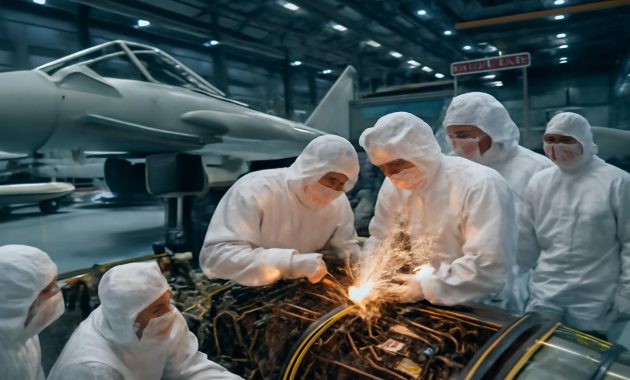
The new funding is expected to accelerate key upgrades: advanced AESA radar, improved mission computers, electronic warfare enhancements, and weapon integration. It’s not a cosmetic update; it’s closer to rewiring the nervous system and sharpening every sense the jet has.
It’s also a political and industrial decision. The Eurofighter consortium is spread across several countries, but Britain’s own aerospace sector is deeply tied into the program. Wings are built in one region, avionics in another, test facilities in yet another, with thousands of skilled workers whose livelihoods are threaded into these metal and carbon-fibre shapes.
For years, there has been a quiet fear in those factories: if the Typhoon stands still, so will we.
Now, at least, there is motion. Not frantic, but purposeful. The idea is simple and stark—use this injection of money and political will to vault over the lost years, to compress delayed decisions and overdue technology into a package that can still make the Typhoon a frontline, credible asset into the 2030s and beyond.
How Britain’s Typhoon Stacks up in a Crowded Sky
Of course, any funding announcement invites comparison. How does this upgraded, re-energized Eurofighter stand against the giants of the air combat world? The answers are complex, but a snapshot helps illustrate the pressure Britain feels—and the opportunity it sees.
| Aircraft | Primary Operator | Generation | Key Strength |
|---|---|---|---|
| Eurofighter Typhoon (upgraded) | UK & European partners | 4.5 | High agility, powerful radar, versatile weapons |
| F‑35 Lightning II | USA, UK, allies | 5th | Stealth, sensor fusion, deep strike |
| Su‑35 / Su‑57 | Russia | 4.5 / 5th (claimed) | Long-range missiles, raw kinematics, deterrence value |
| Future GCAP Fighter | UK, Italy, Japan | 6th (planned) | AI-enabled systems, teaming with drones, deep networking |
On paper, Britain doesn’t expect the Typhoon to be everything the F‑35 is. It doesn’t need it to be. The plan is more nuanced: use the F‑35’s stealth for the most dangerous, deeply defended missions, while the Typhoon, with its upgrades, remains the workhorse of air policing, deterrence patrols, quick reaction alerts, and less stealth-critical strike roles.
But for that partnership to work, the Typhoon cannot be frozen in the 2000s while everyone else has moved on. This funding is about keeping the aircraft in the same conversation as its contemporaries, not relegating it to the museum queue before its time.
From Runways to Living Rooms: Why This Skyward Story Matters
It’s easy to see jets as distant—tiny silhouettes in a high, blue sky, or distant rumbles heard through double-glazed windows. But the story of the Eurofighter and its late-in-the-day revival is, in a quiet way, about ordinary lives too.
In a small town in Lancashire, a machinist working a night shift cuts a component that will sit somewhere deep inside an engine nacelle. In a lab in southern England, a young engineer writes lines of code for a radar system she will never see switched on in person. In a briefing room in Scotland, a pilot stares at a digital map and rehearses, again and again, the decision tree that might one day mean life or death above the Baltic Sea.
The €525 million doesn’t just fund hardware. It keeps these lives linked to a larger story: Europe’s attempt to not be simply a customer in a global arms marketplace dominated by the United States, or a spectator in a security drama driven by Russia’s willingness to use force. It represents, in however imperfect a form, a decision to maintain the ability to shape what flies under British and European flags, not just what is bought off the shelf.
The Senses of a Modern Warplane
If you could sit in the Typhoon’s cockpit after the coming upgrades, what you would notice first is not the roar or the g‑force, but the information. Light, colour, symbology. Friendly aircraft here, unknown contacts there. Ground-based radars painting the sky from below. Satellites sending down their invisible threads from above. Missiles, ships, drones—all drawn into a tapestry of flickering icons.
Earlier generations of pilots were taught to fly by feel and instinct. Those skills still matter, but now they exist alongside something else: the art of not being overwhelmed. The upgraded Eurofighter is being tuned to help its pilots sift through all that noise—to highlight dangers, suggest options, share what it sees with other platforms and commanders.
In that sense, the new funding is as much about sharpening awareness as it is about adding firepower. A jet that can see better, talk better, and survive longer also changes how its home country can act. It can venture further from its own borders, with more confidence; it can arrive earlier, more informed, when allies call.
Making Up for Lost Time—Or Just Not Falling Further Behind?
There is, however, a harder question humming beneath all of this: is €525 million enough? Can a single injection really make up for twenty years of delay?
In purely financial terms, it’s modest compared with the vast sums the United States puts into its next-generation fighters, or what Russia has chosen to spend, at great economic cost and human sacrifice, on its military adventures and rearmament. But the symbolism lies in something else: political focus.
For twenty years, the Eurofighter program has been an exercise in caution. Multiple nations, multiple parliaments, different economic cycles and conflicting priorities: all of them added friction, slowed decisions, scattered responsibility. What this funding signals is a willingness, however belated, to cut through some of that fog.
It’s not a miracle cure for lost time. No amount of money can rewind the years when upgrades could have been simpler, cheaper, and less urgent. But it can stop the drift. It can plant a marker that says: from here on, standing still is no longer an option.
The skies above Europe are busier, more contested, and more complex than at any time since the Cold War. Threats can come from thousands of kilometres away, fired by crews who never see the people their weapons are aimed at. In that environment, the aircraft that patrol the thin air between peace and escalation cannot be allowed to age gently. They either keep evolving—or they become spectators.
A Future Written in Contrails
On another grey morning, not unlike the one at the start of this story, a Typhoon will roll down a runway somewhere in Britain with many of these upgrades quietly humming beneath its skin. To the people watching from a nearby fence, it will look much the same as it did ten years earlier: the same delta wings, the same twin tail, the same clean, predatory lines.
The real difference will be invisible—in the code, in the signals it sends and receives, in the way it can find and evade and survive. The pilot will feel it in the form of options: more ways to respond, more ways to stay alive, more ways to protect the people, ships, and cities that exist far below the flight path.
Somewhere over the horizon, invisible beyond the curve of the Earth, American jets will be doing their own circuits. Russian aircraft will be carving their own patterns into the air, watched, measured, and logged. In that crowded, tense, invisible chessboard of contrails and radar tracks, Britain’s choice to inject €525 million into a delayed but not yet obsolete fighter is one move among many.
But for the people whose safety depends on those moves—the ones who never see the jets up close, who only ever hear a distant rumble and look up too late—the hope is simple: that the aircraft carrying their flag into the sky are ready, not still waiting for decisions that should have been made long ago.
For twenty years, the Eurofighter’s future was spoken of in conditional tenses and postponed promises. Now, at last, there is a hint of present tense urgency in the air. Engines spool up. Sensors wake. The rain falls. And Britain, glancing sideways at the United States and Russia, chooses not to watch from the runway, but to join the scramble.
FAQ
Why did Britain delay Eurofighter upgrades for so long?
The delays were driven by a mix of budget constraints, shifting defence priorities after 9/11 and in Afghanistan and Iraq, and the complexity of coordinating decisions among multiple Eurofighter partner nations. Each country had its own timelines, industrial interests, and political debates, which slowed modernization.
What exactly will the €525 million be used for?
While specific line items can vary, the funding is aimed at accelerating next-phase upgrades: advanced AESA radar, improved mission computers, enhanced electronic warfare systems, and integration of newer air-to-air and air-to-ground weapons. The goal is to keep the Typhoon combat-relevant into the 2030s and beyond.
How does the Eurofighter compare to the F‑35?
The F‑35 is a stealth, 5th‑generation fighter optimized for penetrating heavily defended airspace with advanced sensor fusion. The Eurofighter is a 4.5‑generation multirole fighter known for agility, speed, and powerful radar. In British service, they are meant to complement each other rather than compete, with Typhoons handling many air defence and less stealth-critical roles.
Is Britain moving away from American aircraft by upgrading the Eurofighter?
No. Britain remains deeply integrated with US defence programs, including the F‑35. Upgrading the Eurofighter is more about maintaining European industrial capability and ensuring a balanced, flexible air fleet, not replacing American systems.
What comes after the Eurofighter for Britain?
Britain is working on the Global Combat Air Programme (GCAP) with Italy and Japan to develop a 6th‑generation fighter. That future aircraft is expected to feature advanced AI, manned‑unmanned teaming with drones, and highly networked systems. Until it arrives, the Eurofighter—properly upgraded—will remain a central pillar of British air power.