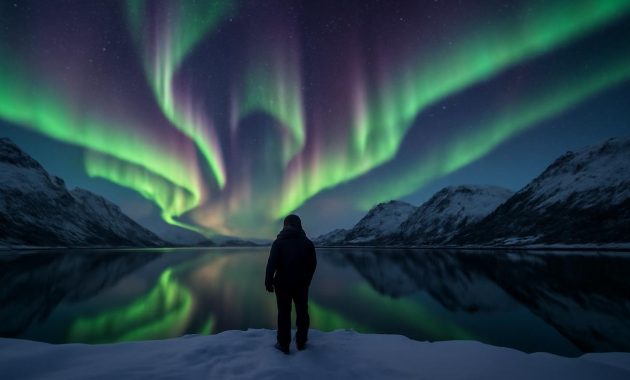
The alert arrived in the middle of an ordinary Tuesday afternoon: NASA had just confirmed that solar winds were stronger this year than they’ve been in a long while. If you were scrolling past headlines, it might have sounded like another distant space-weather bulletin—relevant to satellites and scientists, perhaps, but not to you. Yet hidden in that technical announcement was an invitation, whispered across ninety-three million miles: step outside at night, look north, and you might witness the sky rewrite itself.
When the Sky Starts to Whisper
It begins subtly, if you’re not used to watching the heavens. On a clear, cold night, you might glance up and see what looks like a pale, colorless smear low on the horizon. At first, it’s easy to dismiss—a thin cloud, maybe, or a trick of your tired eyes. But then it moves. It stretches, unfolding like a ghostly curtain, wavering in slow-motion ripples. A faint green hint appears, almost shy, and then deepens into a color you can’t quite name without saying the word: aurora.
Somewhere far above, in the faint, crackling vacuum that hugs our planet, a storm is unfolding. Not thunder and lightning, but a storm of charged particles streaming from the Sun at hundreds of kilometers per second. Those particles, corralled and flung along Earth’s magnetic field lines, are plummeting down into the upper atmosphere, colliding with atoms of oxygen and nitrogen. The result: light. Living, moving, breathing light.
This year, those storms are louder.
NASA’s latest measurements confirm what aurora hunters, photographers, and insomniac stargazers have been feeling in their bones for months: solar winds are stronger, more frequent, and more turbulent. The Sun, it turns out, is approaching one of its restless peaks—and the Northern Hemisphere is directly in the splash zone of beauty.
The Sun’s Mood Swing
To understand why the night sky is putting on such a show, you have to learn the Sun’s rhythm. Our star doesn’t burn with constant, even calm. It pulses, cycles, and occasionally tantrums. Roughly every 11 years, the Sun swings from a state of quieter magnetism to a chaotic, freckled face of sunspots, flares, and eruptions in what scientists call the solar maximum.
We’re climbing that slope right now. Over the past year, NASA and other space agencies have watched the Sun’s surface grow busier, dotted with dark sunspots that can be larger than Earth itself. These spots mark regions of intense magnetic activity, where twisted magnetic fields can snap and reconnect with explosive force. The result: solar flares and coronal mass ejections—vast clouds of charged particles hurled into space.
When those clouds intersect our planetary home, they become what we call “space weather.” The solar wind—a constant outflow of particles from the Sun—is always there, washing past Earth like a gentle breeze. But during an active season like this one, that breeze becomes a gust, then sometimes a gale. NASA’s instruments, from satellites parked a million miles ahead of Earth to probes orbiting close to the Sun, have recorded unusually strong and persistent streams of solar wind this year.
For engineers and satellite operators, this can be nerve-wracking. For the rest of us, it’s an unexpected gift: the auroral oval—the doughnut-shaped zone around Earth’s magnetic poles where auroras typically dance—has been stretching, sagging, and occasionally spilling much farther south than usual.
Auroras on the Move: Where the Lights Are Reaching
On maps drawn up by space-weather forecasters, you can see it: a glowing ring normally reserved for places like Tromsø, Fairbanks, or Yellowknife, now swelling outward over more familiar names. This year, people in cities and rural backroads across the Northern Hemisphere have stepped out of their doors and seen something they never expected in their lifetime: the aurora borealis hanging above their own rooftops.
Farmers in the American Midwest have reported faint, ghostly veils of green over their fields. In northern Germany and Poland, entire communities have paused late-night drives to watch curtains of light flicker silently on the horizon. In the UK, phones have filled with breathless messages: “Look outside now!” as streaks of magenta and emerald ripple above coastal towns that usually only dream of such color.
All of this is directly tied to the Sun’s amplified breath. Stronger solar winds compress Earth’s magnetic field and push the auroral oval toward lower latitudes. That means more of the Northern Hemisphere gets a front-row seat when those charged particles collide with atmospheric gases.
| Region | Typical Aurora Visibility | This Year’s Increased Chances |
|---|---|---|
| Northern Scandinavia, Alaska, Northern Canada | Frequent, many clear nights | More intense, more colorful, longer displays |
| Scotland, Southern Scandinavia, Baltic States | Regular during strong storms | Visible on more nights, higher brightness, overhead displays |
| Northern U.S., Central Europe | Occasional, low on the horizon | Significantly better odds, more frequent horizon-to-sky events |
| Mid-latitude U.S., Southern Europe | Rare, only during extreme storms | Possible during multiple strong events this year |
You might not live in a classic aurora zone, but this year, that matters less than usual. The sky is traveling to meet you.
Inside the Green Flame: What You’re Really Seeing
Stand beneath a strong aurora and your senses get tricked. The sky moves in slow, graceful waves, like underwater light through a swimming pool. At times, it seems like it’s about to drop right on top of you, draping the whole world in silent, electrical silk. There’s an eerie disconnect: your brain expects sound—these curves and flickers look like they should crackle, roar, or hum. Instead, there’s only wind in the trees, distant traffic, or the shuffle of boots on snow.
But behind that quiet choreography is physics at its most dramatic. The increased solar winds blowing off the Sun are mostly made of electrons and protons—tiny charged particles. When those particles are funneled down along Earth’s magnetic field lines, they pour into the thin air of the upper atmosphere, more than 100 kilometers above your head. There, they collide with atoms of oxygen and nitrogen, transferring energy in those collisions.
Excited oxygen atoms glow green and occasionally red when they return to their relaxed state. Nitrogen can wash the sky in purples, pinks, and deep blues. The colors you see on any given night are a fingerprint of altitude and energy: greens often hover at mid-heights, reds higher still, and purples flicker at the edges like whispers.
This year’s stronger solar winds mean those collisions can become more frequent and energetic. The aurora not only appears more often, but it can burn brighter, stretch farther, and pulse in complex patterns—spirals, arcs, sudden eruptions that sweep from one horizon to the other in seconds. In strong storms, you may see “coronas,” where streaks of light appear to converge overhead into a single dizzying point, as if you’re looking up the barrel of a luminous tunnel.
For many people, these displays feel less like a scientific phenomenon and more like an encounter—something ancient, powerful, and strangely personal. No photograph, no matter how expertly taken, quite captures what it feels like to stand in that quiet glow and realize that your sky, the same one you’ve known all your life, still has secrets.
A Night on the Edge of the Aurora
Imagine this: you’ve driven away from the sodium-orange haze of city lights, following a tip from a space-weather app or a friend who won’t stop texting you. The air is sharp when you step out of the car, your breath instantly visible. There’s a dark field, a frozen lake, or a quiet beach spreading in front of you. Above, only stars—at first.
Minutes pass. Your eyes adjust. And then, just at the edge of vision, a pale arc appears, low and dim. You’re not sure; you blink. Is it a cloud? A reflection? Then it brightens, barely, like someone turned up a hidden dimmer switch. A hint of lime-tinged green creeps in. The arc stretches, twists, sends out a faint curtain that ripples downward like a falling veil and then pulls back, as if it’s testing the world beneath.
A murmur goes through the small group gathered there. Someone laughs with disbelief. Someone else swears softly. Cameras begin to click—long exposures, open shutters hunched on tripods. Then the show intensifies. Vertical beams shoot up, side by side, a picket fence of light. They sway and cross each other. In that moment, if you’ve never seen it before, you realize that no digital screen has prepared you for how alive the sky can be.
Living with a Restless Star
Of course, a more active Sun is not purely a poetic gift. NASA’s confirmation of stronger solar winds this year comes with a scientist’s mix of awe and caution. These same charged particles that paint the sky can disturb satellites, interfere with radio communications, and nudge GPS signals off-course. In extreme cases, geomagnetic storms can induce electric currents in long power lines, posing challenges for electrical grids at high latitudes.
Space weather centers around the world, many of which partner closely with NASA’s solar observatories, spend their days and nights watching for that next surge, that next cloud of charged particles racing toward Earth. When instruments detect a particularly powerful blast aimed our way, alerts go out—not just to space agencies, but to airlines that fly polar routes, satellite operators, and power grid managers.
Yet there’s another side to this story, one that doesn’t make headlines as often: a stronger, more visible aurora pulls us back into relationship with the skies above our homes. In cities where most people live under a permanent smear of light pollution, the idea that the sky might suddenly ignite in color is almost mythological. But this year, that myth has been slipping quietly into reality.
People who ordinarily have no reason to think about magnetic fields or solar cycles are finding themselves checking space-weather forecasts, learning new acronyms like “Kp index,” and texting friends late at night: “The Sun’s going wild again—want to go chase it?” In a way, the Sun’s restless mood has made us pay more attention, look up more often, and remember that our planet swims through an invisible river of energy every day.
How to Give Yourself a Chance to See It
You don’t need to be a scientist or own expensive gear to stand under the aurora; you just need opportunity and timing. In years like this, when NASA confirms stronger solar winds and increasing geomagnetic activity, your odds improve dramatically—even if you live far from the Arctic Circle.
Find a dark sky. That’s the single greatest advantage you can give yourself. Streetlights, billboards, and city glow can smother faint auroras, especially when they only brush your region. Driving even 30 minutes out of a city can make the difference between seeing nothing and catching a ghostly arc on the horizon.
Face north if you’re in the Northern Hemisphere, and let your eyes adapt. Turn off your phone screen or set it to the lowest brightness. Give yourself at least 20 minutes; auroras can ebb and flow, and what looks like complete stillness at first may suddenly build into something unforgettable.
And remember that cameras see more than we do in the dark. Even if the display seems feeble, a long-exposure photo from a simple tripod-mounted phone or camera can reveal vivid greens and purples that your naked eye only hints at. The stronger solar winds this year mean you’re more likely to catch those intense moments when even the human eye sees the colors shouting, not whispering.
What NASA’s Confirmation Really Means for You
NASA’s announcement isn’t just data; it’s context for the feelings people are already having as they share photos and late-night stories. Stronger solar winds this year confirm that we are entering a period when auroral activity may be higher, more frequent, and more widespread than we’ve seen in more than a decade.
It doesn’t mean the sky will glow every night, or that every person in every northern city will see curtains of emerald above their house. Weather on the ground still matters. Cloud cover still wins. Light pollution still drowns out subtle displays. And solar activity waxes and wanes on timescales of days and weeks, not a constant neon sign stuck in the “on” position.
But it does mean this: if you live anywhere in the Northern Hemisphere above roughly the mid-latitudes, you have more reason than usual to watch forecasts and to carve out space in your life for a spontaneous late-night drive, or even just a walk to a nearby park. Where auroras used to be the dream of those who booked Arctic cruises or winter flights to remote northern towns, they’re now edging into the realm of possibility for millions more people who have never thought of themselves as living under auroral skies.
There’s something humbling about that. The Sun didn’t get stronger this year for us. It’s following its own cycles, burning and roiling in patterns of magnetic chaos that began long before any of our ancestors first named the northern lights. But in paying attention, in reading NASA’s updates and tracing their implications in the quiet fields and city outskirts of our own lives, we place ourselves back into a story that is both older and bigger than we are.
On some future night, perhaps soon, you might step outside for no particular reason. You’ll notice, out of the corner of your eye, a pale slash of light where the dark should be. You’ll look again. And for a moment, you’ll remember that our star is restless, that the air above you is alive with invisible storms, and that sometimes, when those storms reach down far enough, they leave a message painted in the sky: you are living on a world wrapped in light.
Frequently Asked Questions
Why are solar winds stronger this year?
The Sun is approaching the peak of its roughly 11-year solar cycle, known as solar maximum. During this time, magnetic activity increases, producing more sunspots, solar flares, and coronal mass ejections. These events strengthen and disturb the solar wind, sending larger and faster streams of charged particles toward Earth.
Does stronger solar wind mean more visible auroras?
Yes. Stronger solar winds can compress Earth’s magnetic field and push the auroral oval farther toward lower latitudes. That means auroras can become visible in regions that usually only experience them rarely, and they may appear brighter and more dynamic in areas that already see them regularly.
Can I see the aurora if I live in a city?
It’s possible but harder. Light pollution from streetlights and buildings washes out faint auroras. During particularly strong geomagnetic storms, bright auroras can still be visible even from city locations, but your chances are far better if you can travel to a darker, more rural area with a clear view of the northern horizon.
Is this increased solar activity dangerous?
For everyday life on the ground, it’s usually not dangerous. Earth’s atmosphere and magnetic field protect us from most harmful solar radiation. However, strong geomagnetic storms can affect satellites, radio communications, GPS accuracy, and, in rare extreme cases, power grids at high latitudes. Space-weather agencies monitor activity closely and issue alerts when needed.
How can I know when to go look for auroras?
Watch for space-weather forecasts and geomagnetic storm alerts from trusted scientific agencies and observatories. Many weather apps and astronomy tools now include aurora forecasts based on solar-wind measurements. When you see that a strong geomagnetic storm is predicted for your region, and the skies are clear, that’s your cue to find a dark spot, face north, and give the night some time to reveal what it’s been holding.