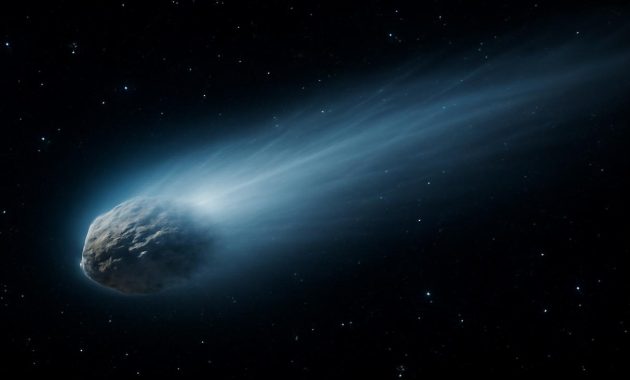
The first time the eight new images of 3I ATLAS appeared on the screen, the room went quiet in a way that felt almost physical, like sound itself had stepped back to make space. The comet—this uninvited traveler from another star—wasn’t supposed to look like this. We’d expected a distant smudge, a grainy dot blurred by the deep black between suns. Instead, the images showed something so finely etched, so unsettlingly clear, that a few of the scientists forgot to breathe for a moment. You could trace the thin, ghost-pale jets fanning off its surface, see the jagged shadows cast by cliffs of ice that had never seen a sunrise from any star we know.
A visitor from nowhere we recognize
3I ATLAS is only the third confirmed interstellar object we’ve ever seen pass through our solar system, and just the second known interstellar comet. The “3I” marks it as the third in a sequence: 1I ‘Oumuamua, 2I Borisov, and now this. But where earlier visitors were quick, elusive, and frustratingly blurry, 3I ATLAS has become something else entirely: a stranger whose face we can finally read.
The comet was first flagged as a suspiciously fast-moving, oddly inclined speck by the ATLAS survey—an automated sky-scanning system built to spot dangerous near‑Earth objects. Its path didn’t quite fit the familiar rhythm of long‑period comets that fall in from the frigid outskirts of our own system. Instead, its orbit was unmistakably hyperbolic, the celestial signature of an object unbound to the Sun. It hadn’t fallen in. It was passing through.
Most stories would end there: a faint object, cataloged and soon lost in the glare of both our star and our ignorance. But this time, a small armada of spacecraft was ready—or at least ready enough. Over several feverish weeks, mission teams piggybacked on existing observatories: a solar probe here, a deep‑space telescope there, even a planetary orbiter repurposed for a few stolen hours of sky time. The result was a coordinated series of eight overlapping images, captured in different wavelengths, stitched into a single, unnervingly intimate portrait.
The moment the images sharpened
Picture a darkened control room, illuminated more by screens than overhead lights, the air carrying the faint electronic hum of machines that do not sleep. On one display, a raw, grainy frame arrives from a spacecraft drifting millions of kilometers away. Another image follows, then another, each at a slightly different angle, each through a different filter. At first they look like noise—static, streaks, faint pinpricks. But with each pass of the processing algorithms, something ghostly and structured begins to emerge.
What had been a smear resolves into a distinct nucleus, only a few kilometers across, its surface carved with chasms and knotted ridges. The coma—the cloud of gas and dust that surrounds the nucleus—unfurls in soft, almost fabric‑like layers. Jets of vapor shoot from the sunlit side in thin, hairline plumes, each one curving in response to both sunlight and the faint but insistent tug of solar wind.
Someone zooms in. The nucleus, no longer a vague idea, becomes a place. You can see contrasts: regions that are darker, mysterious, almost soot‑black; others brighter, as if freshly exposed ice is flashing back the Sun’s light. Where we once imagined a simple snowball streaking through space, we now see something closer to a fractured, half‑melted sculpture of ancient stone and glass.
And that’s when the unsettling part truly begins. Because the longer you stare at the details, the more alien this comet feels—not as a poetic abstraction, but as a physical object that has spent eons under a different sky.
The alien ice under the skin
The eight images were taken across several wavelengths—visible light, infrared, and ultraviolet among them—each peeling back a different layer of 3I ATLAS’s identity. In visible light, the comet’s coma glows a cold, foggy white, threaded with delicate tendrils. In infrared, you see heat signatures pulsing faintly along cracks and pits on the nucleus, like seams in a dark, frozen heart. The ultraviolet view reveals emissions from gases we don’t quite expect in the proportions we’re seeing.
This is where our confidence begins to fray. We know comets from our own solar system fairly well. We’ve orbited them, landed on them, and watched them crumble. They carry water ice, carbon monoxide, carbon dioxide, methane, a familiar cocktail of frozen volatiles. Their dust contains silicates, organics, and the scattered relics of the early solar nebula. But 3I ATLAS refuses to line up neatly with that pattern.
Preliminary spectra teased from the images suggest that the comet’s ices are skewed toward exotic proportions—more of certain carbon‑bearing molecules, unusual ratios of hydrogen to heavier elements, and faint hints of compounds that are either rare in our own comets or present here in oddly amplified voices. It’s as if 3I ATLAS was assembled in a kitchen that followed the same recipe book for building planets and comets, but with different hands measuring the ingredients and a different oven setting the temperature.
And yet, underneath the specifics, a deeper familiarity creeps in. It still sheds gas in sunlight. It still trails dust in a pale tail. It still, in its own way, behaves like a comet. It is both foreign and strangely domestic, like hearing your own language spoken with an accent you can’t place.
Reading a stranger’s surface
In the highest‑resolution frames, processed to the brink of what the data will allow, the nucleus of 3I ATLAS looks rugged, almost scarred. There are pits that resemble collapsed caverns, steep rims catching sunlight at sharp angles. Some are ringed by brighter material, as if fresh ice has been recently exposed by a burst of internal pressure. Elsewhere, long shadows stretch out from jagged relief, vanishing into the dim half‑light that the Sun can’t quite reach.
Those pits and cliffs tell a story of thermal stress and violent venting—the same brutal cycle of heating and cooling, sublimation and collapse, that shapes comets at home. But here, the numbers don’t quite line up. The distribution of activity doesn’t match the simple latitude patterns we’d expect from a comet born under our Sun’s influence. Instead, activity seems lopsided, biased toward a region that, based on its orbit, would have pointed a different face toward its own long‑lost star.
It suggests a history written under another Sun’s geometry, a different tilt, a different dance between heating and freezing. 3I ATLAS carries the climate scars of a vanished solar system on its crust—and for the first time, we can see those scars, not as abstractions in a model, but etched in light and shadow on an object we can almost imagine standing upon, feeling the faint, electric hiss of charged dust in our boots.
The quiet numbers behind the awe
Behind the emotional shock of these images, the data themselves are quietly revolutionary. They’ve given astronomers a rare opportunity: to compare, side by side, the traits of a local comet and an interstellar one with something close to equal clarity.
At the core of that comparison is a simple question: how different is “out there” from “here” when it comes to making small icy worlds?
In a nutshell, the early analysis looks something like this:
| Feature | Typical Solar‑System Comet | 3I ATLAS (Preliminary) |
|---|---|---|
| Origin | Oort Cloud / Kuiper Belt | Interstellar (unbound orbit) |
| Orbit Shape | Long‑period elliptical orbits | Strongly hyperbolic trajectory |
| Volatile Mix | Dominated by H2O, CO, CO2 | Similar core mix, but unusual ratios of carbon‑bearing species |
| Dust Composition | Silicates and organic grains | Silicates plus organics with distinct spectral signatures |
| Surface Activity Pattern | Often tied to solar heating at predictable latitudes | Asymmetric, reflecting a different primordial orientation |
These aren’t just academic notes; they’re clues in a slowly unfolding detective story about how common our kind of planetary system really is. If interstellar comets like 3I ATLAS turn out to resemble our own—same base ingredients, slightly remixed proportions—it suggests that the processes shaping planets and comets across the galaxy might be comfortingly universal. And yet, every small deviation whispers that there are other ways to assemble a world, other flavors of chemistry, other climates engraved into ice.
The unsettling precision of seeing too much
The phrase “unprecedented precision” sounds like a technical boast, the sort of thing buried in a mission report. But there’s something faintly disquieting about this level of clarity when you’re looking at an interstellar object. Until very recently, objects like 3I ATLAS occupied the same mental space as myths—things we knew must exist, statistically, but never expected to confront up close.
These new images collapse that distance. They drag the unimaginable into the intimate. You can zoom in and pick out individual jets, trace their sources to specific fractures, even see how the dust they throw off thickens one side of the coma more than the other. The comet stops being an abstract messenger from another star and becomes a real, physical neighbor temporarily passing through our yard.
There’s a strange vertigo in realizing how far our sight has stretched. For much of human history, anything beyond Saturn was purely speculative. Stars themselves were decorative holes in the sky. Now we are not only tracking visitors from other star systems but resolving their surfaces into textured landscapes of ice and dust. We are eavesdropping on the geology of a place that has never heard of Earth, the Sun, or the fragile organisms learning to read its image.
Time capsules in the dark
If you could somehow stand on the surface of 3I ATLAS—setting aside, for the moment, the inconvenient details of near‑vacuum, radiation, and the tendency of cometary crust to crumble underfoot—you would be standing on a time capsule older than our solar system. The atom‑thin frost on the rocks at your boots might predate Earth’s formation. The ice beneath could preserve a chemical record of the cold nursery where its parent star ignited, light‑years and lifetimes away from here.
Because comets form in the outskirts of planetary systems, far from the heat of their stars, they are some of the best preservation vaults in the cosmos. They lock away not just elements, but temperature histories, density gradients, even fingerprints of the radiation fields that bathed their birthplaces. When such a comet is ripped free—by the gradual nudge of passing stars or the violent rearrangement of newborn giant planets—it carries that record into the void.
3I ATLAS has likely been wandering between stars for hundreds of millions, perhaps billions, of years. In that time, it has been altered, yes—sculpted by stray cosmic rays, abraded by micrometeorites, slowly baked in deep interstellar cold. But much of its interior remains unedited, a frozen chronicle from a system that may now be unrecognizable, or even gone.
The unsettling clarity of these images means we are, for the first time, reading that chronicle not as a blur of averaged data, but line by line, feature by feature. Every crater, every jet, every subtle color shift in the coma is a syllable in a language we are just learning to speak.
What happens after we say goodbye
Soon enough, 3I ATLAS will leave. Its path, steep and open, will carry it out of the Sun’s grasp and back into the dark, where distances between warm stars stretch into light‑centuries. The brief flare of activity as it brushes past our star will die down. Its coma will thin, tails will fade, and the once‑luminous visitor will shrink to a quiet, frozen shard again.
But unlike so many wanderers before it, 3I ATLAS will not be lost. We have frozen pieces of its passage in exquisite detail. The eight new spacecraft images are not just photographs; they are time anchors. Decades from now, when instruments are sharper and models more sophisticated, scientists will return to these frames and find more hidden in their pixels than we can see today. Signatures of dust grain sizes, subtle compositional gradients, maybe even relic patterns that echo processes in its home system’s debris disk.
And there’s a human echo too. For an instant, this comet’s story intersects ours. For a span so brief it barely counts on cosmic timescales, our species—an emergent curiosity on a small blue planet—noticed. We saw it clearly enough to be unsettled, to feel a presence from beyond our origin story with something close to comprehension.
A new way of looking outward
These eight images are a proof of concept as much as a scientific treasure. They show that, with a bit of agility and a willingness to repurpose instruments on the fly, we can do precision science on transients from other stars. We don’t yet have purpose‑built missions pre‑positioned to ambush interstellar visitors, but we have ingenuity, and now we have a template.
Future surveys will almost certainly find more 3I objects—comets, maybe asteroids, perhaps things stranger still. With each discovery, there will be a race against time: can we aim enough eyes at them before they slip away? The experience with 3I ATLAS suggests that the answer can be yes, and that the rewards are worth every late‑night call and hasty recalibration.
There’s a philosophical shift here as well. Once, to study another planetary system, we needed light filtered through its atmosphere or the barest hints of its planets tugging on their star. Now, we are beginning to realize that fragments of those systems sometimes come to us. They arrive unannounced, on dark, hyperbolic arcs, carrying with them a sample of their home chemistry, structure, and history.
As our instruments continue to sharpen, the galaxy will feel less like a distant panorama and more like a neighborhood with drifting mail. Every interstellar comet is a letter from elsewhere, and 3I ATLAS is the first one we’ve read with something approaching fluency. It tells us: yes, you are not unique. Your recipe for worlds is shared, but not identical. The universe is playing variations on a theme, and you have only just begun to hear them properly.
In the end, the most haunting thing about those eight images may not be their precision, but their ordinariness. Strip away the romance, and 3I ATLAS is simply a dirty snowball, behaving under familiar physics. Yet the knowledge that it was built under a foreign sun—that every grain of dust, every trapped molecule of gas, every crack is the product of a history that began light‑years away—turns that ordinariness into something profound.
We are looking at a piece of somewhere else, rendered in unsettling, astonishing clarity. And for a moment, under the quiet glow of spacecraft monitors and starlight reflected off ancient ice, “somewhere else” doesn’t feel quite so unreachable.
FAQ
What is 3I ATLAS?
3I ATLAS is an interstellar comet—the third confirmed interstellar object and second known interstellar comet detected passing through our solar system. Its “3I” designation marks it as the third such object, following 1I ‘Oumuamua and 2I Borisov.
Why are these eight images so important?
The new set of eight spacecraft images captures 3I ATLAS with unprecedented clarity across multiple wavelengths. This allows scientists to resolve its nucleus, jets, and coma structure in far greater detail than any previous interstellar object, providing a unique window into the composition and history of a comet formed around another star.
How do we know 3I ATLAS is interstellar?
Its orbit is strongly hyperbolic, meaning it is not gravitationally bound to the Sun. Its speed and trajectory cannot be explained by any origin within our solar system, indicating it entered from interstellar space and will eventually leave again.
What makes 3I ATLAS different from comets in our solar system?
While it shares many traits with local comets—such as volatile ices and dust tails—its composition appears to have unusual ratios of certain carbon‑bearing molecules and distinct dust signatures. Its pattern of surface activity also seems shaped by a different primordial orientation and climate history under another star.
Can we send a spacecraft to visit an interstellar comet like 3I ATLAS?
With today’s technology, intercepting an interstellar object on short notice is extremely difficult. Their speeds and unpredictable discovery times make direct missions challenging. However, the success of adapting existing spacecraft for detailed imaging is driving serious planning for future rapid‑response or pre‑positioned missions designed specifically to chase the next interstellar visitor.