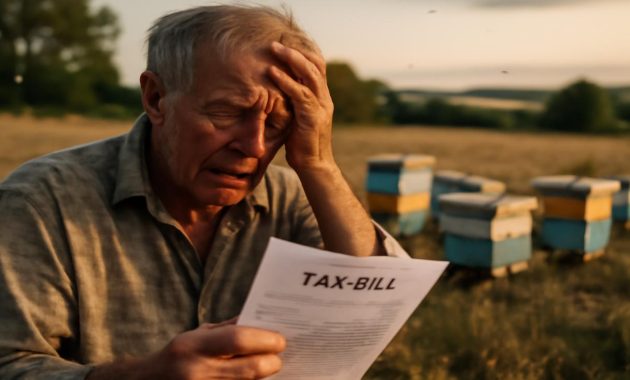
The first time Harold saw the hives, they glowed like small, pale suitcases in the late October sun. White wooden boxes lined up in his back field, humming faintly, just beyond the stone wall his father had stacked rock by rock in the 1950s. The air smelled faintly sweet, as if someone had spilled honey into the wind. It was supposed to be a small favor—just a few boxes, a safe place for bees, nothing more. A kindness, he’d told himself. The kind of thing a man does when he’s retired and finally has more time than obligations, more space than he knows what to do with.
By the time the letter from the county arrived, with its neat black type and dense tax codes, those humming boxes had quietly transformed Harold’s life into something he had never planned for: a farm he did not want, a tax bill he could not afford, and a gnawing question about whether generosity, in this world, might be a luxury punished instead of rewarded.
The Favor That Started With Coffee and a Handshake
The whole thing began at the farmers’ market, on one of those early spring mornings when the air still carries more chill than promise. Harold had gone for tomatoes and bread, and maybe a jar of local honey. His doctor was on him about sugar; honey seemed like a compromise.
He found the honey table near the back, where the pavement met the slope down to the river. A hand-painted sign: “RIVERBEND APIARIES.” The man behind the table was younger than him, late thirties maybe, with sun-creased eyes and a cap stained by many summers. His name was Tyler. The jars lined up in front of him glowed amber and gold, like captured sunsets.
They talked, as people do when there’s nothing in particular they need to rush toward. About bees and weather, about pesticides and clover, about how the world seemed to be tilting sideways. Tyler mentioned, almost offhand, that he was being squeezed: land prices climbing, leases shrinking, suburban developments marching closer to the last open fields. Beekeeping, he said, requires space—quiet, undisturbed space. The kind that’s disappearing.
“I’ve got fourteen empty acres,” Harold heard himself say, the words out before his better judgment had fully woken. “Back behind my house. Used to be my dad’s hayfield. You could put a few hives there, if it’d help.”
Tyler’s face lit up with a tired sort of gratitude. “Are you serious? I mean… yeah. That would help more than you know.”
They hashed out the details over two refills of coffee at the market’s snack stand. How many hives, where they’d go, how often he’d come by. No rent; Harold refused it. “Just bring me a jar or two now and then,” he said. “I like the idea of the land being useful again. My dad would’ve liked it, too.”
No lawyers, no contracts. Just a scribble of a map on a napkin and a handshake that felt, in that moment, as solid as old oak.
The Bees Arrive, and the Land Wakes Up
Early that summer, the hives came. A low trailer rattled up the gravel driveway, carrying pallets stacked with white boxes. Harold watched from the porch as Tyler and his helper unloaded them, boots sinking into the soft earth of the old hayfield. It was a warm day, thick with the smell of cut grass and river mud. Bees drifted around them in puzzled spirals, circling the unfamiliar place that was about to become their world.
By July, the field had changed. It buzzed and shimmered in the heat, clover blooming in soft pink constellations, goldenrod standing taller at the edges. When Harold walked past in the evenings, the hum rose around him like a muted orchestra tuning up. He learned to step slow, to stay calm. The bees, he decided, were like his old coworkers: busy, focused, uninterested in him as long as he didn’t get in the way.
Neighbors stopped by, peering over the stone wall, curious about the new white boxes.
“You starting a farm, Harry?” one of them joked, leaning on the fence with a grin.
“Hardly,” Harold said. “Just helping out a beekeeper. The land was sitting there doing nothing.”
There was pride in his voice, if he was honest. After years of watching his town turn into a patchwork of subdivisions and strip malls, it felt good to think his little patch of earth still served some purpose beyond property lines and resale value. He liked the idea that he was part of something older and quieter: sun, soil, pollinators, seasons. It made retirement feel less like an ending and more like a new role, unhurried but not useless.
The Letter That Turned Honey to Vinegar
The letter arrived on a Tuesday, folded with bureaucratic precision, buried in a stack of junk mail and credit card offers. The return address was the county assessor’s office. Harold slit it open with the same idle curiosity he reserved for appliance manuals and grocery store coupons.
Midway down the page, the words snagged his eye: “Agricultural Use Reclassification,” “rollback taxes,” “supplemental assessment,” “land use compliance review.” The numbers at the bottom, printed in stark black: an additional tax bill that might as well have been written in flashing red.
He read it twice, then a third time, each pass sharpening the edges of the reality it described. His land—fourteen acres of quiet grass and bees—had been flagged for reclassification. The presence of commercial hives, the letter said, constituted agricultural use. Since he had not applied for the associated agricultural land designation properly, the county was recalculating his taxes, not just for this year, but retroactively. There were penalties. There were interest charges. There were deadlines.
At the kitchen table, with the late afternoon light going gray and thin, Harold felt something inside his chest tighten. He had planned his retirement like a cautious engineer: pensions, savings, a spreadsheet for every contingency he could imagine. This new figure did not fit. It glared from the page, a hole punched straight through the careful math of the next few years.
The room seemed, for a moment, too small. He could hear the faint buzz of the bees through the open window, their sound suddenly less like music, more like static.
Phone Calls, Fine Print, and the Slow Creep of Dread
The next week became a blur of phone calls and waiting music. The county assessor’s office transferred him to the tax department, which transferred him to land use compliance, which sent him back to the assessor with a list of forms he apparently should have filed “prior to any change in agricultural use.”
“But I didn’t change anything,” he kept repeating. “I’m not farming. I just let a guy put some bee boxes on my land. I don’t get any money. I’m not selling anything.”
On the other end of the line, a woman with a voice like worn-out paper sighed. “Sir, the law looks at use, not intent. If your land is hosting commercial activity—like beekeeping for sale of honey—it can trigger agricultural classification issues. It’s… complicated.”
Complicated translated, in practice, to a spreadsheet of scenarios, each ending with some variation of “you owe.” He could try to appeal, but the deadlines were tight and the language dense. He could reclassify properly going forward, but that wouldn’t erase the rollback taxes. Every option seemed to cost more than he’d ever imagined a few white boxes could demand.
That night, after too much coffee and too little sleep, he pulled out a yellow legal pad and did the one thing he knew how to do: organize the chaos into columns.
| Option | Short-Term Impact | Long-Term Consequences |
|---|---|---|
| Keep hives, pay taxes | Large unexpected bill; strain on retirement budget | Ongoing higher tax complexity; potential future audits |
| Remove hives immediately | Awkward conversation; may still owe some back taxes | Land returns to simpler status; trust with beekeeper damaged |
| Negotiate cost-sharing with beekeeper | Possible partial relief; difficult money talk | Sets a clearer agreement; relationship depends on fairness |
| Seek legal/tax advice | Additional upfront cost; time and stress | May reduce penalties; helps avoid future surprises |
Each line on the table felt less like strategy and more like confession. Every path involved losing something—money, peace, trust, bees.
When Generosity Meets the Ledger
In the quieter hours—over oatmeal in the morning, or while rinsing dishes under the yellow kitchen light—another, more uncomfortable question kept surfacing: Had he been naïve? Foolish? Was this his fault for believing, in a world of contracts and clauses, that a simple favor could still be simple?
He thought of his father, who had worked this land after his shift at the mill, who lent neighbors tools and time, who never read a single zoning ordinance in his life. If someone had needed to park their tractor in the field for a season, he’d have waved them in without a second thought. But that was a different era, when government felt farther away and land was something you stood on, not something that lived in databases and tax codes.
Now the system seemed to be saying: Kindness counts as commerce. Your good deed is a line item.
Harold had always believed in playing fair. Pay your taxes. Follow the rules. But this felt different. This felt like being punished for leaving the world, in some small way, better than he found it. The idea that his willingness to let bees forage on his grass could threaten his ability to pay for groceries pinched at something tender in him.
Still, belief doesn’t erase a bill.
The Hard Conversation by the Hive Line
He waited three days before calling Tyler. Not because he wanted to avoid the conversation, he told himself, but because he needed time to gather the facts. The truth was simpler: he didn’t want to hear disappointment in the younger man’s voice. He didn’t want to see the look that says, without saying, “I thought you were different.”
When they finally met, they stood between the second and third rows of hives. Bees lifted in shimmering arcs around them, stitching invisible paths in the air. The smell of wax and wildflowers pooled in the heat.
“I had no idea,” Tyler said, hat in his hands, when Harold showed him the letter. “I swear. My other yard is on a commercial farm. They already have all this stuff sorted out. Nobody mentioned that your taxes could be affected like this.”
He looked genuinely stricken, and some tight knot in Harold’s chest loosened a fraction. This wasn’t a con. It was two people caught in the gears of a machine neither of them had built.
“I’m not saying you did anything on purpose,” Harold replied. “But I’m on a fixed income. This—” he tapped the paper “—this isn’t pocket change. I don’t know if I can keep doing this.”
The silence that followed was filled only by the hive’s droning chorus.
“Let me think,” Tyler said at last. “Maybe we can split it. Or I can move half the hives this season, the rest next. I’ll talk to my accountant. Maybe there’s some sort of agricultural exemption we can still apply for retroactively.”
They went back and forth, circling numbers, trading what-ifs. In the end, no magic solution appeared. Splitting the cost would help, but not erase the strain. Moving the hives would stop things from getting worse, but not from being bad already.
“I just wanted to help,” Harold said quietly.
“So did I,” Tyler answered. “Help the bees. Help keep local honey alive. None of this was supposed to end up in a spreadsheet.”
What We Owe Each Other, and What It Costs
There is a particular kind of loneliness that comes when you realize the story you live by may not match the story your society is telling. Harold had grown up with a script that said: be decent, help when you can, and the world will more or less treat you fairly in return. Yet here he was, proof that sometimes the cost of generosity is itemized, compounded, and due by the end of the month.
The question that troubled him most wasn’t, in the end, about money. Not entirely. It was about what this would teach him, and others like him, about helping.
What happens when people hear stories like his at potlucks and barbershops and church coffee hours? What happens when a neighbor asks to store equipment in your barn, or graze goats on your unused hillside, or, yes, place hives on your spare acres—and the first thing you think of is exposure, not community?
He imagined a future where favors fade, replaced by contracts, where every open gate hides a concern about liability, taxation, and unintended consequences. A world where the safest answer to “Could I…?” becomes “Better not.”
There was something bitter in that vision, a future stripped of the easy, informal generosity that had once stitched small towns and rural communities together. It felt like a betrayal not just of his father’s memory, but of the bees themselves—tiny, tireless creatures who pollinate without invoices, who move from flower to flower carrying life on their legs, asking nothing more than the right to exist.
Learning to Ask the Right Questions Before Saying Yes
In the weeks that followed, as the legal pad filled with notes and phone numbers, Harold found a kind of rough clarity. He couldn’t undo what had been done, but he could change what came next—for himself, and maybe for others who might be tempted into similar well-meaning traps.
He still believed in helping. He still believed his land was better with bees on it than empty. But he had learned a hard, practical truth: in a world of complex systems, good intentions need fine print. Not because generosity is wrong, but because the structures around us have grown too intricate to navigate on trust alone.
He began to assemble a different sort of list, written not in frustration but in the quiet conviction of someone who has been burned and doesn’t wish the same on anyone else:
- Before you say yes to using your land, call your county assessor or tax office and describe exactly what you’re planning.
- Ask whether the activity could change your land’s classification or affect exemptions you rely on, especially as a retiree on a fixed income.
- Put the agreement in writing—not to kill the spirit of the favor, but to protect it—from misunderstandings, from unequal burdens, from surprises that turn friends into adversaries.
- Talk openly about costs and risks with the person you’re helping. Kindness should never be built on silence about stakes.
These were not the romantic, neighborly gestures of his father’s time. But they might be the necessary rituals of this one.
In the end, after all the calls and calculations, Harold and Tyler settled on a compromise. Half the hives would move to another site by spring; the rest would stay, legally documented this time, with a small monthly payment from Tyler to help offset the tax increase. Harold would still pay more than he’d expected. It would pinch, but it wouldn’t break him.
The land, once again, had a story that felt almost stable.
Bitterness, Sweetness, and the Choice to Keep Caring
On the last warm afternoon of the season, Tyler brought over a case of honey—twelve jars, each sealed and labeled. The light poured through them on the kitchen counter, turning the room amber. Harold twisted one open and dipped in a spoon. The honey was darker this year, tinged with the wildflowers that had colonized the back field. It tasted complex—floral, slightly smoky at the edges, with a lingering depth that surprised him.
Bitter and sweet, all at once.
He thought of selling the land sometimes, of cashing out and simplifying life to a condo and a balcony, where the only things that grew were tomatoes in pots and his list of streaming subscriptions. But each time he walked the perimeter at dusk and heard the bees droning like a distant engine of the earth itself, he knew he wasn’t ready to let go of this tether to something larger than himself.
His story, he realized, was not just about taxes or bureaucratic traps. It was about the uncomfortable intersection of morality and systems, about what happens when the soft, human impulse to share collides with the hard edges of regulation. It was about learning that doing good in the modern world often demands not just a generous heart, but an informed, cautious mind.
He would keep helping where he could. But he would ask more questions. He would read the fine print. He would insist that generosity be a shared responsibility, not a private burden that could cost someone their stability.
The bees did not care about any of this, of course. They flew their circuits from clover to goldenrod, unaware that their presence had summoned letters, laws, and moral debates. They simply did what they were made to do: collect, connect, sustain.
Watching them, Harold made a quiet promise—to himself, to his father’s memory, to the world that still, somehow, needed small, stubborn acts of care. Generosity, he decided, should not cost you everything. But it will always cost you something: time, effort, vulnerability. The answer was not to stop giving. It was to give with eyes open, with agreements as clear as conscience, so that the harvest—whether of honey or of goodwill—didn’t leave anyone staring at a bill they never knew they’d signed up for.
Frequently Asked Questions
Can letting someone keep bees on my land really affect my taxes?
Yes. In many regions, allowing commercial beekeeping, grazing, or crop production on your property can change how your land is classified for tax purposes. This may trigger agricultural use rules, rollback taxes, or the loss of certain exemptions. Always check with your local tax or assessor’s office before agreeing.
What should I ask the county before offering my land as a favor?
Describe exactly what you plan to allow—beehives, livestock, crops, equipment storage—and ask:
- Could this change my land’s classification?
- Will it affect any current exemptions or special assessments?
- Are there forms I should file before anything starts?
- Could there be retroactive or rollback taxes later?
Getting clear answers up front can prevent costly surprises.
How can I protect myself while still being generous with my land?
Use a simple written agreement that:
- Defines the exact use of your land
- Clarifies who is responsible for any tax changes, insurance, or damage
- Sets a time frame and a way to end the arrangement
You don’t need a 20-page contract, but you should have something in writing so that expectations and responsibilities are shared.
Is it reasonable to ask the beekeeper or farmer to share in any extra tax costs?
Yes. If their commercial activity on your land creates additional expenses for you, it is reasonable—and fair—to discuss cost-sharing or some form of rent, even if modest. Honest conversations about money up front protect both parties and help preserve goodwill.
Does this mean I shouldn’t help people with my land anymore?
Not necessarily. The lesson is not “don’t help,” but “help wisely.” Ask questions, involve local officials when needed, and be transparent with the person you’re helping. Thoughtful, informed generosity can still flourish—even within a complicated system—if we approach it with both heart and awareness.