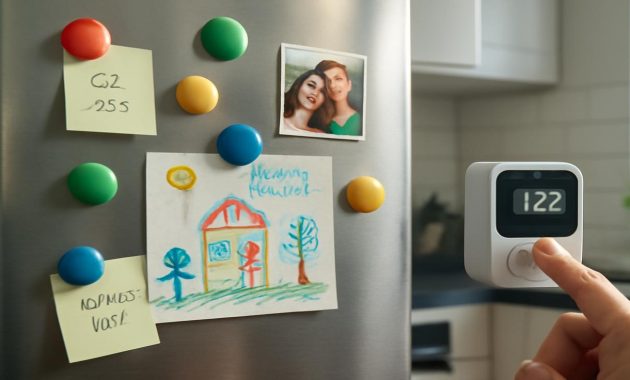
The question floated into the customer-service inbox at Bosch on a Tuesday morning, tucked between a warranty query and a photo of a dented dishwasher door: “Do fridge magnets increase my electricity bill?” It was signed with a first name, a smiley face, and a photo of a refrigerator so smothered in postcards, shopping lists, and alphabet letters that barely any white enamel showed through. Someone had clearly been thinking about it—maybe while the house slept and the kitchen hummed softly in the dark.
The Kitchen That Never Sleeps
Think of your kitchen right now—quiet, maybe, but not really. Somewhere behind a closed door, your fridge is whispering to itself, a low, steady hum, like a very patient animal breathing. The cold light flicks on when you open the door. The compressor buzzes to life and then falls silent. Ice crystals form, melt, refreeze, a tiny winter behind a plastic shell.
We live with this gentle rhythm so constantly that we mostly forget the refrigerator is an electrical machine, tuned to tight tolerances, monitored by sensors, and governed by physics that doesn’t care about grocery lists or souvenir magnets from the beach. But that inbox question struck a strange chord—because it reveals something deeply human: our fear that even our smallest habits might be secretly costing us.
Maybe you’ve wondered it too, fingertips tapping on a penguin magnet while you search for the butter. Those bright little rectangles and cartoon animals feel harmless. But then you picture them—dozens of tiny magnets clinging to a metal box full of coils, wires, and humming circuits. Does all that magnetism do something? Make the motor strain? Nudge your electricity meter forward just a little bit faster?
When the engineers at Bosch sat down to answer, they started the way they always do—with the physics, and then with the story.
How a Fridge Actually Stays Cold (And Why Magnets Seem Suspicious)
Pull your fridge gently away from the wall—just a little—and imagine you can see right through the casing. There’s the insulated box where your food lives. Wrapped around it, almost like the veins and arteries of a living thing, are copper pipes. Deep inside, there’s a compressor—basically a pump—that squeezes a refrigerant, sending it cycling through the system. As it expands and contracts, it absorbs heat from inside your fridge and releases it through the coils at the back or underneath. The whole job of your refrigerator is not to create cold, but to shuttle heat away.
Now add magnets into this picture. You press them onto the metal door with a satisfying click. They hold your kid’s drawing, the vet appointment reminder, the recipe you keep meaning to try. You don’t see anything happen inside. But if these magnets could change the fridge’s energy use, they would have to interact with one of three things:
- The metal skin of the door
- The magnetic door seal
- The electric motor and electronics inside
It feels plausible that all those magnetic fields might tug on something—make a motor fight harder, warp the door, or interfere with sensors. The internet certainly has enough rumors suggesting they do. And yet, as the Bosch engineers will calmly tell you, the real story is almost disappointingly simple.
The Truth About Fridge Magnets and Your Electricity Bill
Start with this: fridge magnets are very weak, and your refrigerator is impressively unfazed by them.
The steel sheet on the outside of your fridge door is there to give structure and act as a durable surface. The working heart of the appliance—the compressor, heat exchanger, sensors, control electronics—is insulated and shielded deep inside. Those components simply don’t “feel” the tiny, static magnetic fields from decorative magnets stuck on the front.
Here’s the key: magnets stuck to your fridge door are static. They’re not moving, they’re not generating electricity, and they’re not interacting with electrical currents inside the fridge in any meaningful way. For a magnet to affect energy use, it would typically need to be part of a motor or transformer, where changing magnetic fields generate or resist current. Your “I Love Paris” souvenir is doing no such thing.
When Bosch’s testing labs look at refrigerators, they measure temperatures, compressor cycles, door openings, ambient room conditions, and power consumption. Magnets on the door don’t register as a variable. In lab conditions—where they push appliances through finely tuned tests—no amount of normal decorative magnets moves the needle on energy use.
So if you’re imagining a bump on your electricity bill because the door is practically tiled in fridge poetry, you can breathe out. Those magnets aren’t the villain in your energy story.
The One Way Magnets Could Matter (And It’s Not What You Think)
There is a tiny, indirect way magnets can matter—but it has nothing to do with the magnetism itself and everything to do with how you use your fridge door.
If you overload your door with heavy objects—thick stacks of paper, notebooks, even small organizers held by big specialty magnets—you might slightly strain the door hinges over many years. That’s not an immediate disaster, but in extreme cases it could cause the door to sit a little off alignment. If the door seal doesn’t close perfectly, warm air can slip in; then your fridge must work harder to stay cold, which does use more energy.
This is not really about magnets; it’s about weight, gravity, and time. You could cause the same problem by storing heavy bottles or jars in the door bins. The magnet itself is just the hook.
But under everyday conditions—standard souvenir magnets, flat photo strips, lightweight kids’ artwork—your fridge door is safe, your seal is safe, and your electricity bill is blissfully unaware.
What Actually Drives Your Fridge’s Energy Use
So if magnets aren’t to blame, what should you actually look at when you care about your energy bill? Here’s where the story shifts from superstition to practical reality. Bosch engineers like to think in variables: temperature, frequency of door openings, loading, and efficiency.
The biggest real players are:
- Room temperature – The warmer your kitchen, the harder your fridge has to work. Hot summer days or a fridge standing near an oven or in direct sunlight mean more compressor time.
- Door opening habits – Every time you open the door, cold air slips out and warm, moist air slides in. Your fridge must cool that new air down again. Long, frequent openings make a difference.
- Thermostat setting – Setting your fridge far colder than necessary wastes energy. Around 4 °C (39 °F) for the fridge and –18 °C (0 °F) for the freezer is usually ideal.
- Ventilation around the fridge – A fridge jammed tight into a small, unventilated nook can’t get rid of heat efficiently. The hotter its coils, the more work the compressor must do.
- Age and design of the appliance – Newer, efficient models with better insulation, improved compressors, and smart controls use less power than older, aging units.
These are the forces that nudge your electricity meter, not the constellation of magnets spelling out tonight’s dinner plan.
To put things in perspective, here’s a simplified comparison:
| Factor | Effect on Energy Use | Realistic Impact |
|---|---|---|
| Decorative fridge magnets | No direct effect | Essentially zero |
| Very heavy items pulling on door | Possible door misalignment over years | Small, long-term, only in extreme cases |
| Thermostat set too cold | More compressor runtime | Noticeable monthly increase |
| Door opened often and left open | Heat and moisture entering | Moderate to high impact |
| Poor ventilation around fridge | Reduced cooling efficiency | Moderate impact |
| Old, inefficient model | Less efficient compressor & insulation | High long-term impact |
The Invisible Dance of Fields and Coils
Still, the word “magnet” carries a kind of quiet magic. It makes us think of swirling fields and unseen forces, iron filings lining up like brushstrokes. It’s natural to assume that anything magnetic must be powerful, must be interacting with everything nearby—especially metal boxes full of wires.
But the truth inside your kitchen is more humble. The magnets on your fridge door are mostly made of ferrite or flexible magnetic sheets—highly convenient, very inexpensive, and relatively weak. Their job is singular: cling to steel with just enough strength to hold a postcard.
The motors and transformers inside your fridge do use magnetism—but a very different kind: controlled, alternating magnetic fields created by electrical current. The metal parts and windings are carefully designed to respond to these specific frequencies. A few millimeters away, outside the insulated housing, a static souvenir magnet simply doesn’t register in that carefully tuned dance.
Imagine watching a violinist in a concert hall while you stand in the lobby. You might hum a note, but the musician can’t hear you; the walls and doors block your sound. In much the same way, the structural casing and spatial distance inside a refrigerator keep that quiet little magnet from having anything to say to the compressor’s magnetic fields.
What Engineers Actually Test (And What They Don’t)
Inside Bosch testing facilities, refrigerators are placed in controlled rooms. Sensors measure energy use with a precision far beyond your household electricity meter. Engineers adjust ambient temperature, loading, and settings. They open the door according to standardized patterns. They track every watt.
There isn’t a standard test that says “cover the door with 37 souvenir magnets and measure again”—and that itself is telling. If magnets posed any serious concern, it would appear in efficiency standards and testing protocols. Instead, the focus is on insulation quality, compressor technology, door seals, and controls—the things that really bend the energy curve.
Informally, when this question does pop up, engineers will sometimes run quick comparative checks. The result mirrors the physics: any difference is so tiny it disappears into the normal background “noise” of measurement.
Rethinking Responsibility in the Age of the Fridge Magnet
So why does this myth persist? Because it taps into a broader cultural mood. We’re hyper-aware of waste now. We worry—not just in the abstract, but in the soft blue light of the kitchen at midnight—that every little choice might be costing the planet something. It’s a heavy feeling, and it looks for outlets.
The fridge magnet becomes a kind of scapegoat. We stare at the door, at the riot of color and paper and plastic, and think: Is all this extra? Is it wasteful? Does it come at a cost I can’t see?
The answer is comforting: no, not in the way you fear. Removing every magnet from your fridge will not save you money on your electricity bill. It won’t trim your carbon footprint in any meaningful way. It might leave your kitchen feeling naked, oddly silent, as if the stories gathered on that door had suddenly gone missing.
Real responsibility—the kind that matters for both your bill and the climate—is less photogenic and more practical. It looks like choosing an efficient model when your old fridge finally gives up. It looks like setting sensible temperatures. It looks like closing the door promptly, giving the coils space to breathe, and not leaving a second, ancient refrigerator running half-empty in the garage “just in case.”
If anything, your magnets are the memory-keepers of those responsible choices: a reminder to defrost the freezer, a list of what’s inside so you don’t stand with the door open, a note to use up leftovers before they become food waste—another hidden cost most of us underestimate.
How Bosch Suggests You Actually Save Energy
When Bosch engineers are asked how to lower a fridge’s energy use, their answers are practical, almost mundane, but quietly effective over years of daily living:
- Set the right temperature: Don’t over-cool. Around 4 °C in the fridge and –18 °C in the freezer keeps food safe without needless extra work.
- Let food cool before storing: Don’t put steaming hot pots directly into the fridge; let them cool on the counter first.
- Keep the door seal clean: Wipe the rubber gasket occasionally. Crumbs or sticky spots can prevent a perfect seal.
- Don’t overcrowd ventilation areas: Leave some space around the fridge so warm air can escape from the back or bottom.
- Think before you open: Know what you’re reaching for; don’t linger with the door open, browsing as cold air spills out.
- Defrost if needed: For older, non–frost-free units, a thick layer of ice insulates the freezer coils and reduces efficiency.
None of this asks you to strip the magnets from your fridge. If anything, you can use a magnet to hold a simple reminder of these habits where everyone can see them.
The Fridge Door as Storyboard, Not Scapegoat
Stand in front of your refrigerator for a moment and really look at it. Maybe there’s a crooked photo of a toddler with ice cream on their chin. A menu from the restaurant that saw you through finals week. A calendar with two months ago still showing. A business card from a plumber you once needed at 2 a.m.
This patchwork is not an accident. Somewhere along the way, the flat metal rectangle of the fridge door turned into a kind of domestic gallery—a place where we pin fragments of our days, our travels, our reminders that life is more than to-do lists and grocery runs. We layer our stories there with small, colorful magnets, each one quietly declaring: something happened that mattered to me, and I don’t want to forget.
In that sense, it’s almost poetic that we’ve worried these tiny storytellers might be making us pay some invisible tax. But the science returns a gentle verdict: your magnets are innocent. The photograph of your grandmother, the pizza coupon you never used, the scribbled note saying “Don’t forget the milk”—none of them has the power to push your meter in any meaningful way.
What drives your electricity bill is far less romantic and far more manageable: temperature settings, insulation, age of the appliance, the climate around it, the tiny rituals of how you live. Those are the levers that matter.
So the next time someone leans against your counter and asks, “Do all those magnets make your bill higher?” you’ll know the answer, from Bosch’s labs to your own lived experience.
Tell them this: “No, the magnets aren’t the problem. They’re just holding the stories.”
FAQ: Magnets, Fridges, and Your Electricity Bill
Do fridge magnets increase my electricity bill?
No. Normal decorative fridge magnets do not increase your electricity bill in any measurable way. Their static magnetic fields do not affect the fridge’s compressor, electronics, or cooling system.
Can magnets damage a refrigerator over time?
Under typical use, no. Lightweight magnets and papers are harmless. Only if you use very heavy objects attached with powerful magnets—putting long-term strain on the door—could you potentially affect door alignment and, indirectly, efficiency. This is rare and requires quite extreme use.
Do magnets interfere with the fridge’s electronics or sensors?
Household fridge magnets are far too weak and too far away from internal components to interfere with electronics or temperature sensors. Modern fridges are designed with shielding and separation between sensitive parts and the outer casing.
What really affects my refrigerator’s energy consumption?
Key factors include room temperature, how often and how long the door is opened, thermostat settings, ventilation around the fridge, how full it is, and the age and efficiency rating of the appliance.
Should I remove magnets if I want to save energy?
No. Removing magnets will not meaningfully change your energy use. If you want to save energy, adjust your temperature settings, improve ventilation, minimize door-open time, and consider upgrading to a more efficient model when it’s time to replace your fridge.
Can magnets affect the door seal?
Normal small magnets and paper do not affect the magnetic door seal. If you overload the door with heavy objects and the hinges become misaligned over many years, the seal could eventually suffer—but this is due to weight and alignment, not magnetism itself.
Do built-in magnetic door seals use the same kind of magnets as decorations?
Not exactly. Door seals use specialized flexible magnets embedded in the gasket to ensure tight closure. Decorative magnets on the surface don’t interfere with these; they simply share the same general physical principle of attraction to steel.