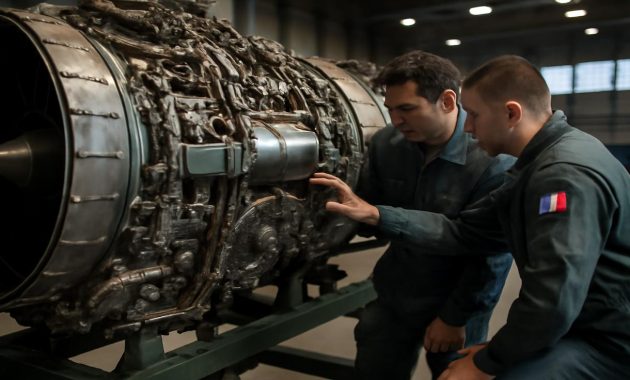
The pilot walks across the tarmac just before dawn, boots tapping lightly on sun‑bleached concrete, the air already humming with the soft metallic tick of cooling engines from last night’s sorties. Ahead of him, a row of Rafale fighters rests under a pale lavender sky, their curved wings beading with dew, their noses pointed east like watchful birds waiting to be called into the air again. For years now, the question hovering over these aircraft has not been whether they can fly, but for how much longer—how many more hours their engines can endure the relentless cycle of thrust and heat and stress. This morning, though, the mood is different. There is relief in the way the technicians joke, in the way ground crew linger under the fuselage, in the relaxed pace of an air force no longer checking the calendar quite so nervously. The Rafale’s heart—its engine—has been renewed.
A Fighter at Midlife, and a Question of Breath
The Dassault Rafale has long been the quiet backbone of the French air force, a multirole fighter whose silhouette has become as familiar in French skies as the contrails of civilian airliners. Born at the end of the Cold War and refined through decades of operational experience—from Libya to the Sahel—the jet has reached that complicated middle age where a machine’s body is still lethal, but its organs begin to feel the strain.
The Rafale’s twin Snecma M88 engines have always been something of a paradox: compact, precise, and remarkably efficient, yet tasked with doing everything from low‑altitude ground attack in desert heat to high‑G air combat maneuvers at freezing stratospheric edges. Each mission leaves microscopic scars—metal expanding and shrinking, blades eroding grain by grain, thermal coatings aging like cracked paint on an old farmhouse wall.
For planners in Paris, the math had become uncomfortable. The Rafale is expected to remain in frontline service well into the 2040s, standing guard until its eventual successor arrives. But engine life cycles were creeping toward their designed limits more quickly than anticipated. Operational tempo, export successes, and the simple accumulation of flying hours all conspired to narrow the margin. Could the air force rely on a fighter whose lungs were beginning to wheeze just as it needed to sprint through another two decades?
That tension has now eased. After years of testing, negotiation, and cautious optimism, a long‑awaited upgrade to the M88 has cleared its final hurdles. The French air force, at least on this front, can breathe easier.
The Moment the Test Cell Doors Opened
Behind this quiet change is a world most people never see: echoing engine test cells where steel doors shut with the muffled finality of a bank vault, and technicians in hearing protection watch data streaming by in columns of glowing numbers. In such a cell, the prototype upgraded M88 engines were pushed to the edge of their design envelope—and then nudged beyond it.
Outside, life went on as usual on the bases where Rafales fly daily. Inside, however, a different kind of flight was unfolding—one measured in hours at maximum power, in simulated sand ingestion, in sudden accelerations from idle to full afterburner. The engineers were not looking for pretty performance graphs; they were searching for failure, for hints of weakness that might appear after hundreds of hours of torture testing.
When the final qualification reports came back, the story was not one of drama but of quiet, cumulative success. New materials in hot‑section components. Refined cooling pathways. Updated software that manages fuel flow like a careful conductor balancing an orchestra, preventing spikes that wear out turbine blades. None of it makes headlines in the way a new airframe might. Yet, together, these changes add up to what really matters: more life per engine, more confidence per flight, more margin for the unexpected.
In the control room on the day the last test cycle ended, one engineer later recalled the moment the engine spool‑down whine finally died away. The room did not erupt into cheers. Instead, there was a long exhale, a quiet series of exchanged looks, and then a simple nod from the lead tester. It was done. The Rafale’s future had just stretched further into the horizon.
The Feel of an Upgrade in the Cockpit
Ask a pilot what an engine upgrade feels like, and the answer is often less about numbers and more about sensation. It’s the way the throttle responds with just a fraction more smoothness, the way acceleration to takeoff speed arrives with a sense of ease rather than effort. In the cockpit of an upgraded Rafale, the change isn’t a cinematic surge of power—it’s a subtle shift in trust.
On a training sortie over the Atlantic, with slate‑colored seas scrolling beneath the wings, a Rafale pilot might test that trust in the kind of maneuvers that make passengers in an airliner grateful for seatbelts they’ll never need. High‑G turns, abrupt climbs, sudden descents—each demanding rapid changes in thrust.
Where before there may have been a persistent awareness of engine age, a quiet mental tally of hours already flown, now there is room for focus. The pilot is less preoccupied with the invisible countdown ticking away in the background and more attuned to the mission at hand—the simulated threat, the formation, the data streaming into the cockpit displays.
Down on the flight line, the upgrade feels different but no less tangible. Mechanics running their gloved fingers along engine panels know that the intervals between deep overhauls will stretch. Logistics officers, long used to juggling spare engine modules like overbooked tickets, can plan with slightly more generosity. The entire ecosystem around each Rafale, from spare parts warehouses to mission planners’ offices, begins to relax into a longer planning horizon.
The Numbers Behind the New Breath
In simple terms, the core of the upgrade revolves around durability and efficiency. Without drowning in engineering jargon, the French air force and industry partners have essentially found ways to make the engine’s hot core last longer under stress, and to manage its “breathing” more intelligently.
| Aspect | Previous Situation | After Rafale Engine Upgrade |
|---|---|---|
| Engine service life | Tighter margins, more frequent overhauls | Extended life, fewer major interventions |
| Maintenance planning | Short‑term scheduling, higher uncertainty | Longer planning horizons, improved predictability |
| Operational availability | More aircraft grounded for engine work | Higher proportion of jets ready to fly |
| Fuel and thermal management | Older control logic, higher wear in extremes | Smarter control, better protection of hot parts |
| Future‑proofing | Limited headroom for new demands | More margin for future upgrades and missions |
None of these changes are dramatic in isolation. But together they tilt the balance of the Rafale’s career in a very practical way. The air force can schedule deployments, training cycles, and modernization plans knowing that the bottleneck is no longer an aging engine reaching the end of its certified life too soon.
Why This Matters Far Beyond the Hangar
An engine upgrade might sound like an internal, almost domestic matter—something for engineers, not strategists. Yet for France, whose security posture stretches from the Mediterranean to the Indo‑Pacific, the breathing room this upgrade affords is geopolitical as much as mechanical.
Consider a Rafale squadron deployed to a dusty forward base in the Sahel. Every additional hour of engine life is one less emergency rotation back to mainland France, one fewer gap in patrol patterns, one more week of uninterrupted support to ground forces scattered across a vast, unforgiving landscape. The desert does not care about maintenance schedules; it simply wears down whatever operates within it. Extending engine life is a way of quietly pushing back against that erosion.
Then there is the export dimension. The Rafale is no longer just France’s fighter; it is now flown, or soon will be, by several nations who bought into the promise of a combat‑proven aircraft with a long future. For these partners, seeing the engine upgrade cleared and implemented sends a reassuring message: this is not a platform approaching retirement, but one that will continue to evolve and be supported.
Air forces often talk about “capability bridges”—those carefully timed stretches of technology and planning that carry them from one generation of equipment to the next without gaps in readiness. The upgraded M88 is a crucial plank in the bridge between today’s Rafale and whatever sixth‑generation system eventually takes its place. Without it, France risked a chasm of uncertainty: a frontline fighter nearing the edge of its mechanical endurance before its successor was truly ready.
Now, that bridge feels sturdier. Decision‑makers can align the Rafale’s twilight years with the dawn of what comes next, rather than being forced into hasty purchases or extended reliance on older, less capable aircraft.
A Quieter Kind of Sustainability
There is also a subtler theme woven into this story, one that speaks to how modern militaries think about sustainability. Extending the service life of a jet engine is, at its core, an exercise in using what you already have more wisely. Instead of discarding hardware prematurely or accepting mounting maintenance burdens as inevitable, the French air force has opted for a more careful stewardship of its machinery.
That stewardship is not only financial—though the cost savings associated with fewer major engine overhauls are significant. It is environmental in a modest but real sense: fewer engines scrapped, fewer replacement parts manufactured and transported, more efficient use of fuel through smarter engine management. In a sector that often feels locked into high‑emission realities, every incremental step toward efficiency is meaningful.
From the vantage point of a pilot throttling up on a runway, these broader themes might seem distant. But they are present in the details: in the maintenance crew that doesn’t have to pull an engine quite as often, in the support infrastructure that runs a little leaner, in the knowledge that this jet will still be here, still capable, years down the line.
Living With a Longer Future
Walk again along that dawn tarmac, past the Rafales with their canopies glinting like dark seashells. Each aircraft now embodies not only its past missions, etched invisibly into every seam and rivet, but an extended promise of future flights. The path from test cell to squadron is not instantaneous, of course; upgrades roll out in planned waves, engines cycle through workshops, software is certified and installed. But the direction of travel is clear.
The French air force, like every air arm, lives in a world of competing clocks. One counts down engine hours. Another marks the approach of new technologies. A third ticks away political cycles and budget years. For a while, these clocks seemed dangerously out of sync for the Rafale. Today, with the M88 upgrade officially cleared, they are closer to alignment.
There will be other challenges. Avionics will need updating, sensors will be replaced, weapons systems integrated. Air combat is an arena where standing still is the same as slipping backward. Yet the Rafale’s most fundamental need—to keep flying safely, reliably, and confidently—has been met for the foreseeable future.
On some future evening, a pilot will return from a long mission, descend through a spill of orange sunset, and line up on final approach. The engines, warmed by hours of strain, will respond with practiced precision to every subtle correction. The jet will flare, wheels will kiss the runway, and the engine note will soften from a commanding roar to a gentle hiss of cooling metal.
He may not think, in that moment, of the test cells or the redesigns, of the tables in planning documents proving extended life cycles. He will simply know that this aircraft—this machine that has carried him through cold skies and hot conflicts—is not nearing the end of its story. It still has breath left, and so does the air force that depends on it.
Frequently Asked Questions
Why was the Rafale engine upgrade necessary?
The Rafale is expected to remain in service for decades, but its M88 engines were approaching the limits of their original life cycle as operational tempo and flying hours increased. Without an upgrade, the air force faced growing maintenance burdens, reduced availability, and a risk that the aircraft’s engines would become a limiting factor before a next‑generation fighter was ready.
What changed in the upgraded M88 engine?
The upgrade focuses on durability and smarter engine management rather than dramatic increases in thrust. It includes improved hot‑section materials, refined cooling solutions, and updated control software to manage fuel and thermal loads more precisely. Together, these changes extend engine life and reduce wear under demanding conditions.
Does the upgrade improve the Rafale’s performance in combat?
Performance gains are mainly indirect. Pilots may notice smoother throttle response and consistent power under stress, but the key benefit is higher reliability and availability. A fighter that can fly more missions with fewer engine‑related interruptions is more valuable in real operations than one with marginally more thrust but lower dependability.
How does this upgrade affect maintenance and costs?
By extending the service life of critical engine components and spacing out major overhauls, the upgrade reduces maintenance frequency and long‑term costs. It also allows better planning of maintenance windows, which means squadrons can keep more aircraft available for training and operations at any given time.
Will export operators of the Rafale benefit from this upgrade?
Yes. Countries that operate or have ordered the Rafale will gain confidence that the aircraft’s engine will remain supportable and modern for many years. Depending on specific agreements, they can also adopt the upgraded engine standard, aligning their fleets with France’s and benefiting from the same increased longevity and reliability.
Is this upgrade connected to future European fighter projects?
Indirectly. Extending the Rafale’s engine life helps ensure that France can bridge the gap between today’s fighter and future systems being developed with European partners. By keeping the Rafale viable and efficient longer, the air force gains time and flexibility to introduce new platforms without creating capability gaps.
Does the upgrade change the Rafale’s environmental footprint?
While the primary goal isn’t environmental, more efficient engine management and extended service life have a modest sustainability benefit. Fewer engines and parts need to be manufactured and replaced, and smarter fuel and thermal control can contribute to more efficient operations over the jet’s extended lifetime.