The road to the psychologist’s office wound past a small lake, where the surface held the pale sky like a secret. You could miss the turn if you weren’t looking for it—just a narrow gravel path tucked between two old maples, their trunks scarred with initials carved by people who thought their love would last forever. As I stepped out of the car, the air smelled like damp leaves and distant woodsmoke, and somewhere in the trees, a single bird practiced the same four-note song again and again, as if it too were trying to figure something out.
The Day Happiness Felt Like a Deadline
Inside, the waiting room didn’t look like any psychologist’s office I had imagined. No sterile white. No cold vinyl chairs. Instead, there was a threadbare rug the color of moss and light pooling against a bookshelf full of titles that sounded like questions: “What Really Matters,” “The Paradox of Choice,” “Flow,” “Man’s Search for Meaning.” I sat in a chair that sighed gently under my weight and rehearsed the sentence I’d come to say.
“I’m not happy. And I don’t understand why.”
It wasn’t that anything was wrong—at least not by the standards of social media highlight reels. The job was decent, the apartment was clean, my body cooperated most days, and my phone knew my face well enough to unlock every time. But life had taken on this strange gray flatness, as though someone had turned down the saturation dial on the world. Even the good days had a faint aftertaste of “Is this it?”
Friends told me to “just focus on being happy,” like happiness was a fitness goal and all I needed was a better routine. I tried. I read listicles about “10 Daily Habits of Happy People,” bought a gratitude journal with a sunrise on the cover, downloaded three mindfulness apps, and even forced myself into hobbies I was supposed to enjoy. Hiking on weekends. Latte dates. Streaming comedies that algorithms swore were “98% match” for my sense of humor.
Sometimes the moments were, objectively, good—the warm weight of a mug in my hands, laughter in crowded rooms, the clean ache of tired legs after a long walk uphill. But there was a quiet, insistent voice in the back of my mind, whittling away at those experiences. “Am I happy enough right now? Is this what happiness is supposed to feel like? What if I lose this?”
Happiness had become a deadline with no due date, a test with no answer key. I was always checking my internal gauge and always coming up short. That’s how I ended up in that moss-colored waiting room, watching sunlight dust the book spines, feeling like I’d failed at something everyone else had secretly mastered.
The Question That Turned the Room
The psychologist—Dr. Larkin—looked more like a naturalist than a clinician. Worn boots. Loose sweater. Hair doing its own wild, silver-threaded thing. She listened without interrupting as I spilled my tidy collection of frustrations, my carefully curated dissatisfaction.
When I finally ran out of words, she didn’t ask me about my childhood, or my goals, or my five-year plan.
Instead, she tilted her head and asked, “When, in your life, have you forgotten to wonder if you were happy?”
The room seemed to pause. Outside the window, the bird was still spiraling through its four-note song, but the sound fell away for a moment.
“What do you mean?” I asked.
“You keep checking your happiness like you’d check your phone battery,” she said gently. “I’m curious about the times when you forgot to check. When you were absorbed, moved, needed—so engaged in something that the question ‘Am I happy right now?’ simply wasn’t there.”
Memories began to surface, uninvited. Staying up all night with a friend whose world had just collapsed, watching dawn leak into a hospital parking lot. The year I volunteered at a community garden and ended most Saturdays mud-streaked and sunburned but weirdly alive. Hours lost in writing a story that no one had asked for, that might never be read.
Those moments weren’t always pleasant. Some were exhausting, heavy, even painful. But they were unmistakably vivid. The edges of things felt sharp then, the colors un-muted. I hadn’t spent those days politely peeking in on my own emotional state. I had been immersed in something that felt, in some quiet, undeniable way, worthwhile.
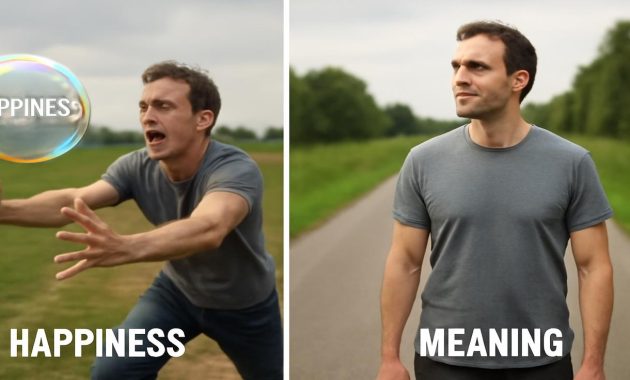
“There’s a difference,” she said, “between chasing happiness and chasing meaning. And for many people, life only starts to feel right when they stop worshiping happiness like a god and start serving something bigger than themselves.”
The Quiet Rebellion Against “Feeling Good”
We’d been taught, she said, to treat happiness like a personal project. A DIY renovation of the inner life. Fix your mindset. Curate your experiences. Cut out “toxic” people. Manifest better outcomes. Always be optimizing. From billboards to podcasts, happiness was branded as a product line—achievable, measurable, upgradeable.
But under the bright packaging, something essential was missing. Happiness, as we usually define it, is a feeling: pleasure, comfort, ease, excitement, satisfaction. Feelings are astonishingly fragile. They flicker with sleep, hormones, weather, headlines, blood sugar. Try to grip them tightly and they wriggle away.
“Psychologically,” she said, “the more we monitor our happiness, the less happy we tend to feel. Think of a child fully immersed in building a sandcastle. They’re not pausing every few minutes to think, ‘Am I having fun yet? How does this compare to the fun my classmates are having right now?’ They’re just there, hands deep in sand, part of the moment. The constant self-checking is an adult habit—and it’s corrosive.”
Chasing happiness often meant avoiding discomfort, steering clear of anything that might be tedious, risky, or emotionally heavy. But the things that gave my life texture—deep relationships, personal growth, commitments that asked something real from me—were stitched together from discomfort as much as from joy.
“Meaning,” she said, “is less about ‘feeling good’ and more about ‘being connected to something that matters.’ It’s not as glamorous. It doesn’t always look pretty on Instagram. But it’s more stable, more generous, and more honest.”
She scribbled on a notepad and then turned it toward me. On the page she had drawn a simple table.
| Chasing Happiness | Chasing Meaning |
|---|---|
| “How do I feel right now?” | “What am I serving right now?” |
| Avoids discomfort and difficulty | Accepts discomfort as part of the deal |
| Short-term mood focused | Long-term purpose focused |
| Self as the center | Self as part of a larger story |
| Fragile, easily shaken by circumstance | Sturdier, can coexist with pain |
“Your problem,” she said, “is not that you’re unhappy. It’s that you think being happy is the point.”
Meaning Feels Different in the Body
When she asked about the “meaningful moments” in my life, I realized something I’d never put into words: they all had a different texture in my body, like a pattern in the grain of wood you only notice when the light hits it at a certain angle.
I remembered reading to my younger sibling by the light of a hallway lamp, my voice rough with sleep while they slowly drifted off, one small hand resting trustingly on my arm. I wasn’t “happy” in a bouncing, celebratory way. I was tired. Worried about my own deadlines. A little hungry. But under all of that, there was a steady warmth, a sense that this moment was non-negotiably important.
I thought of standing in a forest after a storm, the air thick with the sharp green smell of broken leaves, watching a team of volunteers clear a fallen tree from a trail. No one was paid. There were no cameras, no sponsors. Just strangers working together because this path mattered to someone, and that was reason enough. The satisfaction afterward was quieter than happiness—but deeper. It hummed in the bones.
Meaning, I realized, feels less like fireworks and more like roots.
“Exactly,” said Dr. Larkin. “Meaning stretches time differently. When you’re living in service of something that matters, your days might still be hard—sometimes harder. But they stop feeling pointless. Waking up becomes less about ‘Will today make me happy?’ and more about ‘What part do I get to play today?’”
She told me about patients who had come through disasters and losses and still spoke, eventually, of gratitude—not for the pain itself, but for what it called out of them. The chance to show up for others. The courage they discovered. The clarity that comes when life strips away what is trivial and leaves only what is essential.
“Chasing happiness can make us smaller—always curating, protecting, insulating. Chasing meaning almost always makes us larger than we were before. We grow to fit what we care about.”
Redrawing the Map of a Day
“So,” I asked, “how do you actually chase meaning? It sounds poetic, but what does it look like at 7:30 on a Monday morning when the alarm goes off and you just want to stay under the covers?”
She smiled. “Meaning is not mysterious. It shows up in very ordinary places. The trick is to ask different questions about your day.”
Instead of “What will make me feel good today?”, she suggested questions like:
- “Where can I be of real use today—even in a small way?”
- “What am I willing to be uncomfortable for?”
- “Who or what do I want to honor with the way I live this day?”
She asked me to walk through a typical weekday and, instead of labeling tasks as “good” or “bad,” to locate tiny threads of meaning inside them.
Making coffee for myself before work? A small act of care for the only body and mind I’ll ever get. Sending a difficult email? An attempt to set a boundary that protects time for what matters. Showing up to a job that didn’t thrill me? Maybe, for now, it was a way to fund other things that did: the art I made on weekends, the people I supported, the spaces I could help keep alive.
“Meaning isn’t always in the content of the task,” she said. “It’s often in the why behind it. Two people can be doing the exact same thing—say, changing a stranger’s bedsheets in a hospital. One sees it as drudgery. The other sees it as preserving someone’s dignity at a time when that person has lost control over almost everything else. Same task. Completely different experience.”
She invited me to choose one area of life that felt especially hollow—social media, for example—and to experiment with shifting it from a happiness-chasing space to a meaning-chasing one. Instead of posting for validation, could I use it to tell truer stories, amplify others, or simply be more honest? Instead of scrolling for emotional comfort, could I log on with a question: “Is there someone here I can encourage or support?”
“The goal isn’t to never feel happy,” she added. “Happiness is lovely. It’s just not a very good compass. Let meaning be the compass, and happiness can be one of the many kinds of weather you pass through.”
Allowing Happiness to Arrive Like Wildlife, Not Livestock
In the weeks after that first session, I didn’t suddenly transform into some enlightened sage who rose every morning joyfully aligned with the cosmos. Life stayed stubbornly life-like: traffic jams, bad moods, microwaved leftovers, nights when my brain felt like it was made of wet cement.
But I did start chasing something different.
I signed up again for the community garden, less because it made me “feel good” and more because I liked being part of that quiet choreography: hands in the same soil, neighbors trading stories over wheelbarrows and seed packets. I called a distant friend not because I felt like talking, but because their father had just gone into surgery and I knew the long hours of waiting needed company. I committed to finishing a small creative project—an essay no one had ordered—simply because the idea tugged at me, and ignoring it felt like abandoning a conversation halfway through.
Some days, these choices did not make me happy. They made me tired. They ate into my free time. They left me standing in grocery store aisles with a sinking bank account, wondering how to stretch another week’s meals.
But when I slipped under the covers at night, there was a new kind of quiet in me. Not triumphant. Not euphoric. Just a soft, sturdy sense that the day had been used, not merely endured.
I also noticed something unexpected: when I stopped demanding to be happy, happiness showed up more often. Not on command—more like a wild animal wandering into a clearing when the forest is finally still. Sitting in the garden with dirt under my fingernails, watching late sunlight burnish the leaves, there it was. Listening to my friend exhale on the phone after a rough medical update, relief threading through their voice because they weren’t alone—that too was a kind of happiness, quieter and more complex, braided with concern and tenderness.
It wasn’t the bright, polished happiness I’d been sold. It was messy, laced with vulnerability, attached to people and projects that could and would break my heart. But it felt real in a way that the chase for “feeling good” never had.
Building a Life That Can Hold Both Joy and Sorrow
On our last session before a long break, I told Dr. Larkin about this shift—the way my life hadn’t become easier, exactly, but had become less hollow. How the question “Am I happy?” had started to loosen its grip, replaced gradually by “Is this meaningful?” and sometimes, “Is this kind?”
She nodded, folding her hands. “A meaningful life,” she said, “is not one where you’re happy all the time. It’s one where your joy and your sorrow both have somewhere to go.”
Meaning gives sorrow context. When we grieve, we grieve because we’ve loved. When we’re exhausted, it’s often because we’ve poured ourselves into something or someone that matters. Even our anger can point like a compass needle toward what we deeply value—justice, safety, honesty.
“If you anchor your life to happiness,” she continued, “pain always feels like failure. But if you anchor it to meaning, pain can sometimes be a teacher, or at least a witness. It says, ‘This mattered enough to hurt.’ That doesn’t make it pleasant. But it does make it bearable.”
As I left her office, the sky outside had deepened into that blue hour where everything looks briefly like a memory. The bird was still somewhere in the trees, singing its patient, repetitive song. The maple trunks glowed in the last of the light. Nothing monumental had changed. I still had the same job, the same apartment, the same unsorted worries.
But the axis around which my days turned had shifted, almost imperceptibly, like a planet tilting its face a little differently to the sun.
Maybe life wasn’t about finally arriving at some flawless plateau of happiness, arms raised in victory as the credits rolled. Maybe it was about weaving a story worth living inside of—full of detours and difficult chapters, small acts of courage and care, questions that never fully resolved but kept leading you forward.
On the drive home, past the darkening water of the lake, past houses where people were leaning over stoves and laptops and laundry baskets, I let a different question settle in the quiet of the car.
Not “Will I ever be happy?”
But, “What will I give myself to, so that this one, brief, strange life means something true?”
Frequently Asked Questions
Is it wrong to want to be happy?
No. Wanting happiness is deeply human. The issue is making happiness the main goal of life. When you treat happiness as the ultimate objective, you often become more anxious, self-focused, and fragile. When you focus on meaning—on contribution, connection, and living your values—happiness tends to appear more naturally and sustainably.
What exactly is “meaning” in life?
Meaning is the sense that your life is connected to something larger than your moment-to-moment feelings. It can come from relationships, creativity, service, faith, nature, learning, or commitments that matter to you. It’s less about constant pleasure and more about alignment with what you deeply value, even when it’s hard.
Can a life focused on meaning still be fun?
Yes. A meaningful life can include fun, play, and joy—often in richer ways. The difference is that fun stops being the sole target. You might still enjoy movies, travel, or hobbies, but you’ll be less likely to feel empty afterward because they’re woven into a larger story about who you are and what you care about.
How do I start “chasing meaning” in practical terms?
Begin with small questions: “Where can I be useful today?”, “What am I willing to be uncomfortable for?”, “Who do I want to show up for?” Then take one small action that reflects your answers—checking on a friend, doing a task with more care, volunteering a tiny bit of time, or investing a little more effort in something you believe in. Over time, these small acts accumulate into a more meaningful life.
What if I don’t know what my purpose is?
You don’t need a single, grand life purpose to live meaningfully. Meaning often emerges from following your curiosities, tending to what and who you care about, and paying attention to what feels quietly important. Start where you are: look for moments when you forget to ask if you’re happy because you’re absorbed, moved, or needed. Those moments often point toward the kinds of meaning that fit you best.