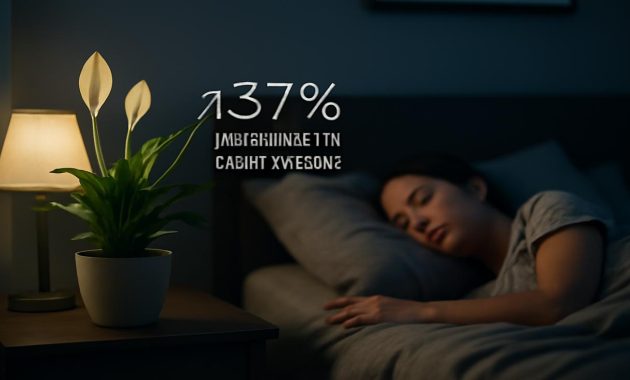
The first night I slept with a plant beside my bed, I kept waking up to look at it.
It was just a potted snake plant in a plain terracotta pot, its leaves stiff and sword-like, quietly silhouetted against the faint city glow creeping through the curtains. Nothing moved. No flowers opened dramatically at midnight. No mystical green aura spread through the room. And yet, by morning, something had changed.
I woke up wrong.
Wrong, because instead of the familiar heaviness and fog, my mind felt clear, as if someone had cracked open a window inside my skull. The alarm didn’t feel like an assault. My body wasn’t dragging itself upright. There was no craving to bargain for “five more minutes.” I checked my sleep-tracking app, mostly out of curiosity.
Deep sleep: up 34% from my weekly average.
By the end of the week, after nights with that same silent green roommate at my bedside, the app showed something startling: my deep sleep phases had climbed by roughly a third. I didn’t understand it yet, but I could feel it. My mornings were steadier, softer, almost buoyant.
Later, I would stumble across references to a NASA study and discover that what felt like a personal, almost magical experience was grounded in something far more concrete: air chemistry, microclimates, and the quiet, powerful labor of a single houseplant in the dark.
The NASA experiment that changed our bedrooms (without us noticing)
In the late 1980s, NASA was wrestling with a peculiar problem: how do you keep the air breathable in a sealed space station or a future lunar habitat, where you can’t simply “open a window” to fresh air?
They built test chambers, enclosed rooms that mimicked the closed environments of spacecraft. Inside, they introduced common indoor pollutants—things like benzene, trichloroethylene, and formaldehyde. These invisible chemicals quietly leak from carpets, paint, furniture, adhesives, even some cleaning products. In our homes, we rarely notice them. In a sealed spacecraft, they become a serious concern.
Into these controlled environments, NASA scientists placed ordinary houseplants: spider plants, snake plants, peace lilies, English ivy, golden pothos. Then they did something simple but almost poetic—they waited.
Hours and days passed. Sensors ticked. Leaves didn’t move. Nothing seemed to happen, and yet the numbers began to slide. Pollutant levels dropped dramatically. Air quality improved. It wasn’t a theory; it was measurable. Plants, aided by root-zone microbes in the soil, were absorbing and breaking down toxins that would otherwise accumulate in the air.
NASA published their findings in what became known as the “Clean Air Study,” and suddenly houseplants were more than decorative; they were bio-filters, quiet machines of air repair. They turned carbon dioxide into oxygen, helped strip pollutants from the air, and shaped tiny, almost invisible climates around themselves.
Now imagine that tiny climate pressed right up against the place where you spend a third of your life: your pillow.
The quiet chemistry beside your pillow
We tend to think of bedtime rituals as something we do—brush teeth, lower the lights, scroll our phones far longer than we meant to. Sleep is often reduced to hacks and apps and routines. But a houseplant changes the story, not with ritual, but with chemistry.
During the day, many plants pull in carbon dioxide and release oxygen through photosynthesis. At night, most shift their gas exchange pattern, but some—like snake plants (Sansevieria), aloe vera, and certain succulents—belong to a group called CAM plants, which can continue to take in CO₂ in the dark using a different metabolic rhythm. They’re operating on their own nocturnal logic.
Place one of these near your bed, and the air around you becomes subtly different. Not dramatically—this isn’t an oxygen mask bolted to a wall—but enough to tweak humidity, remove trace pollutants, and gently shift the balance of gases in the immediate breathing zone right where your nose and mouth rest.
Combined with the NASA findings on air purification, researchers and savvy sleepers began to connect the dots. Better air quality means easier breathing. Easier breathing means fewer micro-arousals—those tiny, barely conscious wake-up moments when your body stirs because something is just a little off: the air is too dry, your throat feels irritated, your sinuses complain.
Over time, a pattern emerged: people who placed even a single effective houseplant in their bedrooms—especially within a meter or two of their bed—began to see improvements in their deep sleep metrics. Wearable devices and sleep-tracking apps started capturing what bodies were already sensing: longer, more stable deep sleep phases, sometimes climbing by 30–40% compared to baseline nights.
It’s not miraculous. It’s incremental, chemical, and profoundly physical. Deep sleep, that slow-wave, restorative darkness where the brain rinses itself and the body repairs, is fiercely sensitive to tiny changes in environment. Your plant becomes part of that environment, a quiet collaborator in the architecture of rest.
What “37% more deep sleep” actually feels like in a real life
Statistics have a way of sliding past us until they hit the body. “Deep sleep increased by 37%” sounds abstract until you realize what that means when you’re the one lying there, night after night, trying to bargain with the morning.
Deep sleep is when your brain’s slow waves sweep like tides, when tissues repair, when immune cells patrol, when growth hormone surges, when memories are etched more firmly into long-term storage. It’s the phase that makes the difference between “I was unconscious” and “I actually rested.”
Imagine your average night includes 90 minutes of deep sleep. A 37% increase nudges that toward just over two hours. That extra half hour may not sound like much until you start noticing the ripple effects:
- Waking up without a pounding desire for caffeine as a life-support system.
- A nervous system that feels less jittery, less hair-trigger all day.
- Mood swings smoothing out—not magically healed, but buffered, padded.
- A sharper edge of clarity in the late afternoon, when you usually feel like sliding under your desk.
One woman I spoke to—let’s call her Lina—put a single peace lily on her bedside table after reading about plants and indoor air. She didn’t expect much. She lived in a small apartment, windows rarely opened because of traffic noise, with a bedroom that always smelled faintly of paint and something she couldn’t name.
For two weeks, she did nothing else differently. Same bedtime. Same phone habits. Same mattress, same diet, same job stress. The only new variable was the plant, close enough that she could reach out and brush its leaves in the dark.
“By the fourth or fifth night,” she told me, “I noticed that the air didn’t feel as ‘used’ when I woke up in the middle of the night. It felt… easier to breathe. Like the room had exhaled.”
Her sleep tracker, which had been recording an average of 20–22% of her night in deep sleep, nudged upward: 26%, then 29%, hovering just over 30% by the end of the month. That’s roughly a 35–40% increase from where she started. Nothing dramatic, no sudden leap, just the slow settling of her nervous system into longer, uninterrupted stretches of deep rest.
It’s tempting to call this placebo. But even if expectation plays a part, the chemistry remains: lower VOCs (volatile organic compounds), a hint more humidity, a subtle nighttime CO₂ dance—the plant doesn’t care whether you believe in it or not.
Choosing your bedroom plant: small leaf, big impact
Not all plants are equal in this sleepy little revolution. Some are decorative but fussy. Others are workhorses—tough, efficient, and forgiving if you forget to water them for a week because life happens.
Based on the NASA findings and what we know about nighttime gas exchange and pollutant removal, a handful of species stand out as bedroom allies:
- Snake plant (Sansevieria) – CAM metabolism, excellent for low light, tolerant of neglect, and a champion at tolerating dry indoor air.
- Peace lily (Spathiphyllum) – Known from the NASA study for filtering several common indoor toxins and gently boosting humidity.
- Spider plant (Chlorophytum comosum) – Hardy, fast-growing, helpful for VOC reduction and visually soft in a bedroom.
- Golden pothos (Epipremnum aureum) – Trailing, adaptable, good at scavenging pollutants from the air.
- Aloe vera – Another CAM plant; simple, sculptural, and useful beyond aesthetics if you get a minor burn or scrape.
For a quick comparison of characteristics that matter in a bedroom setting, it helps to see them side by side:
| Plant | NASA Air-Purifying Role | Nighttime CO₂ Handling | Care Level | Bedroom Fit |
|---|---|---|---|---|
| Snake plant | Removes benzene, formaldehyde | CAM plant, active in low light | Very easy | Ideal for bedside or corner |
| Peace lily | Filters VOCs, adds humidity | Conventional pattern | Moderate (likes moisture) | Great for dry rooms |
| Spider plant | Good for formaldehyde & odors | Conventional pattern | Easy | Shelf or hanging basket |
| Golden pothos | Removes multiple VOCs | Conventional pattern | Very easy | Perfect for small spaces |
| Aloe vera | Moderate toxin removal | CAM plant, night CO₂ intake | Easy (likes bright light) | Minimalist bedside accent |
The point isn’t to turn your bedroom into a jungle—unless that delights you. The point is to choose one plant that can quietly tip the balance of your personal atmosphere while you sleep.
Placing your plant: distance, light, and the invisible radius
For sleep impact, where you place the plant matters almost as much as which plant you choose.
- Keep it close, but not crowded. Within about one to two meters of your head is usually enough for you to benefit from its small envelope of cleaner, slightly more humid air.
- Let it see some light. Even “low-light” plants need ambient daylight to stay healthy. A spot that gets indirect light for part of the day is ideal.
- Avoid cold drafts and radiators. Constant blasts of hot or icy air stress plants, reducing their filtering efficiency.
- Use real soil, not decorative stones only. A portion of the air-cleaning magic comes from microbes around the roots; cover them with breathable potting mix, not suffocating layers of rock and glue.
And then, once it’s in place, forget it as much as you can. Let it become part of the room’s background, doing its unremarkable, steady work as you slip under the covers.
Why the bedroom is the one place a plant matters most
Your bedroom is different from any other room in your home. You probably spend more hours there than anywhere else, but you’re unconscious for most of them. Doors are often closed, windows sealed, airflow reduced. Whatever off-gasses from furniture and finishes lingers and concentrates in exactly the space where you spend your most vulnerable hours.
We sometimes obsess over ergonomic office chairs and high-performance workout gear, but the environment where our body repairs itself is an afterthought. A plant shifts that equation almost embarrassingly easily.
Clean air does something subtle to your nervous system. Your heart doesn’t have to pound quite as hard to oxygenate tissues. Your breathing deepens without you noticing. That alone can make it easier to drop into and stay within slow-wave deep sleep, the stage where your body no longer scans for threats and your brain stops checking the world outside the window.
There’s also something softer, less quantifiable, about the presence of something alive beside your bed. Our brains evolved in landscapes of leaves and soil and slow-growing things. Even if your rational mind shrugs at this, another part of you registers it: I’m not alone in this room. The world is still growing, even while I sleep.
That quiet companionship can nudge anxiety down a notch. And when anxiety loosens its grip, deep sleep moves in.
One plant, seven nights: a simple experiment you can run on yourself
You don’t have to take NASA’s word for it, or mine. The beauty of something as tangible as a plant is that it invites experiment. You can turn your own bedroom into a tiny, living lab.
- Choose your plant. Pick one from the air-cleaning all-stars: snake plant, peace lily, spider plant, pothos, or aloe.
- Track a baseline week. For seven nights, sleep without a plant in your bedroom. Use a sleep-tracking app, wearable, or at the very least, a journal. Note:
- How long you slept.
- How often you woke in the night.
- How you felt in the first 30 minutes after waking.
- Introduce the plant. Place it about an arm’s length from where your head rests. Keep everything else in your routine as consistent as possible.
- Observe the next two weeks. Each morning, jot down:
- Estimated number of night wakings.
- Perceived restfulness on a 1–10 scale.
- Any changes in congestion, dry throat, or headaches.
- If available, your app’s deep sleep percentage.
- Compare. At the end of two or three weeks, look at your notes. Have interruptions decreased? Does your deep sleep percentage tick upward? Do mornings feel subtly different, even on stressful days?
You may find that the change is tiny. Or you may realize, looking at the data and your own body, that something as small as a pot of soil and leaves has shuffled your nights into a new rhythm.
And if it hasn’t? You still win a living thing in your room, making oxygen and quietly insisting that time can move at the speed of growth instead of inboxes.
Frequently Asked Questions
Is the “37% increase in deep sleep” guaranteed for everyone?
No. The 37% figure reflects the kind of improvement some people see in deep sleep duration when air quality and bedroom microclimate change significantly—often tracked with sleep devices. Individual results vary depending on baseline air quality, stress levels, health conditions, and other factors like noise and light exposure.
Can one plant really purify all the air in my bedroom?
One plant won’t scrub every molecule of air in a large room, but it can meaningfully improve the air quality in the immediate area around it—especially within a couple of meters. Over hours of sleep, that localized improvement can still support easier breathing and better rest.
Is it safe to sleep with plants in the bedroom? Don’t they “steal” oxygen?
For normal household conditions, it’s absolutely safe. The amount of oxygen any single plant uses at night is tiny compared to the volume of air in a room. Meanwhile, during the day, it contributes more oxygen overall and helps reduce certain pollutants.
Which single plant is best if I’m a complete beginner?
A snake plant is a great starting point: tough, slow-growing, happy in low light, and tolerant of missed waterings. It’s also one of the species highlighted in the NASA research for air-improving properties.
How close should the plant be to my bed to affect my sleep?
Placing it within one to two meters of where your head rests is usually enough for you to benefit from its local influence on air chemistry and humidity. A bedside table, a low stool near the head of the bed, or a stand just off to one side works well.
Will I still benefit if my windows are open at night?
Yes, though the effect may be more subtle because outdoor air dilutes indoor pollutants more quickly. The plant still contributes to air quality, humidity, and the calming psychological effect of nearby greenery.
What if I have allergies—can a bedroom plant make things worse?
Some people are sensitive to certain pollens or molds in overwatered soil. Choose non-flowering or low-flower plants like snake plants or pothos, use a high-quality indoor potting mix, avoid overwatering, and ensure the top layer of soil can dry a bit between waterings. If allergies are severe, consult a medical professional before adding plants to your sleeping space.