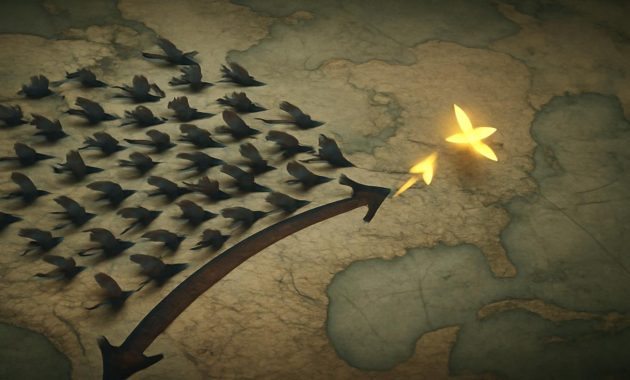
The first time anyone noticed something was wrong with the bird, it was already flying confidently toward disaster. It was autumn along the North Atlantic coast, the sky a slate-grey bruise, the kind of day when most migratory birds were arrowing south. But this one—small, speckled, and determined—wasn’t heading toward warmth. It was flying in exactly the wrong direction.
A Bird That Refuses to Read the Map
The story begins with a dot on a screen. On a chilly morning at a research station near the Norwegian Sea, zoologist Lina Hart watched the GPS trace of a tagged sand-colored songbird move—not south, not southeast, but northwest. Away from safety. Away from its ancestral wintering grounds.
“It has to be a glitch,” she muttered, tapping the side of her monitor. The bird, a juvenile wheatear-sized migrant that her team had briefly netted and fitted with a tiny tracker, had lifted off exactly when it was supposed to. The timing matched the age-old pattern. The direction did not.
For hours, then days, the bird’s journey unfolded on the screen like a stubborn mistake. While its relatives swept toward Africa and the Middle East, this one carved a thin line toward colder seas, storm systems, and a blank patch of research data. It wasn’t alone, either. The more Lina and her colleagues dug into prior years of partial tracking logs, mist net captures, and field observations, the more they found an unsettling pattern: every year, a small fraction of these birds left on schedule—but set their internal compass the wrong way.
They should have been flying south. Instead, they were migrating in almost the exact opposite direction.
Born Pointing the Wrong Way
The species—still being anonymized in publications while data is collected, but we’ll simply call it the “wayward warbler”—is, in almost every other respect, perfectly ordinary. It’s no larger than a sparrow, feathers dusted in soft olives and creams, with a faint eye-stripe like a smudged line of charcoal. In summer, it breeds in high, wind-brushed meadows and scrubby forest edges that smell of damp moss and resin.
When you stand in those meadows in June, the air hums with the insect-buzz and a distant, tinkling chorus: the contact calls of adults hopping through low shrubs. If you listen closely, you can hear the thin, tentative begging notes of nestlings hidden in grass nests—a compact world of feathers, heat, and rapidly beating hearts. By late August, those nestlings are sleek, lean juveniles with an urgent restlessness inside them. They’ve never seen winter. They have no elders flying in front of them as guides. Still, when the nights lengthen and the stars sharpen, they know what to do.
They launch.
Zoologists have known for decades that many migratory birds are born with an innate sense of direction. They imprint on the night sky, on the Earth’s magnetic field, on the length of the day. They carry a kind of genetic roadmap in their cells. But what Lina’s team was seeing suggested something startling: some birds seem to be born with that map printed upside down.
“We expect drift, we expect storms, we expect navigation errors,” Lina explains. “But what we’re seeing here isn’t random. It’s consistent. It’s as if some individuals are hardwired to head the wrong way—and they do it with complete confidence.”
The First Time the Sky Looked Wrong
Imagine being that young bird on the night it leaves. The sky is wide and ink-dark, punctured by pinpricks of starlight. A cold wind brushes your feathers in small shivers. Instinct hums in your bones: Go. Everyone around you lifts into the darkness, the air suddenly alive with wings you can’t see but can feel, the soft turbulence of thousands of tiny bodies rising. You climb, your muscles burning pleasantly, and you choose a line in the sky that feels right.
The thing is: right is wrong this time.
No one course-corrects you. No elder pulls alongside to say, “Not that way, turn.” For most songbirds, migration is solitary. Each bird carries its own instructions. So you fly, night after night, riding cold fronts and slipping between storms, faithfully following a broken compass the way a lost traveler follows a defective GPS, trusting every wrong turn.
The Mystery in the Data: When Wrong Becomes a Pattern
What began as “one weird data point” turned into an unsettling trend as more tagged birds took flight. Over four years, the research team tracked hundreds of migrants. Most took the standard route: a broad, curving arc southward, then southeast, a journey that would eventually drop them onto wintering grounds rich with insects and mild temperatures.
But every year, a stubborn minority—somewhere between 3% and 6%—peeled off toward the opposite quadrant of the compass. They weren’t just off by a few degrees. Many were nearly 180 degrees off. Instead of seeking warmth, they were veering toward colder, harsher latitudes.
Some turned back abruptly after several hundred kilometers, carving strange loops in the tracking data as if they’d flown into a wall of wind and panic. Others kept going, vanishing beyond the edge of the area with reliable GPS signal. A few—only a few—made landfall somewhere unexpected and survived, long enough at least to transmit data again.
When the team overlaid the tracks on a map, the routes looked like veins branching away from a heart—and some of those veins flowed in the wrong direction. The researchers ruled out the obvious: device malfunctions, human error, storms that physically blew birds off course. The pattern held even in stable weather, even when multiple birds launched from the same patch of hillside on the same calm night.
“If migration is a song,” one of Lina’s colleagues joked, “these birds are singing it backwards.” But beneath the humor was a real sense of unease. Because this wasn’t random misfortune. It looked uncomfortably like evolution experimenting in real time.
A Table of Troublemakers
In one of the early internal reports, the team summarized several of the most striking cases. For a while, this table sat pinned on the wall of the field station, a snapshot of the puzzle they were trying to solve:
| Bird ID | Age | Expected Route | Actual Direction | Approx. Distance | Outcome |
|---|---|---|---|---|---|
| #A17 | Juvenile | South–southeast | Northwest | 1,100 km | Signal lost over open sea |
| #C03 | Juvenile | South | North–northwest | 650 km | Reversed course, joined main flyway |
| #F29 | Adult | Southeast | West | 1,450 km | Wintered in unknown coastal area |
| #H11 | Juvenile | South–southwest | North–northeast | 900 km | Recovered weak, released, route repeated |
Each row in that table is a life threaded through uncertainty. For every “signal lost” there is a bird caught in some final storm, a body falling into dark water. For every one that survives, there is a different question: What did it find out there that allowed it to live, and what story will its genes now tell?
Evolution, or a Dead End?
Zoologists have a phrase they keep coming back to when they talk about such misdirected travelers: “reverse migration.” It sounds like something intentional, as if the birds decided, together, to try a new lifestyle. Of course, there is no conscious council. There are only mutations.
The leading theory is deceptively simple. Migration routes are, in part, genetic. The direction, the distance, the stopover habits—they’re encoded in stretches of DNA that shape how a bird interprets environmental cues. Sometimes, those instructions get scrambled. A single mutation could flip a directional preference, like rotating a compass rose on a map. The result: a bird born with its coordinates rotated, setting out confidently toward a future that, historically, would have mostly meant death.
Yet evolution is greedy with opportunities. Even accidents are raw material. If just a few of those misdirected birds stumble into a place that can support them—an unclaimed wintering ground, a patch of coastline newly rich with insects due to warming climates—then what looks like a mistake could become the beginning of a new migratory route carved into the species’ story.
Lina’s team is torn between these possibilities. Are they mostly watching a tragic error play out over and over? Or are they witnessing, in real time, the very slow, very clumsy birth of a new way of being a bird?
The Baffled Experts
In late-night conversations over mugs of cooling coffee, the researchers argue gently about what, exactly, they are seeing. One camp leans toward the tragic reading: the world is changing so fast that inherited navigation programs are becoming misaligned with reality. Urban light pollution confuses star maps. Subtle shifts in the Earth’s magnetic field overlay with the chaos of human-built skylines. A bird whose internal compass might once have been merely quirky could now be disastrously wrong in a sky choked with signals.
Others point to the rare successes. “Look at F29,” one of the data analysts says, tapping the screen where that bird’s track bends far away from the species’ usual winter range. “She survived. She came back. She repeated the route.” Fitness, in evolution, is a simple ledger: did you live long enough to breed, and did your offspring do the same? If the answer is yes, then your odd behavior is no longer just an error; it’s a possibility.
Bafflement, in this context, doesn’t mean ignorance. It means standing at the edge of what we can model, staring at a set of behaviors that hover between catastrophe and innovation, and realizing we are watching the toss of a very slow coin.
Inside the Bird’s Compass
To understand how a warbler can be born pointing the wrong way, you have to shrink yourself down to something microscopic, to the level of molecules and cells.
Inside the retina of many migratory birds are special photoreceptor molecules believed to be sensitive to the Earth’s magnetic field. Think of them as tiny chemical compasses that respond to subtle differences in direction, tuned by evolution to tell the bird which way is “homeward” in spring, or “away” in fall. Layered on top of that are other cues: the position of the stars, the faint gradient of polarized light at sunset, the smell of distant land carried on wind.
Somewhere in the mix, something goes off script.
Experiments with related species in planetarium-like setups have shown that young birds, raised without any chance to learn from adults, still orient themselves in roughly the correct direction when the artificial star field mimics a real night sky. Shift the star pattern by 180 degrees, and the birds change direction. Alter the magnetic field, and the orientation shifts again.
All of this suggests that the warbler’s “wrong-way” travelers may simply be reading a subtly altered version of the same cues. Their inner compass is not broken in a chaotic way; it’s consistently rotated. On certain nights in the flight tunnel experiments, Lina watched as a juvenile with a “reverse” lineage repeatedly hopped toward the part of the cage corresponding to the opposite direction of the species’ usual migration—as if some invisible force were calling from the wrong horizon.
“The most unsettling part,” she admits, “is that they look so certain. You realize that certainty isn’t the same thing as correctness. Not for birds. Not for us.”
When the Sky Itself Is Changing
The landscape these birds move through is not the same one their ancestors mapped. Winters are milder in some places, harsher in others. Insect emergences have shifted with the lengthening of warm seasons. New wetlands have been created; others have disappeared under concrete and drainage ditches.
A bird veering northwest where it once would have died in icy emptiness might now find a coastline that, thanks to warming currents, hosts insect hatches well into the colder months. A misdirected flight that used to be a dead end might now be merely risky—and in evolution, “risky but sometimes successful” is a seed worth planting.
This is where zoologists find themselves uncomfortably entangled in hope and dread. On one hand, the ability of migration systems to flex, even clumsily, offers a thread of resilience in a warming world. On the other, the very need for that flexibility is a symptom of deep planetary imbalance.
What Happens to a Species That Loses Its Way?
Wander far enough into this problem and you begin to glimpse a longer story, one in which our sense of direction is as fragile as the warbler’s. The birds are not making moral choices; they’re following inherited algorithms. But we, watching them, are forced to ask our own uncomfortable questions.
If a small songbird can survive by accidentally inventing a new route, what does that say about rigidity in our own systems? Our infrastructure, our traditions, our assumptions about how the world should work—they, too, are maps drawn from the past. What happens when the landscape underneath them shifts?
Standing on a wind-stripped ridge as dusk settles, watching silhouettes of tiny forms lift one by one into the dark, you can feel both the precarity and the courage of their departure. Thousands of generations have done this. Each individual is a fragile, warm-blooded gamble against distance and weather. That some will go the wrong way has always been a part of the equation. The difference now is what “wrong” means on a planet whose climates are slipping.
For the wayward warbler, the coming decades may decide whether reverse migration remains an oddity, a recurring tragedy, or the trembling outline of a new tradition. For the zoologists piecing together their tracks, bafflement has deepened into something quieter: an awareness that, in studying how the birds navigate, they are also learning how the world is rearranging itself beneath their wings.
Some winter, not very far from now, an observer on a remote, wind-battered coastline may look up to see a small flock of these birds where none have ever been recorded before—feeding, resting, their bodies fat and sleek and ready to return north. If that happens enough times, their descendants will no longer be “wrong-way” travelers. They will simply be birds following a new path inscribed by the invisible ink of selection and survival.
Until then, each migration season will carry its share of quiet tragedies: narrow wings beating tirelessly toward empty horizons. Somewhere over cold water, a tiny heart will slow, then stop, its last direction locked inside the fading signal of a GPS tag. Back at a research station, a dot will freeze on a screen, and someone will sigh.
And yet, the next autumn, when the days shorten and the stars sharpen, new juveniles will step to the edge of the night, feel the old tug in their bones, and launch. Most will follow the familiar path. A few will peel away, their internal maps skewed but resolute, arrowing across a dark sky they are certain they understand.
We, grounded and watching, can only follow their ghostly traces across our maps and wonder which of them, decades from now, will be remembered as a mistake—and which as the first bold lines of a route that did not exist until a small bird, born pointing the wrong way, decided to fly anyway.
Frequently Asked Questions
What does “reverse migration” mean in birds?
Reverse migration describes a behavior in which a migratory bird travels in nearly the opposite direction of its species’ usual route. Instead of flying toward its traditional wintering or breeding grounds, it heads toward a different, often less suitable region. This appears to be driven by genetic or navigational errors rather than conscious choice.
Do wrong-way migrating birds always die?
No. Many likely do perish, especially if they end up over open ocean or in areas without enough food or shelter. However, some survive—by reaching alternative habitats or by turning back and rejoining the main flyway. Those survivors can potentially pass on their unusual navigational tendencies to offspring.
Can these wrong migrations lead to new migratory routes?
Yes, potentially. If misdirected birds consistently survive and successfully breed in new areas, their altered migration behavior can become more common in the population. Over many generations, this can give rise to new, stable routes and even new wintering or breeding grounds.
Why are zoologists especially interested in this now?
Rapid climate change and habitat transformation are reshaping the landscapes birds depend on. Mistakes that used to be fatal may now sometimes lead to viable new habitats. By studying reverse migration, zoologists can better understand how flexible—or fragile—migration systems are in a rapidly changing world.
How do scientists track these birds without harming them?
Researchers use ultra-light tracking devices—such as tiny GPS tags or geolocators—attached with harnesses designed to minimize impact on the bird’s movement and survival. Birds are carefully captured, tagged, and released within minutes. Ethical guidelines and animal welfare protocols govern these studies to reduce stress and risk.