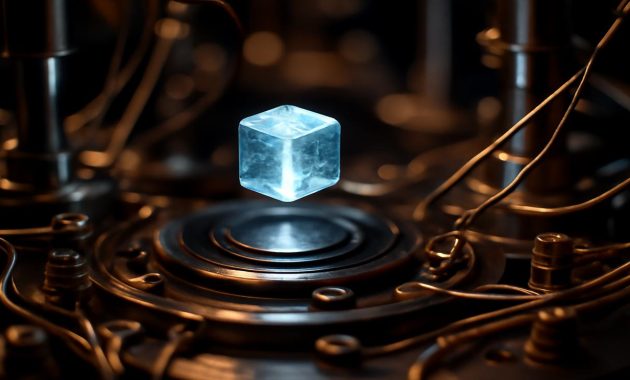
The room is quiet enough that you can hear the soft gasp that escapes someone in the back row. On the screen at the front of the auditorium, a single shimmering image hangs in the dark: a close-up of a tiny device, barely visible to the naked eye, yet cradling the promise of a computing revolution. A Princeton physicist describes it in calm, measured tones, but the story underneath is anything but calm. It is the story of a race that has stretched across decades and continents, through frozen laboratories and screaming magnets, all for one elusive prize: a qubit good enough to make quantum computing not just impressive in theory, but practical in the messy, noisy, real world.
The Problem with Fragile Miracles
For years, quantum computers have lived in a strange space between science fiction and laboratory curiosity. You’ve probably seen the images: gleaming chandeliers of copper and gold dangling like mechanical jellyfish, disappearing into the bellies of dilution refrigerators that chill their contents to temperatures colder than deep space. Inside those machines, qubits — the quantum version of bits — flicker between 0 and 1, and crucially, in both at once. That “both at once” is where the magic lives, the phenomenon of superposition that allows quantum computers to explore solutions in parallel rather than one at a time.
But if superposition is the magic, fragility is the curse. A qubit is like a soap bubble in a hurricane. The slightest nudge — a stray vibration, a whisper of heat, a faint electromagnetic ripple from the outside world — can cause it to “decohere,” collapsing its quantum state into something boring and classically definite. People talk a lot about quantum supremacy and quantum advantage, about solving in seconds what would take classical supercomputers thousands of years. But behind the headlines, a harsher truth lurks.
Most of today’s quantum processors are noisy and unstable. The qubits forget their state — their carefully prepared quantum superpositions — in microseconds or less. They misfire. They flip. They drift. To correct these errors, you need extra qubits: armies of them, constantly watching, measuring, and fixing. The ratio is brutal. One logical, error-corrected qubit — the kind you’d need to actually run useful, large-scale algorithms — might require hundreds or even thousands of physical qubits.
The math has never been kind. If you need millions of physical qubits to simulate complex molecules, design new drugs, optimize supply chains, or break certain encryption schemes, but every qubit is weak and short-lived, the dream begins to look like a mirage shimmering just out of reach. The question haunting the field has become painfully simple: can we build a qubit that is not a delicate miracle, but a sturdy building block? A qubit that can, in some sense, handle the world?
The Princeton Qubit That Wouldn’t Give Up
In a quiet lab at Princeton University, the answer is starting to sound more like yes.
Picture a chip, not unlike the silicon wafers that dominate everyday electronics, but patterned with intricate superconducting circuits. These circuits are cooled until electrical resistance disappears, and quantum behavior emerges. This is not entirely new; superconducting qubits power the machines being built by companies like Google, IBM, and others. But Princeton’s team has taken that familiar platform and done something radically patient with it: they’ve focused, obsessively, on the lifetime of a single qubit.
Instead of rushing to string hundreds of qubits together, they’ve been tuning the environment around just one — shaping electromagnetic fields, sculpting tiny resonators, redesigning the geometry so that unwanted interactions simply have nowhere to go. They’re building, in effect, a sanctuary for a qubit, a space where noise is not welcome.
What they found, and what has rippled through the quantum community, is a qubit whose coherence time — the length of time it can hold onto its fragile quantum state — is dramatically extended. Where many current devices measure that time in microseconds or low milliseconds, this new architecture stretches much further. It’s not merely a marginal improvement. It’s the sort of extension that changes how you think about the whole game of quantum computing.
Because here’s the thing: a longer-lived qubit doesn’t just mean you can run a computation for slightly longer. It reshapes the foundation of quantum error correction, that intricate scaffolding of additional qubits and algorithms designed to catch mistakes before they snowball. If your qubits are constantly on the verge of forgetting who they are, you need hordes of correction qubits. But if a qubit is stable, patient, and slow to decohere, the overhead drops. The system becomes simpler. The gulf between a lab demo and a working machine narrows.
The Taste of Time: Why Coherence Is Everything
Imagine trying to hold a conversation in a room where the lights flicker off every second. You’d have to constantly repeat yourself. You’d need extra people to remind you what was just said. You’d talk more slowly, plan more carefully, and even then you’d lose things. Now imagine the lights stay on for a full minute, then an hour, then a day. Same conversation, different world.
That, in essence, is what a longer coherence time brings to quantum computing. In the fleeting life of a qubit, coherence time is the span during which it can remain in a well-defined quantum state, preserving the subtle correlations — entanglement — that give quantum algorithms their strange power. A short coherence time means your program must be very short and exceedingly clever. A longer time means more room to maneuver, more space for complex logic, more reliability.
Princeton’s breakthrough doesn’t happen in isolation. It emerges from a decade of slow, meticulous refinement: better materials to reduce microscopic defects; improved microwave engineering to isolate frequencies; clever use of cavities and resonators to shelter quantum information. If you could shrink yourself down onto the surface of the chip, it would feel less like a circuit and more like an exquisitely tuned landscape of energy, where only certain paths are allowed and noise is guided away like runoff after a storm.
In that landscape, a qubit with a long coherence time is like a pool of still water in a stone basin. The ripples of disturbance can’t easily reach it. It can simply be, holding onto its delicate state while the rest of the world thrashes about. The longer that stillness endures, the more steps your quantum algorithm can take before everything crumbles back into ordinary reality.
For the first time, the central bottleneck begins to look less like a law of nature and more like an engineering challenge — difficult, but tractable. And that shift in perception is almost as important as the numbers themselves.
Why This Feels Different from Previous “Breakthroughs”
If you’ve followed quantum computing at all, you may feel a twinge of skepticism. Haven’t we heard this before, from somewhere else, in some other lab? Another record-breaking coherence time. Another “world’s best qubit.” Another announcement that the future is almost here. The rhythm of quantum hype can be exhausting.
What sets this development apart is not just the raw performance; it’s how well it meshes with the broader ecosystem. Princeton’s design speaks the language of existing superconducting platforms. It doesn’t demand exotic new materials that behave unpredictably at scale, nor does it require abandoning decades of accumulated knowledge about how to fabricate, wire, and control these circuits. It’s a refinement, but a profound one, more like a new architectural style than an alien city.
That compatibility matters. It means that lessons learned in this carefully controlled, single-qubit sanctuary can, in principle, be translated into multi-qubit processors. The same tricks that protect one qubit from noise can be repeated across an array, etched and wired in the same kind of foundries that already know how to handle these geometries and materials.
In other words, the Princeton qubit doesn’t live on an island. It stands at the edge of a bridge, looking across to the land of real, industrial-scale quantum machines.
From Fragile Toys to Working Tools
What does “practical” even mean in the context of quantum computing? It doesn’t necessarily mean a laptop on your desk humming with qubits any time soon. It means a machine that can reliably outperform classical computers on problems that matter — not just contrived benchmarks. It means hardware you can program today and trust tomorrow. It means that, for specific classes of tasks, turning to a quantum processor stops being a speculative gesture and becomes part of the standard toolkit.
When error rates fall and coherence times rise, a threshold comes into view. Algorithms that once seemed hopelessly out of reach start to look merely ambitious. Quantum chemistry simulations, for example — the kind that could help design better catalysts for energy storage or greener industrial processes — demand deep, layered circuits and persistent entanglement across many qubits. With flimsy qubits, the required overhead explodes. With long-lived qubits, the equation looks far less grim.
There is also a psychological shift. As hardware grows more dependable, more research emphasis moves from “Can we keep this thing alive?” to “What is this thing actually good for?” We’ve seen similar transitions in other technologies. Early aviation was consumed by the sheer effort of staying aloft. Once that problem was solved, people started asking where we could go and what we might carry. Quantum computing is inching toward that same inflection point.
To appreciate where we are in that journey, it helps to see the rough contrast between yesterday’s qubits and what Princeton’s work hints at.
| Aspect | Typical Noisy Qubits | Princeton-Style Long-Lived Qubit |
|---|---|---|
| Coherence Time | Microseconds to low milliseconds | Extended by orders of magnitude in carefully engineered devices |
| Error Correction Overhead | Hundreds–thousands of physical qubits per logical qubit | Potentially far fewer physical qubits per logical qubit |
| Scalability Outlook | Steep and uncertain hardware demands | More realistic scaling pathways |
| Use Cases | Proof-of-concept demos, limited benchmarks | Pathway toward practical, domain-specific advantages |
These differences won’t transform the world overnight. But they hint at a future where quantum processors are less like delicate prototypes and more like specialized instruments — still exotic, still demanding, but dependable enough that whole industries can build around them.
The Human Side of Ultra-Cold Physics
For a moment, step away from the diagrams and numbers and imagine the texture of the work itself. It’s well past midnight in the lab. The windows are black mirrors, reflecting coils of orange cable and the gentle glow of instrument panels. From the corner, the quiet, relentless hum of a cryogenic refrigerator seeps into everything. The device inside it — that tiny, long-lived qubit — is sitting at a fraction of a degree above absolute zero.
Graduate students and postdocs move with the patient rhythm of people who know that one careless jolt could ruin a weeks-long experiment. Helium lines are checked. Microwave pulses are tuned. Code is rewritten, re-run, and reinterpreted. It is painstaking, often tedious work, punctuated by sudden, electric moments when the data curves on a screen bend just so, signaling that something extraordinary is happening.
Part of what makes Princeton’s qubit so compelling is that it emerges from this very human process of iteration. There’s a myth that breakthroughs are singular, blinding events — the eureka in the bathtub, the lone genius in the attic. In reality, quantum hardware progress feels more like watching a tree grow ring by ring. Another defect is identified and reduced. Another material is cleaned a little better. Another control line is filtered more carefully. Over time, those rings add up to a stronger trunk.
We feel the drama now because we’re finally hitting a point where those incremental gains coalesce into qualitative change. The qubit doesn’t just live longer; it enables different things. It alters the tone of the entire conversation.
What a Practical Quantum Future Might Actually Look Like
Stand at the edge of this possible future and look around. It’s not a world where every device is quantum. Your phone, your laptop, your smartwatch — all still blissfully classical. Quantum machines live in data centers, connected not by magic but by fiber optics and standard network protocols. They don’t replace classical servers; they sit alongside them, called into action when a problem demands their particular kind of strangeness.
A materials scientist might send a job to a quantum cluster to model a new battery chemistry with almost painful precision, capturing electron correlations that would stump a classical supercomputer. A logistics company might tap quantum solvers for a subset of nasty optimization problems buried deep in its scheduling engine. Pharmaceutical researchers might lean on quantum simulations to screen candidate molecules, narrowing the field before expensive lab work begins.
Behind all of that — behind the glossy user interfaces and the cloud APIs — are those qubits, humming along in the dark, suspended in baths of liquid helium, surrounded by small armies of classical control electronics. The reason anyone dares to trust them with important work is because they last long enough, and err rarely enough, that carefully designed error-correction schemes can do their job.
It’s important not to confuse “practical” with “easy.” These systems will remain challenging to build and operate. They will demand specialized expertise, much as particle accelerators or fusion experiments do. But the transition from impossible to difficult is, historically, the hinge upon which revolutions turn.
Princeton’s long-lived qubit is one of those subtle hinges. A small, intricate device, no bigger than a fingernail, that redefines how long we can hold on to quantum information — and with it, how far we might push the algorithms of tomorrow.
A Quiet, Powerful Shift
There will still be bold claims and premature promises in the quantum world. That seems inevitable. Technologies close to their tipping points tend to attract noise, both literal and metaphorical. But behind the fanfare, in the steady glow of lab monitors and the chill of cryogenic chambers, the texture of the work is shifting from “if” to “how far” and “how soon.”
The story of Princeton’s breakthrough qubit is not the final chapter of quantum computing; it’s more like a crucial bend in the river. The current, once meandering through the shoals of fragile hardware, is gathering into a stronger, clearer flow. Somewhere downriver lie machines that can meaningfully change how we understand chemistry, materials, optimization, and perhaps even fundamental physics itself.
For now, though, it’s enough to stand in that unusually quiet lecture hall, looking at the glimmering image of a tiny device on a screen, and feel that familiar, unmistakable sensation: the sense that a once-impossible idea has taken one serious step toward becoming part of the everyday fabric of the world.
Frequently Asked Questions
What exactly did Princeton researchers achieve with this new qubit?
They engineered a superconducting-based qubit with a dramatically extended coherence time compared with typical devices. By carefully shaping the qubit’s electromagnetic environment and improving materials and design, they created a quantum state that remains stable long enough to significantly ease the burden on error-correction schemes and enable more complex computations.
Why is coherence time so important in quantum computing?
Coherence time is how long a qubit can maintain its quantum state before decohering due to noise and interactions with its environment. Longer coherence times allow deeper circuits, more algorithmic steps, and more robust entanglement. This directly reduces error rates and the amount of hardware overhead needed for quantum error correction, making practical applications more feasible.
Does this mean we will have quantum computers in our homes soon?
No. Even with long-lived qubits, quantum computers are likely to remain large, cryogenically cooled systems housed in specialized facilities. The practical future looks more like cloud-accessible quantum processors used for specific tasks, not personal quantum laptops or phones.
How is Princeton’s qubit different from commercial qubits already in use?
While it still uses superconducting technology, Princeton’s design focuses heavily on reducing environmental noise and engineering longer lifetimes for individual qubits. The underlying physics is compatible with existing platforms, but the performance gains — especially in coherence time — can substantially lower the costs and complexity of achieving reliable, large-scale quantum computation.
What kinds of real-world problems could long-lived qubits help solve?
More stable qubits make it more realistic to tackle computationally intense tasks like simulating complex molecules for drug discovery, designing new materials and catalysts, optimizing large-scale logistics networks, and exploring advanced cryptographic protocols. These are areas where even a modest quantum advantage could translate into significant practical impact.