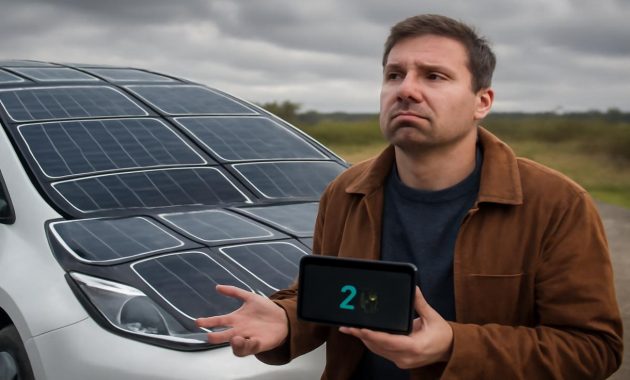
The first time Lena saw the car, it was turning lazy circles in the mall parking lot, catching the sun like a quiet miracle. The roof shimmered, not with paint, but with tiny squares of dark glass that looked like a river frozen mid‑ripple. Kids stopped to stare. A man lifting a stroller into his SUV paused, one arm dangling in midair. Even from where she stood, clutching her iced coffee and grocery list, Lena could feel that tug of future‑shaped possibility: A car that charges itself. A car that drinks sunlight.
The Daydream on the Driveway
Two months later, one of those cars sat in Lena and Marco’s driveway, its hood still faintly speckled from the long highway drive home. The dealership had called it “a glimpse of the future,” and it felt exactly like that, as if the future had been shrink‑wrapped and financed at 3.1 percent APR.
The solar tiles were the star of the show. They stretched from the windshield’s edge to the tailgate, swallowing the roof, rear hatch, and part of the hood in a quilt of black, high‑efficiency photovoltaic cells. Even the salesman’s voice had softened with reverence when he’d walked a palm over the surface.
“Think of them,” he’d said, “as free miles falling from the sky.”
On that first afternoon, the air was hot and syrupy. Heat rose in visible waves from the asphalt. The car’s glossy panels flashed and darkened as clouds drifted past. Marco stood at the end of the driveway, hands on hips, staring at the roof as if he could will it to fill the battery by admiration alone.
“We should name her,” he said.
“Name her after what?” Lena asked, shading her eyes.
“After what we’re never going to do again,” he said. “Wait in line at a charging station.”
Lena laughed, but she wanted to believe it. She pictured herself in supermarket parking lots, in trailhead pullouts, in office garages with broken chargers—the car silently siphoning sun, topping itself off while she went about her life. Gas stations felt suddenly like rotary phones and paper maps: an artifact on its way out.
The Numbers Behind the Shimmer
Their first weekend with the car, the forecast showed wall‑to‑wall clear skies. It felt like the universe had scheduled perfect testing conditions just for them. On Saturday morning, before breakfast, Marco slipped out to the driveway with his phone, the EV’s app already open. He took a screenshot of the battery percentage—62 percent—like a scientist noting a baseline.
“Let’s see what the sun can do,” he said.
They left the car parked all day, nose pointed south, nothing plugged in, nothing turned on. The solar array was rated at about 700 watts under ideal conditions, the brochure had said. It was a number that had sounded heroic when the salesman said it: bright, simple, powerful.
“Seven hundred watts,” Marco repeated now, rolling it in his mouth like a foreign word. “That’s, what, like seven bright lightbulbs?”
By late afternoon, the heat had grown thick enough to taste. The pavement smelled like tar and hot dust. Lena walked out barefoot, feeling the baked grit of the driveway under her feet, and opened the app herself. The icon of the car sat in a virtual sunbeam, a tiny animated shimmer crawling over its rooftop.
Battery: 66 percent.
“Four percent?” she said. “That’s it?”
They did the math at the kitchen table, sticky with watermelon juice. Their EV could travel about 4 miles on each kilowatt‑hour of energy. The brochure and the car’s manual both agreed on the solar system’s maximum potential: in perfect, lab‑grade sunshine, the panels might collect around 4–5 kilowatt‑hours over a long summer day.
On paper, that came to maybe 16–20 “free” miles in those perfect conditions. In reality, their car spent parts of the day in partial shade from a maple tree, and the sun had never bothered asking the brochure for permission before slipping behind clouds.
That Saturday, after an entire blaze‑bright day, the car gained about 3 kilowatt‑hours. Roughly 12 miles.
“So,” Lena said slowly, “we left it in full sun all day and got… enough to go pick up takeout across town and come back.”
Marco stabbed a seedless cube of watermelon with his fork. “I mean, it’s something.”
It was something. It just wasn’t what their imaginations had drawn: a car that shrugged off range anxiety altogether, a machine so in tune with the sun that plugs and cables became optional.
The Promise vs. the Physics
A week later, they started framing it in words they hadn’t used at the dealership: “trickle charge” and “top‑up” instead of “self‑charging” and “energy independence.” The difference was small on the surface but deep beneath it, like discovering that your dream cabin by the lake is, in fact, a very nice tent.
On long drives, they found themselves watching the solar readout on the dash. As they cruised at highway speeds, air conditioning humming, the panels were putting maybe 300 watts back into the battery—while the motor was using 15,000 to keep them moving, more when they passed a truck or climbed a hill. It was like trying to refill a bathtub with a teacup while the drain was open.
“This is like getting excited about the interest on a checking account,” Lena said, squinting at the numbers.
“It’s like getting excited about finding loose change under the couch cushions every day,” Marco said. “Maybe by December you’ve got enough for pizza.”
None of this meant the solar roof was useless. On the contrary, there were small miracles hiding in the details. The panels powered the ventilation fan when the car sat in hot parking lots, keeping the cabin several degrees cooler without draining the main battery. On a sunny Tuesday when Lena forgot to plug it in overnight, those extra trickle‑charged miles were the margin that kept her from limping into the office on 3 percent.
But the fantasy had been different. They’d pictured the car as a kind of terrestrial starship, glazing itself with sunlight and gliding serenely past lines of vehicles waiting at chargers. What they had, instead, was a clever supplement—an elegant bonus layer on top of an EV that still relied, most of the time, on the thick black cable coiled on the garage wall.
When Marketing Outruns the Morning Sun
The slogans that had lodged themselves in their heads did not help. “Drive on pure sunlight.” “Freedom from the plug.” “Miles from the sky.” The photos showed cars cutting through alpine valleys, golden hour light spilling over solar roofs like divine approval. You could almost hear the faint hum of inevitability: this is how we will all travel, soon.
Driving to visit friends one weekend, Lena scrolled through an article on her phone while the car charged at a highway rest stop. The writer had interviewed engineers from several solar‑EV startups, and their quotes were blunt.
“We are fighting the laws of geometry,” one of them said. “A car only has so much surface area, and you can only jam so many watts per square meter into sunlight before you reach a hard physical limit.”
On a clear summer noon, even the best solar cells could capture maybe 200 watts per square meter of real‑world sunlight. Their EV had roughly 4 square meters of usable panel area. Even if the conversion were perfect, the total power budget was fundamentally capped by the size of the car itself.
“So that’s… 800 watts, in lab fantasy land,” Lena said, reading aloud.
“And you need, what, 15,000 watts to keep us tooling along at 70,” Marco said, looking at the charging percentage creeping up on the screen.
The article made another point they hadn’t considered: cars are rarely parked in perfect solar conditions. They sit in garages, under trees, between tall buildings. The very people who could benefit most from surface‑harvested energy—apartment dwellers and city residents with sketchy access to chargers—were also the ones most likely to keep their vehicles under shade or inside.
Yet the dream was compelling because the images were so clean: no combustion, no cords, just motion and light. It had the simplicity of a child’s drawing, the kind you might see taped to a school wall: stick‑figure family beside a little black car with a bright yellow sun overhead.
Reality, like always, was trickier. It required angles and kilowatt‑hours and the patient boring truth that sometimes the least glamorous part of a new technology—the unremarkable public charger behind the grocery store, the string of rooftop panels on a warehouse—does most of the heavy lifting.
What Solar on an EV Actually Gives You
Over the next few months, Lena and Marco started to think about their solar roof less as a revolution and more as a quiet assistant—something that worked in the background, adding small but steady benefits while the rest of their lives went on.
They made a habit of parking in the only unshaded corner of the office lot. At the trailhead, they chose the sunny edge instead of the spot under the cottonwood tree. On a clear July afternoon, they’d come back from a hike to find the app reporting a gain of 10 miles while they were gone.
“That’s round‑trip to the farmer’s market,” Marco said. “On sunlight.”
There were other perks, too, most of them invisible unless you were paying attention:
- The car’s 12‑volt system—lights, locks, computers—was topped off by the solar array, easing the load on the main traction battery and slightly improving long‑term health.
- On cold but sunny winter days, the panels pre‑warmed the battery just enough to make fast charging more efficient when they finally did plug in.
- In emergencies—blackouts, storms, grid failures—the car could trickle enough power into itself to maintain basic functions for days without needing an external source.
When they added rooftop solar to their house a year later, something about the whole ecosystem snapped into focus. Their home panels did the heavy lifting, pumping dozens of kilowatt‑hours into the grid on long summertime days. Their car, plugged in overnight, quietly refilled on that solar‑credited energy. Meanwhile, its own little rooftop array kept nibbling away in the background, shaving off a slice of daily consumption and powering its own mind and lungs.
It dawned on them that the solar roof wasn’t the story. It was a supporting character in a bigger, messier, more interesting one: the slow rewiring of how energy moved into and around their lives.
A Clearer View: Expectations vs. Reality
On a cool September evening, over dinner with friends who were shopping for their first EV, the topic came up in the way these things often do: half technical, half mythological.
“So that solar roof,” their friend Sam said, nodding toward the driveway. “Worth it?”
Lena and Marco traded a look.
“It depends what you think you’re buying,” Lena said. “If you think you’re buying a car that never needs to plug in, absolutely not.”
“But if you think you’re buying an EV that happens to give you a handful of free miles every day and runs its own systems from the sun?” Marco added. “Then yeah. It’s pretty great.”
Sam frowned. “Handful. Like how many?”
They’d tracked enough data by then to answer with something more concrete than feelings. Over one sunny summer month, their car had added about 220 miles purely from solar. Some days it was 4 miles. On the brightest days it pushed close to 15. Cloudy days, the bonus shrank to almost nothing.
| Condition | Approx. Energy Gained | Extra Range (approx.) |
|---|---|---|
| Clear summer day, parked in full sun (8–10 hours) | 3–4 kWh | 12–16 miles |
| Partly cloudy day, some shade | 1–2 kWh | 4–8 miles |
| Overcast or rainy day | 0.2–0.5 kWh | 1–2 miles |
| Winter day, low sun, parked outside | 0.5–1 kWh | 2–4 miles |
Sam chewed on that, eyes flicking from the table out toward the driveway where the last teakettle light of the day slid over the car’s dark tiles.
“So like… once a week you get a fully free commute,” he said.
“More or less,” Lena said. “And the rest of the time, it’s shaving a bit off everything.”
“And you still plug in like a normal EV,” he said.
“Absolutely,” Marco said. “If we pretended we didn’t need to, we’d be walking a lot more.”
The Quiet Value of “Less Exciting” Solar
As the months went by and the first‑year novelty wore off, other kinds of solar started to feel strangely more magical than the glittering tiles on their roof. There was the grocery store whose entire parking canopy was laced with panels; Lena realized one morning that their car was sipping electrons that had fallen on the same asphalt she was wheeling her cart across.
There was the highway rest stop that had added a ring of solar‑powered fast chargers, their curved metal arms tossing square shadows on the concrete. Under a pale winter sky, the chargers purred steadily even as a nearby gas station’s price signs flickered with every twitch of the global oil market.
And there was home: the soft tick of the net‑meter spinning backward on bright afternoons, the utility bill that collapsed from a polite threat into a shrug.
“The best solar for driving,” Marco said one night as they stood in the driveway, looking from the car’s roof to the dark outline of their house array, “might not actually live on the car.”
“It’s like the difference between packing your own snacks and everyone bringing something to the picnic,” Lena said. “One’s cute. The other feeds the whole crowd.”
Their EV’s solar roof had become, by then, something they were quietly fond of. It had paid them back in ways that didn’t show up on any spreadsheet: the small thrill of knowing that today’s errands were “on the sun,” the satisfaction of watching their daily range estimate tick up while they sat by a lake, hearing the plunk of fish and the far‑off burr of someone else’s gas mower.
But when friends asked them for advice, they had stopped calling it a revolution.
So Was It the Idea of the Century?
On a blue‑cold January morning, frost feathered the edges of the car’s solar tiles like lace. The panels were awake but sluggish, the low sun barely skimming their surface. Lena scraped ice from the windshield, breath fogging the air, and checked the app. Overnight, under a clear winter sky that felt more like glass than air, the roof had gathered enough energy for… about one extra mile.
“One mile,” she murmured. “A whole mile on starlight and streetlamp glow.”
She knew the photons had mostly come from the distant, unsentimental sun. But the image felt right: the car drawing tiny sips from whatever light it could find, refusing to waste a single drop.
Was this “the idea of the century,” the visionary leap its marketing had suggested? No. Physics had voted decisively against that. A few square meters of even the best solar tech simply couldn’t overturn the energy arithmetic of moving a ton of metal through air at highway speeds.
What it turned out to be, instead, was something humbler and in some ways more interesting:
- A reminder that our machines can be more opportunistic, catching small, otherwise wasted streams of energy and putting them to work.
- A nudge toward thinking of cars as part of a bigger energy ecosystem, not just hungry endpoints on a grid.
- A daily, physical connection between motion and light—between how we move and the star that makes all of it possible in the first place.
On its own, the solar‑tiled EV roof will not rewrite how the world drives. But as one panel on one piece of a much larger surface—rooftops, parking lots, warehouses, depots, bus shelters—it makes a quiet case: distributed, boring, relentless solar is actually the idea of the century. The roof on the car is just a shiny, mobile reminder of that truth.
Later that day, driving home under a sky the color of steel, Lena watched the tiny solar icon on the dash flicker, then fade as the clouds thickened. The range estimate stayed where it was. No miracle miles today.
But she knew that somewhere above the low ceiling of clouds, the same sun was hammering rooftop arrays and solar farms, filling home batteries, spinning meters backward, and—by a series of invisible steps—putting the electrons in her car that actually mattered.
“Do your best,” she said softly to the dark tiles above her as she pulled into the garage. “You’re not the whole story. But you’re part of a good one.”
Frequently Asked Questions
Do solar panels on an EV mean I never have to plug in?
No. Current solar roofs on EVs add extra range but are nowhere near powerful enough to fully replace charging. Most drivers should still plan to plug in at home or at public chargers as usual.
How many miles per day can a solar‑equipped EV realistically gain?
In strong summer sun, parked outside all day, many systems add roughly 10–15 miles of range. On cloudy days or in winter, that can drop to just 1–4 miles, sometimes less.
Is it worth paying extra for a solar roof on an EV?
It depends on your expectations and parking habits. If your car sits outside in the sun and you value extra range, slightly lower energy use, and features like solar‑powered ventilation, it can be worthwhile. If you park mostly indoors or in shade, the benefit will be much smaller.
Does driving with sun on the roof add range, or only parking?
Both can add a little energy, but driving consumes far more power than the panels can supply. Most meaningful solar gain happens while parked in good sunlight, with the car’s major systems off.
Is putting solar on the car better than putting it on my house?
For most people, rooftop solar on a house or building delivers far more usable energy than the limited surface of a car. A home array can power your EV and your household, while a car roof can only contribute a modest amount of extra driving range.