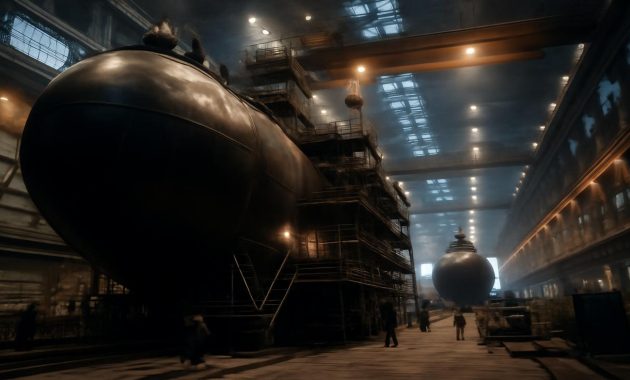
The wind off the Clyde tastes of salt and steel. You feel it before you see anything—before the cranes, before the skeletal ribs of ships under construction, before the austere factory walls that hide the United Kingdom’s most ambitious industrial gamble in generations. Somewhere behind those walls, men and women in hi-vis jackets and spotless white overalls are piecing together an idea so vast it almost slips out of language: a plan to build one nuclear-powered submarine every 18 months, for decades. Not just a shipbuilding program, they insist, but a re-engineering of time itself—compressing what used to be long, uneven cycles of naval construction into a metronome-steady rhythm that could define a century.
A Nation Learning to Breathe Underwater
Stand at the edge of the shipyard at Barrow-in-Furness and the air hums with an odd kind of electricity. It is not the clean, distant buzz of a tech campus, nor the gritty roar of a 19th-century steel mill. It’s something in between: precision and brute force stitched together by laser-guided cranes, automated welding arms, and thousands of human hands. On a gray northern morning, the United Kingdom’s pledge to build a new generation of submarines—Astute, Dreadnought, and the AUKUS-class boats that will one day slide silently below the surface of the Indo-Pacific—feels less like a policy and more like a weather system rolling in.
Submarines are strange creatures. They live in the imagination before they ever meet the sea: long black silhouettes gliding under waves, their true contours blurred by secrecy and myth. They are, in many ways, the most unnatural thing we’ve ever demanded of steel—to become a pressure-proof, self-contained world that can slip into the ocean’s crushing dark and live there for months. To decide, as a nation, that you will build one every 18 months is to promise a kind of continuous magic trick, repeated on an industrial scale.
The UK has been building submarines for a long time; this isn’t a sudden leap from zero. But what’s happening now is different in both rhythm and ambition. The old pattern—long gaps, uncertain budgets, designs that sprawled over decades—is giving way to something more relentless. The country is trying to turn submarine building into a pulse, a regular heartbeat you could plot on a graph. You can feel that ambition in the smell of new-cut metal, in the rattle of freight trains delivering components, in the conversations over tea breaks about schedules that stretch not just to 2030, but to 2050 and beyond.
The Most Gigantic Project You’ll Never Really See
Gigantic projects usually demand to be seen. Motorways carve across hillsides, bridges stride over estuaries, wind farms spin like slow choreography against the sky. This one hides. Nuclear-powered submarines are built in covered docks, rolled out in the dead of night, tested under shrouds of security. Yet its scale is no less astonishing for its invisibility. In fact, that hiddenness may make it feel even stranger: a colossal national effort whose main output will vanish beneath the surface of the sea.
When officials talk about it, they reach for comparisons. It’s like a new railway age, they say, like the construction of the great Victorian dockyards, like the aerospace boom after the Second World War. But those analogies all miss something crucial: submarines combine all of these challenges at once. A single nuclear-powered submarine is part power station, part data center, part warship, part deep-sea habitat. It must be quiet enough not to be heard, strong enough not to be crushed, and smart enough to survive in waters thick with sensors, drones, and rival machines hunting for the slightest acoustic trace.
To deliver one every 18 months means orchestrating a vast choreography of design, supply chains, engineering, and training. Steel plates rolled and shaped years in advance. Nuclear reactors whose components are measured not in millimeters but microns. Cables that snake through the hull like neural pathways, each connection tested to the point of obsession. It also means something more subtle: teaching an entire national ecosystem to think in submarine time.
You can see that ecosystem starting to take shape on a single, ordinary weekday. A bus driver finishing the early shift in Barrow, dropping off workers on their way to the yard. A small manufacturer in the Midlands shipping custom valves and fixtures built to a specification that, for security reasons, they’ll never fully know. A PhD candidate in Glasgow modelling how sound moves through seawater at different temperatures, trying to shave a fraction of a decibel off some future boat’s signature. A teacher in Plymouth explaining to a classroom of 15-year-olds what nuclear engineering is, and why the world suddenly needs more of it again.
How Do You Build a Submarine Every 18 Months?
The pace is the part that makes even seasoned shipbuilders pause. Submarines are traditionally slow-cooked: a design refined and re-refined, sections cut and welded over years, systems integrated at a careful, almost meditative speed. Compressing that into an 18-month drumbeat isn’t a matter of working faster; it’s about working differently.
First comes modularity. Instead of building a submarine as a single, sprawling, growing creature, engineers break it into enormous sections—cylindrical “modules” or “blocks”—that can be worked on in parallel. One hall might host the living quarters, a separate bay the engine room, another the sensor suites and control spaces. These modules grow like separate organs, only later being fused into a single steel body. Everywhere you look, there are jigs and fixtures and rigs designed for repetition: tools not for a one-off masterpiece but for a long-running series.
Then there’s digital design. The latest boats are born first as intricate 3D models, down to the last pipe bracket and access panel. Engineers strap on VR headsets and walk inside hulls that do not yet exist, looking for clashes, awkward corners, maintenance nightmares. The aim is ruthless: to find mistakes when they’re just pixels, not when they’re already welded and bolted into 9,000 tons of reality. Every error caught early is time clawed back from the schedule.
Even more quietly, procurement morphs into something closer to agriculture: a calendar of long lead times, seasonal bottlenecks, and careful cultivation. Forgings for nuclear reactors can take years. Highly specialized alloys, acoustic tiles, periscopes that are no longer periscopes but masts bristling with cameras and antennas—all must be ordered before the future submarine is more than a designation in a folder. It’s like deciding you’ll be hungry in ten years and planting the field today.
| Aspect | Traditional Sub Build | 18-Month Drumbeat |
|---|---|---|
| Design Approach | Iterative, slower, paper-heavy | Fully digital twins, VR walk-throughs |
| Construction Style | Sequential hull build | Parallel modular blocks |
| Workforce Skill Flow | Boom-and-bust cycles | Continuous recruitment and training |
| Supply Chain | Shorter-term, project-specific | Decades-long partnerships and planning |
| Strategic Outcome | Fleet renewed in bursts | Rolling, predictable modernisation |
Inside the yards, the human choreography changes too. Apprentices are not just filling gaps; they’re the front line of a generational relay. Veteran welders, pipefitters, nuclear specialists pass on skills that have no direct analogue in civilian life: how to weld on the inside of a pressure hull so that there is nowhere for a crack to begin, how to pack a reactor compartment so tightly that every component can still be reached and maintained in a space barely wider than your outstretched arms.
Silent Partners: Nature, Ocean, and the Edge of Perception
For all the talk of weapons and deterrence, submarines are, in their essence, arguments with nature. The sea does not want you there. At 300 meters, pressure claws at steel; at 400, it begins to sound different, groaning and pinging as the hull flexes just slightly under the weight. The United Kingdom’s decision to commit so deeply to underwater craft is, in part, a decision to embed itself more intimately in that alien environment—to learn its sounds, its moods, its subtle betrayals.
The acoustic world of a submarine is a sense we do not have words for on land. Inside the sonar room, operators listen to a tapestry of clicks, rumbles, and sighs that can stretch for hundreds of miles. The distant thunder of merchant ships. The long, low shimmer of wind on waves. The organ-deep call of whales. To survive, these new submarines must sink below that noise, becoming quieter than background ocean itself. Every pump, every fan blade, every rotating shaft is a potential shout in a world where survival depends on whispering.
So the “gigantic project” isn’t just steel and budget lines; it’s a refinement of attention. British scientists and engineers spend years modelling how sound curves in the North Atlantic versus the South China Sea, how temperature layers trap or reveal noise, how a hull might be shaped so that the sea slides around it with a fraction less turbulence. This is nature storytelling of a different sort: reading the narrative of the ocean in order to write a vessel that can move through it almost as a ghost.
And then there is the sea itself, which has opinions about human plans. Rising temperatures, shifting currents, melting ice—these reshape the tactical map. Arctic routes open for longer each year; storms grow fiercer, patterns less predictable. Submarines built in the 2040s will serve in seas that behave differently from those of their launch days. Designing for that future means layering climate science onto naval architecture, building in resilience not only against rivals, but against the moods of the planet.
Cities of Steel, Towns of Flesh
Walk through Barrow or Plymouth or Faslane and you can smell the project in the air: cutting oil, welding fumes, the oddly comforting scent of fresh paint and insulation. Corner shops stock early-morning snacks for night-shift workers. Rental prices creep upward. Career fairs bristle with banners for marine engineers, systems technicians, cyber specialists. A colossal national ambition always lands somewhere, and for the UK’s one-sub-every-18-months future, it lands hardest in places like these.
For some, it feels like salvation. Many of Britain’s industrial towns have known the long ache of decline, the slow drift of jobs and purpose. Submarine building promises decades of high-skilled work, of apprenticeships that lead somewhere solid, of pride you can point to—even if the finished product will disappear below the waves. Parents talk about their children “getting into the yard” with the same mixture of hope and reverence that others reserve for university admissions.
But there’s an unease, too, that runs just under the surface. This boom is built on warships, on nuclear reactors, on a world tense enough that silent deterrence seems not outdated but urgently necessary. The cold, rational language of defence strategy sits uneasily beside the warm, daily realities: the grandparents picking up kids from school, the teenagers idly scrolling through videos on their phones, the café barista who knows everyone by name.
At town meetings and in pub conversations, you hear questions that statistics alone can’t answer. What does it mean to tie your future so tightly to an industry whose success is measured in its ability to threaten, however abstractly? Can a shipyard be both a source of pride and a reminder of how fragile peace is? These are not simple puzzles, and no single submarine, however advanced, can solve them.
Time, Deterrence, and the Long Now
The scale of the UK’s project isn’t only about money or tonnage; it’s about time. To commit to rolling submarine construction is to think in slices of 18 months stacked across half a century. Young apprentices filing through the yard gates today could retire with boats still sliding off the lines, each one the descendant of decisions made before they were born.
Submarines inhabit a strange moral space. They are, in their most extreme form, machines that exist to make certain kinds of catastrophe so terrifying that no one ever chooses them. A nuclear-armed ballistic missile submarine, drifting unheard in the ocean’s dark, is the physical embodiment of a threat that everyone hopes will remain imaginary. To build one is to participate in a paradox: investing enormous care, brilliance, and resources into something you pray will never be used as intended.
The United Kingdom’s new drumbeat of construction is shaped by that paradox. The argument goes like this: in a world where great-power rivalry is back, where the seabed bristles with sensors and cables, where trade routes depend on the quiet safety of distant oceans, you need submarines that can remain hidden, credible, and modern. Fall behind, and your deterrent becomes a museum piece, impressive to look at, useless in the only contest that matters—one measured in doubts and calculations inside foreign ministries and military headquarters.
Yet beneath the geopolitics is something more elemental: a renewed relationship with the sea itself. The program binds the UK’s future to the ocean in a way that feels almost Victorian again, when shipyards and harbours were the country’s beating industrial heart. Only now, the focus isn’t the visible ship skimming the waves, but the unseen shadow far below.
The Submarine as Story
In the end, every gigantic project becomes a story we tell ourselves. Nuclear submarines, by their nature, resist easy narratives. They vanish. They keep secrets. They do their work, if they do it at all, in the negative space of history—the wars that did not start, the crises that did not tip over the edge.
But walk once more along the edge of the Clyde, the wind sharp and insistent on your face, and the story becomes more textured. A gull wheels and screams above the water. On the opposite bank, a train rattles by, carrying commuters who will never set foot on a submarine, never hear the muted thunder of a diving plane, never watch a hull slip beneath the waves and feel that peculiar combination of pride and dread.
Somewhere out there, a boat built in Britain is already moving silently through the deep, its crew attuned to every creak and murmur, the ocean pressing in from all sides. And somewhere behind it, still on the slips and in the sheds, another hull is growing, panel by panel, module by module, as the clock ticks down to the next 18-month milestone.
This is the United Kingdom’s most gigantic project not because it will dominate skylines, but because it will shape something harder to see: the nation’s posture towards risk, security, and the deep blue unknown. It is a wager that the skills of welders, designers, oceanographers, and reactor physicists can keep pace with a changing world—and that in the long conversation between humanity and the sea, there is still room for a new kind of vessel, sliding into the water at a rhythm as steady as a heartbeat.
Frequently Asked Questions
Why is the UK aiming to build one submarine every 18 months?
The 18-month target is about creating a steady, predictable drumbeat of construction. It helps maintain skills, stabilise jobs, keep the industrial base healthy, and ensure that the submarine fleet is continuously refreshed rather than updated in sudden, disruptive bursts.
Are these submarines all nuclear-armed?
No. The UK builds different classes of nuclear-powered submarines. Some carry nuclear missiles for deterrence, while others are attack submarines focused on surveillance, protection of sea lanes, and conventional military tasks. All are nuclear-powered, but not all are nuclear-armed.
How long does a modern UK submarine stay in service?
A modern nuclear-powered submarine is typically expected to serve for around 25 to 35 years, depending on its class, upgrades, and how intensively it’s used. The new build rhythm is shaped to overlap these lifespans and avoid gaps in capability.
What kind of jobs does this project create?
The program supports a wide range of roles: welders, fabricators, electricians, software engineers, nuclear specialists, systems integrators, acoustic scientists, logistics planners, and many more. It also feeds into universities, colleges, and research labs linked to marine and defence technology.
Is this project only about defence, or does it have civilian benefits?
While the primary purpose is defence and deterrence, many of the technologies and skills involved—advanced manufacturing, digital modelling, materials science, nuclear safety, and ocean research—spill over into civilian sectors such as energy, civil engineering, and environmental monitoring.
Where in the UK are these submarines being built and supported?
Key hubs include Barrow-in-Furness for construction, Faslane on the Clyde for basing and operations, and various sites across England, Scotland, and Wales that supply components, research, and specialist services to the wider submarine enterprise.
How does this submarine program relate to the environment?
The program interacts with the environment in complex ways. Nuclear propulsion cuts direct emissions at sea but demands strict safety and waste management on land. At the same time, understanding how submarines move and listen in a changing ocean is driving deeper scientific study of marine ecosystems, soundscapes, and climate-driven shifts in the sea itself.