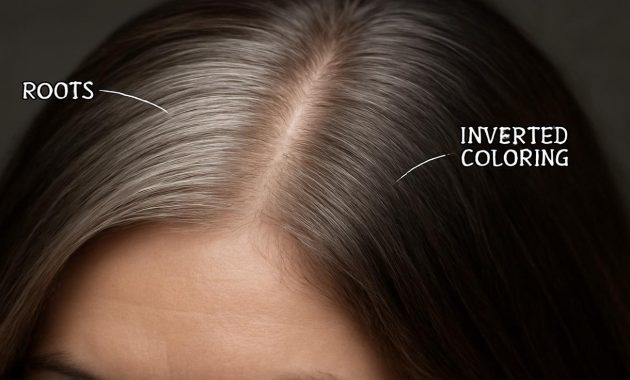
The first thing you notice is the light. It pours through the salon windows in a wide, forgiving sheet, catching silver strands, soft lines, the gentle movement of hands that know their way around both scissors and stories. A woman in her late fifties sits in the chair by the mirror, watching herself with the cautious curiosity of someone renegotiating a long-term relationship—with her hair, with her age, with the word “visible.” Her roots are shimmering white, her lengths a stubborn, faded brown, and for years she’s been at war with the sharp dividing line between the two. Today, though, something is different. Her colorist is talking not about hiding the gray, but about reversing the logic of color altogether. “Inverted coloring,” she says, comb gliding through silver like it’s spun light. “Instead of chasing your roots, we redesign where the depth lives. You’re not covering your gray; you’re framing it.”
The Quiet Revolution at the Roots
For decades, salons were battlegrounds where roots were the enemy and appointments were emergency triage. The “root effect” was the telltale stripe, that high-contrast band of white or gray that made you feel late, neglected, almost caught out. It wasn’t just about hair—it was the reminder that time was doing its subtle, relentless work, top down, millimeter by millimeter.
But somewhere in the last decade, something began to shift. You started seeing women—smart, modern, distinctly alive women—in their fifties, sixties, seventies, letting silver and white shimmer unapologetically. Not in a “giving up” way, but in a “I choose this” way. Still, for many, there was a problem: blended gray can be gorgeous, but the harsh line between colored lengths and a natural root still felt like a betrayal in the mirror.
Enter inverted coloring: a technique that turns the old logic of dye on its head. Instead of darkening the roots and lightening the ends, the colorist gently deepens the lengths and sometimes the undersides of the hair, leaving the roots and upper layers more natural, lighter, and often brighter. The result is almost counterintuitive: the parts we once fought hardest to hide become the highlight, a kind of built-in illumination around the face.
It’s almost like learning to read your own reflection from a new angle. The brightest part of your hair now lives near your skin, softening features, bouncing light into eyes, turning every turn of the head into a quiet invitation: Look here. See me. Not my dye job—me.
What Inverted Coloring Really Is (And Isn’t)
Inverted coloring sounds technical, but at its heart it’s a conversation about direction. Traditional coloring, especially before gray comes in, tends to put the darkest shade at the base and let the ends go lighter from sun, wear, or balayage. With inverted coloring for gray or white hair, that hierarchy flips. Your own pale roots become the star, and the darker dimension moves lower, where it blends gently into what’s already there.
Imagine your hair in three vertical bands: the root area near the scalp, the mid-lengths where your old color usually lingers, and the ends that carry the longest history. In a conventional approach, your stylist would aim to match your natural color at the root and pull it down, trying to erase the line between “now” and “then.” In inverted coloring, they do almost the opposite: your naturally light roots are allowed, even encouraged, to take center stage, while soft lowlights or muted tones are painted below them to create depth and movement.
This technique isn’t about theatrical, high-contrast ombré or dramatic reversals. On the contrary, the best inverted coloring on gray or white hair is subtle, like the shift of light in a room as afternoon becomes evening. It’s more about toning what’s beneath the gray than overriding it. The natural silver is preserved, refined, sometimes cooled down or warmed up with transparent glazes, while the darker shades are placed strategically where they can create dimension without demanding attention.
It’s also not a one-size-fits-all solution. Inverted coloring is less a single formula and more a philosophy: respect the gray, elevate the white, and support both with carefully placed color that works with nature instead of against it. For every head of hair, that looks a little different.
Why It Works So Well After 50
After 50, your hair isn’t simply “graying.” It’s rewriting its own texture, volume, and reflectivity. Many women find that their hair becomes drier, finer, and oddly contradictory—fluffy at the crown, frizz-prone at the ends, softer around the hairline yet wirier in the back. Color behaves differently on this new canvas. Heavy, opaque dyes that once looked lush can now feel flat and wig-like. Dense single-process color might cover every white strand but leaves the overall shape dull, like a painted helmet.
Inverted coloring leans into what age is already doing. As gray gathers mainly at the temples, around the part, and in the front hairline, this approach treats those areas as natural highlights. They frame your face with light, lifting your complexion the way a good reflector lifts a portrait photograph. The darker or more muted tones live below and behind, adding depth much the way shadows carve definition into cheekbones or jawlines.
The psychological shift here matters just as much as the visual. When you stop trying to drag your roots back to what they were at 30, you start making peace with what they’re doing at 55. The “root effect” softens into something gentler, almost unnoticeable, because the eye is no longer trained on that harsh demarcation line. Instead, there’s an easy gradient, a near-seamless blend that lets your hair grow in without urgent salon alarms ringing every four weeks.
Inside the Chair: How a Colorist Sees Your Gray
Walk into a salon and sit down for inverted coloring, and the first thing a good colorist will do is study—really study—your hair in natural light. They’ll lift sections at the crown, trace the pattern of your white strands with their eyes, and note where the gray is dominant and where your old tone still lingers. To them, your hair isn’t a problem. It’s a map.
Start by thinking about your gray like a landscape, not a defect: maybe the front and temples are pale silver, the top scattered with white threads, while the mid-lengths and ends cling to an older brunette, blond, or red identity. The challenge is not to “correct” that difference, but to orchestrate it.
With inverted coloring, they might:
- Leave the front hairline largely natural, only toning it slightly to neutralize yellow or dullness.
- Add soft, smoky lowlights to the mid-lengths under the top layer, choosing shades just a few steps deeper than your natural gray.
- Use translucent glazes or demi-permanent color instead of harsh permanent dyes, allowing your natural white to shine through like light through frosted glass.
- Darken the interior or underneath layers a touch, so that when your hair moves, shadow and light play together instead of clashing.
The overall effect feels more like photography than painting: exposure, contrast, warmth, and coolness fine-tuned so that your gray and white seem intentional, not accidental. You walk out of the salon with hair that still feels like yours, only edited—a director’s cut of your natural color story.
Choosing the Right Balance: Shades, Tones, and Contrast
Color after 50, especially when gray is in the picture, is rarely just about “blonde” or “brown.” It’s about tone: are your grays icy and cool, or soft and pearly? Does your skin glow more with a whisper of beige warmth, or does anything golden instantly turn brassy on you?
In inverted coloring, the darker tones that support your gray need to be chosen with care. Go too stark and you risk rebuilding the very contrast you were trying to escape; go too subtle, and the effect looks flat. Think of your hair in terms of light-diffusing neutrals:
- Soft mushroom browns that melt into silvery grays for those who once wore brunette.
- Smoky taupes that give body without shouting “I’m dyed.”
- Cool beige or oat blondes that pair beautifully with white streaks.
- Muted steel or slate tones for very cool, almost snow-white hair that wants a bit of edge.
The magic lies in placement, not just color choice. A slightly deeper tone around the nape can visually thicken fine hair, while a cleaner, brighter root and hairline can make tired skin look lit from within. The old equation—darker roots equal youthful—slowly gives way to a new truth: brightness around the face is what brings softness and vitality, especially when fine lines and texture have begun to tell their own stories.
Life Between Appointments: Low-Maintenance, High-Impact
One of the quiet freedoms of inverted coloring is how much it extends the life of a salon visit. Because the root is no longer a battlefield, your hair can grow without screaming for reinforcements. The line between “salon fresh” and “overdue” blurs into a long, forgiving stretch of okay.
For many women, that means stretching appointments from every 3–4 weeks to 8–12 weeks or more, depending on how dramatic the underlying contrast once was. Instead of panicking over that first half-centimeter of new white growth, you’re watching it blend into the existing lightness at the top while the deeper shades live farther down, quietly doing their job of adding shape.
Day to day, caring for inverted coloring is less about babying a dye job and more about respecting the new texture of your hair. Gentle shampoos, hydrating masks, and occasional purple or blue toning products can keep your silver from going yellow and your deeper tones from going muddy. Heat styling, if done, should be more about enhancing what you already have—loosely smoothing, adding a bend—than forcing your hair into submission.
And then there’s styling itself. When your brightest hair lives at the top and around your face, even simple shapes suddenly look intentional. A loose, low chignon reveals deeper, shadowed tones at the back of the head while letting pale tendrils fall forward. A cropped bob shows off clean silver at the crown while darker interior sections peek through at the nape. Every parting becomes a way to edit the balance of light and shadow on a given day.
Inverted Coloring for Different Cuts and Personalities
There is no single “after 50” haircut, no universal prescription for feeling current or beautiful. But inverted coloring is remarkably flexible; it slips easily into a variety of styles, each one telling a slightly different story about the woman wearing it.
- The softly layered bob: On this classic shape, natural silver at the crown and front can be framed by slightly darker, whisper-thin lowlights in the mid-lengths. When the hair moves, shades flicker like sunlight on water.
- The cropped pixie: With shorter cuts, inverted coloring might simply mean allowing a bright, natural front and crown while deepening the tiny nape or interior sections. The effect can be chic, gamine, and wonderfully low-fuss.
- The long, air-dried waves: For those who’ve kept their length, inverting the color gives flow and drama without the weight of thick, uniform dye. The top glows silver; the lower sections carry soft, smoky tones that keep the length from feeling stringy.
- Curls and coils: Textured hair loves dimension. Darker lowlights beneath a crown of salt-and-pepper spirals can give shape and definition, allowing the natural pattern to steal the show.
The common thread in all these looks isn’t age or even grayness; it’s a willingness to collaborate with the hair you have now instead of clinging to the memory of hair you once had. Inverted coloring doesn’t erase your story—it underlines the most interesting lines and lets the rest fade gently into the background.
A Quick Look at Options: Comparing Color Approaches After 50
Sometimes, the easiest way to understand inverted coloring is to see how it stacks up against other common approaches. The differences are subtle, but for everyday life—and how you feel in the mirror—they matter.
| Approach | How It Looks | Maintenance | Best For |
|---|---|---|---|
| Traditional single-process color | Uniform shade from root to tip; grays fully covered | High; roots visible in 3–4 weeks | Those wanting complete coverage and strong color |
| Conventional highlights/balayage | Lighter pieces throughout; some blending of grays | Moderate; 6–10 weeks | Softening gray without fully embracing it |
| Full grow-out to natural gray | Authentic silver/white; may have strong demarcation during transition | Low once transition is complete | Those ready to stop coloring altogether |
| Inverted coloring | Brighter roots and hairline; soft depth on mid-lengths and underneath | Moderate to low; lines of regrowth are softer | Enhancing gray/white while avoiding “root effect” |
Starting the Conversation With Your Stylist
Walking into a salon and saying “I want inverted coloring” may or may not ring a bell, depending on how plugged-in your stylist is to terminology. What matters more is how you describe the feeling you’re after. Bring photos—yes, of other women whose gray you admire, but also of your own hair on days you liked it. Point to the part that bothers you most: is it the stark line at the roots, the yellowing ends, the flatness near your face?
Then, try language like this:
- “I want my natural gray and white to be the brightest part of my hair, especially around my face.”
- “Can we put the darker tones lower down and underneath, so the regrowth doesn’t look like a hard line?”
- “I want to transition into embracing my gray, but I don’t want an obvious root band while I’m doing it.”
- “I’m okay with seeing some of my white, but I want the overall effect to feel soft, dimensional, and intentional.”
A good colorist will hear not just the words, but the longing behind them: to be seen as present, stylish, and fully yourself without pretending that time hasn’t moved. They might suggest doing the change in stages—first softening old color, then adding strategic lowlights, then gradually toning more of your natural gray instead of covering it. The path can be slow, but every appointment leaves you a little more aligned with the person you see in your head when you think, quietly, “me.”
Rewriting the Story of Gray and White
There’s something quietly radical about stepping into your fifties and beyond and deciding that your gray hair isn’t a problem to be solved but a material to be shaped. Inverted coloring is just one technique in a world of options, but it symbolizes a wider change in how we think about visibility and age. Instead of pushing brightness down and away—toward the tips, toward the shadows—it invites the light to live where you are most seen: at your roots, around your face, close to your expression, your laughter, your gaze.
Back in that sunlit salon chair, the woman in the mirror tilts her head as the colorist dries the last pieces. The top is luminous, a soft mist of silver and white that seems to float, while the lower sections hold just enough shadow to anchor it all. There is no obvious line, no scolding border between “before” and “after.” Just a gradient of time and tone and experience, seamlessly blended.
She leans closer, not to check for what’s been hidden, but to take in what’s been revealed. The color looks like her, only clearer, like someone finally focused the camera. “It doesn’t look dyed,” she says slowly. “It just looks…right.”
That might be the quiet magic of inverted coloring after 50: not that it turns back the clock, but that it helps the clock and the mirror shake hands at last.
FAQ: Inverted Coloring and Gray Hair After 50
Is inverted coloring suitable for all types of gray and white hair?
Most of the time, yes. Inverted coloring can be adapted for scattered salt-and-pepper, strong white streaks, or nearly full silver. The strategy and depth of lowlights simply change depending on how much natural lightness you already have and where it sits on your head.
Will inverted coloring damage my hair?
When done with demi-permanent colors, glazes, and gentle lowlights, it’s generally less aggressive than full permanent coverage. However, any chemical process carries some risk, especially on hair that’s already been colored or lightened many times. A strand test and honest discussion with your stylist are essential.
How often will I need to maintain inverted coloring?
Typically every 8–12 weeks, depending on how fast your hair grows and how much contrast you prefer. Because your roots are not being darkened, new growth blends more gracefully, allowing longer stretches between appointments.
Can I transition from fully dyed hair to natural gray using inverted coloring?
Yes, and that’s one of its strengths. Your stylist can gradually shift the focus of color downward, toning and blending the old dye while allowing more of your natural gray to appear at the top. Over several visits, the line between “dyed” and “natural” softens significantly.
What if I decide I don’t like my gray after trying inverted coloring?
You still have options. Inverted coloring doesn’t remove the possibility of going back to fuller coverage; it simply offers a gentler, more flexible way of exploring gray. If you miss deeper, richer color, you and your stylist can adjust the formula to reintroduce more depth while keeping some of the dimension you’ve grown to like.
Do I need a particular haircut to make inverted coloring work?
No single cut is required, but styles with some movement—layers, soft bobs, textured pixies—tend to show off the light-and-shadow effect best. A blunt, very solid one-length cut may require more subtle placement to avoid looking too blocky.
How do I talk to my stylist if they aren’t familiar with the term “inverted coloring”?
Focus on describing the result rather than the label. Explain that you want your roots and hairline to stay lighter and more natural, with darker tones placed lower and underneath to avoid a harsh root line. Bring photos that illustrate the look, and be open to your stylist’s professional interpretation.