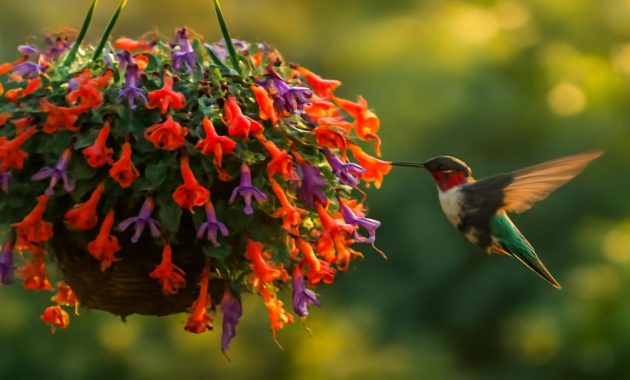
On a slow, blue-sky morning, you hang a modest basket of flowers by the porch, more out of hope than expectation. The street hums with distant traffic, a lawn mower chuckles somewhere down the block, and the world smells faintly of cut grass and coffee. Then—so fast you almost doubt it—a flicker of iridescent green arcs into the corner of your eye. A hummingbird, no bigger than your thumb, slows to a shimmering hover in front of your basket, wings a translucent blur. It leans in to drink, its beak disappearing into a bloom you chose. For a heartbeat, the world pauses. You hear the soft whir of wings, like a tiny fan, before the bird zips away in a streak of color, leaving you grinning at nothing in particular.
The Magic of a Basket at Eye Level
There’s something different—almost intimate—about attracting hummingbirds with a hanging basket instead of a feeder. Feeders are practical, sure: plastic reservoirs of sugar water that work like neon diners at a highway exit. But a hanging basket is a tiny, living ecosystem you get to build—a gravity-defying garden that moves in the wind, spills color over the edges, and offers real nectar that these birds evolved to seek.
Hanging baskets also happen at your level. On a balcony railing, under a porch beam, from the eaves of an apartment—suddenly the birds are not just specks in the yard. They’re close enough for you to see the glint in their eye, to notice how their throat feathers flash from dull brown to electric ruby with the tilt of the light. When they visit, they pause right in your airspace, not far above your coffee cup.
Part of the magic is how three worlds meet in that small circle of soil: plant, bird, human. The flowers reach for light, spilling blooms and fragrance. The hummingbird arrives as a tiny pollinating meteor, drawn by color, shape, and sugar. And you, the accidental choreographer, pick which plants get to play the starring roles, which colors will hang like lanterns in the air.
Choosing that one flower—or mix of flowers—that a hummingbird can’t resist becomes less about “decor” and more about an invitation. You’re essentially writing a love letter in petals and nectar, addressed to any passing hummer that happens to read the message written in red, orange, and tubular blooms.
What Hummingbirds Really Look For in a Flower
Before you pick a single plant for your basket, it helps to step into the mind (and beak) of a hummingbird for a moment. Forget pretty color combinations and aesthetic Pinterest boards. Hummingbirds don’t care if your basket matches your shutters. They’re after one thing: fuel.
These birds run on a razor-thin energy budget. A hummingbird’s heart can beat more than a thousand times per minute. Their wings may flap 50–80 times per second. They’re constantly burning through calories just to stay airborne. Every flower they visit has to earn its keep. So what makes a bloom worth their time?
First, nectar—and not just a little. Hummingbirds want flowers that refill quickly and generously. That usually means tubular or trumpet-shaped blooms where nectar pools deep inside, safely tucked away from less specialized pollinators.
Second, shape and color. Red is their billboard on the highway, flashing “food here” from a distance. They’ll also stop for hot pinks, oranges, purples, and sometimes whites, but red still wins the popularity contest. The tube shape matters too: slim, elongated corollas that match the length of their narrow beaks and tongues.
Third, continuous bloom. A single brief flush of flowers isn’t helpful to a bird that needs reliable fuel stations. Hummingbirds gravitate toward plants that keep blooming for months, not just a week in May. In a hanging basket, your goal is a rotating buffet where something is always in bloom.
Last, easy access and safety. If your beautiful basket hangs in a wind tunnel or in full view of a perching predator (like a lurking outdoor cat), hummingbirds might treat it as a risky stop. They want a place where they can dart in, drink, and vanish without drama.
How a Hanging Basket Checks All the Boxes
A hanging basket offers a cozy, concentrated cluster of everything hummingbirds like—nectar, color, height—placed right where you’ll see it. You can tilt it into their preferred comfort zone: bright but not scorching sun, sheltered from wild wind, and within reach of another safe perch like a nearby tree or railing.
With the right plant choice, your basket becomes more than decoration. It transforms into a bright, living “rest stop” in the sky, a station on the invisible routes hummingbirds travel each day as they patrol for food.
The One Flower That Steals the Show
If you had to pick a single flower to anchor a hummingbird-friendly hanging basket—one that offers non-stop color, dependable nectar, and a cascading habit that looks like actual fireworks in bloom—it would be trailing or basket-form fuchsias.
Hang a well-grown fuchsia basket in midsummer and it looks like someone turned gravity upside down. Dozens of pendulous buds dangle like ornaments, opening into two-toned flowers with flared skirts and dangling stamens. To our eyes, they’re elegant. To a hummingbird’s eyes, they’re a neon-lit buffet.
The tubular bases of fuchsia blossoms hide nectar that hummingbirds can reach perfectly with their long tongues. When the birds hover beneath the blooms, their beaks slip into the tubes like a key into a lock. The flowers dangle at just the right angle: no awkward landings, just hover, sip, hover, sip, on to the next.
There’s also something almost cinematic about a hummingbird visiting fuchsias. The bird arrives as a flash of motion, then slows to hover beneath these dangling, lantern-like blooms, wings a translucent disc. Their beak points up, the flower points down, and for a second they meet in the middle, like an upside-down toast.
Why Fuchsias Work So Well in Baskets
Fuchsias weren’t designed for ground-level flowerbeds. Their natural grace shows best when gravity can have its say—when stems droop, when blooms swing, when the air can move around them. That’s where a basket becomes their stage.
In a hanging basket, fuchsias can:
- Spill over the edges, making more blooms visible from below and all sides, perfect for hovering visitors.
- Catch light differently throughout the day, their pinks, purples, reds, and whites glowing in soft shade or dappled sun.
- Stay cooler than in tight, heat-baked ground beds, which many fuchsia varieties appreciate.
And despite their elegant look, fuchsias are workhorses when it comes to blooming. With regular care—consistent watering, some feeding, and the occasional grooming—they can keep sending out flowers from late spring right into fall, depending on your climate. For hummingbirds, that means a steady flow of nectar all season long.
Designing a Hummingbird Basket They Can’t Resist
Imagine you’re designing a tiny, hovering café. What matters isn’t just which flower you choose, but how you arrange the menu, how you light the sign, and where you place the tables. A beautiful hummingbird basket is part art, part ecology, and part quiet observation experiment.
You can absolutely plant an entire basket with just one stellar variety of trailing fuchsia and call it done. In fact, that’s a powerful, simple choice hummingbirds will appreciate. But if you enjoy mixing plants, you can layer other hummer-friendly blooms with complementary shapes and colors.
Smart Plant Partners for Your Fuchsia Basket
Here’s a comparison of popular hanging-basket flowers that hummingbirds tend to favor, along with how they fit into a mixed design:
| Plant | Flower Shape & Appeal | Bloom Season* | Best Basket Role |
|---|---|---|---|
| Trailing Fuchsia | Dangling, tubular, nectar-rich; very attractive to hummingbirds | Late spring to frost | Star of the show, main nectar source |
| Trailing Petunia (e.g., Surfinia) | Trumpet-shaped, large, colorful; hummingbirds often visit | Spring through fall | Filler and color companion |
| Calibrachoa (Million Bells) | Mini trumpets, abundant blooms; some hummingbird appeal | Spring to fall | Edge spiller, dense color |
| Cuphea (Cigar Plant) | Slender tubes, orange/red; highly favored nectar plant | Summer to frost | Accent “hot spots” for extra nectar |
| Lantana (Dwarf/Trailing) | Small clusters; butterflies & some hummingbirds visit | Summer to frost | Sunny-side color and support |
*Bloom seasons vary by climate and care.
If you’re new to this, start simple: one large, healthy trailing fuchsia in the center of the basket, surrounded by two or three calibrachoas or trailing petunias in complementary colors. Pick at least one strong red, magenta, or deep pink to flash a clear “open for business” sign to passing hummingbirds.
As your confidence grows, you can experiment. Try a fuchsia-and-cuphea pairing in a warm, bright spot, or fuchsia with dwarf lantana on the side of the basket that gets more sun. Watch which flowers the hummingbirds favor. They’ll tell you, with their visits, which plants earn their space.
Light, Water, and Care: Keeping the Café Open
Hanging baskets live a slightly more extreme life than plants in the ground. Suspended in the air, they dry out faster, heat up faster, and depend entirely on you for water and food. But that also means you can fine-tune conditions for your chosen flowers—and for the hummingbirds that visit them.
Most basket fuchsias prefer bright light without brutal midday sun. Morning sun with afternoon shade, or dappled light all day, keeps them happiest. Too much noon sun and they sulk; too little light and they bloom sparsely. Watch how the light passes around your porch, balcony, or yard through the day, and hang the basket where the plants get about 4–6 hours of gentle sun.
Water becomes your daily ritual. On a warm day, soil in a hanging basket can go from damp to desert-dry in a single afternoon. Slip a finger into the soil up to your first knuckle: if it feels dry, it’s time. Water deeply until it runs out of the drainage holes, so the entire root ball drinks. In very hot spells, you might water morning and evening. This steady moisture is what drives continuous blooming—and, by extension, continuous hummingbird visits.
Feeding Flowers to Feed Birds
While you could hang a sugar-water feeder, there’s a quiet satisfaction in knowing that the nectar your birds drink is plant-made. To keep blooms coming, use a gentle, balanced fertilizer formulated for flowering annuals every couple of weeks during peak growing season. Avoid overdoing it—lush, leafy growth with few flowers won’t help your visitors.
You’ll also find yourself doing regular, almost meditative grooming. Pinch off spent blooms and any seed pods that form; this “deadheading” nudges the plant to keep blooming. You might trim a leggy stem here or there, shaping the basket so it stays full and billowing. Over time, you’ll develop an eye for the small tweaks that keep the basket vigorous.
And then there’s the part that’s not strictly necessary but feels right: giving the basket a once-over before a storm, or rotating it every week so all sides get light. These small acts are a way of tending not just plants, but a relationship—with the tiny, buzzing guests you hope will keep returning.
Bringing the Show Up Close
One of the quiet joys in this whole hummingbird-basket project is proximity. You’re not trying to create a distant scene; you’re setting the stage for encounters. That means thinking like a bird and like a spectator.
First, choose a spot where hummingbirds feel safe. They like an escape route—open air they can dash into if startled. Hanging a basket tucked way back in a narrow, enclosed nook can make them wary. Instead, pick a place with open approach paths and a nearby perch: a tree branch, a railing, even a clothesline where they can pause and preen between sips.
Second, think about your own vantage point. Where do you naturally sit, work, or wander during the day? If there’s a chair you love by a window, a small table on a balcony, or a shady corner on the porch where you drink your coffee, that’s where the basket belongs. Aim for eye level or just above—it’s far more engaging to see a hummingbird hovering in front of your face than high overhead.
Over time, if you move calmly and consistently in that space, the birds will start to accept you as part of the background. You’ll notice how they sometimes hang in place to look you over, tiny black bead eyes appraising, before darting back to the flowers. They may learn your rhythms: morning coffee means the human is quiet and still; evening watering means the blooms will be fresh for tomorrow’s rounds.
It doesn’t hurt to layer your efforts with other hummingbird-friendly elements nearby—a patch of salvia in a pot on the steps, maybe, or some bee balm in a planter. Your hanging basket becomes the centerpiece of a small sky garden, one that’s mapped and remembered by the birds as they weave through your neighborhood each day.
Frequently Asked Questions
Which flower is best in a hanging basket for attracting hummingbirds?
Trailing fuchsias are one of the best choices. Their drooping, tubular blooms are packed with nectar, bloom for a long season, and hang at perfect angles for hovering hummingbirds. A single well-planted fuchsia basket can become a reliable feeding station.
Do hummingbirds prefer real flowers over sugar-water feeders?
They use both. Real flowers provide nectar plus trace nutrients and support pollination. Feeders offer a concentrated, predictable sugar source. A hanging basket of nectar-rich flowers near (but not crowding) a feeder gives them options and encourages more natural foraging behavior.
How close can I hang the basket to where I sit?
Hummingbirds are surprisingly tolerant if you move calmly. Hanging the basket 4–8 feet from your favorite chair or window often works well. They may be shy at first, but usually adapt, eventually visiting even while you’re nearby.
How much sun does a hummingbird basket need?
It depends on the plants. Trailing fuchsias typically prefer morning sun and afternoon shade or consistent bright, indirect light. If you’re mixing in sun-lovers like lantana or certain petunias, hang the basket where it gets at least a half-day of gentle sun, then adjust placement based on how the plants respond.
Can I grow a hummingbird basket on an apartment balcony?
Yes. A balcony is an excellent place for a hanging basket, especially if there are trees, gardens, or other flowering plants visible nearby. Even in urban areas, hummingbirds follow green corridors. A single, nectar-rich basket can become a welcome stop on their daily patrols.