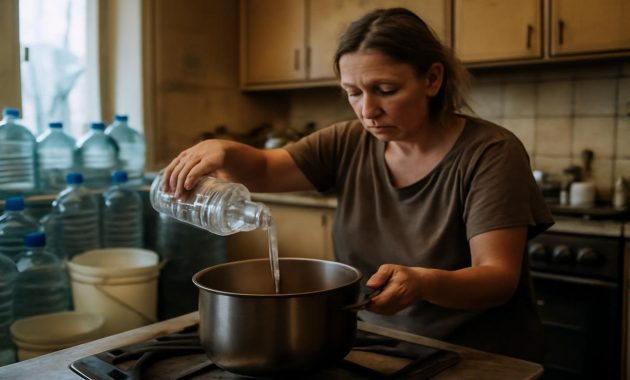
The smell hits first, faint but unmistakable—the sour tang of unwashed dishes, the mineral ghost of old pipes, the humid, closed-in scent of a town that has been holding its breath for too long. On Willow Street, where front porches lean a little toward the road like tired shoulders, Waterbury wakes up to another day of the water crisis. Faucets still turn, but many residents barely trust what comes out. So they ration. They substitute. They invent. They lean on one another. The familiar act of turning on a tap has become a small gamble, a negotiation with risk and necessity. And in between those ordinary gestures of daily life, something else is flowing—quiet ingenuity, stubborn care, and a kind of makeshift dignity you can feel in the steam over a shared pot of boiled water.
A Morning Without Running Water
By 6:30 a.m., the first streaks of light brush the cracked sidewalks outside the Martinez apartment. Inside, the entire household is already in motion. The kitchen, normally a place of quick breakfasts and clinking mugs, has been reorganized into a small-scale water station. Gallon jugs line the counter like sentries, each one labeled with black marker: “Drinking Only,” “Cooking,” “Hand Wash,” “Toilet Flush.”
“We used to leave the water running when we brushed our teeth,” Elena says, rolling her eyes at her past self as she pours a careful stream from a repurposed iced tea jug into a plastic basin. “Now, if we see a drip, we’re on it like it’s an emergency.” She laughs, but it’s a tired sound.
Her two kids take turns at the basin, swirling soft toothbrushes through the cool water, spitting into an old yogurt container instead of the sink. The routine looks strange at first glance—makeshift and a bit awkward—but the children go through it with effortless rhythm. This is their new normal, the choreography of a town learning how to be clean without trusting the very supply that once seemed endless.
On the stove, a large pot rattles gently as water reaches a boil. This will be the day’s washing reserve: dishes, a few wiped counters, maybe a careful sponge bath for the youngest. Every minute of boiling is a small act of defiance: against contamination, against scarcity, against the slow erosion of what used to feel like simple dignity.
The New Rituals of Clean
Bucket Showers and Bathing by Lantern
Across town, in a third-floor walk-up overlooking an alley of overflowing trash bins, twenty-eight-year-old James has perfected his “two-bucket shower.” One bucket is filled from jugs of store-bought water; the other collects graywater from rinsed vegetables and cooled boiled water from pasta nights. He keeps them side by side in the bathtub, a cracked blue plastic cup perched on the rim like a ceremonial ladle.
“The first week I tried nothing but baby wipes,” he admits, running a hand over the stubble on his chin. “Didn’t last. You start to feel… not like yourself. There’s something about real water on your skin. Even if it’s just a cup at a time.”
He has it down to a routine: two cups to wet his hair and shoulders, one more to soap up, four to rinse fully. Between each splash, he waits, listening to the water drip from his elbows, counting in his head—not for time, but for volume. “That’s about eight cups,” he says. “Half a gallon. I write it down. I track everything now.” He taps a notebook on a shelf, pages filled with neat, meticulous rows of numbers: date, gallons stored, gallons used, where they went.
At night, when the electricity flickers or the pressure drops even further, some families bathe by lantern light, improvising with washcloths and shared basins. You can see glows in bathroom windows across Waterbury, flickering islands of quiet where people try to wash the day off in the most literal way they still can. Hygiene—once a background habit—has moved front and center, a daily project requiring attention, planning, and sometimes teamwork.
Kitchen Sinks Turned Conservation Labs
The kitchen, too, has become a space of calibration and experiment. At the Delgado home, a dish rack now sits inside a larger plastic tub. Every rinse of a plate, every quick swish of a glass, feeds the water collected below. Later, that tub will be carried—carefully, two hands, slow steps—to the bathroom for flushing the toilet. Nothing gets used just once.
“It’s like a weird science project,” says sixteen-year-old Mariah, who convinced her parents to start measuring exactly how much water they use to wash dishes. “We timed it, and leaving the tap running for five minutes was like… forget it. We’re not doing that again. Now we use a spray bottle for rinsing. Just enough. No more than that.”
Their dining table—once crowded with schoolbooks and open laptops—is now partly given over to water storage. Rows of reused glass jars and recycled plastic bottles line up like translucent bricks, each one carefully filled from a trusted source or boiled and cooled. One jar is lightly clouded with dissolved soap; it’s the “handwash jar,” kept strictly for scrubbing after coming in from outside.
“We used to buy hand soap that smelled like mangoes or vanilla or whatever,” Mariah says. “Now it’s whatever bar soap we can find cheap that lasts the longest and rinses the easiest. Less bubbles, less water to wash it off. It’s funny… I never thought I’d miss bubbles.”
Community Hacks and Unlikely Helpers
Laundromats, Gyms, and Parking Lot Faucets
Waterbury’s laundromats have turned into quiet hubs of both cleanliness and gossip. On a damp Thursday afternoon, the hum of oversized washers mixes with the low buzz of conversation. People don’t just come here for laundry—they come to feel, for a brief hour or two, that water flows the way it should.
Outside Suds & Spin on East Main, a pair of five-gallon jugs stand waiting in a beat-up shopping cart. Their owner, a grandfather named Rudy with patient eyes, nods toward them. “While the clothes are going, I fill these from the machine hookup out back,” he says. “They don’t love it, but they don’t stop me. Everyone knows we’re all just trying to get by.”
Some gyms have seen a surge in day passes. Residents without reliable water at home are buying cheap monthly memberships, not just to stay fit but to access the most coveted luxury in town: a pressurized hot shower. “I come here twice a week,” says Keisha, pulling a towel from her gym bag. “I actually work out now, I guess, but I’m mostly here for that fifteen-minute shower. It feels like a spa day, even if it’s just fluorescent lights and cheap body wash.”
Parking lots have become improvisational water stations. Behind the community center, a lone spigot—once used to water flower beds—now sports a chain of hose attachments, splitters, and valves that look like a mechanical octopus. People line up with milk jugs, repurposed paint buckets, and collapsible camping containers, sharing tips as they wait: how to keep stored water from tasting like plastic, which filters are still in stock at the hardware store, who might have a spare barrel to trade.
Inventors in Every Apartment
Inside a small second-floor apartment on Crowley Street, science teacher and single mom Anika has turned her living room into what her children affectionately call “The Water Lab.” On a low table, she’s set up a series of makeshift filters—coffee cones layered with clean cotton cloth, plastic bottles cut in half and inverted over jam jars, a ceramic pot slowly dripping clear water from a sand-and-charcoal-filled core.
“We’re not doing anything fancy,” she says, pulling a kettle off the stove before it whistles. “Boil, cool, filter, label. But I want the kids to know what’s happening to the water they drink. It’s not magic—it’s physics and patience.”
Her oldest, twelve-year-old Jonah, proudly demonstrates the “two-step handwash station” he designed out of an old metal stand and a pair of stacked basins. The top holds clean water released by a simple foot pedal made from a bungee cord and a chunk of scrap wood. The bottom catches the used water for flushing. “No one touches the tap with dirty hands,” he explains. “It’s like the ones we had at camp, but now it’s in our hallway.”
Innovation pops up in smaller ways, too: shower caddies repurposed as hanging drying racks for dishcloths so they can be reused longer between washes; leftover rain barrel projects suddenly dusted off and placed beneath gutters whenever the weather looks promising; five-dollar spray misters from the dollar store upgraded into full-body “mini showers” on back porches and balconies.
| Creative Hygiene Hack | Water Needed (Approx.) | Where the Water Comes From |
|---|---|---|
| Two-bucket showers with a scoop cup | 0.5–1 gallon per person | Stored jugs, gym refills, boiled tap |
| Handwashing basin with captured graywater | 1–2 cups per wash | Filtered tap, bottled, or community taps |
| Dishpan-in-sink method for reuse | 1–2 gallons per meal | Boiled tap, rainwater (for pre-rinse) |
| Toilet flushing with collected graywater | 1–1.5 gallons per flush | Bath water, dishwater, laundry runoff |
| Spray-bottle “mini baths” | 2–4 cups per use | Filtered tap or bottled water |
Hygiene Under Pressure: Bodies, Pride, and Routine
When Cleanliness Becomes Emotional
In living rooms and on stoops, people talk about rashes and dry scalps as readily as they talk about grocery prices now. Dealing with limited water has made bodies—and all their needs and quirks—impossible to ignore.
“My eczema flared up bad when this all started,” says Tasha, who works the register at a downtown corner store. “I was trying to stretch showers to every three, four days. Using way too much sanitizer. My hands cracked open. My little girl’s hair got so dry from the bottled water and no conditioner—it felt like straw. I cried one night just combing it.”
After comparing notes with other parents, she started a new ritual: Sunday evening “moisture night,” with a gigantic pot of boiled-and-cooled water just for hair and skin care. The kids line up at the table while she works in leave-in conditioners that don’t require rinsing and gently cleans scalp with diluted shampoo applied from a squeeze bottle. The water they use for rinsing is caught in a basin and later becomes toilet flush water. Nothing is wasted, but for that hour, the focus is on care, not scarcity.
For teenagers, hygiene has turned into a social tightrope walk. No one wants to be “the one who smells.” Some have begun carrying small washcloths and travel sprays of diluted soap solution in their backpacks, sneaking into school bathrooms between classes to freshen up. A few teachers quietly stock deodorant sticks in their desk drawers, sliding them across when students ask for help in hushed voices.
“It changes how you feel about yourself,” says Darnell, a high school senior. “Like, you could have the cleanest shoes in the world, but if you’re not sure about your armpits, you don’t feel right. So we share stuff. Wipes, cologne, whatever. It’s like a new type of school supply.”
Neighborhood Networks of Care
Trading Showers for Rides, Soap for Storage
The longer the crisis continues, the more Waterbury’s informal networks seem to thicken and spread. Facebook groups and group texts buzz late into the night with offers and requests: “Extra five gallons if someone can pick up meds for my mom.” “Got a working filter—will trade use for a ride to work.” “Can store two barrels in my basement for anyone in the building who doesn’t have space.”
In one three-story brick building on Cooke Street, the residents have started what they jokingly call “The Hygiene Co-op.” It began when one tenant, an overnight nurse with odd hours, realized her shower time rarely overlapped with anyone else’s. She started offering neighbors thirty-minute windows to come use her bathroom during the day when she was at work, in exchange for a share of their filtered or boiled water. Someone else contributed extra soap and shampoo bought in bulk. Another offered to pick up and deliver laundry. Within weeks, shower slots were penciled into a shared calendar tacked to the stairwell wall.
“We’re strangers who know each other’s shower schedules now,” one resident laughs. “It’s weirdly intimate. But also… it made the building feel like a community for the first time. Before this, we just nodded in the hall. Now we share bowls and buckets and stories.”
At the Trinity church hall, folding tables fill each Wednesday with donations: bar soaps, travel-sized shampoos from old hotel stays, packs of baby wipes, stacks of clean towels. People take what they need and share what they can. No one has much, but small offerings—half a bottle of lotion, an extra roll of toilet paper, an unused toothbrush—add up. Volunteers set up a “hygiene corner” where anyone can ask quietly for menstrual products, incontinence pads, or diaper cream without having to explain too much.
Learning to Count Every Drop
Numbers Become a Shared Language
In the early days of the crisis, people spoke in generalities: “We’re using less,” “We’re trying to be careful.” Now, the language has sharpened into numbers. One family can tell you exactly how many gallons they need per day to keep everyone washed, fed, and functioning. Another has boiled their usage down to a weekly chart stuck to the fridge with a magnet shaped like a dolphin.
“Before, I had no idea how much water it took to live,” says Thomas, who works part-time at a hardware store that has completely sold out of five-gallon containers. “Now I know: about 15 gallons a day for the three of us, if we’re really careful. That’s with cooking, drinking, washing hands, sponge baths, and flushing. That number is burned into my brain.”
Children absorb this arithmetic almost by osmosis. In some homes, they’re the ones reminding adults not to dump unused glassfuls of water down the sink, but into the plant-watering jug or the cleaning pail instead. A few kids have turned it into a kind of game—who can get their “personal water score” the lowest without feeling grimy or thirsty?
“It’s survival math,” says Anika, the science teacher. “They’re learning volume, measurement, and the physics of filtration because they have to. But they’re also learning empathy—seeing whose needs get met first when there isn’t enough to go around. That part is harder.”
Holding On to Ordinary Moments
Amid the buckets and basins, the calculations and compromises, Waterbury’s residents still reach for ordinary comfort. A little boy blows bubbles in dishwater and laughs as they pop on his nose. Two teenage sisters argue over who used the last clean towel, then end up sharing it anyway, shoulders bumping as they brush their teeth over a shared basin. An elderly man waters his tomato plants with leftover rinse water, apologizing softly to them as if they can understand that he’s doing his best.
On a late summer evening, as the sun sinks behind a ragged line of rooftops, the Martinez family sits on their front steps. Inside, pots of boiled water cool slowly on the stovetop. Outside, the street smells faintly of hot asphalt and grilled meat from somewhere down the block. The children chase one another with a spray bottle, their laughter carrying above the distant sirens and the clatter of a passing bus. Each spritz is a tiny luxury, a miniature rebellion against the idea that scarcity must choke out joy.
“We’re tired,” Elena admits, watching them. “Every day is like… another thing to plan, another thing to worry about. But you find ways. You borrow ideas. You share. You keep clean as best you can, because it makes you feel human. And you hope—really, really hope—that one day, turning on the tap can go back to being something you don’t have to think about.”
Until then, Waterbury’s people will keep inventing. They will keep scrubbing and boiling and measuring, passing along tricks and tools and fragments of wisdom the way water itself once moved through the town—quietly and continuously, from one house to the next. In the absence of reliable streams from the pipes, another current has formed: one of resilience, resourcefulness, and the most basic of human desires—to feel clean, and therefore, to feel whole.
Frequently Asked Questions
How are Waterbury residents managing personal hygiene with limited safe water?
Most residents are combining multiple strategies: shorter and less frequent showers, sponge baths or “bucket showers,” using spray bottles for quick rinses, and prioritizing hand and face washing. Many boil questionable tap water for washing and save bottled or filtered water for drinking and brushing teeth.
What are the most common creative hygiene solutions people are using?
Common strategies include catching graywater from washing dishes or bathing to flush toilets, setting up handwashing stations with basins instead of running taps, sharing showers within buildings, using gyms and community centers for access to hot showers, and improvising filtration with boiling, cloth filters, and household charcoal.
How do families keep children clean and healthy during the crisis?
Families focus on frequent handwashing with small amounts of water, wiping down faces and bodies with cloths, scheduling regular “wash nights” with carefully rationed boiled water, and using leave-in hair products or low-rinse soaps. Many parents also involve kids in tracking water use, turning conservation into a shared responsibility.
Is relying on baby wipes and hand sanitizer enough for hygiene?
Wipes and sanitizers help but are not a complete substitute for water. They are most effective as supplements—for example, between sponge baths or when water is especially scarce. Overreliance on them can lead to skin irritation, so residents often rotate between wipes, cloth washing, and occasional full rinses when possible.
What role do community spaces play in helping people stay clean?
Laundromats, gyms, churches, and community centers have become vital hubs. They provide access to functioning plumbing, showers, and sometimes donated hygiene supplies. Many residents trade rides, water storage, or chores in exchange for shared use of showers and washing machines, turning hygiene into a communal rather than strictly individual effort.