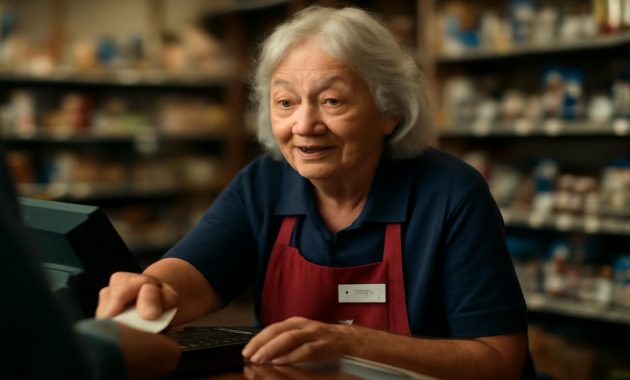
The line at the grocery store was barely moving, but nobody seemed to mind. Third in line, a silver-haired woman in a green cashier’s vest was chatting with the customer in front of her as she rang up apples, coffee, and cat food. She had the kind of easy laugh that made strangers want to tell her their stories. Her name tag read: “Marjorie – Here to Help.” If you looked closely, there was a second, smaller pin beneath it: “Retired, but still in the game.”
At 72, Marjorie had officially retired from her job as a school secretary four years earlier. She’d had the cake, the farewell speech, the stack of cards signed in looping ink. She’d also had something else: a calculator, a small panic, and a quiet realization that the numbers didn’t really add up. The pension she’d counted on wasn’t enough. Her savings were thinner than she wanted to admit. The cost of rent, food, medicine, and her slightly extravagant love of helping her grandchildren with college books – all of it pressed on her like a subtle but constant weight. So she did what more and more older adults are doing: she went back to work.
The French have a word that fits people like her: cumulants – seniors who “cumulate” or combine their retirement pension with paid work. The word is drifting into more languages, more conversations, and, slowly, more lives. You can spot cumulants in grocery aisles, guiding tours at museums, driving rideshares, designing websites, leading nature walks, and answering customer service calls from their own living rooms. They are retired – on paper. In reality, they are at the cash register, behind the wheel, in the workshop, in front of the laptop, continuing to work not just for the joy of staying active, but very often, to make ends meet.
The new face of retirement: not an ending, but a remix
The classic picture of retirement – a gold watch, a beach chair, a long slide into hobbies and grandchildren – is fading like an old postcard left on a windowsill. In its place is a messier, more dynamic, and far more realistic image: older adults working part-time, changing careers entirely, starting small side businesses, or taking on seasonal jobs. Many of them are not doing it for fun alone. They are doing it because they must.
Walk into any early-morning café and you might bump into this new retirement. There’s the 68-year-old former engineer who now drives a delivery van three days a week before sunrise, the 73-year-old who prepares online tax returns from her kitchen table, the 65-year-old artist who took a job in a hardware store so he could keep up with rising rents. The air smells of roasted coffee and printer paper. Laptop screens glow with spreadsheets and schedules. Conversations drift from cholesterol levels to shifts, from travel dreams to fuel prices.
For many cumulants, the decision to work after retirement lands somewhere between necessity and choice. On one side are bills, inflation, and medical expenses that grow faster than pensions. On the other side are the less measurable things: boredom, a sense of fading relevance, and a quiet hunger for structure and companionship. Retirement, it turns out, can feel too much like a vacuum when you’ve spent forty or fifty years waking up to an alarm clock.
Instead of stepping fully out of the current, cumulants wade back in – not always by diving into the same job they left, but often by redesigning work to fit the life they want now. They might take shorter hours, flexible contracts, or seasonal roles. They may turn passions into income: knitting for online shops, teaching piano, offering paid birdwatching walks in the local park. They are rewriting the script and proving that retirement is less “The End” and more “To Be Continued.”
Why wallets – not wanderlust – are pushing seniors back to work
Underneath the heartwarming stories and Instagram-ready photos of “active seniors” lies a more uncomfortable truth: a lot of cumulants are working because their finances demand it. It may sound dry, but you can feel it in the small details of a life: the groceries that get quietly swapped for cheaper brands, the vacations that turn into day-trips, the prescriptions that trigger tense conversations at the pharmacy counter.
Consider how the financial ground has shifted under today’s seniors:
- Rising cost of living: Food, housing, utilities, and healthcare have all climbed in price, often faster than pensions or savings accounts.
- Longer lives: Living longer is a gift, but it also stretches savings across more years than many people planned for when they first imagined retirement.
- Unstable careers and pensions: Not everyone had a stable, pension-rich career. Many worked part-time, changed jobs often, or raised families with years out of the workforce. Their retirement income reflects that instability.
- Support for family: Some seniors are still helping adult children who face their own financial struggles, or they’re stepping in to help with grandchildren’s expenses.
When all these factors collide, the romantic fantasy of a fully work-free retirement collides with the reality of monthly bills. Going back to work – or never really stopping – becomes a bridge between what a pension provides and what life actually costs.
To see this more clearly, picture a very simple budget – not theoretical, but close to what many retirees describe when they sit at the kitchen table with a pen and a notepad.
| Monthly Item | Average Cost (Currency Units) |
|---|---|
| Rent / Property costs | 700 – 1,200 |
| Groceries | 250 – 400 |
| Utilities & Internet | 150 – 250 |
| Transportation | 80 – 200 |
| Healthcare & medication | 150 – 350 |
| Other (clothes, gifts, small pleasures) | 100 – 200 |
Now place next to that a pension that sits around the lower end of that spending – or even below it. The gap is where cumulants live. A couple of days a week of paid work, or a small but steady freelance income, can spell the difference between constant anxiety and a bit of breathing room. Between staring at receipts and quietly ordering dessert.
Cumulants, not “has-beens”: a new respect for older workers
Step into the back room of a garden center on a breezy spring morning, and you might see a scene that explains another side of this story. A group of employees huddles around a whiteboard while their manager talks through the day’s plan. Among the young seasonal workers in hoodies and sneakers stands a white-bearded man named Luis, in a sun-faded cap. When the manager hesitates on how to organize the new shipment, it’s Luis who gently suggests a better layout – one he remembers from his years managing a nursery long before most of his coworkers were born.
Workplaces that welcome cumulants are discovering something powerful: experience doesn’t vanish when you walk out of your last full-time job. It accumulates. It evolves. It can be shared – if someone invites it in.
For seniors, this recognition matters deeply. When a culture glorifies youth, older adults can start to feel invisible the moment they step out of the official workforce. Their skills, stories, and instincts become like books on a high shelf no one bothers to reach for. Paid work changes that. It pulls those books down, opens them, and underlines them with fresh ink.
Many cumulants talk about the non-financial rewards almost more than the paycheck:
- The buzz of being needed when a customer is confused or a coworker is overwhelmed.
- The rhythm of a week divided into “work days” and “free days,” instead of a long blur of sameness.
- The small, human exchanges: jokes at the coffee machine, shared frustrations with software updates, the gentle ritual of saying “See you Thursday.”
There’s also the matter of identity. For decades, many people introduced themselves with their job: “I’m a nurse.” “I’m a mechanic.” “I’m a teacher.” Retirement can steal that ready-made answer, leaving a blank space where a social anchor used to be. Cumulants are building hybrid identities: “I’m retired, but I also…”. In that “also” lives a sense of continuity, dignity, and pride.
Of course, this only works if workplaces respect their older employees. Ageism – subtle jokes, lowered expectations, or being overlooked for training – can turn a hopeful new job into a weary repeat of old injustices. The healthiest workplaces don’t treat cumulants as stand-ins or novelties; they see them as colleagues whose age is one part of who they are, not the whole story.
From flower stalls to laptop screens: the many ways seniors are working
If you imagine all cumulants wearing the same uniform – maybe a supermarket vest or a tour guide badge – you’re missing the wild variety of this trend. Older adults are stepping into some jobs we expect to see them in and many we do not. Wander through a city on any weekday, and the pattern starts to emerge.
At the corner market, the person diligently arranging oranges in a pyramid is a retired accountant who prefers moving boxes to moving numbers now. In a sunlit yoga studio, a soft-voiced instructor in her late sixties leads a class of mixed ages, her movements slower but precise, her calm presence anchoring the room. At the public library, a retired lawyer now spends three afternoons a week helping people fill out forms and understand their rights.
Some cumulants return to familiar territory, taking consulting roles in the same industries they once navigated full-time. Others make dramatic pivots: the former bus driver selling handmade birdhouses at weekend markets, the one-time corporate manager who trains as a health aide to support even older neighbors, the ex-teacher who now narrates audiobooks from a makeshift studio in her spare bedroom.
The digital world has stretched the map even further. Seniors who once mailed letters now send invoices. Many are:
- Offering language lessons or tutoring online.
- Selling crafts or vintage items through digital marketplaces.
- Working in remote customer service roles, headset resting gently over thinning hair.
- Doing micro-consulting, lending deep knowledge for short, focused projects.
For some, the shift online requires patience – learning new platforms, wrestling with passwords. Yet plenty of cumulants embrace it with the same stubborn, quiet determination they once used to figure out how to program the first VHS recorder on the block.
Between these jobs runs a common thread: a desire to keep contributing without sacrificing everything. Many seniors don’t want another forty-hour week; they want four hours on Tuesday, six on Thursday, and a bit of space for sore knees, doctor visits, and sunsets. The most successful arrangements honor that. They treat older workers not as leftover labor, but as people who have already done a lifetime’s worth of work and are now carefully adding only what fits.
The emotional weather of working after retirement
It would be easy to paint this whole story in cheerful colors: resilient elders, flexible jobs, communities enriched by experience. And much of it is that. But there’s another emotional layer, quieter and more complicated, that deserves to be seen.
Some seniors feel a pinch of shame when they admit they’re working again – as if retirement should have meant they “did it right,” and needing extra income is a sign of failure. Others feel anger at systems that never paid them fairly to begin with, leaving them patching together odd jobs in their seventies. There’s fear too: fear of getting sick and not being able to work, fear of being replaced by an algorithm, fear of asking for a job and hearing, gently or bluntly, “You’re too old.”
Yet, alongside these dark clouds, there are streaks of sunlight. Many cumulants describe a surprising lightness in their new roles. Without the pressure of building a career or chasing promotions, they approach work with a different mindset. A difficult customer is just a difficult customer, not a threat to their future. A slow week is a chance to rest, not a cause for panic.
They also carry a long perspective. They have survived recessions, layoffs, inflation, family crises. They know, deep in their bones, that a bad day is just a day. This resilience can ripple out through a workplace. A younger coworker overwhelmed by a minor setback may find comfort in the steady presence of someone who’s already seen a dozen versions of the same storm – and lived to tell the tale over coffee.
In conversations with cumulants, one phrase comes up often: “I want to feel useful.” Underneath the financial calculations and the scheduling, that desire hums like a low, persistent note. Humans, after all, are not meant only to consume or to pass time. We are built to make things, solve things, ease each other’s burdens. Paid work isn’t the only way to do that, but for many seniors, it’s a clear, structured, and socially recognized path toward that feeling of usefulness.
And then there are the small, luminous moments that make all the spreadsheets worth it: a customer’s genuine thank you, the pride in mastering a new system, the shared laughter with coworkers half their age, who stop seeing “old” and start seeing “Ana” or “George” or “Fatima.” These are the tiny anchors that keep cumulants not just afloat, but oriented toward something that feels like meaning.
What this growing trend asks of all of us
When you put all these stories side by side – the early-morning drivers, the museum guides, the flower sellers, the remote tutors – a larger picture comes into focus. The rise of cumulants is not just an individual lifestyle choice; it’s a social mirror. It reflects how we value older adults, how we structure our economies, and how we imagine the arc of a human life.
On a practical level, it asks governments and institutions hard questions: Are pensions keeping pace with reality? Are healthcare costs pushing seniors into the workforce out of desperation? Can policies be adjusted so that those who want to work can do so without losing essential benefits, and those who truly cannot work are not left behind?
On a cultural level, it challenges our habits of mind. The next time you see an older person in a service uniform, what story flashes into your head? Pity? Surprise? Admiration? Indifference? The rise of cumulants asks us to replace flat assumptions with curiosity and respect.
On a personal level, it invites each of us to imagine our own later years differently. Maybe retirement won’t be a single cliff we fall off at 65, but a rolling landscape of part-time projects, shifting roles, new experiments. Maybe the question won’t be “When will you stop working?” but “How would you like work to fit into your life now?”
In the end, cumulants are improvising in real time. They are taking the pieces they have – pensions, skills, aches, desires, responsibilities – and assembling a life that, while rarely perfect, is at least honest. They are working after retirement to keep the lights on, to keep the fridge full, to help their families, to stay upright in a world that moves a little faster every year.
So the next time you’re in a grocery line and the cashier’s hair is white, the hands a bit slower but steady, and the name tag says “Retired, but still in the game,” you might see them differently. Not as someone who missed the chance to rest, but as someone who chose – or was forced – to remix what rest even means. Someone balancing the ledger between survival and purpose, one shift, one conversation, one scanned carton of milk at a time.
Frequently Asked Questions
Why are more seniors working after retirement?
Many seniors are working after retirement because their pensions and savings do not fully cover rising living costs, especially housing, food, and healthcare. At the same time, some enjoy the structure, social contact, and sense of purpose that work provides, so they choose part-time or flexible roles that fit their new stage of life.
What does “cumulant” mean?
“Cumulant” is a term used in some countries to describe retirees who “cumulate” or combine their pension with income from paid work. In practice, it refers to seniors who are officially retired but continue to work, whether part-time, seasonally, or as freelancers.
Is working after retirement good for seniors’ health?
It can be, if the work is not too physically or emotionally demanding. Many studies suggest that staying mentally active, socially engaged, and physically moving contributes to better health and well-being in older age. However, exhausting or stressful jobs can have the opposite effect, so balance and choice are crucial.
What kinds of jobs do cumulants usually take?
Cumulants work in a wide range of roles: retail, customer service, tutoring, caregiving, consulting, seasonal tourism, creative crafts, remote office tasks, and more. Some return to their old professions in lighter ways; others switch to completely new fields that match their current energy and interests.
Do seniors who work after retirement take jobs away from younger people?
Research generally shows that older workers do not significantly reduce opportunities for younger workers. They often fill part-time, flexible, or specialized roles that might otherwise remain vacant. In many workplaces, mixed-age teams benefit everyone by combining fresh perspectives with long experience.
How can families support seniors who decide to keep working?
Families can support cumulants by listening without judgment, helping them navigate technology or paperwork, respecting their need for rest, and treating their work – whether small or large – as meaningful. Open conversations about money, health, and preferences can also help seniors avoid overworking out of silent worry or obligation.
What can employers do to make work better for older employees?
Employers can offer flexible hours, part-time options, and roles that make smart use of seniors’ experience. Providing training on new tools, ensuring accessible workspaces, and actively challenging ageist attitudes in the workplace all help. The most important step is simple: seeing older employees as valuable colleagues, not as temporary or fragile add-ons.