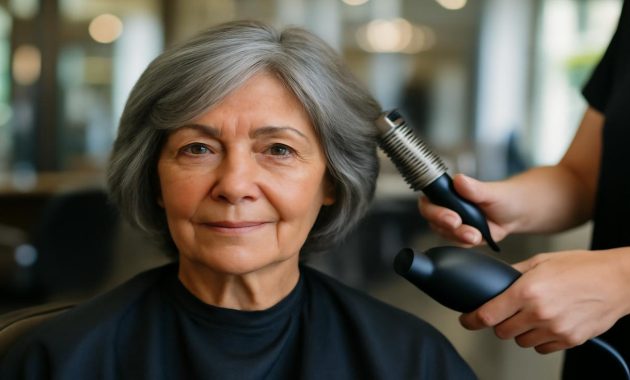
The woman in the salon chair is somewhere north of sixty and south of “old.” You can tell by the way she sits: shoulders back, chin lifted, as if bracing for turbulence. In the mirror, her eyes track every move of the stylist’s scissors with a concentration usually reserved for landing airplanes or threading needles. On the trolley beside her, there’s a photo torn from a magazine—soft layers, side-swept bangs, silvery blonde. The caption on the page said, “The Secret to Looking Ten Years Younger.” Her fingers rest on that image the way some people rest on a prayer book.
“Nothing too… elderly,” she says. “But I don’t want to look like I’m trying too hard, either.”
The stylist smiles the way stylists do when they have heard this sentence twelve times that week alone. “Something youthful,” he says. “But natural. Fresh.” The words float through the chemical-scented air: youthful, natural, fresh—three magic charms laid like charms over the slow, honest fact of time.
When “Youthful” Starts to Sound Like an Insult
Once upon a time, a haircut was just a haircut. Maybe it said something about you—your job, your taste in music, your tolerance for blow-drying—but it wasn’t a referendum on the entire trajectory of your life. Then somewhere around fifty, and especially after sixty, hair stopped being just hair. It became a report card.
Suddenly, the world had opinions: “Cut it short, it’s more youthful.” “Don’t go too short, that will age you.” “Color it, or you’ll look washed out.” “Don’t color it, you’ll look desperate.” You start to feel as if there’s a narrow hallway of acceptable choices and every door is labeled with something vaguely insulting.
Ask a stylist what looks “youthful,” and they’ll give you a glowing list: soft bobs, shaggy layers, cheekbone-grazing lobs, pixies with texture, bangs that “lift” the face. Ask women over sixty what looks “desperate,” and some of those same styles show up again—just with different lighting, a different story, and a different wearer.
Because here’s the thing no glossy magazine checklist will admit: the line between “youthful” and “trying too hard” is as thin and shifting as a single strand of hair. What looks breezy and modern on one sixty-five-year-old looks like a costume on another. And too often, stylists talk as if youth is the prize and age is the problem to be cleverly disguised under foils and fringe.
So let’s do something slightly wicked. Let’s walk through the salon together and rank some of the most common “youthful” hairstyles after sixty—brutally, honestly, with every whispered “She looks amazing” and every muttered “Oh, honey, no” accounted for. Not by rules, but by how they actually land in the wild: in grocery store aisles and family dinners, in bathroom mirrors under unforgiving morning light.
The Ranking: From Effortlessly Ageless to Definitely Trying Too Hard
“Brutal ranking” doesn’t mean shaming anyone for what makes them feel good. It means peeling back the marketing, the salon-speak, and the flattering lies, and asking: how does this really read on a real sixty-plus face, with real life and real stories woven into the hairline?
| Rank | Style Type | How Stylists Sell It | How It Often Looks in Real Life |
|---|---|---|---|
| 1 | Soft, Lived-In Bob | “Classic, chic, face-lifting” | Effortlessly modern when not over-styled |
| 2 | Natural Gray with Intentional Shape | “Bold, confident, sophisticated” | Strong and current when cut is sharp and cared for |
| 3 | Soft Shag or Layered Lob | “Movement, texture, youth” | Flattering if layers are subtle; messy fast if overdone |
| 4 | Textured Pixie | “Edgy, playful, low-maintenance” | Can look chic or harsh; all about softness and styling |
| 5 | Heavy Bangs + High-Maintenance Color | “Instant youth, face-framing” | Most likely to read as trying-hard if not perfectly tailored |
1. The Soft, Lived-In Bob: Quietly Winning the Whole Game
Imagine walking into a café and spotting a woman in her late sixties at the corner table. She’s reading a paperback, glasses tipped low on her nose, a half-finished cappuccino cooling beside her. Her hair is a softly textured bob—just skimming the jaw or brushing the collarbone—tucked casually behind one ear. It moves when she laughs. It doesn’t sit on her head like a plastic helmet.
This is the reigning champion: the lived-in bob. Not the severe, angular bob of the early 2000s that could slice a tomato, but a looser, airier version with the edges slightly shattered and the layers barely there. Stylists love it because it’s easy to sell as “lifting” the face—shorter in the back, a whisper of length toward the front, a hint of curve that echoes cheekbones.
Why it works so well after sixty has nothing to do with pretending to be thirty. It’s about proportions. As faces change—skin softening, jawlines blurring, cheeks hollowing a bit—the hair that once looked glamorous at mid-back can start to drag everything down. A bob, done right, puts the focus back on eyes and lips, where expression still crackles.
But like a well-cut blazer, the power of the bob lies in fit. Too stiff, and it feels like a helmet of denial. Too flippy and round, and it edges into “kindergarten teacher on picture day.” The sweet spot is movement: a bit of swing, a parting that isn’t glued in place, ends that look touchable instead of razor-sharp.
A lot of women call this haircut “freeing.” Not younger, not cooler—just lighter, as if they can actually feel their neck again. That lightness? It reads as youthful without screaming it. The hair isn’t trying to erase the years; it just makes more room for the woman wearing them.
2. The Silver Siren: Natural Gray with an Intentional Cut
There’s a moment many women remember with cinematic clarity: the day they decided to stop coloring. It usually happens after yet another round of root touch-ups, head bowed under the sharp smell of dye, staring at the stained towel beneath the sink at home and thinking, “Is this really worth it?”
Going gray—really going gray, not just skipping one appointment and hoping nobody notices—is both terrifying and oddly exhilarating. The color myth says: darker = younger, blonder = softer, maintained = cared for. Gray, the myth whispers, is surrender.
But the ranking of real-life impact tells a different story. When gray hair is given an intentional shape—whether that’s a sculpted crop, a sleek bob, or longer layers that move like water—it can look not just “not old,” but distinctly modern. The crucial word is intentional.
Gray without shape can read as “I gave up.” Gray with a sharp cut reads as, “I made a decision.” There’s a difference you can feel across a crowded room. The eye doesn’t think “old lady”; it thinks “she knows who she is.”
Stylists often underestimate how much women over sixty are willing to risk if it means freedom from the root treadmill. A good one will talk less about hiding silver and more about how to support it: toners to keep it from going yellow, products for shine, a cut that plays with how your unique pattern of gray falls around your face.
Ironically, a well-cut gray style often looks far less “desperate” than an obviously dyed one. You’re no longer wrestling your true color into submission; you’re collaborating with it. There’s something deeply youthful about that kind of self-trust, even if the strands themselves glitter like frost.
3. Shags, Lobs, and the Fine Line Between “Effortless” and “Exhausting”
Say the word “shag” to a stylist and their eyes light up. Texture! Layers! Movement! Say it to a woman over sixty, and watch her hesitate. For a lot of people, the word conjures 1970s rock bands and feathered disasters, or those infamous “modern shags” that look amazing on 21-year-old influencers with ring lights and questionable diets.
The truth is, a gentler cousin of the shag—the layered lob, the collarbone grazer with barely-there layers—can be an absolute hero cut. It gives fine hair a bit of volume, lets wavy hair be wavy without the commitment of long hair, and works with both natural gray and soft color. When stylists say “youthful,” what they usually mean here is: it moves.
But the brutal part of the ranking comes in when those layers get enthusiastic. Too many and the hair starts to look chewed instead of shaped. On aging hair that’s already lost some density, over-layering can turn “soft and tousled” into “thinning and frayed” in a single blow-dry.
The other trap is styling. Some of these allegedly “effortless” cuts require a round brush, three products, and a wrist like a Pilates instructor. They look fabulous walking out of the salon and then wilt into shapeless fluff in normal bathroom conditions. That divergence—between ad and reality—is where resentment grows.
If you can push your hands through it and let it air-dry without feeling like a failure, the shaggy lob lives up to its promise: it feels alive. If you need a YouTube tutorial every morning, it crosses into “trying too hard” territory, no matter how many times the stylist calls it low-maintenance.
4. The Textured Pixie: Liberating or Laser-Precision Youth Grab?
There’s a reason the moment a woman chops her hair into a pixie gets framed as an act of rebellion. There’s skin. There’s neck. There’s no soft curtain of hair to hide behind when your ex appears in the grocery store or when the camera flips to selfie mode by accident.
On paper, the textured pixie is a stylist’s dream for post-60 hair: light, easy to dry, works with thinning or fine strands, naturally lifts the face. They will sell it to you as “edgy but soft,” “playful,” “Parisian,” “very Jane Fonda in that one movie.” They are not entirely wrong.
On the right face with the right cut, a pixie can look electric. It shows off cheekbones, jawline, the curve of your skull. It turns earrings into exclamation points. It offers a kind of gamine sharpness that reads as ageless, mostly because it sidesteps the whole long/short/youthful debate entirely.
But here’s the brutal reality: it is unforgiving when it’s wrong. A harshly cut, too-tight pixie can make fine lines and hollow temples feel spotlighted. Over-texturing can read as spiky, which on younger faces looks rebellious and on older faces can veer toward brittle. Add harsh, too-dark color, and the whole thing can start screaming “I refuse to age” in capital letters.
The women whose pixies look phenomenal usually have one thing in common: their stylist understands softness. The neckline is tapered, not harshly shaved. The top has enough length to lie down a little, to be mussed with a fingertip and not stand up like a faded memory of 1980s gel. The overall impression is intentional but not armored.
Done that way, the pixie isn’t a desperate claw at youth; it’s a stripping away of everything unnecessary. It says, “Here I am, face first.” That’s not youthful, exactly. It’s bolder than that.
5. Bangs, Bottled Youth, and the Most Over-Promised Hair Combo on Earth
If there were a single, universal spell that stylists love to cast on women after sixty, it would be this: bangs plus fresh color. “It softens the forehead,” they say, “and brings light to your face.” Somewhere in that phrase, you can hear the unspoken math of age: cover the lines, brighten the canvas, subtract ten years.
The problem isn’t that it never works. The problem is how often it almost works—and then tips, quietly, into looking like a disguise.
Heavy, straight-across bangs on a face with delicate, thinning hair can feel like a curtain that’s been yanked too far forward. They trap oil, demand constant trimming, and sweat into odd shapes in summer. On the right person, they’re French-cinema chic. On the wrong one, they become a sticky fringe of regret resting on the eyebrows.
Add aggressive coloring to the mix—dark, flat browns that no longer exist naturally on someone’s head, or high-maintenance blondes that fight every hint of gray at the roots—and upkeep starts to show. The first week looks polished; by week four, there’s a stripe at the scalp and a sense of strain around the whole project.
What many people actually read as “desperate” isn’t the desire to look younger. It’s the visible struggle: the color that looks too uniform, the fringe that won’t behave, the way the whole hairstyle seems to exist in a state of constant negotiation with time.
The gentler version—softer, wispy bangs that blend into longer pieces around the face, color that acknowledges the presence of gray instead of waging war on it—often looks more genuinely brightening. It doesn’t pretend you’re not sixty-eight. It just illuminates the fact that you’re a very alive sixty-eight.
What Stylists Don’t Always Say Out Loud
Behind the cape and the flattery, there’s a quieter conversation that doesn’t make it into the glossy salon brochures. Stylists are trained in shape, color, texture; they’re not always trained in the psychology of aging in a culture that worships youth. They mean well when they say “We’ll take ten years off,” but the phrase carries a little grenade—you were better ten years ago.
That’s why some of the most grounded over-sixty women walk into salons already knowing what they’re not doing. Not going back to the every-three-weeks color treadmill unless they absolutely love the result. Not cutting so short they feel exposed if that exposure doesn’t match who they are off the salon chair. Not committing to styles that only exist in the fantasy world of professional blowouts.
They ask different questions: How will this look air-dried? What will this color do when my roots come in? Can I style this with my actual hands, not a team of backstage assistants? They’re not asking for youth. They’re asking for ease, truth, and a little bit of magic.
And somewhere in there is the quiet redefinition of “youthful.” Maybe it’s not about hair that hides your age; maybe it’s about hair that matches your energy—whether that energy is wild-grandmother-on-a-motorbike or soft-book-club-and-garden-tea.
Choosing Your Cut Without Losing Your Self
There’s no single hairstyle that will rescue anyone from a bad day, a deep wrinkle, or the realization that gravity is not negotiable. But there are questions that can keep you honest when you sit in that chair and the stylist says, with all the earnest cheer in the world, “Let’s do something youthful!”
- Does this cut make my face the main event, or does it shout louder than I do?
- Will I still like this in the harsh light of my bathroom, not just in the salon mirror?
- Does the upkeep fit my life, or will I resent the calendar reminders for touch-ups?
- Do I feel more like myself with this, or like I’m auditioning for a younger version of me?
The most quietly powerful women after sixty aren’t chasing the hair of their thirties. They’re editing. Subtracting everything that no longer feels like them and keeping what does—even if the world has opinions about whether long gray braids or snow-white buzz cuts or soft silver bobs are “appropriate.”
In the end, the brutal ranking isn’t really about styles. It’s about stories. A lived-in bob that lets you bike without wrestling with ponytails. A silver crop that freed you from the Saturday-morning dye marathon. A textured pixie you got after a divorce because you needed to feel the back of your neck in the wind. Bangs you grew out because they belonged to a version of you who was always apologizing.
Your hair is allowed to evolve the way you have: sometimes graceful, sometimes messy, occasionally daring, rarely perfect. Youth is not the prize at the end of the salon visit. Feeling honestly, comfortably, vividly like yourself is.
And if that self currently wants a sharp little pixie and fire-red color at seventy-two? That’s not desperation. That’s authorship.
FAQ: Hairstyles After 60 and the “Youthful vs. Desperate” Debate
Is long hair always aging after 60?
No. Long hair can look beautiful at any age if it’s healthy and intentionally styled. What often feels aging isn’t length itself, but lack of shape, heavy bulk dragging the face down, or damaged ends. Long, well-shaped layers or a sleek, nourished curtain of hair can look elegant and very current.
Are bangs a good idea for mature faces?
Sometimes. Soft, wispy, or side-swept bangs can soften lines and highlight your eyes. Thick, blunt, or very short bangs can be harsh or high-maintenance. The best approach is to test with longer, blendable fringe first—you can always go shorter, but growing out bangs takes patience.
Does going gray automatically make me look older?
Not automatically. Unshaped, neglected hair of any color can read as older. A well-cut gray style often looks modern, confident, and surprisingly fresh. The key is shine, condition, and a cut that respects your natural texture and face shape.
How do I tell if a style will look “trying too hard” on me?
Check three things: effort, contrast, and comfort. If the style needs a lot of daily work, is a dramatic contrast to your natural color or texture, or makes you feel like you’re playing a role rather than being yourself, it may read as forced. If it feels natural to live in, it’s probably right for you.
What should I ask my stylist to get an age-appropriate but not “old” cut?
Skip the word “youthful” and say things like: “I want something that lifts my face, works with my texture, and is easy to style at home.” Bring photos of women your age whose hair you like. Ask honestly about upkeep, and insist on a cut that looks good with minimal styling, not just under salon lights.