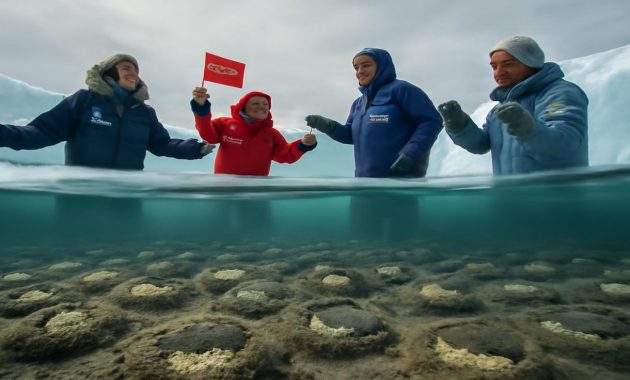
The first thing you notice is the sound—or rather, the lack of it. Out on the frozen skin of the Weddell Sea, the world feels padded, muffled, like someone has turned down the volume on the planet. Wind scratches across the ice, a low, ceaseless hiss. The horizon is a flat, shimmering line where white meets a sky so pale it seems bleached. Nothing moves. Nothing speaks. If you didn’t know better, you’d think this place was empty.
A Secret City Beneath the Ice
But beneath your boots, not even a hundred meters down, there is a city. A secret city, sprawling and alive.
The scientists on the German research vessel RV Polarstern didn’t set out to find it. They were mapping the seafloor cameras and sensors as they drifted under the ice, following currents and studying ocean conditions. Their towed camera system skimmed just above the bottom of the Weddell Sea, sending back grainy, greenish footage.
At first, the researchers saw a round depression in the sediment. A neat circle, like someone had pressed a giant thumb into the seafloor. At the center: a fish. A small, pale icefish guarding a cluster of yellowish eggs. Then another nest appeared on the screen. And another. And another.
The video feed started to look like a cosmic pattern: crater, crater, crater. Nest after nest, each about the size of a large dinner plate, each with a watchful parent hovering above its future offspring. The scientists stared in disbelief as the images scrolled by. Someone did the quick math, then did it again. It couldn’t be right.
But it was. They had drifted right across what is now believed to be the largest known fish breeding colony on Earth: around 60 million active nests of icefish, covering an area the size of a small country. A hidden metropolis of life beneath the Antarctic ice.
The Fish That Chose the Coldest Nursery
It takes a particular kind of creature to call this place home. The residents of this underwater city belong to a group called icefish, and they are as extraordinary as their surroundings. They have almost transparent bodies. Their blood is pale, nearly colorless. Unlike most fish, they don’t rely on red hemoglobin to transport oxygen. Instead, they’ve evolved to live in water that hovers just above freezing, where oxygen is so abundant it can move through their bodies more easily, even without the usual machinery of red blood cells.
Imagine a world lit only by faint blue-green twilight. Above, the underbelly of the sea ice diffuses what little light filters through. Below, the seafloor is a broad, gently undulating plain. On this plain, each nest is a carefully prepared hollow where a devoted parent hovers, fanning water across thousands of eggs to keep them oxygenated and free of suffocating sediment.
In any direction you might look, there are nests: some newly made and full of translucent eggs; others abandoned, with empty craters and the ghostly remnants of once-thriving families. It’s a neighborhood with its own rhythms, its own hazards—predators glide at the edge of visibility, scavengers pick at leftovers, and currents tug gently at the sandy rims of the nests.
The icefish have chosen a nursery that, at first glance, looks wildly inhospitable: perpetually near-freezing waters, sealed off from the sky by a permanent lid of ice in many places. Yet for millions of years, these conditions have created a remarkably stable environment, precisely the kind of predictable cold that icefish—and the entire Antarctic marine ecosystem—have come to depend on.
Discovery That Changed the Map
In the world of marine biology, the discovery of this massive breeding colony landed like an earthquake. No one had expected anything on this scale. Biologists had long known about icefish and their unusual blood, their cold-water adaptations, and their scattered nests. But this—tens of millions of nests in one concentrated area—rewrote the ecological story of the Weddell Sea.
To grasp the magnitude of it, imagine an underwater suburb extending as far as the eye can see, every single driveway occupied, every home with a parent fish watching over their eggs. The scientists used sonar, cameras, and mapping tools to estimate the full extent of the colony. What appeared on their screens was nothing less than a biological megastructure.
There were patterns: zones of dense nesting, regions of older or abandoned nests, shifting boundaries where the colony expanded or thinned out. Currents funneled slightly warmer, nutrient-rich water to the area, and that subtle shift in temperature seemed crucial. It was just warm enough to enhance survival, just cold enough to remain glacial, just rich enough to feed the food web that radiates out from this breeding ground.
The discovery didn’t just tweak a few lines in a scientific paper; it forced scientists and policymakers to reconsider what the Weddell Sea actually is. Not just another patch of ocean at the bottom of the world, but a vital cradle for a species that, in turn, helps feed seals, penguins, and even whales. An unseen nursery whose success or failure could ripple through the entire Antarctic ecosystem.
The Hidden Value of a Frozen Nursery
These nests are more than an oddity; they’re the foundation of a complex, delicately balanced web. The adult icefish and their offspring supply food to higher predators like Weddell seals and certain penguins, stitching together an intricate network of survival that depends on cold, stable conditions and clean, undisturbed seafloor.
If you could chart the threads of dependency—from the eggs in those nests, to the young fish, to the predators that rely on them, to the nutrients recycled by scavengers—you’d see the colony not as an isolated phenomenon, but as the beating heart of a local ecosystem. Which is exactly why, almost as soon as the discovery was publicized, another kind of attention turned southward.
Where Protection Meets Opportunity
In boardrooms and government ministries far from the ice, the language around the Weddell Sea started to split in two directions. To conservationists, this immense fish nursery was a revelation, a once-in-a-generation chance to protect a cornerstone of Antarctic life before it was disturbed. To others, it looked like something else: a resource.
International waters are always crowded with overlapping ambitions, and Antarctica is no exception. Fishing fleets from several nations already edge close to Antarctic waters, targeting species like krill—tiny shrimp-like creatures that are themselves essential to the entire marine food chain. Where there are fish breeding in huge numbers, sooner or later, someone will ask the question: Should we harvest them?
On paper, Antarctica is governed by a unique collection of treaties and agreements that emphasize peace and science. The Antarctic Treaty System, and within it the Commission for the Conservation of Antarctic Marine Living Resources (CCAMLR), are supposed to ensure that conservation comes first, even when commercial pressures build. But the treaties only work when member nations agree on what “conservation” means in practice—and that is where things start to fray.
Some countries push for large marine protected areas (MPAs), zones where fishing and other extractive activities are heavily restricted or banned. Others argue that tightly managed, “sustainable” fishing should still be allowed, even in ecologically sensitive zones, as long as scientific monitoring continues. Their argument: the ocean’s resources should support human needs, from food security to economic opportunity.
The Weddell Sea, and specifically the region hosting this vast icefish colony, has become one of the sharpest fault lines in this debate.
Table: Two Futures for the Icefish Colony
Governments, scientists, and fishing interests often describe the Weddell Sea in starkly different terms. The table below highlights the tension between two competing visions for this hidden breeding ground:
| Perspective | Main Goal | View of the Icefish Colony |
|---|---|---|
| Conservation-focused nations & NGOs | Long-term ecosystem protection | A critical nursery that must remain untouched to safeguard Antarctic food webs and resilience to climate change. |
| Fishing-oriented nations & industry groups | Access to new fishing grounds under “sustainable use” | A potential resource that might be harvested carefully, with monitoring, to support economic and food demands. |
| Polar scientists & research alliances | Preserve a living laboratory | An irreplaceable natural experiment to study evolution, climate impacts, and ecosystem dynamics in a relatively untouched state. |
Every year, CCAMLR members gather to debate new protections and catch limits. Proposals for a large marine protected area in the Weddell Sea have been on the table for years, but agreement has been stubbornly out of reach. The discovery of the fish nests injected new urgency—and fresh controversy—into those negotiations.
Clashing Visions on Thin Ice
Picture a long conference table in a warmly lit room in Hobart, Tasmania, where CCAMLR often meets. Delegates in business suits sit beneath world maps and slides of satellite images. On the screen, a bright patch of color indicates the area of the newly mapped icefish colony. The delegates listen to scientists describe the millions of nests, the dependent predators, the vulnerable eggs.
Then come the statements. One representative argues that this colony must be granted strict protection: no fishing, no disturbance, long-term monitoring only. Another calmly counters that their nation respects conservation, but cannot ignore growing demand for seafood. With “proper management,” they say, it might be possible to allow limited fishing in parts of the region. A third asks for more data. How exactly would a certain level of fishing affect the colony? Where are the boundaries of harm? Can anyone be sure?
Behind these careful words lies a basic clash of values. Is the Weddell Sea first and foremost a sanctuary, or is it a pantry? Do we owe the fish nests the right to exist undisturbed, or do they sit within a global ocean that must, in part, feed an expanding human population?
The reality is that data for such a remote ecosystem is always incomplete. No one can run a neat, controlled experiment on a 60-million-nest colony and then simply roll back the results if the outcome looks bad. The best available science strongly suggests that heavy disturbance—trawling on the seafloor, shifting food webs, or rapid climate change—could unravel the balance that allows this nursery to thrive.
Climate change, in particular, hangs over the debate like a dark cloud. As ocean temperatures creep up and ice patterns shift, the delicate conditions that make this colony possible could change. That vulnerability has become a powerful argument for those pushing for full protection: if the system is already under stress from warming, why pile on additional pressure from industrial activity?
Science as Witness, Not Judge
Scientists find themselves in a strange position. They are the ones who revealed the colony to the world, their cameras and calculations turning whispers into proof. They can describe the area’s ecological importance, model potential impacts, and urge caution. But they don’t get to vote on binding protections. Science can be a witness, not the judge.
Still, their voices carry weight. Images of the seafloor signed with thousands of watchful icefish parents have circled the globe, igniting awe in people who will never set foot anywhere near Antarctica. Public pressure can reach where scientific papers cannot, altering the political temperature in ways that are hard to quantify yet impossible to ignore.
What Happens When the World Looks Down Here
There’s a curious paradox at the heart of this story. For millions of years, the Weddell Sea colony survived precisely because no one knew it was there. Now, its best chance at survival may depend on as many people as possible knowing about it.
This is the double-edged nature of discovery. Shining a spotlight on an ecosystem attracts two kinds of attention: the kind that wants to guard it, and the kind that wants to extract from it. Antarctica has seen this pattern before, from the days of rampant whaling to modern debates over krill fishing and bioprospecting for valuable genetic material in cold-adapted organisms.
In the case of the icefish nests, there is still a window of possibility. The colony is not yet hemmed in by fleets. No industrial trawlers are currently ripping across the seafloor where the nests lie. The clash, for now, is mostly on paper and in meeting rooms, in projected maps and theoretical scenarios.
The choice unfolding is whether the world decides to act before exploitation begins, or after damage is done. That alone makes the Weddell Sea colony different from so many other marine stories, which often start with decline and end with regret.
A Test of Our Imagination
Protecting something you can see and touch is easy to argue for. A coral reef glowing with color. A forest where you can stand beneath ancient trees. A coastline you walked as a child. But how do you fight to protect a place you will never see? A place that, for nearly everyone on Earth, might as well be a legend: millions of fish nests in the darkness beneath Antarctic ice.
It requires imagination. It requires the willingness to care about an environment that does not directly feed you, entertain you, or offer you an obvious piece of economic value. And it requires a kind of humility—an acceptance that some parts of the planet are more important as they are than as they might be converted into products or profits.
Standing on the ice, the emptiness feels absolute. The wind claws at your face; the horizon offers no comfort. Knowing what lies beneath—that crowded, beating city of nests and lives-in-waiting—changes how the silence feels. It’s no longer emptiness. It’s a pause above a miracle.
Whether that miracle remains intact may depend on decisions made thousands of miles away, under fluorescent lights, guided by charts, treaties, and national interests. Those governments now argue, in carefully moderated tones, about how far humanity’s reach should extend into the last great cold places.
Meanwhile, in the unbroken dark of the Weddell Sea, the icefish continue their ancient work, oblivious. They fan their eggs. They patrol the edges of their nests. They wait out the long, dim months for the moment when the next generation is ready to swim up into the cold, oxygen-rich water that has shaped their kind for ages.
The question for us is simple, but it is not easy: Will we let them keep doing that work in peace?
Frequently Asked Questions
Why is the Antarctic icefish colony such a big deal?
The colony is the largest known fish breeding area on Earth, with an estimated 60 million active nests. That scale makes it a crucial hub of life in the Weddell Sea, supporting predators like seals and potentially influencing broader Antarctic food webs. It’s not just a curiosity—it’s a structural piece of the ecosystem.
Where exactly is this fish nesting colony located?
The colony is in the Weddell Sea, off the coast of Antarctica, beneath sea ice in relatively deep, near-freezing waters. The nests are found across hundreds of square kilometers of seafloor, far from any human settlements, accessible only by specialized research vessels.
Are there fishing boats operating directly on this colony now?
At present, there is no widespread industrial fishery targeting the colony itself. However, surrounding Antarctic waters are already used for commercial fishing, especially for krill. The fear is that, without strong protections, interest in exploiting this newly discovered resource could grow.
Why can’t we just fish “sustainably” in the area?
In theory, sustainable fishing sounds reasonable, but in a place as remote and complex as the Weddell Sea, it’s difficult to measure impacts accurately or react quickly if things go wrong. The colony’s scale and ecological importance mean that miscalculations could cause long-lasting damage, especially when combined with climate change.
Who decides whether the area will be protected?
Decisions are made by member states of the Commission for the Conservation of Antarctic Marine Living Resources (CCAMLR), which operates under the broader Antarctic Treaty System. All key decisions require consensus, so a single country can block the creation of a marine protected area even if many others support it.
What kind of protection could the colony receive?
The strongest option is to designate the region as part of a large marine protected area, with bans or strict limits on fishing and other industrial activities. This would allow scientific research while minimizing disturbance. Weaker protections could involve limited fishing with monitoring, but those carry higher risks.
How does climate change factor into all of this?
Climate change is altering sea temperatures, sea-ice cover, and ocean circulation around Antarctica. The icefish colony depends on very specific conditions: cold, oxygen-rich, relatively stable waters. As those conditions shift, the colony may already be under stress, which makes additional human pressures like fishing more dangerous to its long-term survival.