The first warning doesn’t sound like a siren. It comes as a whisper across fiber‑optic cables and satellite feeds: a cluster of numbers, a skewed graph, a pattern that shouldn’t be there. In early February, long before the Arctic sun should rise high enough to soften the sea ice, meteorologists watch their screens and fall quiet. A sudden and dramatic shift is unfolding far to the north, beyond the reach of most people’s imaginations—but not beyond the reach of their lives.
When the Wind Changes Shape
In weather centers from Oslo to Anchorage, the story starts with air—cold, invisible, and restless. Meteorologists have a term for what they’re seeing: a disrupted polar vortex, that swirling crown of frigid air that usually spins, tight and contained, above the North Pole. Some winters, it wobbles. This year, it lurches.
High above the Arctic, winds slow and buckle. Warm air from the south punches upward like an unwelcome guest, folding into the stratosphere. The polar night, built on months of darkness and locked‑in cold, begins to fracture. Screens fill with colors that mean temperature anomalies: bruised purples fading into alarming reds and oranges. The Arctic, in places, is as warm as a chilly spring day.
Meteorologists know how this story usually ends. The disturbance in the stratosphere ripples down, warping the jet stream—those high‑altitude rivers of air that steer storms and seasons. Cold air spills south into continents that aren’t expecting it. Mild air surges north, melting ice that should remain hard‑frozen for weeks to come.
But this time, the fingerprints of the event look sharper, more insistent. The early February shift is stronger, larger, and layered on top of something that has been quietly building for decades: an Arctic that is already running a persistent fever.
The Arctic Is Not Just Far Away
For most people, the Arctic lives mostly in photographs—a white emptiness, dotted with bears and icebergs. It feels remote, almost fictional. But to meteorologists, the Arctic is not a postcard. It is the operating system of the planet’s weather. Break it badly enough, and the rest of the world will start to misbehave.
In recent years, scientists have measured the Arctic warming at over three times the global average. Sea ice that once regrew each winter like a dependable scar tissue is thinner now, more fragile. Permafrost that has been frozen since before human civilizations rose is softening, slumping, releasing gases that had been locked beneath the surface for millennia.
Against this backdrop, an early February atmospheric upheaval is more than weather. It is a stress test on a system already pushed toward the edge. Each pulse of warm air into the Arctic becomes a chisel at the ice, a nudge at the permafrost, a rearrangement of the timelines all living things have come to depend upon.
When meteorologists warn that this shift has scientists alarmed over a looming biological tipping point, they’re not being dramatic. They’re listening to the Arctic the way a doctor listens to a failing heart: the rhythm is still there, but something in the pattern has gone wrong.
The Subtle Mechanics of a Tipping Point
Biological tipping points rarely arrive with fireworks. They creep. They accumulate. They are the moment a forest, a tundra, a coastline can no longer do what it has always done—and instead flips into a new, often less hospitable state.
In the Arctic, several such tipping points are stacked like dominoes, each leaning, ever so slightly, into the next. Scientists often talk in careful terms—thresholds, non‑linear responses, regime shifts—but underneath the cautious language is a stark reality: push a living system too far, and it won’t simply bounce back when the pressure eases. It will reorganize, abruptly and permanently.
| Arctic System | Current Stress | Potential Tipping Outcome |
|---|---|---|
| Sea Ice | Rapid thinning, earlier melt seasons | Seasonally ice‑free Arctic Ocean |
| Permafrost | Warming ground, increased thaw events | Massive carbon and methane release |
| Tundra Ecosystems | Shrub expansion, changing snow cover | Shift to shrubland or boreal forest |
| Marine Food Webs | Sea ice loss, altered ocean currents | Collapse of ice‑dependent species |
An early February atmospheric jolt pushes on all of these at once. Warm air above the ice cap encourages melt ponds to form earlier in the season, darkening the surface and helping it soak up even more sunlight when it returns. Rain falls instead of snow in some places, creating icy crusts that seal food away from reindeer and musk oxen. Rivers, swollen by out‑of‑season meltwater, pulse fresh water into the Arctic Ocean, subtly redrawing the boundaries of marine life.
Each event might be survivable on its own. But then comes another displaced cold spell, another heat pulse, another winter thaw. Feedback loops stir: ice loss begets more heat absorption, which begets more ice loss. Permafrost thaw releases greenhouse gases, which trap even more heat, softening even more ground. The system begins to lean, a fraction of a degree at a time, toward an edge that no one can see clearly, but that everyone fears.
The Breath of the Frozen Earth
Imagine walking across tundra that looks, at first glance, perfectly solid. The surface is a braided patchwork of dwarf shrubs, lichens like pale crusts on stone, mats of moss and dry grasses. But here and there, the ground has slumped—small, shallow depressions filled with murky water. To someone who has known this land for generations, these are new wounds.
Permafrost is not just frozen dirt. It is a vast archive of ancient life: roots, leaves, dead insects, the remains of animals that never fully decayed in the cold. Lock that material in ice, and it waits. Thaw it, and it begins to rot, releasing carbon dioxide and methane. The Arctic, once a quiet vault for old carbon, can become an active source.
Scientists drilling cores from the softening ground describe a particular smell when permafrost wakes up—a sweet, organic breath, like a compost pile disturbed in deep winter. It is the scent of time collapsing. What had been preserved for tens of thousands of years is suddenly entering the modern atmosphere in the span of a human life.
An early February warming spike matters because it chips away at what should be the coldest, most stable weeks of the year. The deeper the ground warms, the more likely it is that even a “normal” summer will now be enough to push permafrost past a critical temperature. Soon, the soil no longer refreezes completely in winter. Microbes never truly rest. The vault door is left slightly ajar, year‑round.
When Seasons Lose Their Grip
The biological tipping point, though, isn’t only about ice and soil. It’s about timing—the choreography of life that depends on winter being winter, spring being spring. When meteorologists talk about a disrupted February as “alarming,” part of what they fear is the way it scrambles the calendar written into the bodies of plants and animals.
Birds that migrate using changing daylight as their cue may arrive to breeding grounds that are already out of sync. Insects, triggered by sudden warmth, may hatch early, only to be wiped out by a returning cold snap. Or they may thrive, exploding in numbers just as the predators that once kept them in check are thrown off balance by their own mistimed life cycles.
Even something as simple as snow behaves differently. A brief thaw in February, followed by a hard freeze, can turn the snowpack into solid armor. Reindeer and caribou, which usually dig through powder to reach lichens and grasses, suddenly face an impenetrable shield of ice. Starvation spreads quietly, hoof by hoof.
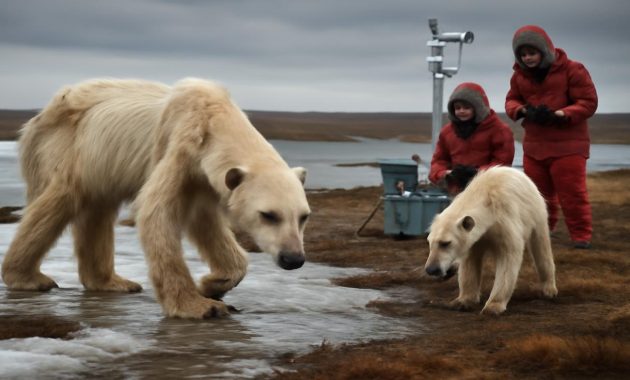
Out on the thinning sea ice, polar bears trace the edges of floes that no longer hold as firm. Seals, which depend on snowdrifts to build their subnivean lairs, may find only thin, brittle crusts. A single warm, wet storm in mid‑winter can collapse those shelters, exposing pups to freezing wind—and to predators.
None of this happens in isolation. As the Arctic reshapes itself, it exerts pressure on the systems humans rely on far to the south. Jet stream distortions can elongate droughts, intensify heat waves, stall storms over cities and croplands. A warm pulse in February in the far north can echo months later as failed harvests, infrastructure damage, and health crises elsewhere.
Listening to the Scientists’ Unease
What unnerves many meteorologists and climate biologists now is less a single staggering statistic than the feeling of patterns slipping their grasp. The early February Arctic shift does not arrive as a lone mutant event; it slots uneasily into a chain of “once‑rare” occurrences that have become unsettlingly familiar.
Record low winter sea ice extents, rain falling on ice sheets in mid‑winter, lightning storms at latitudes that once knew only snow—each anomaly stacks on the last. Computer models that project future climates bend and warp as new data pour in, often revealing that changes are arriving faster, and with more intensity, than earlier estimates suggested.
There is a kind of professional heartbreak in this. Many of the scientists raising the alarm have devoted their lives to understanding snow, clouds, wind, and ice. They speak in caveats and confidence intervals, but behind their careful phrasing is genuine worry: the systems they study are beginning to cross lines we cannot redraw.
When they say “biological tipping point,” they’re describing a world where Arctic ecosystems can no longer buffer or adapt to the shifting climate, where the loss of key species and functions accelerates. A tundra that once reflected sunlight with a pale, snow‑bound face turns darker with shrubs and exposed soil, feeding more heat into the atmosphere. An ocean that once teemed with ice‑dependent plankton communities turns to open water, favoring different species, rewriting the menu for everything above them in the food web.
What It Means for the Rest of Us
It is tempting to file all of this under “far away problems,” the kind of remote tragedy that stirs concern but not urgency. Yet the Arctic’s changes are not keeping their distance. The boundary between “up there” and “down here” is a fiction.
Consider agriculture. Jet stream distortions linked to polar warming have been associated with stuck weather patterns: long, scorching heat waves in some regions and relentless, flooding rains in others. Crops that evolved—or were bred—to rely on relatively predictable seasons buckle under the whiplash of extremes. Food prices shift. Political tensions follow.
Infrastructure, too, feels the pulse of a misbehaving Arctic. Sudden cold outbreaks in mid‑latitude cities stress power grids not built for such volatility. Warmer winters can expand the range of pests and diseases, pushing into regions with little natural or human resistance. Wildfire seasons lengthen as parched landscapes and stalled high‑pressure systems look to the Arctic’s slackened ice cover and say: this, too, is part of the same story.
Perhaps the hardest connection to articulate, though, is emotional. Knowing that winter itself is becoming less anchored has a way of unsettling people at a deep, almost mythic level. The sense that the seasons are slipping out of the frames that shaped human culture, agriculture, festivals, and memories can feel like losing a shared language.
Standing at the Edge Without Looking Away
So what do we do with the knowledge that an early February atmospheric wobble over the Arctic may be a sign of a near‑future biological tipping point? Resignation is one option, but it is a poor companion to reality. The more honest response is a kind of fiercely clear‑eyed attention.
Scientists are pushing for denser monitoring of the Arctic—more weather balloons, more ocean buoys, better satellite coverage, deeper collaboration with Indigenous communities whose observations stretch back generations. Every additional data point helps clarify where the thresholds might lie, which feedback loops are accelerating fastest, and which actions might still meaningfully slow them.
On the human side of the equation, the levers remain familiar, even if too often ignored: rapidly cutting greenhouse gas emissions, protecting intact ecosystems that store carbon, rethinking energy and land use in ways that respect planetary limits rather than treating them as negotiable. None of that will restore the Arctic of a century ago. But it may still determine whether we cross one tipping point, or many.
There is also room, and need, for storytelling—not as distraction, but as translation. To make the Arctic less abstract, less distant. To understand that when meteorologists stare at their February graphs in silence, what they are really watching is a conversation between ice, air, light, and life, one that is beginning to sound strained.
Somewhere tonight, a satellite will pass over the pole, its instruments measuring the faint glow of heat rising through clouds and darkness. Those numbers will be turned into maps, models, warnings. But behind them is a simpler image: a thin shell of air around a blue planet, patterns of wind re‑arranging themselves in ways that pull at the seams of forests, cities, farms, and seas.
We are not separate from that shell. The story that begins with an early February Arctic shift does not end at the circle of the polar night. It runs straight through the places we call home.
Frequently Asked Questions
What exactly was unusual about this early February Arctic shift?
The shift involved a strong disruption of the polar vortex and an intense warming of the Arctic atmosphere during a time that is typically among the coldest weeks of the year. Temperatures rose far above the seasonal average, sea ice conditions weakened, and the jet stream showed pronounced waviness—signals that, together, point to an increasingly unstable Arctic climate system.
What is a biological tipping point in the Arctic context?
A biological tipping point is a threshold beyond which Arctic ecosystems undergo a rapid and often irreversible change. This could include permafrost thawing so much that it becomes a continuous source of greenhouse gases, sea ice shrinking to the point where ice‑dependent species collapse, or tundra vegetation shifting so dramatically that it alters regional climate and carbon cycles.
How does a disrupted polar vortex affect people living far from the Arctic?
When the polar vortex is disrupted, cold Arctic air can spill southward while warm air surges north. This can lead to extreme winter weather, such as severe cold snaps in some regions and unusually warm spells in others. It also tends to distort the jet stream, which can stall storms, prolong droughts, or intensify rainfall events in mid‑latitude regions.
Is this Arctic shift caused solely by climate change?
No single event is caused “solely” by climate change, but a rapidly warming Arctic makes such disruptions more likely and often more severe. Climate change sets the background conditions—thinner sea ice, warmer oceans, and milder average temperatures—that amplify the impact of natural atmospheric variations like polar vortex disturbances.
Can anything still be done to avoid these tipping points?
Yes. While some changes in the Arctic are now unavoidable, the pace and extent of future tipping points depend heavily on how quickly global greenhouse gas emissions are reduced. Protecting remaining ice, slowing permafrost thaw, and preserving intact ecosystems all become more feasible under lower warming scenarios. Every fraction of a degree avoided reduces the risk of crossing additional, more severe thresholds.