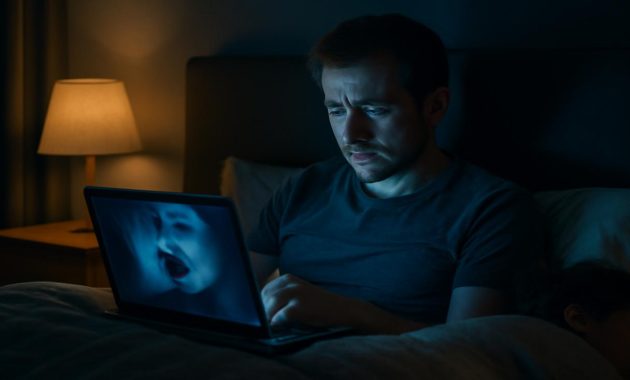
The first time she saw the video, Anna thought she had blacked out. There she was on the screen—her face, her mouth, her body—or what looked like her body—moving in ways she never had, saying things she would never say. There was a strange delay between what she knew to be true and what her eyes insisted was real, like waking from a dream into a second, crueler dream. She turned to Mark, her boyfriend of four years, and he wouldn’t meet her eyes. The sound of the ceiling fan suddenly felt too loud. The room smelled faintly of coffee and dust and something else she couldn’t name—something metallic and sour, like panic.
“It’s Not Cheating If It’s Only Pixels”
He said it the way someone might explain a parking ticket—annoying, inconvenient, but not world-ending. “It’s not cheating if it’s only pixels,” Mark told her, finally looking up from his phone. “It’s not real. It’s just…video. It’s not like I slept with anyone.” The video kept looping on the laptop screen between them, silently now, her own deepfaked face performing for strangers.
The words felt flimsy, brittle, like they would snap if you pressed on them. Only pixels. Only. As if pixelated intimacy existed in a vacuum, as if her face hadn’t been pulled—stolen—from years of selfies, videos, and vacation photos. As if her body hadn’t been reconstructed from scraps of other women’s bodies. As if desire rendered in high resolution could be neatly separated from the reality they lived in: shared passwords, shared rent, shared toothbrush cup.
In that moment, what broke wasn’t just trust. It was the boundary between digital fantasy and real-world harm, between “online” and “offline,” between play and violation. The split ran silent and deep, like a fault line under a quiet town.
The Night the Screen Became a Mirror
Later, when Anna tried to explain it to a friend, she described the oddest detail: the sound of the laptop’s cooling fan. How aggressively normal it all looked—the cluttered desk, the half-eaten bag of chips, the faint reflection of the window in the glossy screen. There was no sinister soundtrack, no dramatic lighting. Just everyday domestic life, quietly rearranging itself around a violation that didn’t leave bruises but still hurt to touch.
The deepfake itself was disturbingly good. Not perfect, but close enough that anyone who knew her would recognize her. The left eyebrow a bit too still, the skin a fraction too smooth, like someone had taken a real memory and run it through a filter. But the gestures—her characteristic head tilt, the quick half-smile she always did when she was nervous—those were there. Or, more accurately, they had been learned.
Mark had fed an app a diet of her face. The technology did the rest, studying, mapping, predicting, rendering. It wasn’t just a video; it was an algorithm’s idea of her, built from the digital breadcrumbs of a life lived partly online. The intimacy of the result wasn’t accidental. It was engineered.
“I was lonely,” Mark said. “You’ve been so busy. It wasn’t supposed to hurt you.” In his mind, it was like watching porn with the volume turned up—more immersive, more tailored, but still basically harmless. He had stepped over an invisible line he didn’t even fully believe existed.
When Fantasy Wears a Familiar Face
If this were a story from ten years ago, Mark might have been caught with search history full of strangers—performers in places he’d never visit, anonymous bodies he would never meet. People row about that too, of course, but the characters remain separate, other. Deepfakes twist that distance into something more intimate and more predatory.
The new frontier of virtual intimacy is customization. Not just categories, but people. People you know. People you love. People who have never consented. The co-worker from accounting. The girl from high school whose Instagram is public. The ex who blocked you. Or, like in Anna’s case, the partner who trusted you with her phone when yours died.
Deepfake creation tools are no longer the domain of specialized studios. They run in browser tabs, on consumer laptops, on phones on the subway. A handful of photos and minutes of video—things we offer to social media without a second thought—can be enough to build a disturbingly convincing moving replica.
To someone like Mark, who grew up online, where faces are endlessly copied, memed, and remixed, it might feel like just another kind of fan edit. An edgy fantasy. A private indulgence that, if kept secret, harms no one. But this is where the ethical vertigo sets in. Because the harm is not measured only by what happens in the bedroom, but by what happens in the mind—and in the uneasy quiet of the person whose image has been taken.
Is It Really “Only Pixels”?
Pixels, after all, are only one layer of reality. A digital threat rarely stays confined to its screen. You can close the laptop, but memory is a harder thing to power down. Once you’ve seen yourself do something you never did, wearing a borrowed body like a costume, you can’t neatly fold that knowledge away. The violation seeps under doors.
Online, there’s a harsh paradox: people repeat “it’s not real” to minimize the damage, yet those same pixels can destroy reputations, cost jobs, fuel harassment. When someone leaks a deepfake—of a teacher, a colleague, a neighbor—the excuse suddenly changes: then the argument becomes “it looks real enough, how can we be sure?” We downgrade reality when it’s convenient and upgrade it when it’s useful as a weapon.
Even if Mark never shared the files, his private archive of synthetic intimacy with Anna’s face still relies on a real person’s stolen likeness and unspoken consent. The body on screen may be part AI puppet, part collage, but the embarrassment, the nausea, the sense of having been used—those are undeniably real. So are the questions that creep into a relationship once the secret comes out: Would he rather have that version of me than the complicated, tired, imperfect me on the couch? Was I ever really with him, or just raw material for fantasy?
The Emotional Economy of Digital Betrayal
Every relationship has its own map of boundaries—spoken promises, unspoken no-go zones, shifting grey areas. Some couples permit porn; some don’t. Some shrug at flirtatious DMs; others call it emotional betrayal. Deepfakes, in a way, are the stress test for those boundaries—because they occupy such an uncertain territory between fiction and violation.
Anna didn’t have a rule in mind for this because who would think to? Her list of deal-breakers had always been tangible: a real affair, physical violence, lies about money. She had not prepared for “uses my face in synthetic porn built from strangers’ bodies.” Yet the moment she saw it, she knew: something fundamental had cracked.
Trust is not only about what your partner does when you’re not looking. It’s also about how they imagine you when you’re not in the room. Mark’s confession revealed an inner theater she never wanted to audition for. It wasn’t just sex; it was authorship. He had cast her, directed her, edited her, replayed her. He had taken her autonomy and replaced it with a silent, responsive avatar that did whatever he wanted.
He tried to explain: “I thought if I used your face, it meant I was still loyal. I wasn’t looking at other women. It was…you.” But the “you” in that sentence had been hollowed out and re-filled with fantasy. That’s the twist: deepfake intimacy can masquerade as a form of closeness—“see, it’s you I want”—while quietly erasing the actual person in favor of an endlessly compliant version.
A New Kind of Triangle
In the oldest stories of betrayal, there are three people: the betrayed, the betrayer, and the other person. In this new script, the third character is glitching, synthetic, part-stranger, part-loved one, part-code. A ghost wearing someone’s skin.
And yet, the pain lands much the same. Anna felt replaced not by a living rival, but by a simulation that still managed to feel threatening. This other-her was younger, more acrobatic, always ready, never exhausted after long shifts. She had no boundaries to negotiate, no trauma to trigger, no worries about contraception or safety. She was versions of porn spliced together under a familiar face.
That triangle—partner, self, synthetic self—creates a strange rivalry. How do you compete with a version of you that never says no? What does it do to your self-worth to know that your image can be made to perform anything, forever, without your participation?
The Quiet Theft of Consent and Identity
The rise of deepfake intimacy forces us to revisit an old question in a new light: What does consent mean when your image can act without you?
We’re used to thinking of consent as something tied to physical presence or direct participation. You were there; you said yes. Or you were there; you said no. But what happens when you weren’t there at all, and software fills in the gaps with eerie precision? Your image is there; your voice—synthetically cloned—might be there; your mannerisms, too. The absence lies in the only place that matters: your will.
Most people will never know if their face has been used in a stranger’s private fantasy project or dumped into some anonymous database of synthetic bodies. The crime leaves no obvious fingerprints. There is no knock on the door, just an uncomfortable suspicion in the back of your mind whenever someone says, “I found an old video of you…”
To make it more tangible, imagine a simple comparison between traditional infidelity and deepfake-based betrayal:
| Aspect | Traditional Affair | Deepfake Intimacy |
|---|---|---|
| Third Party | Real person, separate identity | Synthetic body wearing a familiar face |
| Consent | Betrayed partner excluded | Image owner entirely unaware and unconsulted |
| Evidence | Messages, locations, witnesses | Files that can be duplicated and leaked instantly |
| Emotional Impact | Jealousy, betrayal, insecurity | Violation of identity, body, and privacy at once |
| Plausible Deniability | “We’re just friends” | “It’s not real, it’s only pixels” |
The technology doesn’t just reproduce bodies; it scrambles categories—sex and data, desire and design, person and product. Your face becomes a kind of raw material, like stock footage, available for cut-and-paste storytelling you never signed up for.
The Long Shadow of Exposure
When deepfakes leak—which they often do—the consequences extend far beyond the original betrayal. Victims have lost jobs, been harassed, blackmailed, or pushed into isolation. Some have had to explain to family members, colleagues, and bosses that the video doing the rounds isn’t “real,” only to watch skepticism flicker across faces. The burden of proof lands squarely on them, not on the creator.
In that sense, saying “it’s only pixels” is a particularly cruel distortion. Pixel-based realities already decide whether a job application gets read, whether someone believes you, whether you can walk into a room without whispers. A synthetic video can be more persuasive, in some ways, than memory. It can be replayed. It can be zoomed in on, slowed down, dissected. Memory, by contrast, stutters and blurs. In a cultural courtroom, we still trust the visual over the verbal, the clip over the claim.
Redrawing the Boundaries of Intimacy
Somewhere beyond Anna and Mark’s apartment, lawmakers are scrambling to catch up. There are debates about criminalizing non-consensual deepfakes, about copyright over faces, about data rights. But legal frameworks move slowly, clicking forward like reluctant gears. Technology doesn’t wait.
While the courts puzzle over definitions, couples, friends, and families are left to negotiate their own rules in real time. They ask uneasy questions they never expected to have to ask: “Have you ever used my photos for that?” “Would you tell me if you had?” “Is it cheating if it’s me, but not me?”
It may be that the most urgent work, right now, is not technological or legal, but conversational. We have to learn new words for new fractures. To talk honestly about digital desire without hiding behind the false safety of screens. To admit that pixels can hurt. To recognize that a face is not just a pattern of data points, but a doorway other people use to recognize us, trust us, love us.
Reclaiming the Right to Your Own Image
For anyone who has felt suddenly unsafe in their own reflection, reclaiming that right begins with something simple but difficult: insisting that what happens to your image matters. It’s not prudish to care; it’s basic self-defense.
We also need wider cultural empathy. It’s easy to scoff at those who panic about “fake videos,” to tell them to shrug it off because it’s not “really” them. But the lived experience of seeing your likeness perform without your consent is closer to identity theft than to a bad meme. It doesn’t matter that your atoms weren’t there. Your story was.
In the end, the measure of harm isn’t whether there was physical contact. It’s whether a person’s sense of autonomy, safety, and dignity has been eroded. And that erosion can happen quietly, in rooms that smell of coffee and dust, while someone explains, with a tired shrug, that it was “only pixels.”
Pixels built the modern world. They carry our declarations of love, our breakups, our first glimpses of newborns, our last messages to the dying. To pretend they are neutral, harmless, somehow separate from “real life,” is a luxury we can’t afford.
Frequently Asked Questions
Is using deepfake porn of a partner considered cheating?
Whether it is “cheating” depends on the boundaries of the relationship, but it is almost always a serious violation of trust. Even if there is no physical contact with another person, using someone’s face or body without consent—especially in sexual content—crosses ethical lines that many people experience as betrayal.
What makes deepfake intimacy different from watching regular pornography?
Traditional porn typically involves consenting performers who choose to appear on camera. Deepfake content often uses the images of people who never agreed to be involved—friends, partners, celebrities, or strangers. That lack of consent, combined with the personal familiarity of the face, makes it fundamentally different and more harmful.
If no one else sees the deepfake, is it still wrong?
Yes. The harm is not only about public exposure. Creating sexualized content of someone without their knowledge or consent is a violation in itself. It turns their image into a private toy, strips away autonomy, and can deeply damage trust if it comes to light—even if the files were never shared.
Can victims of non-consensual deepfakes do anything to protect themselves?
Options vary by country and region. Some places have begun to introduce laws against non-consensual deepfakes or image-based abuse. Victims can sometimes report content to platforms for removal, consult legal professionals, and document evidence. However, prevention and strong social norms condemning such behavior are just as crucial, because once something is online, complete removal is extremely difficult.
How can couples talk about boundaries around virtual intimacy?
Open, explicit conversations help. Partners can discuss what each considers acceptable: pornography, sexting, AI-generated content, and the use of each other’s photos. It’s important to ask direct questions—“Would it upset you if…?”—and to listen seriously to each other’s answers. Clear agreements and ongoing check-ins can reduce misunderstandings and surface issues before they become deep fractures.