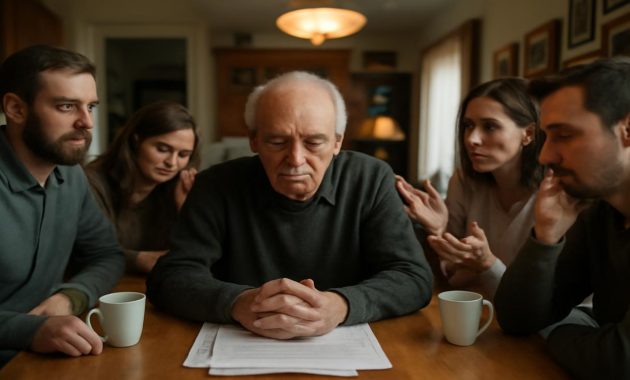
The morning my father called us all home, the sky over our old house had that pale, washed‑out blue of late autumn—the kind that makes every sound feel sharper. The gravel crunched under car tires one by one as my brothers and sisters arrived, each of us carrying our own version of history in the way we walked up the front steps. The house smelled exactly as I remembered: a quiet blend of pine cleaner, old paper, and something warm from the kitchen that always seemed to linger in the air, even when nothing was cooking.
The Day Fairness Came Wrapped in an Envelope
We did not know why he had called us. That was the first shared tension, the invisible thread pulling us tight in the living room. My father sat in his old recliner, the fabric worn thin on the arms where decades of hands had rested. He looked smaller than I remembered, like someone had turned down the volume on him. Yet there was a seriousness in his eyes that made us all sit up a little straighter.
On the coffee table lay a neat stack of envelopes, lined up like small, white promises. Five of them. One for each child. My younger sister, Emma, noticed first. Her brows drew together, and she glanced at me. I shrugged, though my pulse quickened.
“I wanted to do this while I can still look you all in the eye,” my father said. His voice had a paper‑dry rustle, steady but tired. “I met with the lawyer yesterday. My will is finalized.”
There it was. The word that makes grown children instantly feel like characters in someone else’s courtroom drama: will. No one spoke. Somewhere in the kitchen, the refrigerator motor kicked on, a low hum filling the silence.
He reached forward with careful fingers and pushed the envelopes, one by one, toward the edge of the table. “Everything I have,” he said, “is going to be divided equally among the five of you. The house, the savings, the land—all of it. Equal shares.”
My older brother, Mark, exhaled sharply. Emma blinked. Our middle brother, Luke, shifted in his seat. Beside me, my sister Nora, the eldest, squeezed her hands together. My father watched us in turn, as if measuring each reaction with an old carpenter’s eye.
“It’s only fair,” he added, as though the sentence needed a closing nail. “You’re all my children.”
The word fair hung in the air like a fog. For a few seconds, nobody challenged it. Then, something moved under the surface of the room—an old, unspoken current waking up.
Old Stories, New Fault Lines
On paper, equality sounds so clean. Five children, one estate: divide, sign, done. But real life is messier, like the smudged fingerprints on the hallway walls we left growing up, some higher, some lower, each spaced differently apart.
Mark had been the one who left home first, on a football scholarship no one saw coming. He built a business from scratch, made and lost money, then made it again. Sitting there in his pressed shirt and polished shoes, he looked like the child least likely to need an inheritance at all.
Nora, who had practically been a second parent to the rest of us, still lived ten minutes away from our father, dropping by to cook him dinner, bring him medicine, take him to appointments. The lines around her mouth told stories of worry, of years that asked for more than they gave back.
Luke’s life had been different from the start. He was the one who needed extra help in school, extra trips to specialists, extra patience. As an adult, he floated from job to job, never quite catching the current. There had been months when he slept in the spare room down the hall, when Dad covered his rent quietly, when we all pretended not to notice.
Emma, the youngest, had the crisp, hungry energy of someone still trying to prove herself to the world. Student loans. A small apartment. A new job that paid in experience first and a livable wage later.
And me—I was somewhere in the middle, in more ways than birth order alone. Not the most successful, not the most struggling. The one who moved to another city, but remembered every birthday. The one who called more than I visited.
Equal, our father said. And the room, full of these uneven lives and memories, began to tilt under that word.
When Equality Feels Unequal
The first person to speak was Nora. It made sense; she had always been the one to say the hard things. She cleared her throat, her voice catching on the first syllable.
“Dad,” she said, “I’m grateful. Really. But… have you thought about, well… everyone’s situation?” She glanced quickly at Luke, then at Emma, then back at our father. “I mean, Luke—”
“I knew this would come up,” Dad cut in softly, not unkindly. “Yes, I’ve thought about it.”
Mark leaned forward, elbows on his knees. “I don’t need the money,” he said bluntly. “If that’s what you’re worried about. You can give my share to whoever you think needs it more.”
Our father shook his head. “That’s not the point. This isn’t about who needs what, or who has done what. It’s about the fact that you’re all my children. That’s what matters to me.”
There it was again: not a financial argument, but a moral one. Equality, in his mind, was not a calculation; it was a declaration of love.
And yet, to Nora, it didn’t feel that simple.
“But Dad,” she said slowly, “I put my life on hold for a long time to help out here. I don’t regret it. I’d do it again. But I can’t pretend it didn’t cost me things. Jobs. Time. Maybe even a family of my own. Doesn’t that… count?”
Her words landed on the table like small stones. My father’s fingers tightened around the armrest of the recliner. “You think I don’t know what you’ve done for me?” he asked, his voice quieter now. “You think I didn’t see all those nights you stayed when everyone else left? I’m not blind, Nora.”
Luke looked down at his hands, thumbs circling each other in anxious loops. “I didn’t ask you to bail me out,” he muttered. “Not all the time, anyway.”
“No,” Dad replied. “You didn’t. But I’m your father. Helping you was not a burden. It was my role.”
We were no longer talking about money; we were talking about history, about devotion, about the invisible ledger families keep in their hearts. Every favor, every sacrifice, every missed soccer game, every late‑night phone call—it all sat there, unbalanced and unable to be fully repaid.
Fairness Versus Equality at the Kitchen Table
We ended up around the kitchen table eventually, as families always do when conversations get too large for the living room. The table bore decades of scratches and water rings, an accidental archive of birthdays and arguments. Mug handles turned between fingers. Steam from fresh coffee rose and disappeared in the air between us.
“So what does fairness look like, then?” Emma asked, palms open on the table. “Because if equal isn’t fair, and fair isn’t equal, where does that leave us?”
The question settled between us like a third cup of coffee—uncomfortable but necessary.
Mark shrugged. “In my line of work,” he said, “people like to talk about ‘equity’ instead of just equality. Equal is everyone gets the same. Equity is people get what they need to be on similar footing. Different starting lines, you know?”
He glanced at Luke, and then at Emma. “If Dad divided things based on need, for example, I’d probably end up with the smallest slice. That would be fair, in a way.”
“But then you’re punishing someone for doing well,” Emma countered. “Is that fair? You worked for what you have. Should that mean you’re entitled to less from your own father?”
“I wouldn’t call it punishment,” Mark said. “More like… adjustment.”
Nora rubbed her forehead. “And what about the time I gave up? There’s no spreadsheet for that. No way to ‘adjust’ for missed years.”
I watched their faces, listened to their definitions of fairness—need, effort, sacrifice—and realized something quietly unsettling: each of us was building fairness around the part of our story that hurt most.
For Mark, fairness meant not being penalized for his success. For Luke, it might mean getting extra support. For Nora, it meant having her sacrifices acknowledged. For Emma, it meant starting her adult life without feeling like the last one in line. For me, it meant trying not to tear the family fabric just as Dad began to fade.
My father, listening to all this, seemed to be weighing not the money, but the impact of each definition on what little time we had left together.
What We Think We Deserve, and What We Can Live With
We talk a lot in abstract terms about fairness and equality, but sitting around that old kitchen table, the concepts had faces, names, and the crackle of decades‑old tension. The conversation kept circling back to one central contradiction: love feels equal, but lives rarely are.
My father finally spoke up, his voice carrying the weariness of a man who had replayed this scene in his head for months. “Any way I do this,” he said, “someone is going to wonder if they got too much or too little. That’s the curse of dividing a life into pieces.”
He took a breath. “When I say ‘equal,’ I’m not pretending your paths have been the same. I know they haven’t. What I’m saying is: I refuse to put a price on your different lives. I don’t want to say, ‘This child is worth more’ because of what they earned, or lost, or gave up.”
He leaned back, eyes glistening. “If I start weighing sacrifices and missteps and needs, I will get it wrong. And you will carry that wrongness long after I’m gone.”
There was a painful clarity in that. His choice of equality was both an attempt to avoid injustice and a surrender to its inevitability. He knew he could not calculate fairness perfectly. So, he chose the blunt instrument of equal shares, hoping it would at least spare us from the wound of explicit comparison.
Still, the question gnawed at us: was treating us the same the best way to honor the ways our lives were not the same?
The Quiet Arithmetic of Inheritance
Inheritance is never just about numbers. It’s about the stories those numbers seem to confirm or erase. Around that table, we began to run a different kind of math—emotional, imperfect, but honest.
We imagined different versions of Dad’s will. One where Luke got more, because he had less stability. One where Nora received extra, a tangible “thank you” for years of caretaking. One where Mark received less, or nothing at all, his success seen as self‑sufficiency. One where Emma got a larger chunk to help her launch into independence. One where I, the middle one, hovered in the murky average of “fine enough.”
Each version solved one problem and created another. Give more to Luke, and perhaps he feels like a charity case, his struggles forever stamped in legal ink. Give extra to Nora, and maybe the rest of us feel our love measured and found lighter. Trim Mark’s share, and he might say he’s being taxed twice—by the world and by his own blood. Boost Emma’s portion, and we might resent opportunities she received that we never had.
We are often told that money can’t buy love, but it stubbornly persists in acting like a scoreboard for it. A will may be a legal document, but in a family, it also reads like a final letter, a last verdict on what we meant.
My father, I realized, was trying to write a letter that didn’t place us in ranked order.
A Simple Table, A Complicated Truth
At one point, Emma grabbed a notepad and drew a quick table, trying to make sense of the abstract debate in a concrete way. The numbers were made up, but the pattern felt painfully real.
| Child | Life Circumstances | Equal Inheritance | “Fair” Inheritance (Hypothetical) |
|---|---|---|---|
| Nora | Primary caregiver, fewer career options | 20% | 25–30% to recognize sacrifice |
| Mark | Financially secure, successful business | 20% | 10–15% due to lower need |
| Luke | Unstable work, ongoing struggles | 20% | 25–30% to support stability |
| Me | Moderate stability, lives away | 20% | 15–20% depending on view |
| Emma | Early career, debts, starting out | 20% | 20–25% to help launch |
We stared at the columns, aware that no one at the table could fill in those percentages without revealing their own hidden hopes and fears.
“That’s the problem,” my father said at last, tapping the paper. “This chart doesn’t measure love. It can’t. But once I start changing those numbers, you’ll all look at them as if they do.”
Choosing a Story Together
The debate could have split us apart. There are families that never recover from the reading of a will, from the shock of who gets what. But something unexpected happened as the afternoon light shifted across the kitchen floor.
Mark pushed the notepad away. “Look,” he said, “Dad made his choice. We can argue with it, or we can decide what to do with it.”
He turned to Luke. “If I get the same share as you, and I know you’re having a harder time, I can choose to help. It doesn’t have to be written into the will for it to be real.”
Luke glanced up, wary. “I don’t want handouts.”
“It wouldn’t be a handout,” Mark replied. “It would be family. There’s a difference.”
Nora looked at Dad. “If I accept equal, does that erase everything I did?”
He reached across the table and took her hand. “Nothing can erase what you did,” he said, his thumb brushing the back of her knuckles. “Not a will. Not money. It’s written in me, not in the bank.”
She swallowed, eyes shining. “Then I’ll take equal,” she said quietly, “but I want something else too. I want it in writing that I did right by you. A letter. From you. Not for the lawyer. For me.”
My father nodded slowly. “That,” he said, “I can do.”
Emma leaned back, exhaling. “Maybe the fairness isn’t all in the money,” she said. “Maybe some of it is in how we treat each other once the money shows up.”
It was such a simple sentence, but it shifted something fundamental. Instead of asking, Is Dad’s choice fair? we began to ask, How can we live fairly with Dad’s choice?
In that pivot, the inheritance ceased to be a verdict and became a shared responsibility—a story we would write together in the years after our father was gone.
What Stays After the Will Is Read
As evening drew in and the sky turned the bruised purple of approaching winter, the house settled around us the way it had when we were children, creaking and sighing in all the old familiar places. We left with our envelopes still unopened, tucked into bags and coat pockets, the paper warm from our hands.
The money inside those envelopes would not fix Luke’s uncertainty or refill Nora’s missed years. It would not fuel Mark’s next business or erase Emma’s loans overnight. It would not bring back our mother, whose absence was felt in every room, or stretch our father’s time beyond what nature allowed.
What it could do, though, was force us to confront the stories we told ourselves about what we were owed and why. It made us look closely at the words we often use interchangeably—fairness, equality, need, desert—and admit that they do not always line up neatly.
Our father chose equality not because he believed our lives had been equal, but because he did not want his final act to sort us into winners and losers. He trusted us, perhaps recklessly, to sort out the nuances ourselves—to keep loving each other in the wide, uneven spaces the will did not address.
Months later, when the legal documents had been processed and the numbers wired to our accounts, something remarkable happened. Quietly, without fanfare, the redistribution began. Mark helped Luke pay off a lingering debt. Nora used some of her share to finally take a trip she had postponed for a decade, with all of us insisting she go. Emma and I pooled a portion of ours to set up a small emergency cushion for future crises, a family fund with no paperwork, only promises.
Was it perfectly fair? Probably not. But it felt—if not equal, then at least kind. And kindness, we discovered, can sometimes carry you through the places where fairness fails and equality oversimplifies.
In the end, my father did not solve the ancient riddle of fairness versus equality. No one can, not with a single pen stroke. But in choosing equality, and in trusting us to live fairly within it, he gave us something more enduring than any amount written in a will: the chance to decide, together, what kind of family we wanted to be when no one was left to referee.
Maybe that is the real inheritance. Not the house, not the land, not the balance in an account—but the questions that force us to see each other more clearly, and the fragile, beautiful choice to answer them with as much grace as we can find.
Frequently Asked Questions
Is dividing an inheritance equally among all children always the fairest choice?
Not always. Equal division is simple and can prevent feelings of favoritism, but it may ignore very real differences in need, sacrifice, and circumstances. What is “fairest” depends on a family’s values, history, and how openly they can talk about those differences.
What’s the difference between fairness and equality in inheritance?
Equality means everyone receives the same share. Fairness often considers context—who needs more help, who contributed more, who made sacrifices. Equality treats everyone the same; fairness tries to treat everyone according to their situation.
How can families reduce conflict around inheritance decisions?
Honest, early conversations help more than any legal formula. Parents explaining their choices while they are still alive, listening to their children’s feelings, and documenting the reasons behind their decisions can ease resentment later, even if everyone doesn’t fully agree.
Can parents acknowledge a caregiving child without changing the will?
Yes. They can offer financial support or gifts during their lifetime, write a personal letter of gratitude, or give non‑financial legacies such as cherished items or stories. Some families also create separate agreements or compensation for long‑term caregiving outside the will.
What happens if siblings disagree with an equal inheritance plan?
Legally, challenging a valid will is difficult. Emotionally, siblings can choose how to respond: they may accept the decision, privately redistribute funds among themselves, or distance themselves from one another. The healthiest path usually involves open dialogue, empathy for each person’s story, and a willingness to prioritize relationships over exact “fairness.”