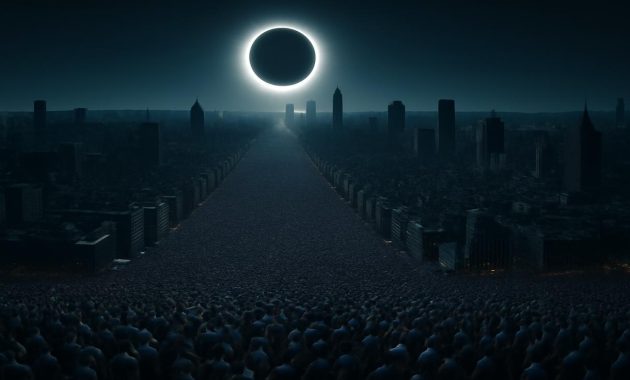
On an ordinary Tuesday afternoon, in the middle of streaming shows and scrolling feeds and simmering traffic, the sun will simply go out.
Not forever. Not for hours. For just about six minutes. But those six minutes of darkness—midday turning to twilight, then almost night—are already rearranging plans, rerouting flights, filling hotel rooms months in advance, and sending emergency planners into war-room mode. All for a shadow hurtling across the planet faster than a jetliner, a line of darkness that will slice through cities, small towns, and oceans as billions of eyes tilt upward.
It will be the longest total solar eclipse many people alive today will ever see. Six minutes of the moon perfectly covering the sun, six minutes of plunging temperatures and gasps from crowded fields and rooftops, six minutes when the ordinary rules of day seem to loosen, and something ancient and wild presses in around the edges of modern life.
The Day the Sky Forgets What Time It Is
Imagine standing in a familiar place—a schoolyard, a supermarket parking lot, a stretch of beach you’ve walked a hundred times. The light feels a little odd at first, like someone turned down the saturation on the world. Shadows sharpen, cooler and more defined than you’re used to. People squint and say, “Huh, it looks weird out here today.”
Then the temperature drops. It’s subtle at the beginning, a brush of air on your arms, then a distinct chill that makes you tuck your hands into your pockets. Birds flutter and fall strangely quiet. Dogs whine, then pace, then lie down with their heads on their paws, watching the sky as if they sense something coming but can’t quite name it.
The sun, which you couldn’t stare at a few minutes ago without pain, is now a thinned, frail disc behind protective glasses. A bite appears on the edge—just a nibble of shadow—and grows. People point. Someone who rarely looks up from their phone is suddenly craning their neck, sharing glasses with a stranger, saying over and over, “Wow, wow, look at that.”
And then, abruptly, the last bright bead of the sun slips away behind the moon. The world exhales into darkness.
Streetlights flicker on in confused automation. Stars and planets appear in the middle of the afternoon. The horizon glows in an eerie 360-degree band of twilight while overhead there’s a hole in the sky—a black circle wreathed by a shimmering halo of white fire, the sun’s hidden corona, suddenly naked and alive.
This is what six minutes of darkness feels like. Not the everyday darkness of night, but a temporary unpinning of the sky, a reminder that our daylight is not guaranteed, that the universe is moving in enormous clockwork arcs whether we notice or not.
The Longest Shadow: Why This Eclipse Is Different
Total solar eclipses happen more often than many people think, but they rarely happen where you are, and even more rarely last this long. Some are just a quick gasp—two minutes of totality, maybe three—before the light returns. This one is a different creature.
Six minutes of totality is astonishing in eclipse terms. The geometry has to be just right: the moon at an ideal distance from Earth, the Earth in the sweet spot of its orbit, the alignment landing a perfect bullseye for those lucky enough to stand in the narrow path of the moon’s umbral shadow. Outside that path, people will see only a partial eclipse. Impressive, yes. Life-changing, probably not. But those within the path of totality will stand squarely under the longest midday night they’re likely to experience in their lifetime.
Scientists have run the numbers, plotted the shadow’s track, and dusted off data from historical eclipses: those breathless accounts from sailors, desert traders, temple scribes, and 19th-century astronomers who timed totality with pocket watches and scribbled descriptions of sky-colors in the margins of notebooks. This upcoming event edges toward the outer edge of what’s possible, flirting with the rare, almost mythical long eclipses that have entered legend in poetry and sacred text.
The numbers tell one story: six minutes of sun erased. But what really sets this eclipse apart isn’t the math; it’s the stage on which it will play out—an era of instantaneous global communication, drone footage, live streams, and billions of cameras pointed toward the same piece of sky.
Authorities on Alert: Planning for Crowds, Chaos, and Wonder
Behind the scenes, far from the poetic language and dreamy social posts about “cosmic alignment,” emergency managers are staring at maps and traffic models and trying not to panic.
In control rooms and city halls along the path, the word “eclipse” doesn’t conjure mysticism; it conjures logistics. How many extra cars can that rural highway hold before it locks up entirely? How fast can cell networks crumble under an unexpected surge of uploads and video calls? What happens if a town of 8,000 swells to a crowd of 80,000 in a single afternoon?
Local authorities, meteorologists, and public safety officials have watched what happens when totality crosses nations. They’ve seen the surprise gridlock, the overwhelmed gas stations, the medical calls from unprepared hikers and sunburned families on road shoulders. This time, they’re trying to get ahead of it.
In some areas, staff are being trained months in advance. Hospitals are updating emergency protocols. Tourism boards are quietly urging visitors to stay the night rather than try to flee the moment the sun returns. Counties are coordinating with neighboring regions on detour routes and temporary event zones, like pop-up festivals born from darkness.
It’s not that they fear the eclipse itself; the moon and sun will do what they’ve done for eons. What they fear is the human reaction: the spontaneous decisions, the last-minute drives, the people who will slam on the brakes in the middle of a highway, throwing open their car doors in awe at the sudden night.
Some agencies are already drafting public messages so simple and clear they could be printed on a postcard: Plan ahead. Arrive early. Stay put. Bring water. Bring patience. Look up, but don’t forget to look around you, too.
The Shadow’s Itinerary: A Planet on the Move
The path of totality will slice across the globe like a high-speed secret, there one moment and gone the next. Long before anyone feels the chill or sees the strange sharpening of shadows, orbital models have already choreographed the entire event—down to the second.
For observers, though, those seconds translate into memories. People are planning pilgrimages well in advance, turning this narrow line on a map into a ribbon of gatherings and improvised communities. Farmers are opening fields for tent camping. Schools are rearranging exam schedules. Amateur astronomers are hauling telescopes to ridges and lake shores, eyes alight as they talk about prominence loops and magnetic field lines as casually as other people talk about sports scores.
The following table gives a simple sense of how the experience changes depending on where you stand in relation to the path of totality and how authorities are likely to respond:
| Location Type | Eclipse Experience | Expected Crowd Behavior | Typical Preparations |
|---|---|---|---|
| Inside path of totality | Up to ~6 minutes of full darkness, visible corona | Heavy travel, spontaneous gatherings, traffic jams | Traffic control, extra emergency staff, public viewing zones |
| Near but outside totality | Deep partial eclipse, dimming but no full night | Moderate interest, some travel toward totality path | Public info campaigns, limited traffic planning |
| Far from path | Minor partial eclipse or none visible | Mostly remote viewing, social media engagement | Media coverage, educational programming |
Even in areas that will see only a partial bite taken out of the sun, the event will ripple through schedules and conversations. In cities thousands of kilometers from the path of totality, people will step out onto balconies between meetings, sharing glasses and phone screens, trying to catch a glimpse. In remote villages directly under the shadow, the event may become a story handed down to children yet unborn: the day the sky went dark at noon and everyone stood together in a field, holding their breath.
A Global Reaction: When Billions Look Up Together
We’re used to global events that spread from screen to screen—a big game, a political moment, a breaking news story. But this is something else: a scheduled, unstoppable, physical phenomenon in the sky that will arrive on time whether or not the internet notices.
Of course, the internet will notice.
Expect live streams from mountaintops and high-altitude balloons, from ships at sea and crowded city plazas. Expect time-lapse videos that condense the eerie darkening of the day into a few heartbeats. Expect social feeds to fill with shaky, exuberant phone videos of people shouting at the sky: half laughing, half crying, swearing they never knew anything could feel quite like that.
There will be language for it in every tongue on Earth. In some places, it will be wrapped in myth—monsters devouring the sun, dragons crossing the heavens, cosmic omens reborn in the age of camera phones. In others, it will be treated as a grand outdoor science class: children and teachers lined up in schoolyards with cardboard viewers and safety glasses, talking about orbits and penumbras and the quiet machinery of the solar system.
What unites all those reactions is the shared astonishment. For a handful of minutes, the world’s attention will tilt in the same direction. We’ll trade our usual downward gaze into little glowing rectangles for an upward stare into a sky that suddenly feels very close and very strange.
And then, just as we begin to sink fully into that strangeness, the sun will return.
Six Minutes in the Dark: What It Feels Like to Stand in Totality
People who’ve chased total solar eclipses across continents will tell you there’s a before-and-after to your first one. You can read all the diagrams you want, watch all the videos, and still find yourself stunned by the physicality of it when it actually happens overhead.
In the last minutes before totality, the light goes wrong in a way that’s hard to capture on camera. Colors fade to a bruised, metallic flatness. The world looks like a movie shot on a strange filter. The sun shrinks to a crescent, and the final moments feel like the tightening of some invisible thread.
Then, the “diamond ring” effect: a last blazing bead of sunlight sticking to the moon’s edge, dazzling and delicate, before it snaps away. Glasses come off. A collective cry rises from the crowd—sometimes cheers, sometimes stunned silence, sometimes a raw, unbidden roar from people who thought they would simply watch quietly and instead discover tears on their faces.
The corona blooms into view, a ghostly white halo stretching outward in delicate streamers. You can see with your bare eyes what is usually hidden by the sun’s glare: the feathered shapes of solar wind made visible, the breath of our star.
Wind may pick up. Temperatures may drop further. Insects may start their nighttime songs. For six minutes, you are standing in a world that has slipped slightly out of phase with itself.
When the first thin sliver of sun reappears, it’s almost painfully bright, a reminder of how much power had been hidden just moments before. The spell breaks. People laugh, chatter, compare photos that fail to capture what they felt. The sky brightens quickly. Birds start up again, sounding uncertain, as if they, too, are trying to figure out what just happened.
How Authorities Want You to Prepare (and Why It Matters)
For public officials, the goal is simple: turn a potentially chaotic influx of visitors into a safe, shared moment of awe. To do that, they’re quietly asking for your help long before you ever put on a pair of eclipse glasses.
They want you to think of the eclipse not as a quick errand to run, but as a full-day event. That means:
- Arriving early in your chosen viewing area, ideally the day before, to avoid clogging narrow roads and small-town intersections.
- Bringing more supplies than you think you need: water, snacks, sunscreen, layers for when the temperature drops, and any medications you might require.
- Topping off your fuel tank well before you get close to the path of totality, since small stations can’t magically handle festival-sized surges.
- Downloading maps ahead of time in case cell service droops under the weight of thousands of people trying to upload the same moment at once.
- Watching the sky from a safe place, not the shoulder of a busy highway or the middle of an active roadway.
They also want you to understand the non-negotiable part: eye safety. During the partial phases of the eclipse—before and after totality—looking directly at the sun without proper protection can damage your vision in ways you may not feel immediately. Official eclipse viewers, made with proper filtering material, are essential. Sunglasses, stacked glasses, smoked glass, reflections in water: none of those are safe substitutes.
During full totality, when the sun is completely covered, you can remove your glasses and look directly at the black disc and its corona. But the moment even a sliver of sunlight returns, the glasses must go back on. Authorities and educators will repeat this so often leading up to the event that it may sound like background noise, but it’s the single most important instruction they can give.
Why We Keep Chasing the Shadow
Strip away the traffic models and the emergency plans, the hotel bookings and camera checklists, and you’re left with something simple and ancient: the tug of curiosity. A total solar eclipse reaches past our routines and pulls on that old animal part of us that once huddled at sudden noon darkness and tried to make sense of it.
We understand the mechanics now. We can describe the orbital ballet in equations, predict the path centuries in advance. Yet when the moment comes—when the sun, that constant disc we barely think about as we go about our days, vanishes behind the moon—understanding doesn’t blunt the feeling. If anything, it sharpens it.
Six minutes of darkness is nothing on a cosmic scale. Stars live and die in spans beyond our comprehension. Galaxies drift through one another across unimaginable distances. But for us, bound to our brief human lifetimes, those six minutes stretch and deepen. They become a shared story that will be told and retold in kitchens, classrooms, bars, and park benches for years.
“Where were you when the sun went out?” someone will ask. And you’ll remember who you were standing next to, what the air smelled like, how the hair on your arms rose when the light turned strange. You’ll remember a moment when time felt slightly loosened, when billions of strangers looked up together and, just for a heartbeat, remembered that we live on a small, spinning world under a restless, beautiful sky.
Frequently Asked Questions About the 6-Minute Eclipse
How rare is a total solar eclipse that lasts around six minutes?
Total solar eclipses themselves are not extremely rare globally, but long ones are. Most totalities last two to three minutes. Reaching around six minutes pushes the event into the upper range of possible durations. For any given place on Earth, a similar eclipse may not happen again for hundreds of years.
Is it safe to look at the eclipse with the naked eye at any point?
It is only safe to look at the eclipse with the naked eye during full totality, when the sun is completely covered by the moon. At all other times, including the first and last moments of coverage, you must use certified eclipse viewers or indirect viewing methods to protect your eyes.
Why are authorities so concerned about traffic and crowds?
Areas within the path of totality can experience sudden, extreme spikes in population as visitors pour in to witness the event. Many of these locations have limited roads, lodging, and services. Without planning, this can lead to gridlock, fuel shortages, and delays for emergency vehicles.
Will animals really behave differently during the eclipse?
Yes. Many animals use light levels as cues for daily rhythms. During totality, birds may roost, insects may start their nighttime songs, and some mammals may show confusion or temporary shifts in behavior. The effect usually fades quickly once daylight returns.
What should I bring if I plan to travel into the path of totality?
Plan as if you’re attending an all-day outdoor event: eclipse glasses, water, snacks or meals, sunscreen, warm layers, a hat, a full fuel tank, offline maps, and any medications or first-aid supplies you might need. A blanket or chair and a flashlight for post-eclipse navigation can also be helpful.
Can I photograph the eclipse with my phone?
Yes, but you’ll need to protect both your eyes and your device. During partial phases, never look at the sun through your phone’s screen without proper eye protection, and consider using a solar filter for your camera lens. During totality, you can safely remove filters and capture the corona, but remember: no photo will fully match the experience of simply watching.
What if I’m not in the path of totality?
If you’re outside the path, you may still see a partial eclipse, which can be striking in its own right. Many people also choose to watch live coverage from areas under totality. If you ever have the chance to travel into the path in the future, though, it’s worth the effort: the difference between a partial eclipse and totality is like the difference between hearing about a storm and standing in the downpour.