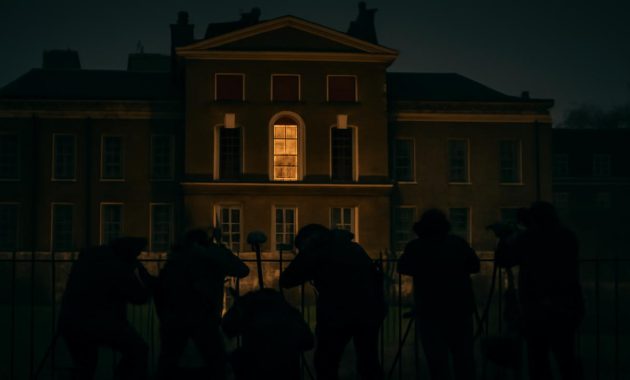
The rain had only just stopped when the first birthday cards began to appear at the palace gates—paper wishes wrapped in plastic sleeves, small bursts of color pressed against the black iron railings. Some were carefully lettered in calligraphy, others written in the slightly wobbly hand of a child. A few carried pressed flowers, taped to folded card. Security staff gathered them gently, as photographers’ lenses clicked from a polite distance, trying to capture the soft, human moment at the center of a storm.
A Birthday in the Eye of the Storm
There is something almost tender, almost fragile, about a birthday in the public eye. It should be a simple thing: a cake, some candles, a handful of people who know your middle name and your worst jokes, a house that smells like sugar and melted wax. But when the birthday belongs to the Princess of Wales, simplicity is the first thing to vanish.
On this day, every detail—what she wears, whether she appears on the balcony, who stands nearest to her—becomes a line of code that the world will attempt to decipher. The Princess turns another year older not in quiet anonymity, but beneath the strange, insistent glow of global scrutiny. Her smile is captured in ultra-high definition, her gestures slowed down and replayed, her absence from one event or her presence at another dissected by voices she will never hear.
And yet, somewhere behind the stone walls and manicured lawns, someone is likely checking the oven, making sure a cake layer isn’t burning. Somewhere, wrapping paper is being folded over the corners of a box with clumsy care, and three young children are perhaps rehearsing a chorus of “Happy Birthday, Mummy” that will never reach a news bulletin but will mean more than any public tribute ever could.
The Strange Intimacy of Watching from Afar
In a world that lives half-online, the Princess of Wales is both distant and strangely familiar. We have watched her walk across windswept palace courtyards in tailored coats, kneel at the level of schoolchildren with paint on their fingers, and stand on the balcony during parades as fighter jets roar overhead and confetti spins down like technicolor snow. We have seen her in carefully composed portraits, and in split-second candid shots that were never meant to be shared as widely as they were.
We have opinions about her clothes, her hair, the way she balances a clutch bag in one hand and a toddler in the other. We notice the small lines that deepen each year at the corners of her eyes and tell ourselves that means time is passing for her, too—as if the passing of time were a privilege we all need reassurance of. This is the peculiar intimacy of monarchy in the digital age: the sense that we know someone whose life we have never once stepped into.
And yet, on a birthday, that imagined intimacy collides with reality. Behind the polished images, there is still a woman waking up with morning breath, someone who might steal five extra minutes in bed, who may or may not have slept well the night before. There is the possibility that she has a small ritual—a favorite coffee mug, a quiet moment by a window, a short walk where she can be just Kate, not Catherine, not Her Royal Highness.
The Weight of Being “The Princess of Wales”
The title she carries is heavy with history. “Princess of Wales” conjures a lineage of fairy-tale illusions and tabloid nightmares, of balcony kisses and broken marriages, of shimmering gowns and flashbulb frenzies. It is a title draped with expectation, stitched with the unspoken agreement that its bearer belongs partly to the public imagination.
On her birthday, that expectation sharpens. Commentators round up the year in review: her patronages, her wardrobe, her public speeches, her perceived triumphs and missteps. Headlines stack up like judgmental little scorecards. Was she visible enough? Strong enough? Warm enough? Modern enough? The questions are unfair in their impossibility—no one human can live up to the collage of contradictions we demand from our modern royals: be accessible, but never too familiar; be glamorous, but not vain; be strong, but not cold; be maternal, but never overwhelmed.
All the while, the Princess herself is existing in the ordinary messiness of human life: raising children, navigating family dynamics, handling private worries that never make the news—health, aging parents, the small cracks and repairs that thread through any real marriage. The scrutiny doesn’t pause for any of that. It runs alongside everything, like a low, constant hum.
Global Attention, Local Moments
It’s easy to forget that for every viral photograph of the Princess stepping out of a car with immaculate posture and a carefully chosen coat, there are hours that remain unseen. Paperback novels on a bedside table. A mug ring left on a desk. A pair of ballet flats kicked off just inside a doorway. The small domestic geography of her life does not make headlines, but it anchors everything that does.
On her birthday, the world’s gaze intensifies, and yet her most important moments remain stubbornly local. Perhaps it is a child’s hand slipping into hers during breakfast, or a slightly lopsided handmade card with glitter that will stay stuck to the kitchen table for days. Perhaps it is a private joke shared with her husband over a cup of tea, or the quiet recognition that another year has passed and with it, another layer of childhood is being shed from the small figures running through palace corridors.
These are the things we cannot see, and maybe should never see. They are the counterweight to global scrutiny—the invisible ballast that allows her to keep walking into rooms where every eye turns to her first.
Under the Lens: Why We Can’t Look Away
The modern gaze is relentless. Social media has transformed public figures into endlessly refreshed content, sliced into twenty-second clips and screenshots. The Princess of Wales, like so many women in the public eye, is consumed in fragments: an angle of her jaw at a state banquet, the texture of her coat at a remembrance ceremony, a brief tightening of her expression during a difficult moment.
We zoom in, compare, critique. We turn human beings into puzzles, convinced there is always a hidden meaning, a private crisis, a secret message tucked into the details. Under this lens, a birthday becomes not just a milestone but a spectacle. Was there a new portrait released? Who took the photograph? What does the choice of setting say about the royal brand this year? Did she appear with the King and Queen? What does her body language suggest about her health, her happiness, her future role?
In quieter moments, it’s worth pausing to ask why we are so hungry for these signs. Maybe royal birthdays have become our way of checking in on an institution we are not sure how to feel about—a living relic of tradition moving through a world that keeps trying to update itself. Or maybe, more simply, we are drawn to the contrast: the idea that someone can sit at the intersection of fairytale and reality, wearing diamonds while wiping jam off a child’s chin.
A Softer Kind of Well-Wishing
Somewhere between the frenzied headlines and the handmade cards at the palace gates, there is room for a softer kind of birthday wish. One that is less about performance and more about humanity. What does it mean to wish “happy birthday” to someone whose life will never resemble our own—and yet whose inner world is probably more like ours than we think?
Perhaps it means hoping she is given something precious and rare: unobserved time. An afternoon where phones are off, cameras are absent, and the only record of the day resides in memory, not in pixels. A long walk where no one shouts her name. A moment to stand in a garden and let the wind tangle her hair without worrying how it will look from across the street.
It might mean wishing her the strength to remain porous—to care, to connect, to kneel on playroom floors and school gym mats without building walls so thick that no criticism can penetrate. But also the courage to draw boundaries when necessary, to remember that even a public figure is allowed a private self.
And, in a way, it means wishing the same for ourselves. To consume less harshly. To scroll with more grace. To let our curiosity be tempered by empathy, to remember that no amount of privilege cancels out the basic, beating, easily bruised humanity underneath.
Tradition, Modernity, and the Woman in the Middle
The Princess of Wales stands at one of the strangest crossroads in public life: a thoroughly modern woman in a role built from centuries of tradition. She has degrees and digital initiatives, a camera roll full of family photos she’s taken herself, and a schedule that ping-pongs between nursery drop-offs and state banquets. She champions early childhood development while walking past portraits painted at a time when women’s roles were sharply constrained.
On her birthday, that contrast comes into sharp focus. The tradition: gun salutes in parks, formal social media posts from official channels, polite statements from dignitaries. The modernity: millions of comments from strangers, trending hashtags, fan-made videos set to music and filtered through nostalgia. Somewhere in between stands the woman herself, trying to knit both worlds together into a life that feels not just dutiful, but meaningful.
It’s easy to assume that she has everything. And in material terms, she has more than most can imagine—palaces, jewels, access, influence. But she has also inherited a job that demands her face become a canvas for everyone else’s expectations. Every year older is another year deeper into that role, another turn of the screw between personal desire and public responsibility.
In this tension, her birthday becomes more than a marker of age. It becomes a measure of how she is slowly, steadily, reshaping the image of what a future queen consort might be: less aloof, more present; less ornamental, more engaged; still elegant, but not untouchable. Whether we approve or disapprove of monarchy, we are watching a living experiment in how ancient institutions adapt to a generation raised on authenticity and transparency—even when those values collide with the need for mystique.
A Day on the Calendar, a Life in Motion
It’s easy to imagine the birthday as a still point—a single day ringed on the calendar, circled in ink by private secretaries and penciled in by school staff. But life does not pause for it. Meetings still happen. Emails still arrive. Political storms keep brewing, global crises do not politely reschedule themselves. Somewhere, a child still forgets where they left their shoes. Somewhere, the family dog still needs walking.
To wish the Princess of Wales a happy birthday, in the midst of this, is to send a small note into an endlessly complicated atmosphere. It’s to acknowledge that behind titles and tiaras, behind the swirling speculation and the long lenses, there is a human being trying to live one continuous, coherent life in fragments of public and private time.
Perhaps the most generous thing we can offer, from our side of the screen or across the palace gates, is a kind of spaciousness in our attention. Let the birthday be a moment for gentler observation. Instead of asking what her smile might secretly mean, we might ask what it costs to keep smiling at all. Instead of critiquing each choice of dress or hairstyle, we might recognize the unasked-for courage it takes to keep walking out into the world, knowing you are always being measured.
| Aspect | Public View | Likely Private Reality |
|---|---|---|
| Birthday Portrait | Analyzed for symbolism, style, and message. | A few favorite shots, chosen for how they feel to her family. |
| Public Greetings | Formal posts, official statements, media coverage. | Texts from friends, drawings from her children, quiet hugs. |
| Global Scrutiny | Debates about her role, her health, her image. | The effort to stay grounded, to protect her family’s peace. |
| Royal Duty | Appearances, engagements, speeches. | Scheduling around school runs, planning for tomorrow. |
In the end, a birthday is a small, stubbornly human thing. It is candles and breath and a moment of making a wish—however symbolic, however private. It is a reminder that even lives lived on the grandest stages move forward in the same steady rhythm as our own: one day, and then another, and then another.
To say “Happy Birthday” to the Princess of Wales this year is to fold all of that into three simple words. It is to acknowledge that she is aging not just as a royal figure but as a woman, a mother, a daughter, a wife. It is to hope that somewhere amid the ceremony and speculation, she finds an hour that belongs only to her.
Somewhere tonight, a light will be switched off in a palace bedroom. Makeup will be removed, earrings placed into a small dish, a dress slipped from shoulders and replaced with something soft and unremarkable. Outside, the cameras will have gone home, the crowds dispersed. Inside, another year will have quietly settled around her shoulders—light in some places, heavy in others.
And perhaps, before sleep, she will think not of the headlines, but of the small, unphotographed moments that stitched the day together: the way a child’s hair smelled when they leaned in close, the flicker of candlelight on icing, the warmth of a hand resting briefly on her back. The world will remember the day in images and commentary. She will remember it in textures, sounds, and breaths.
That, more than anything, is where the real birthday lives. Beyond the scrutiny. Beyond the title. In the quiet geography of a single human life, walking forward under a gaze that will never fully understand her, but might, on this one day, choose to wish her well all the same.
Frequently Asked Questions
Why is there so much global attention on the Princess of Wales’s birthday?
The Princess of Wales occupies a rare position at the crossroads of tradition, celebrity, and political symbolism. Her birthday becomes a focal point for reflecting on the monarchy’s future, her personal role within it, and the public’s fascination with royal life. Media outlets and social platforms amplify this attention, turning what could be a private milestone into a global talking point.
How does intense scrutiny affect royal birthdays?
Intense scrutiny transforms birthdays from simple celebrations into semi-official events. Every photograph, outfit, and appearance is interpreted for hidden meaning about health, relationships, and the state of the monarchy. This can create pressure on royal family members, who must balance personal emotions with public expectations, even on days that should be intimate and relaxed.
Do members of the royal family have normal birthday traditions?
Despite the formality surrounding them, royals do maintain many familiar traditions: family meals, homemade cards from children, cakes, and private gatherings. While official engagements or ceremonies may feature on the day, much of the celebration—especially for those with young families—happens behind closed doors in ways that would feel surprisingly ordinary to most people.
Why do people send cards and messages to the Princess of Wales?
Sending cards and messages allows people to feel connected to a figure they may admire or feel curious about. For many, it is a gesture of goodwill, a way to express support or affection across the distance between palace and public. These messages also serve as a reminder that, beneath all the protocol, there is still a person at the receiving end of those wishes.
Is it appropriate to discuss the Princess’s private life on her birthday?
Public curiosity is almost inevitable, given her visibility, but there is a growing awareness of the need for boundaries and respect. While it is natural to reflect on her public work or the symbolism of her role, focusing too intensely on speculation about her private life can cross into intrusion. A more considerate approach is to recognize her humanity and allow space for her to celebrate away from constant analysis.