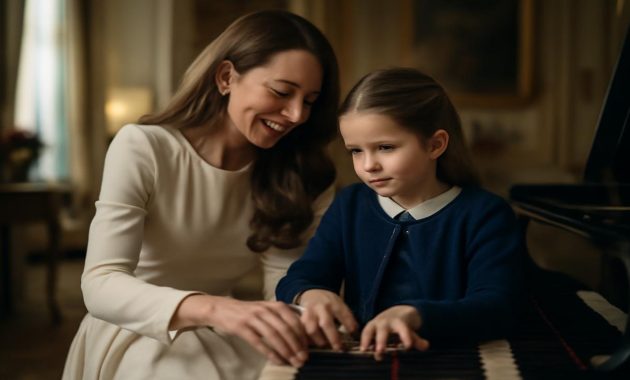
The keys gleam under the stage lights, a row of tiny moons waiting to be touched. A hush moves through the hall, the sort of silence that feels alive, breathing in time with a hundred held breaths. And then, very gently, two pairs of hands—one familiar to millions, one still small and soft with childhood—settle on the piano. The Princess of Wales looks at her daughter, Princess Charlotte. Charlotte looks back, eyes bright, a half-shy, half-excited smile flickering across her face. Four hands, one instrument, and a moment the internet won’t stop talking about: the royal mother–daughter piano duet that has melted screens, timelines, and hearts across the world.
A Room Full of Quiet, and One Small Breath In
It isn’t the grandeur that makes this scene stick with you. Not the royal titles, not the camera lenses hovering like dragonflies, not even the historic weight of the building in which they sit. It’s the quiet. The shared, private, unspoken moment between a mother and her daughter right before the first note.
For all the orchestras and choirs that have accompanied the British royal family through their ceremonies and celebrations, this is something different. This time, the music doesn’t simply surround them; it comes from them. From Catherine’s practiced grace, and from Charlotte’s careful, focused fingers. It is a performance and yet, strangely, it feels like eavesdropping on something more intimate—like catching sight of bedtime stories or whispered laughter across a kitchen table.
The Princess of Wales has, of course, played piano publicly before, quietly revealing an old talent nurtured long before she became one of the most photographed women on earth. But tonight, there is a new note: the presence of her daughter. Charlotte, pigtails slightly loose from the day’s excitement, sits upright with a seriousness that belongs to children when they are doing something that matters deeply to them.
A nod from her mother. A breath in. Their fingers press down together, and the sound rises—hesitant at first, the way all big moments begin—then steadier, warmer, richer. You can almost feel the collective tension ease, like a tight chord resolving. The cameras may be rolling, but in that first ripple of melody, the world shrinks down to just the two of them and the piano.
The Viral Meltwatch: When the Internet Pauses to Feel
In an online world addicted to speed and outrage, it’s an odd thing when everything suddenly slows. Yet that’s exactly what happened when the duet video surfaced. The clip didn’t crash onto the internet like a scandal; it slipped in like a soft note, and then kept echoing outward.
The word “meltwatch” started appearing almost instantly in comments and captions—a playful shorthand for the act of sitting there, phone in hand, watching your own heart crumble a little under the weight of something unexpectedly tender. It wasn’t just royal followers or devoted monarchists who pressed replay. It was people scrolling between news alerts and half-finished emails, people who’d only ever glanced at royal headlines, suddenly caught in the same quiet spell.
What were they melting over, exactly? Not perfection. There is a sweetness in how human the whole scene is. Charlotte glances sideways to check she’s still in step with her mother. Catherine’s hand shifts ever so slightly, a reassuring anchor on the keys. There’s no showy flourish, no theatrical grandstanding—only the calm, almost fragile beauty of two people making music together in real time.
In a strange way, that ordinariness is the magic. This isn’t a princess descending a staircase in a glittering gown. It’s a girl learning, trying, listening, and being held gently in the space where her mother’s experience meets her own early attempts. It just so happens that millions are watching.
The Moment the Notes Left the Room
As the clip spread, people pulled it into their own lives. It played in offices on muted lunch breaks, in kitchens over simmering saucepans, on buses and trains as commuters leaned closer to their screens. Conversations bloomed in comment sections—mothers tagging daughters, piano teachers marveling at posture and phrasing, grandparents recalling the days when small hands once fumbled over the same keys in their own living rooms.
The duet became less about the royals and more about something universal: the first time a child stands beside you in something you love and says, “Show me.” The first time you stand back just enough to let them try, resisting the urge to fix every wobble, letting the notes be slightly imperfect because the courage behind them is perfect enough.
For a while, as the video traveled, the endless churn of online news loosened its grip. Instead of demanding hot takes, it invited something softer: shared delight. People were not simply watching; they were remembering—and, in some quiet internal way, participating.
Four Hands, One Story: Reading the Body Language
If you watch closely, the real story of the duet isn’t only in the music; it’s in the spaces between the notes, the language of glances and half-smiles and tiny shifts of posture. Performance becomes conversation.
Charlotte sits with the careful concentration of a child who knows everyone is watching, but is trying not to think about it. Her back is straight, feet just finding their place on the pedals. She knows the piece, but there is a difference between playing in practice and playing with a thousand invisible eyes on you. Every child who has ever stood on a stage and felt their mouth go dry will recognize that moment.
Beside her, Catherine’s demeanor is all composed warmth. She leans in slightly—but not so much that it overshadows her daughter—creating a small zone of quiet safety between them. Her hands lead occasionally, then retreat, like a parent letting a child cross a narrow bridge first, but stepping close enough to catch if needed.
Their timing becomes its own tender metaphor. Sometimes they strike together, sometimes one follows the other half a beat behind, their hands briefly brushing. You can sense years of unseen moments behind that coordination: practice sessions, giggles over wrong notes, the first time Charlotte’s hand found the courage to land where it should.
| Element | What You See | What It Feels Like |
|---|---|---|
| Eye Contact | Quick glances between mother and daughter | Reassurance, “I’m here, you’re doing fine” |
| Hand Position | Catherine steady, Charlotte intent and careful | Experience guiding emerging confidence |
| Body Angle | Both leaning slightly toward each other | A small, shared world inside a vast room |
| Final Note | A breath, then a shared smile | Relief, pride, and quiet joy |
In that final chord, when their fingers lift and the sound lingers in the air, you see a microsecond of bare emotion cross Charlotte’s face. It’s the look of someone asking silently, “Did I do it?” and hoping the answer is yes. The answer, evidently, is written not only in her mother’s smile, but in millions of comments, likes, and quietly misty eyes around the globe.
Music as a Bridge Between Public and Private
For the royal family, every appearance carries a dual weight: what it means to them, and what it means to everyone watching. A simple wave, a gesture, a wardrobe choice—all of it is dissected, shared, transformed into symbol. But music is different. Music refuses to be completely managed. It slips through the cracks of stagecraft and enters the softer, less guarded parts of us.
In this duet, the monarchy’s ceremonial aura softens at the edges. What’s left is something surprisingly ordinary: a mother passing on a skill, a child trying to honor both the moment and the person beside her. The setting may be royal, but the story itself—learning, trying, belonging—is as common as scraped knees and bedtime songs.
And this is, perhaps, why the performance didn’t just trend; it lingered. In a time when almost everything public feels rehearsed, curated, and optimised for attention, the duet gives off the opposite energy. It is careful but not slick, polished but not sterile. You can imagine the missed notes that happened in practice, the repetition, the nervous questions: “What if I mess up?” “What if I forget?” You can imagine the reassuring answers, too.
When a Piano Becomes a Storytelling Tree
Watch the duet again and pretend, just for a moment, that the piano is not an instrument but a kind of ancient tree. Its polished surface is bark smoothed by generations of hands; its strings are roots gathering and transmitting memory. Two small hands and two adult hands touch those “roots” at once, sending vibrations down and out, across time, across families, across oceans of screens.
Every family has its version of this tree. Maybe it’s not a piano. Maybe it’s a wooden table where recipes are passed down in the language of flour and spice. Maybe it’s a fishing pier where knots and patience are learned. Maybe it’s a path through a city park walked by three generations, each leaving their footsteps as quiet annotations for the next.
For Charlotte, the piano on this night is both instrument and archive. On its keys lie the echoes of her mother’s younger self, practicing long before there were tiaras or titles in the picture. Now Charlotte steps into that echo, adding her own notes, her own timbre. The duet becomes part of the family’s living story, one that just happens to be unfolding where everyone can see it.
There is a certain tenderness in such shared rituals, especially when they are made visible. To those who watch from afar, the piano isn’t merely a grand object on a grand stage; it’s a reminder that even in the most formal of lives, there are still living rooms, still weekend lessons, still the small domestic repetitions that quietly shape who we become.
Why This Moment Landed So Deeply
Plenty of royal clips go viral, from balcony waves to candid missteps. Yet the reaction to this duet felt different—less like gossip and more like witnessing something that people didn’t quite have words for but immediately recognized. Why?
Part of the answer lies in timing. The world feels frayed in so many directions: headlines heavy, feeds crowded with conflict. Elegantly staged hope can feel hollow. But two people, clearly nervous, clearly human, choosing to share something as ephemeral and delicate as a musical piece—that carries a quiet kind of courage.
There’s also the intergenerational thread. Viewers see not only a little girl playing the piano; they see the possibility of continuity. In an age where so much feels temporary, where communities and traditions can flicker in and out of existence with each algorithmic shift, the idea of passing down something—anything—endures like a lantern held out in the dark.
And then there is the simple, concrete beauty of the sound itself. The notes, clear and bright, travel beyond the ornate room and the cameras. They slip into kitchens, buses, and quiet bedrooms late at night, stitching together people who will never meet but, for a fleeting few minutes, are listening to the same small, shared piece of music.
A Duet That Keeps Playing Long After the Last Note
Some performances end when the applause fades. Others keep echoing in quieter ways, showing up unexpectedly in the days and weeks that follow, a bit like a tune you can’t get out of your head. The duet between the Princess of Wales and Princess Charlotte seems to belong to the second category.
Parents, inspired, sit down beside their own children at old instruments suddenly dusted off. Grandparents send the video on with a simple message: “Remember when you played for us?” Piano teachers share it with their students as proof that everyone, no matter how visible or important, feels nervous and must learn, note by note.
In classrooms, in private lessons, in homes where music is made imperfectly but wholeheartedly, the video becomes a reference point. “Your hands can shake and it can still be beautiful.” “You can share the spotlight and still be seen.” “You can be learning and leading at the same time.”
In a way, the internet’s collective “meltwatch” is less about being overwhelmed by cuteness and more about seeing a glimpse of something that feels increasingly rare: unguarded tenderness, shared publicly but not cynically. It reminds us that the softest stories can still travel far, even across cables and towers and satellites.
And somewhere, away from the cameras, there will be another piano, another afternoon, another session where Charlotte sits down again, perhaps a little taller this time, perhaps trying a new piece. Maybe the cameras will be there, maybe not. But the music will keep moving between them—mother to daughter, daughter to keys, keys to the listening world, like light shifting over water.
What We Carry Away From the Keys
When the last frames of the video fade, we’re left with more than just a royal moment. We’re left with questions that feel quietly personal. Who first put your hands on the things you now love? Who sat beside you, patient in your clumsy beginnings? What small talents have you tucked away, waiting for a reason—to share them, to pass them on, or simply to remember that they are still a part of you?
The Princess of Wales and Princess Charlotte don’t answer these questions for us; they simply offer a scene that asks them more gently than words could. Four hands on a piano, two lives at different points on their paths, meeting in the same place for a brief, luminous interval. The sound rises. The sound fades. The feeling lingers.
Long after the internet finds its next obsession, somewhere in the quiet between one day and the next, that duet will still be echoing—not only in the official archives, but in the memories of those who watched and felt something soften, just for a moment. Like a chord resolving. Like a breath let out. Like a heart melting, just enough to remember what it means to be moved.
FAQ
Why did the duet between the Princess of Wales and Princess Charlotte go viral?
The duet resonated because it combined public ceremony with intimate, relatable emotion. Viewers saw not just royalty, but a mother supporting her daughter through a vulnerable moment, which created a powerful sense of shared tenderness online.
Does the Princess of Wales have a background in music?
Yes. Catherine, Princess of Wales, learned piano as a child and has occasionally shared this talent publicly. Her ease and confidence at the keyboard suggest years of private practice long before her royal life.
Was Princess Charlotte’s performance considered advanced for her age?
Charlotte’s playing showed focus, coordination, and timing that impressed many viewers, especially given her youth and the pressure of the occasion. While she is still clearly a learner, her poise at the piano stood out.
What do people mean by “internet meltwatch” in this context?
“Meltwatch” became a playful term for repeatedly watching the video while feeling emotionally moved—“heart melting”—by the warmth and vulnerability of the performance.
Why do musical moments like this feel so powerful, even through a screen?
Music carries emotion in a direct, wordless way. When we see people—especially family members—sharing it with sincerity and a bit of nervousness, it taps into universal experiences of learning, supporting, and being seen, making the moment feel deeply human and relatable.