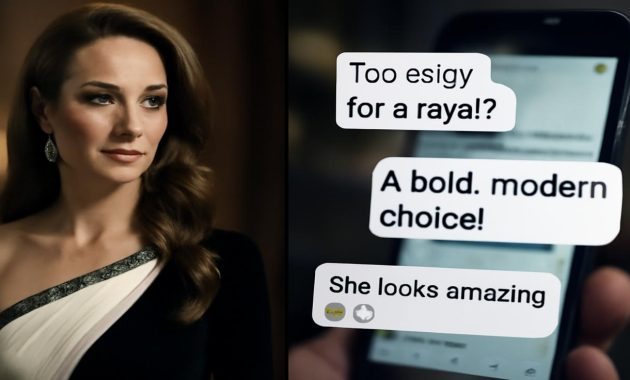
The flashbulbs start before the car door even opens. A low, electric murmur rolls along the crowd barrier like a wave catching its breath. It’s the kind of February night London does so well—cold, sharp, and silvered with rain—but the air outside the Royal Festival Hall is suddenly warmer, denser, as every camera lens swivels, every neck cranes. She’s here. After a year of conspicuous absence, whispered worry, and headlines written in the future tense, the Princess of Wales has returned to the BAFTAs. And this time, she’s wearing Gucci.
A Carpet, A Crown, And A Collective Inhale
For a fraction of a second, there’s an almost reverent pause, as if the red carpet itself needs to readjust to the scale of the moment. Then Catherine steps out of the car, and the crowd erupts—not a polite, royal-appropriate ripple, but a full, unmistakable roar. You can feel it, even through the screen, that invisible surge of attention converging on a single silhouette.
We’ve grown used to a particular visual story from her at this event: Alexander McQueen’s sculpted drama, Jenny Packham’s liquid shimmer, Elie Saab’s gauzy romance. In recent years, her BAFTA gowns have been part royal armor, part diplomatic essay—classic British couture, careful nods to sustainable fashion, subtle rewears that send the message: I am watching the world, and I know it’s watching me back.
Tonight breaks that pattern. The first thing you notice is the color—a deep, molten garnet that seems to drink in the light and exhale it back out in softer, warmer tones. The second is the silhouette: a column of silk that moves like poured wine, cut with the precision that made Gucci, the Florentine powerhouse, a byword for refined excess. There’s a cross-current here, a friction of expectation and surprise, and everyone on that carpet feels it. Catherine has stepped out of her own established visual script, and in fashion terms, that’s a political act.
As she walks—unhurried, poised, the faintest suggestion of a smile hovering at the edges of her mouth—you can almost hear the collective reloading of opinions. Stylists on sofas in New York and Paris lean forward. Twitter drafts multiply. WhatsApp chats ignite. Because this is more than just “a royal in a dress.” This is a Princess of Wales in Gucci, and the implication is loud enough to cut through the noise of the night: something has shifted.
The Dress That Split The Room
You don’t need to be a fashion historian to understand why her choice detonated such a reaction. Gucci, after all, is not neutral ground. The house carries decades of mythology—Tom Ford’s provocative sex appeal, Alessandro Michele’s fever-dream maximalism, Sabato De Sarno’s new, paired-down “quiet luxury” edge. When a royal steps into that river, she’s not just trying on a gown. She’s wading into a narrative already in motion.
The gown itself is a study in controlled drama. The bodice is clean, almost architectural—no glitter, no floral appliqué, nothing that so much as hints at fairy tale. Instead, there’s structure. A subtle, squared neckline that frames the collarbones like a painter’s composition. Shoulders that sit exactly where they’re meant to be, not sliding, not slipping, but holding the line with almost military precision.
Then the fabric falls, straight at first and then with a soft eruption at the knees—a gentle fishtail that doesn’t so much flare as unfold. From the back, a slim, disciplined train follows her like a quiet thought. There’s movement, yes, but no chaos. It’s elegant without trying to be nice. Regal without needing to whisper “princess” into your ear.
And yet, the internet has never met a nuance it couldn’t flatten. Within minutes, screenshots of the dress have fractured across the digital landscape. One corner hails it as Catherine’s most confident look in years, a signal of ease with high fashion and a willingness to step into a more European, cosmopolitan aesthetic. Another corner sees betrayal: of British designers, of royal tradition, of the carefully cultivated message of sustainability that rewearing British couture had come to represent.
“It’s a gorgeous gown,” one stylist writes on Instagram, “but Gucci is an unexpected choice for the most photographed British royal at the most prestigious British film awards. This is a night tailor-made for homegrown talent.” Beneath, the comments are a battlefield of heart emojis and rolling eyes.
The Quiet Politics Of A Red Carpet
Royal fashion, especially at this level of visibility, is never just about personal taste. It’s choreography. Every neckline, every hem length, every fabric origin carries a kind of diplomatic weight. When Catherine re-wore her white, one-shoulder Alexander McQueen gown to the BAFTAs in 2023—originally seen at a state banquet in 2019—she wasn’t simply saving a dress from the back of the wardrobe. She was making an argument: that even at the highest echelons of privilege, reusing can be aspirational, not apologetic.
So a fresh Gucci, tonight of all nights, is a deliberate pivot. It reads as an embrace of high Italian craftsmanship, of European couture as a shared cultural space rather than a foreign one. It also reads, to some, as a quiet distancing from the idea that the Princess of Wales must always be the living billboard for British industry, especially when walking a British red carpet lined with British nominees.
Backstage, the mood is more mixed than the headlines will later suggest. A British designer, whose gown appears on an A-list actress moments after Catherine’s arrival, offers a carefully measured reaction, the sort that is both generous and edged with disappointment.
“She looks incredible,” he says. “Catherine almost always does. Of course, as a British designer, you dream of dressing her for a night like this. But fashion is global now. Maybe that’s the point she’s making. Or maybe she just fell in love with the dress. We forget she’s a person in all of this.”
That’s the paradox, isn’t it? The public wants the Princess to be both symbol and woman, both message and human instinct. We applaud her restraint and then ask for risk. We want sustainability but gasp when she repeats an outfit too often. We praise her support of British craftsmanship, then swipe endlessly through Italian labels on our own phones. Her wardrobe is a mirror we keep trying to adjust until our own reflection looks more flattering.
Why Gucci, Why Now?
Look closely at the broader arc of Catherine’s style, and this choice feels less like a betrayal and more like a natural evolution. As her public role has expanded—from charity patron and early years advocate to future queen-in-waiting—her fashion has quietly matured. The pastel coat dresses and floral skater frocks have been gradually traded for bolder shapes, cleaner lines, and a more international vocabulary of luxury.
Gucci, in this moment, carries a particular resonance. Under its current creative direction, the house has been shedding some of its maximalist past and leaning into a kind of sharpened minimalism: rich fabrics, restrained palettes, impeccable tailoring. It’s a language Catherine already speaks fluently through her favored British designers. The Gucci gown tonight feels less like a departure from her taste and more like an extension—she’s not shifting her personality, just her passport.
There’s also a timing component that’s easy to miss. This is her first major red-carpet reappearance after an extended period away from the feverish glare of event culture. Rumors proliferated in that vacuum. Health speculation. Marriage speculation. The kind of low-grade royal panic that surfaces every time a Windsor spends too long out of frame. When she chose to return to this particular spotlight, at this particular event, every element of her appearance was bound to be loaded with meaning.
By stepping out in something unmistakably new, unmistakably luxe, unmistakably international, she seems to be writing her own caption across the clickbait: I am still here. I am not retreating. I can withstand this level of scrutiny and still choose joy, beauty, and complication.
The Calm In The Eye Of The Style Storm
From a distance, the storm around her feels almost comical. Columns will be filed about “brand loyalty” and “missed opportunities for British fashion.” Think pieces will parse whether a royal should ever indulge in something as straightforwardly glamorous as Gucci in a time of economic uncertainty. Social media, ever efficient, will slice the debate into neat, combative extremes: she’s either a style revolutionary or a tone-deaf elitist.
Up close, though, the scene is far gentler. On the carpet, Catherine’s interactions are small lessons in how to be a lightning rod without looking scorched. She leans down to speak to a young filmmaker whose short is nominated in the emerging talent category, hand resting loosely on her clutch, the train of the Gucci gown folding itself obediently at her heels. For these few minutes, the dress is just fabric again—a beautiful frame around a human exchange that will mean far more to that filmmaker than the brand stitched into the lining.
Inside the hall, under the amber theater lights, the gown changes character. It’s less glossy now, more velvety, the deep red almost black at the seams where the fabric bends. On camera, that subtlety plays as depth, a kind of visual gravitas that suits her seat in the royal box. There’s no constant glint to pull you away from the stage, no aggressive sparkle. Gucci, here, is doing what the best fashion quietly does: amplifying presence, not replacing it.
Still, you can feel the hum in the room during the commercial breaks as phones come out and the real show, the one happening on timelines and group chats around the world, gathers pace. The Princess of Wales in Gucci is being zoomed into, cropped, analyzed, screen-captured, shared, critiqued, adored, and dismissed in a million different living rooms at once.
How The Internet Broke It Down
To understand the full scope of the reaction, you have to step off the carpet and into the scroll. Overnight, the discourse settles into patterns, each camp convinced not just of its opinion, but of its moral weight.
| Reaction Group | Core Argument | Typical Comment Vibe |
|---|---|---|
| The Traditionalists | Royals at British events should wear British designers. | “Stunning dress, wrong brand, wrong night.” |
| The Globalists | Fashion is international; she can support multiple houses. | “She’s a global figure, not a walking Union Jack.” |
| The Feminists | Her clothes are over-scrutinized; focus on her work, not her wardrobe. | “Imagine this energy going into her early years initiatives instead.” |
| The Aesthetes | Forget the politics, is it beautiful and well-styled? | “Colour: 10/10. Fit: 9/10. Hair: perfection.” |
Each group is partly right and partly blind. The Traditionalists are correct that royal fashion has long been a tool for soft power, a living endorsement of national industries. The Globalists are right that, in an era of cross-border creativity, the walls around “Britishness” in fashion were always a little permeable. The Feminists are justified in their frustration at how quickly a woman’s achievements are eclipsed by her outfit. And the Aesthetes, well, they’re the ones who remember that fashion can be fun, not just a referendum.
Caught in the middle is Catherine herself, who will likely never publicly explain why this dress, why this house, why this night. Royals rarely annotate their own symbolism. They let the world project its needs onto their choices, like constellations on a clear sky.
What This Says About Where She’s Heading
Zoom out far enough, and the Gucci controversy stops being about Gucci at all. It becomes another tile in the evolving mosaic of the modern monarchy. The royal family has been under pressure to prove, repeatedly and convincingly, that it understands the times it lives in—a task made Herculean by the fact that the institution itself was built in a different century for a different kind of public gaze.
Catherine has increasingly become the bridge between those worlds. She’s the one who kneels on the floor with toddlers in primary schools, talks openly (if carefully) about motherhood and mental health, and builds long-term projects around early childhood development instead of one-off patronage appearances. Her wardrobe has always been drafted into that mission, used as a quiet tool of relatability and aspiration.
Choosing Gucci at the BAFTAs might signal a willingness to let that bridge stretch further—to accept that she can simultaneously be the grounded, jeans-and-blazer working royal and the woman who occasionally steps into unapologetic, marquee-name glamour. Perhaps it’s an acknowledgment that younger generations, the ones the monarchy desperately needs to keep interested, are perfectly comfortable with those kinds of contradictions.
There’s also a sense—subtle, but there if you look—that Catherine is more at ease with her own power now. The early years of her public life were marked by caution: safe silhouettes, nude pumps, a kind of careful modeling of “relatability.” Now, her choices feel less like they’re trying to offend no one, and more like they’re prepared to accept that displeasing some is inevitable.
The Woman Inside The Gown
Near the end of the night, as the BAFTA trophies are cradled in shaking hands and the orchestra plays people towards the exits, there’s a blink-and-you-miss-it moment that won’t make the highlight reels. Catherine stands slightly to the side, waiting to move, the hem of her Gucci gown gathered neatly in one hand. For a heartbeat, there is no audience, no cameras, no swirling commentary—just a woman in a heavy dress navigating a crowded aisle in high heels.
It’s strangely grounding. Because while we turn her outfits into op-eds and moral tests, she is still negotiating the same few seconds of awkwardness every formalwear wearer knows: where do I put my feet, my hands, my face? Am I in someone’s way? Can I breathe?
The dress is exquisite, yes. It is also just a dress. The controversy is real, and also ephemeral. In a few weeks, the fashion story will move on. A different red carpet, a different celebrity, a different house. Yet this moment will stay folded into the ongoing narrative of who Catherine is becoming in the public imagination: not a blank canvas, but an active collaborator in how she is seen.
In the end, the Princess of Wales walking the BAFTAs in Gucci is less about a line on a label and more about a line being crossed—from a version of royalty defined by strict national borders and safe choices to one that flirts with the messy, global, polarized reality of contemporary culture. It is a step, however small and silk-swathed, into the understanding that even crowns, like couture, must evolve—or risk being admired only in museums.
Frequently Asked Questions
Why did the Princess of Wales wearing Gucci at the BAFTAs cause controversy?
The controversy stems from expectations that senior British royals, especially at major UK cultural events like the BAFTAs, will champion British fashion houses. By choosing Gucci, an Italian luxury brand, Catherine disrupted that unwritten rule and sparked debate about tradition, loyalty to British designers, and the global nature of modern fashion.
Has Catherine, Princess of Wales, worn Gucci before?
Yes, she has incorporated Gucci into her daytime wardrobe in the past, particularly blouses, separates, and more understated pieces. However, choosing Gucci for a major, globally televised red carpet like the BAFTAs feels like a more emphatic, highly visible endorsement, which is why it attracted so much attention.
Does the royal family have to wear British designers?
There is no formal rule requiring royals to wear British designers, but there is a long-standing tradition and expectation that they will frequently do so, especially at national events. Their outfits are often seen as a soft-power tool to promote British craftsmanship and the domestic fashion industry.
Was the Gucci gown seen as a move away from sustainable fashion?
Some critics framed it that way because Catherine has previously re-worn gowns at the BAFTAs to highlight sustainability. However, sustainability in fashion is complex. A well-made couture gown that is worn multiple times and carefully preserved can also be part of a sustainable approach, even if it’s new to the public eye.
What does this choice say about Catherine’s evolving style?
Her Gucci moment suggests a growing confidence in taking stylistic risks and embracing a more international fashion identity. It indicates that she is comfortable balancing her role as a symbol of British tradition with the reality of a global fashion landscape—and with the inevitability of divided opinion whenever she steps into the spotlight.