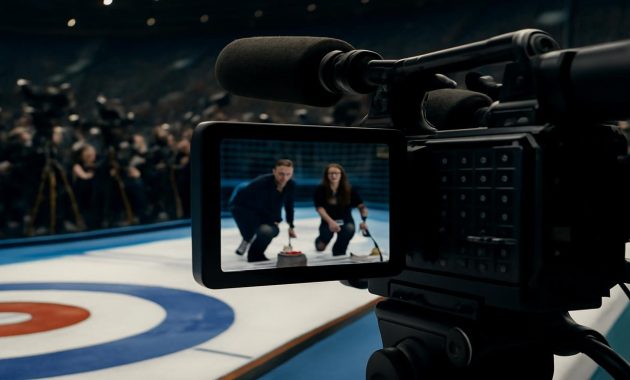
The ice looks almost too perfect to touch—smooth, pearl-gray, and faintly glowing under the arena lights. A low, expectant murmur runs through the small crowd, the kind of hum that happens right before a story takes an unexpected turn. At the far end of the rink, a line of bright red stones waits like patient sentries. And at the near end, the Prince and Princess of Wales stand shoulder to shoulder, cheeks faintly pink from the cold, curling brooms in hand, ready to slide into a world where finesse matters more than formality, and even future kings can slip on the ice.
Royalty on Thin Ice (In the Best Possible Way)
Scotland has a particular way of welcoming its guests. It is never just with handshakes and polite smiles; it is with wind that wakes your bones, with air that smells of rain and salt, with hills that shoulder the sky. On this early winter morning, it welcomes Britain’s most-watched couple not with pageantry but with a sport born in its frozen lochs: curling.
Cameras line the edge of the rink like metallic birds, lenses shifting and blinking. A boom mic hovers overhead, catching the scrape of brushes and the faint squeak of rubber soles on ice. Yet, for all the equipment and the royal titles present, there is an odd, charming casualness in the air, like a family game night that accidentally wandered onto live television.
William, in a navy team jacket zipped up against the chill, rocks back on his heels, eyeing the cluster of stones on the far end like a strategist in a war room. Beside him, Catherine’s expression is all concentration and mischief. Her ponytail flicks behind her as she leans forward, fingers flexing around the broom handle, body language saying she has absolutely come here to win.
The instructor, a seasoned Scottish curler with a weathered face and bright eyes, explains the line of delivery again. “It’s no’ about brute force,” he tells them, his accent curling and rolling like the stone itself. “It’s control. It’s touch. Ye’re not throwin’ a rock; ye’re glidin’ it.”
William laughs. “Sounds like a metaphor for royal life,” he replies, and the arena ripples with warm, appreciative laughter. But when he steps onto the hack and takes his first careful slide, the easy charm fades into sheer, visible focus. The cameras zoom in. A nation that has seen him salute, speak, grieve, and celebrate is now about to see him do something much more human: try not to fall.
Learning to Glide Under the Scottish Lights
The first stone leaves his hand with a hesitant grace, wobbling slightly, a gray blur crawling along the lane. It is not perfect—far from it—but it moves with intent, a small statement of effort. The sweepers, including a very enthusiastic local coach, fall into motion, their brushes rasping across the ice in quick, urgent strokes.
The sound of curling is one of its secrets. On television, it can seem slow, quiet, almost meditative. Up close, it is a symphony of textures: nylon bristles scratching, soles squeaking, jackets rustling, a low hiss as the stone skims over the pebbled surface. Above it all comes the occasional shout—“Hard! Hard!”—as players coax friction and direction from invisible patches of ice.
The Prince squints as his stone slides into the house and nestles just outside the scoring ring. Not terrible for a novice, but definitely not one for the history books. He gives a mock-bow to the spectators. “That was just a warm-up,” he says, grinning. “Don’t put that one in the highlights.”
Catherine steps up next, adjusting her stance with the kind of practiced athletic ease that has become one of her trademarks. She listens as the coach quietly talks her through the delivery—heel against the hack, hips square, shoulders loose. The Princess nods once, eyes narrowing in playful determination. There is a faint breath, a silent count, and then she moves, pushing off with a smooth glide that surprises even her.
The stone leaves her hand like it belongs there. It travels straighter, steadier, its handle gently rotating. The team around her stirs, then bursts into motion, sweeping with practiced urgency. The air feels charged, everyone leaning with the stone as if they could will it into perfection.
It slides into the outer ring, beating William’s first attempt. Just slightly—but enough. Catherine covers her mouth in delighted disbelief, eyes crinkling. William throws his hands up, half protesting, half applauding. “Beginner’s luck,” he insists, but the tilt of his smile says he knows this is exactly the storyline the cameras were hoping for.
The Ice Becomes a Level Playing Field
One of the quiet joys of watching people learn a new sport is how it levels everyone. Titles and reputations do not glide well across frozen water; the ice does not care what your name is. It only cares about weight, direction, friction, and the trembling margin between too soft and too strong.
As the session continues, the distinction between royal couple and local players begins to blur. There is teasing, there is advice shouted in friendly tones, there are awkward half-slips and quick recoveries that draw gasps from the watchers and tight smiles of relief from the players.
William takes a slightly braver slide on his second go, pushing harder, body lower. The stone cuts a determined line down the sheet. “Sweep! Sweep!” he calls, the word bursting out of him with boyish competitiveness. Brushes whirl in front of the stone, the sound harsh and rhythmic. This time, when it reaches the house, it nestles neatly inside the ring, nudging a previous stone out of scoring position.
From the sidelines, Catherine claps, then narrows her eyes with mock-wariness. “That was suspiciously good,” she says. “Have you been practicing without telling me?”
“Just watching a lot of late-night curling,” he answers. “You never know when it’ll come in handy.”
They laugh, but there is something true tucked inside the joke. Moments like this—unscripted, low-stakes, oddly specific—have become some of the most beloved glimpses the public gets of them. Not the balcony waves or the solemn ceremonies, but the silly, human, quietly competitive scenes: racing each other in dragon boats, playing rugby drills, now hurling stones down a frozen lane while cameras search for an angle that captures both majesty and mischief.
When Competition Turns Charming
By the time someone suggests a friendly “royals versus locals” mini-match, the ice is dotted with stones like scattered punctuation marks. The air has warmed with body heat and laughter, breath no longer fogging in front of faces. The arena feels less like a royal engagement and more like a neighborhood sports hall suddenly thrust into the spotlight.
The Prince and Princess, teamed up with a couple of junior curlers and one veteran coach, crouch together at the side of the sheet, planning. They lean in over the chalkboard strategy diagram as though studying a battle map. Catherine points with the end of her broom, tracing an invisible trajectory that loops around a guard stone. William nods, eyebrows raised. “Risky,” he says, “but let’s go for it.”
When it is her turn again, she settles into the hack with a seriousness that makes the crowd go quieter. Her slide is smoother now, muscles already learning the puzzle pieces of balance and release. The stone slips from her fingertips, this time with gentler weight. It curves, ever so slightly, hugging the edge of a guard, then swings inward—as if remembering an old Scottish instinct it never knew it had.
It stops, perfectly placed. Not just in the house, but in scoring position, protected, smugly tucked behind a line of other stones. A collective exhale goes up, followed by applause that is louder, more surprised, and touched with genuine admiration.
William, watching from the side, shakes his head dramatically. “Right. That’s it. I’m not playing cards with you anymore,” he says. “Clearly you’re far too good at strategy.”
“Someone has to keep you on your toes,” she fires back, eyes gleaming.
Their banter bounces across the rink, caught and replayed by microphones, but what the cameras cannot quite translate is the strange intimacy of the sound of stones colliding. When William releases his next shot and it drifts down the ice, there is a split second of silence right before impact. Then the stones kiss—more a clack than a clash—and shift positions with the soft authority of physics. His shot clears a defender and opens a line Catherine’s previous stone can now exploit. The team cheers like they have just scored in the final seconds of a championship game.
Scotland’s Game, Scotland’s Story
It is easy, in the glare of royal coverage, to forget that curling is not just a novelty sport wheeled out for photo opportunities. It is deeply woven into Scotland’s winter history. Long before modern arenas and polished stones, people played on frozen ponds and lochs, bundled against the kind of cold that stiffens breath inside your chest.
The sport’s old nickname—“the roaring game”—came from the low rumble of stones sliding across natural ice, a deep, earthy sound like distant thunder. Watching William and Catherine laugh their way through its modern incarnation is a reminder that this is not just a photo op; it’s a meeting point between tradition and present day, formality and play.
The arena’s walls are decorated with fading team photographs from past decades: juniors with crooked helmets, seniors with weathered smiles, regional champions holding trophies like fragile newborns. Today, a new set of images is being added to that long, unbroken line—images of a prince lowering himself carefully onto the ice, a princess adjusting her footing as she tries not to giggle mid-slide.
For the curlers hosting them, there is pride in showing off a sport that might not always dominate primetime but has a fierce, loyal soul. One coach, eyes shining, explains to a nearby reporter that the visibility matters. “If folk see them trying it, laughing, getting it wrong, then getting it right,” she says, “maybe they’ll say, ‘Why not us?’ That’s how you get more people through the doors.”
The Moment the Ice Owns the Royals
No royal sports outing is complete without the possibility of embarrassment. The ice, of course, understands this. It waits patiently, a smooth conspirator.
It happens when William, flush with a string of improving shots, decides to push just a little harder on his slide. He launches himself with slightly more enthusiasm than stability. For a breathless heartbeat, he is gliding in textbook form, posture long, stone steady, the cameras catching him at a particularly heroic angle.
Then his back foot skids.
He wobbles, arms windmilling, boot desperately searching for friction. There is a collective gasp—the sharp intake of dozens of lungs in unison. Somehow, almost miraculously, he recovers, catching himself with a clumsy step that turns the glide into something more like a half-lunge.
The stone, having long since left his hand, continues on serenely, completely unbothered by his near disaster. It slides into the house with efficient, boring competence while its owner stands there, one foot braced, shoulders shaking with laughter.
Even Catherine cannot hold back, pressing her hand to her face as she doubles over. “That was nearly very dramatic,” she manages between laughs. “I thought we were going to have our first royal curling casualty.”
“The stone did better than I did,” he concedes. “I’m just the transport system.”
The arena relaxes again, the tension broken. There is something brave, in its own small way, about letting millions of people watch you wobble and recover. The cameras zoom in, not unkindly; the moment will be replayed on news segments and social feeds, tagged with captions about relatability and resilience. Underneath all of it is a simple truth: even on ice, dignity is rarely about never slipping; it is about how you laugh when you almost fall.
A Royal Scorecard on Ice
By the time the last stones have been thrown, the scoreboard tells one story, but the mood on the ice tells another. Points have been gained and lost, tricky draws made, bold shots missed by a heartbreaking inch. The Prince and Princess have held their own, with Catherine perhaps edging the unofficial “shot of the day” award, much to her husband’s good-natured annoyance.
For anyone curious how the friendly face-off played out, here is a playful look at their unofficial performance, as quietly tallied by amused onlookers:
| Player | Best Shot | Most Memorable Moment | Unofficial Style Rating |
|---|---|---|---|
| Prince of Wales | Clean takeout that opened the house and shifted momentum. | Near-slip recovery that had the whole rink gasping, then laughing. | 8/10 – Strong enthusiasm, bonus points for self-deprecating humor. |
| Princess of Wales | Perfectly drawn stone curling around a guard into scoring position. | First successful shot beating William’s, followed by victorious laughter. | 9/10 – Smooth technique, quiet competitiveness, and unshakable composure. |
The numbers are playful, of course. The real victory belongs to the club, to the sport, to the people in the stands who will talk for years about the day royalty came to their chilly corner of the world and threw stones like the rest of them.
As the Stones Come to Rest
Eventually the last stone slides to its final resting place, its gentle spin slowing, then stopping altogether. The sheet, once busy with motion and purpose, becomes suddenly still. The sounds soften: brushes are set aside, shoes squeak their last across the ice, the buzz of conversation rises as everyone exhales together.
William and Catherine peel off their club jackets, condensation beading at their temples. They chat with the junior players who shared their team, leaning down to listen, asking about school and future championships. They pose for photos, brooms held like trophies. A young curler, barely tall enough to see over the barrier, shyly asks Catherine if the stone was heavy. “Very,” she answers conspiratorially. “But don’t tell anyone—I think you’d handle it better than I did.”
Outside, the Scottish afternoon is already fading toward an early dusk, the kind that drapes everything in pale silver. The cold beyond the doors is sharper than the manufactured chill of the arena, but it feels somehow friendlier now, as if today’s laughter has warmed the whole town by a fraction of a degree.
The cameras pack away their cables and lenses, but the story they caught will live much longer than the echo of their shutters. Viewers at home will watch the highlights not just for royal gossip, but for the reassurance that even on the slip–prone surface of public life, it is still possible to look silly, to try hard, and to enjoy it all anyway.
For the Prince and Princess of Wales, the day will slide into memory as just one of countless engagements. Yet somewhere in the weave of their shared story, this chapter will shine with a particular winter light: the day they faced off in Scotland, stones gliding down a sheet of ice, their laughter drifting like mist over the house rings, and for a little while, the distance between crown and crowd melted away.
Frequently Asked Questions
Did the Prince and Princess of Wales actually compete against each other?
Yes. While it was all in good fun, there was a clear friendly rivalry between them. They took turns throwing stones, teasing each other over good (and not-so-good) shots, and playfully comparing results.
Who seemed to perform better at curling?
Both improved quickly, but observers noted that the Princess of Wales delivered a particularly impressive draw shot that curled neatly into scoring position. The Prince countered with some strong takeouts. In the spirit of the day, the “winner” was less important than the shared fun and the promotion of the sport.
Why were they curling in Scotland specifically?
Curling has deep roots in Scotland, where the modern game was developed on frozen lochs and ponds. Their visit highlighted local sporting culture and community clubs, shining a spotlight on a sport that is central to Scottish winter life.
Was the event open to the public?
The curling challenge took place in a controlled setting with invited guests, local players, staff, and accredited media. While not a full public free-for-all, it was designed to be accessible, warm, and community-focused rather than overly formal.
Did anything go wrong during the session?
Nothing serious—but there were a few near-slips and wobbles on the ice, especially when the Prince overcommitted on one slide. Those almost-mishaps became some of the most endearing moments, emphasizing the human side of learning a new sport.
What was the purpose of the curling challenge?
Beyond lighthearted competition, the visit aimed to highlight grassroots sport, community engagement, and the value of staying active. It also showcased a distinctly Scottish game, celebrating regional heritage within the wider UK story.
Will they likely try curling again?
While nothing official has been announced, their visible enjoyment, quick improvement, and the enthusiastic response from players and spectators suggest that if curling appears on a future royal itinerary, they will be more than ready to step back onto the ice.