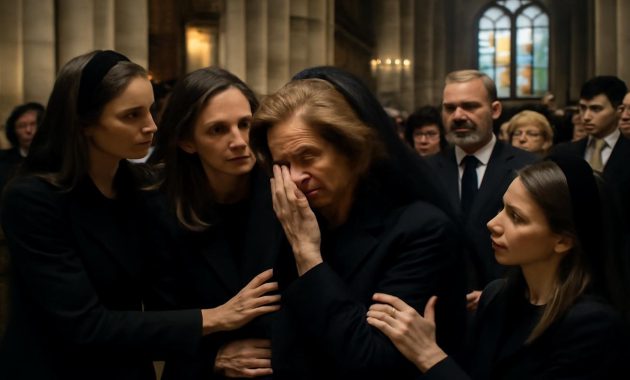
The church doors opened to the soft murmur of rain on ancient stone, and all at once, the quiet square in Athens seemed to breathe in. Black-coated figures moved slowly up the worn steps, umbrellas folding like dark wings at the threshold. At the center of it all, a slight, familiar figure in mourning black—Queen Sofia of Spain—walked forward with the measured grace of someone holding herself together one careful breath at a time. This was not a day of crowns and sashes, of balcony waves and orchestras. This was a day for sisters, for memory, for the invisible threads that still connect Europe’s dispersed royal families. It was the memorial service for Princess Irene of Greece and Denmark—Sofia’s beloved younger sister—and the air inside the church felt as dense and fragile as a held-back sob.
Echoes of a Shared Childhood
Before the readings, before the hymns, there was a moment when the queen paused in the half-light of the nave, under flickering votive candles. Her daughters, Infanta Elena and Infanta Cristina, hovered close on either side like protective sentinels. You could see them subtly adjusting their pace to match their mother’s, their bodies angled inward as if forming an invisible shield. The camera lenses trained on them might have captured only the choreography of grief, but those who watched carefully saw something more intimate—a life’s worth of shared stories, distilled into glances and gentle gestures.
For Queen Sofia, this farewell was not simply ceremonial. It was deeply personal, an unwinding of a thread that began in the sunlit rooms of the old royal palace in Athens, where she and Irene once chased each other over polished floors as children, barefoot and laughing, years before exile, duty, and distance scattered them across borders. Princess Irene, the youngest of King Paul and Queen Frederica’s three children, had always been the quieter presence—musical, thoughtful, with an air of gentle irony that those close to her cherished. She was often described as the “soulful” sister: the one who listened more than she spoke, who could be found at the piano rather than in the spotlight.
That sibling dynamic never truly changed. Even as Sofia became first a Greek princess, then Queen of Spain, and later a matriarch on the European stage, Irene remained the calm harbor in the background—unmarried, discreet, and steadfastly loyal. She lived for years with her sister in Spain, slipping through royal corridors like a quiet guardian, a constant presence in a world defined by public scrutiny and political storms. Their bond had the density of shared exile—those early years after the Greek monarchy’s fall, when the family had to redefine “home” again and again. That bond was visible now in the set of Queen Sofia’s shoulders, in the way her hand briefly brushed the coffin as she passed.
Table of Attendees and Their Connection
In a world where royal duties are mapped out like a statecraft tapestry, the congregation that gathered for Princess Irene’s memorial told a story of intricate family ties and enduring loyalties.
| Royal Figure | Title & Country | Connection to Princess Irene |
|---|---|---|
| Queen Sofia | Queen Mother of Spain | Elder sister |
| Infanta Elena | Duchess of Lugo (Spain) | Niece |
| Infanta Cristina | Infanta of Spain | Niece |
| King Felipe VI (in spirit, through representation) | King of Spain | Nephew |
| Members of Greek and Danish Royal Houses | Various titles | Cousins and extended family |
| Other European Royals | Reigning and former families | Long-standing friends and relatives by marriage |
In the Soft Half-Light of the Nave
The church felt cool and old, its stone walls breathing out the faint smell of wax and incense. Light filtered in through tall stained-glass windows, softened by the grey day outside, draping the pews in a watery glow. As the congregation settled, all the grandeur that usually accompanies such gatherings was muted, almost deliberately subdued. This was not a state funeral; it was more intimate, a memorial with the unhurried tone of a family farewell.
When Queen Sofia reached her seat near the front, she moved slowly, her gaze briefly catching the coffin where Irene’s framed photograph rested, surrounded by pale lilies and white roses. It was a simple image—no tiara, no regalia. Just Irene, with her composed smile and intelligent eyes, looking very much as those who loved her remembered her in quieter settings.
Infanta Elena remained close, occasionally bending her head toward her mother, their dark veils nearly touching. Infanta Cristina, usually less comfortable in the harsh focus of cameras these days, appeared fully present, attentive, her expression stripped of any public mask. In their mother’s grief, whatever had once divided the family seemed, at least for this day, secondary. The three women sat together in a straight line of shared lineage and shared loss—grandmother, daughters, sisters, aunts.
A hush fell as the first hymn began. The voices of the choir rose, weaving through the candlelit space with a clarity that made the moment feel almost suspended in time. Many of the guests bowed their heads, others watched the coffin with still, open faces. Queen Sofia’s hands, folded neatly in her lap, were motionless, but her eyes glistened. She blinked slowly, drawing in long, measured breaths as the familiar cadence of Orthodox prayers mingled with the sorrow in the room.
When Royalty Becomes Simply Family
There are occasions when royal gatherings are primarily about protocol—carefully staged choreographies of precedence and political symbolism. This was not one of them. Here, inside these echoing walls, the lines between kings, queens, and common mourners blurred. Their titles receded, and what remained were siblings, cousins, nieces, nephews—people united by the quiet ache of saying goodbye.
European royalty, so often portrayed as a network of distant, dignified figures, suddenly seemed more like an extended family spread out over many houses, converging around a shared kitchen table after a loss. Their family tree stretches back through centuries—intermarriages, alliances, exiles, restorations—but in this moment, it felt like something softer and more immediate. A cousin reached out to squeeze Queen Sofia’s hand. An older royal—her hair silver, her expression gentle—leaned in to whisper a few words that made the queen’s lips curve, just barely, in grateful acknowledgment.
It is easy, from a distance, to assume that people born into privilege float above the common sorrows that weigh on others. Yet grief, in its unadorned form, is the great equalizer. As the eulogies unfolded—some delivered in careful Greek, others in English—stories emerged that dipped beneath the ceremonial surface. One speaker recalled Irene’s humor, recalling how she could defuse tension at family gatherings with a small, perfectly timed comment. Another remembered her deep love of music, her habit of playing the piano alone late at night, allowing the notes to wander through whatever house she inhabited at that point.
These details painted a picture that was less about a princess and more about a person: a woman who loved Chopin and stray cats, who preferred conversation in a quiet corner to the spotlight of a grand hall, who stayed close to her older sister not out of duty, but out of a genuine, enduring affection. In the front pew, Queen Sofia listened, her eyes sometimes closing for a few seconds, as if replaying a memory in her mind. Perhaps she saw the two of them back in their childhood sitting rooms, or in Madrid decades later, sharing late-night talks about nothing and everything.
The Private Weight Behind Public Composure
In moments like these, royal composure is both shield and burden. Queen Sofia has spent a lifetime mastering the art of steady presence: the serene smile, the gentle nod, the sense that she is always just a bit removed from the chaos around her. Yet at Irene’s memorial, there were flashes where the façade seemed thinner—when her lips pressed tight to hold back a tremor, when her hand moved instinctively toward Elena’s arm for quiet support.
Her daughters’ roles reversed for the day: they were no longer the ones being guided and corrected by their mother’s quiet discipline. They became the ones doing the guiding. A light touch at her elbow as she stood. A discreet tissue passed from daughter to mother at just the right moment. These were small, almost invisible acts of care, but they carried an enormous emotional weight. It was as if a generational circuit had briefly closed—everything Sofia had poured into her children over decades of royal duty and private effort now flowing back to her when she needed it most.
For the European royals gathered there, this interplay between private emotion and public role is deeply familiar. They, too, know the dissonance of grieving in front of cameras, of adjusting a hat or straightening a coat while their hearts feel heavy. Watching Queen Sofia, many would have recognized their own experiences echoed in her quiet, dignified sorrow.
A Tapestry of European Houses
Princess Irene’s very title—“of Greece and Denmark”—reminds us just how interwoven Europe’s royal families are. Born into the Greek royal house, itself a branch of the Danish monarchy, she grew up at the crossroads of multiple dynasties. Her siblings would go on to marry into Spain and Germany; her cousins scattered across northern and western Europe. What might look, on a formal program, like a collection of unrelated dignitaries was, in fact, a densely connected web of relationships—some of them forged at state banquets, others formed in childhood summer holidays, shared schools, and overlapping godparent roles.
This particular gathering felt like an echo of the Europe that once was—a continent where royal bloodlines served as living bridges between nations. In recent decades, many of these monarchies have been transformed, modernized, or, like Greece’s, dissolved. Yet the family ties endure, carrying with them a sense of continuity that is hard to articulate and impossible to manufacture.
As the memorial progressed, you could sense an undercurrent of collective memory in the room. For Queen Sofia, the day was a farewell to the last of her original, immediate family—the sister who had shared with her the formative experience of a lost throne and a recreated life. For others present, it was a chance to honor not only Irene, but also the world she represented: a quieter, more introspective branch of royal life, often overshadowed by those who establish dynasties and reign on thrones.
In a way, Irene embodied an alternative royal archetype—the one who serves through presence rather than power. Her work with charitable causes, her long-standing support of her sister and their extended family, and her decision to remain largely out of the limelight made her the kind of figure whose influence is felt more than seen. It is perhaps why, for those gathered, this memorial carried a sense of bidding farewell not just to a person, but to a style of living and serving that feels increasingly rare.
Grief in the Age of Cameras
Outside the church, cameras clicked in rapid bursts as each arriving car door opened, releasing another figure into the drizzle. The contrast between the intimacy unfolding inside and the spectacle gathering outside could not have been starker. On screens and in photographs, the story was simplified into captions and image sequences: “Queen Sofia mourns her sister”, “European royals gather in Athens.” Yet from within the nave, the presence of those same cameras receded into a distant hum.
There is a particular kind of courage required to grieve under observation. Every quiver of the mouth, every hand raised to the face, every bowed head can be frozen into an image, interpreted, dissected. Over decades of public life, Queen Sofia has learned to navigate this reality with remarkable poise, but that does not make the experience any less human. Even princesses and queens feel the weight of being watched when their hearts are at their most exposed.
As the service moved toward its final prayers, one could see Sofia and her daughters lean slightly toward one another, their shoulders nearly touching. The physical closeness formed a kind of quiet boundary—an assertion that, even here, in a space saturated with public attention, there were small zones of privacy that no lens could penetrate. Their shared grief became, paradoxically, both a public symbol and a deeply private language.
After the Last Amen
When the final amen drifted upward and the congregation began to stir, there was a long, collective pause, as if no one wanted to be the first to break the spell of stillness. Then, slowly, people began to stand. Queen Sofia rose between her daughters, and for a second she allowed her hand to rest on the back of the pew in front of her, steadying herself. The air inside the church remained cool, but a faint warmth had returned to her face—a softness that comes not from the absence of sorrow, but from the quiet solidarity of being surrounded by those who share it.
As she approached the coffin one last time, guided on either side by Elena and Cristina, the queen’s expression held something solemn and resolute. She reached out, her fingertips lingering for a heartbeat on the polished wood, and bowed her head. No words were audible, but you could imagine the conversation that played silently in that moment: thank you, I miss you, we did the best we could, we will remember you.
One by one, other royals stepped forward—some crossing themselves, others offering a small bow or brief touch. The line became a subtle demonstration of continuity: generations passing in single file before the memory of someone who had known them, perhaps held them as infants, watched them marry, age, and assume new roles in their respective lands.
When Queen Sofia finally turned away, her daughters moved in step with her, instinctively forming that same triangle of care that had accompanied her throughout the morning. Outside, the rain had softened to a fine mist, blurring the outlines of the waiting cameras. The queen’s face, so often studied for signs of political meaning, today held just one clear message: this was a sister saying goodbye.
In the end, that is what lingered longest about the memorial for Princess Irene of Greece and Denmark—not the titles, not the careful order of arrival, but the human story at its core. An elder sister, now in the late chapters of her own life, standing in a church in the city of her birth, surrounded by daughters, cousins, and old friends, letting go of the last person who remembered every stage of her journey from Greek princess to Spanish queen.
As the royal cars pulled away and the square slowly emptied, the memory of the day settled like the fading echo of a hymn. Somewhere beyond the stone walls and television images, beyond the analysis of royal watchers, there remains a quieter truth: in that church, for those few hours, Europe’s royal houses were not institutions, but simply a family in mourning—and Queen Sofia, held up by her daughters and by a circle of kin, was not only a queen, but a sister left behind.
Frequently Asked Questions
Who was Princess Irene of Greece and Denmark?
Princess Irene of Greece and Denmark was the youngest child of King Paul of Greece and Queen Frederica. She was the younger sister of Queen Sofia of Spain and spent much of her later life close to her sister, often residing in Spain and supporting various cultural and charitable activities.
What was Queen Sofia’s relationship with Princess Irene like?
Queen Sofia and Princess Irene shared a particularly close bond, forged in childhood and deepened by shared experiences of exile and life changes. Irene was a constant presence in Sofia’s adult life, often described as both confidante and companion, especially in quieter, private moments away from official duties.
Why did so many European royals attend the memorial?
Princess Irene belonged to a network of interconnected royal families across Europe. As a member of the Greek and Danish royal houses and sister to the Queen of Spain, she was related—by blood or marriage—to many European royals. Their attendance reflected both personal affection and long-standing family ties.
How did Queen Sofia’s daughters support her during the service?
Infanta Elena and Infanta Cristina remained physically close to Queen Sofia throughout the memorial. They walked beside her, offered subtle physical support, and created a quiet, protective presence around their mother, reflecting a deeply personal, familial response rather than a purely ceremonial one.
What made this memorial service feel different from a typical royal event?
Although many royals were present, the service felt intimate and family-centered rather than heavily ceremonial. The focus was on personal memories of Princess Irene—her character, her love of music, her supportive role within the family—rather than on formal displays of rank or state ritual.