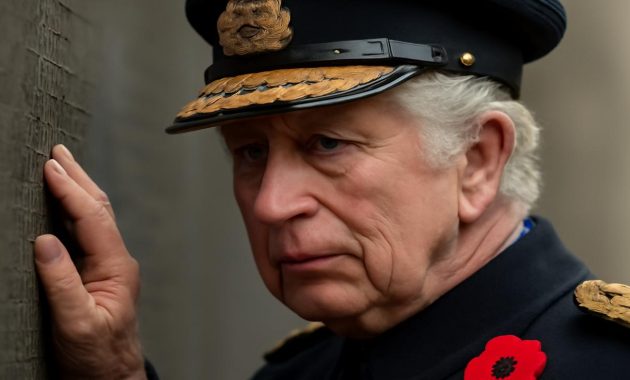
By the time the hymn began its second verse, something had already shifted. The chapel, usually a place where centuries of ritual seem to smooth emotion into marble, felt strangely fragile. A shaft of late afternoon light picked out dust in the air, gilding the faces of the choirboys and the folds of royal uniforms. And at the heart of it all, beside the wreath of poppies and white lilies, King Charles III blinked once, twice, then held his breath just a second too long. It was the smallest of pauses—yet in that breath, an entire nation leaned closer.
The day the mask slipped
The remembrance service had begun like so many before it: slow processions, precise orders barked in softened tones, medals catching the light like small, held suns. Outside, the November air clung to the mourners’ coats, the kind of chilled damp that seeps under collars and finds the skin. Inside the chapel, the scent of beeswax and old wood hung heavy, as though the building itself remembered every note of sorrow ever sung within its walls.
Remembrance is, by design, a rehearsal of grief. The familiar rituals are meant to keep it contained—weathered by repetition, softened by tradition. Kings and queens have stood where Charles now stood, backs straight, expressions composed into that peculiar royal stillness that reads as both compassionate and impenetrable. Crowds have watched them the way one watches distant cliffs: for signs of erosion that might never come.
And yet, on this day, the erosion arrived—not as an avalanche, but as a fine, unmistakable crack.
At first it was barely noticeable. A tightened jaw. A hand, clad in a white glove, adjusting a cuff that did not need adjusting. The camera, trained on him with the unblinking patience of modern broadcasting, caught the minute tremor as he lifted the wreath. A murmured prayer, the brush of poppies against stone, and then his eyes—blue-grey, often described as cool—shone a little too wet in the chapel light.
There is a language to royal composure: the measured nod, the downcast gaze, the practiced neutrality that says “I feel, but not in a way that will trouble you.” It is a shield, forged over generations, to protect both sovereign and subject from the rawness of unfiltered emotion. But on that afternoon, as the choir’s harmonies rose and dispersed in the rafters, Charles’s shield thinned. Grief—personal and national, fresh and ancient—pressed through.
The weight of remembrance on a new king
Remembrance services have always held a particular power in Britain. They are the country’s quiet heartbeat of sorrow: the two-minute silences, the rustle of paper poppies pinned to coats, the sight of veterans shuffling on leaning frames, their uniforms now slightly too loose, their medals still sitting perfectly straight. For a monarch, these moments are more than ceremonial duties; they are obligations woven into the very fabric of the Crown.
For King Charles, this obligation carries new layers. He is no longer the Prince of Wales standing one step back; he is the focal point, the embodiment of continuity. The first remembrance as king after the passing of his mother, Queen Elizabeth II, landed with a particular weight. The notes of the “Last Post” are, after all, not only for the fallen of distant wars but also, now, for eras closing and parents gone. In this echoing space, public mourning braids itself with private loss.
He stood that day beneath the carved angels and stained glass, each pane a scene of sacrifice and redemption. The chapel’s silence after the bugle’s final note was unnervingly complete. These moments—those long stretches of quiet when the only sounds are the faint rustle of uniforms and the shuffle of polished shoes—are where composure is tested most. There are no lines to recite, no cues to follow; there is only the heavy presence of absence. The people you loved. The people you never met. The futures unraveled by war.
As Charles’s eyes lowered to the wreath, some watching noticed it first: the way his chest rose on a slightly unsteady breath. This was not the effortless poise of younger days, when he could still hide behind his mother’s towering figure. This was a man suddenly carried to the brink of his own limits by the very duty he spent a lifetime preparing to shoulder.
And something about that—about seeing a monarch not as the gloved hand of the state but as a son, a father, a man carrying his own private cemetery inside him—hit home with unusual force.
A rare crack in the stone
For decades, the British monarchy has walked a narrow line between mystique and accessibility. Too closed, and it becomes an antique under glass. Too open, and the spell that holds the institution together risks breaking. Emotional restraint has long been part of the Crown’s unspoken code. The late Queen’s famous maxim, “Never complain, never explain,” was less instruction than incantation, a way to hold the storm at bay.
But times shift, and with them, expectations. The public, increasingly fluent in the language of vulnerability, watches now for signs of emotional literacy in its leaders. In a culture that talks openly about grief and mental health, a monarch who never flinches can begin to feel less like a reassuring constant and more like an unreachable relic.
So when King Charles’s composure faltered—just for a heartbeat—it felt like watching a statue breathe. This was not the orchestrated, polished emotion of a televised address; it was the unscripted, slightly untidy kind that creeps in at the edges of ceremony. It took the form of moist eyes, a tremor at the corner of the mouth, a microsecond delay in stepping back from the cenotaph.
Millions, watching live or in later clips replayed on glowing screens, seemed to exhale in tandem. Social media, usually so quick to flatten nuance into performance, filled with comments not about royal extravagance or irrelevance, but about the simple, human act of holding back tears in public. For once, the viral moment was not scandal, but softness.
| Aspect | Traditional Expectation of Royals | What the Public Saw in Charles III |
|---|---|---|
| Emotional Display | Controlled, distant, almost unreadable. | Visible emotion: glistening eyes, slight tremor of the jaw. |
| Role in Ceremony | Symbol of continuity, seemingly unaffected by the moment. | A man carrying personal and national grief at once. |
| Public Perception | Distant, dignified, sometimes emotionally opaque. | Relatable, vulnerable, unexpectedly approachable. |
| Symbolic Impact | Stability through stoicism. | Stability through shared humanity. |
In a world accustomed to curated authenticity, there was something almost startling about this fleeting, unscripted moment. It wasn’t accompanied by a statement or campaign. Nobody had polished it into a message about compassion or modern monarchy. It was simply a visibly moved king, standing in a sea of uniforms and poppies, struggling as any human would to contain the tide of memory.
Why this moment captivated the public
Part of the moment’s power lay in its timing. Britain has been weathering a protracted season of uncertainty: economic strain, political shake-ups, the aftershocks of a global pandemic, a farewell to the long, steady reign of Elizabeth II. In such times, people look for narratives that make sense of instability. They seek out characters—real or fictional—who mirror their own anxieties and quiet resilience.
King Charles, for so long an heir-in-waiting, has often seemed defined more by controversy or caricature than by emotional connection. The intense scrutiny of his personal life, the louder voices within and outside his family, the weight of climate advocacy and duty—all these have constructed a somewhat remote silhouette. But grief, especially when worn unexpectedly, has a way of cracking silhouettes open.
For many, watching him struggle with his emotions at the remembrance service provided a surprising inversion. Instead of the public projecting feelings onto the Crown, they watched the Crown visibly feeling something back. He was no longer just the distant recipient of bouquets and formal bows; he became a recognizable human being having a difficult day at work—a job, incidentally, that sometimes demands he revisit the nation’s deepest traumas on an annual schedule.
The camera zoomed in enough to show the tiny tremors but held back enough to preserve a sense of respect. That balance—intimacy without intrusion—allowed viewers to join the moment without feeling they had trespassed on something too private. The effect was akin to overhearing a song from someone’s open window at dusk: uninvited, yes, but somehow tenderly shared.
Across living rooms and cracked phone screens, there were people who understood precisely the choreography of that visible restraint: how it feels when tears gather but never quite fall, how the throat tightens around silence, how a long exhale can be both a surrender and a retrieval of control. Whether they had lost relatives in war, in hospitals, or in the ordinary attrition of time, they knew that peculiar, public-private grief—the kind that demands you carry your mourning in a straight-backed posture.
Grief as a bridge between palace and pavement
In that chapel, the King was surrounded by uniforms stitched with history: generals and admirals, veterans whose hair had turned white but whose bearing still squared off against invisible enemies. Outside, crowds held photographs and poppies, some pinned with names, others with a single date. Each face, each name, unfurled its own story into the air.
The monarchy has always drawn its power from symbolism: crowns, scepters, processions, carefully chosen words read from ancient texts. But it also draws something less visible, something more precarious: resonance. People must feel, somehow, that this shimmering institution anchored in palaces and regalia still reflects their own lived experiences. Moments of shared vulnerability can act as unexpected bridges, spanning the distance between palace marble and the pavement where most lives unfold.
On that day, the bridge was built out of silence and saltwater eyes. It didn’t erase the distance between monarch and subject—centuries of hierarchy do not dissolve in a single quiver of the lip—but it softened the edges. The King was no longer just a custodian of tradition; he was a custodian of memory, standing among others whose memories weighed just as heavily.
The public, famously skeptical yet curiously tender when it comes to displays of genuine feeling, seemed to welcome this rare glimpse. It was as though the stiff, formal figure at the cenotaph stepped down, for a moment, into the same mist of remembrance that everyone else was breathing. In that shared air, it became harder to maintain the fiction that grief belongs only to the ordinary while composure belongs to the crowned.
The evolving language of royal vulnerability
The British royal family has been slowly, sometimes awkwardly, learning a new emotional lexicon. The days when stoic silence was the sole acceptable response to personal catastrophe have eroded, often under the pressure of public and media criticism. From televised statements after tragedies to personal reflections on mental health, the institution has been nudged toward a more open register of feeling.
King Charles’s visible emotion at the remembrance service belongs to this quiet evolution, though it felt less like a strategy and more like a slip of the mask. It was not a speech crafted with advisors or a campaign about wellbeing; it was a bodily refusal to entirely conform to centuries of restraint. In its rawness, it hinted at something that cannot be easily scripted: the way grief accumulates as we age, layering itself over previous losses until a song, a scent, a wreath laid at a stone can detonate the whole archive.
This is a man who has attended more funerals than most, who has walked behind more flag-draped coffins than he might care to count, who has seen his family’s private tragedies turned into public theatre. His tears, or near-tears, belong as much to that personal history as they do to the fallen service members being remembered. In that sense, he stood not just as a king, but as a living palimpsest of national and familial sorrow.
For many watching, that mattered. It suggested that the person presiding over these rituals is not merely repeating lines, but living inside them. That the remembrance service is not simply another date in the royal diary, but a yearly descent into a place that costs him something emotionally. A king who pays that price might feel more trustworthy, more anchored, than one who sails through every ceremony as though nothing could reach him.
What this reveals about us
The fascination with this small crack in royal composure also tells a story about the people doing the watching. We live in an age saturated with images and, paradoxically, hungry for the unguarded. Every platform asks us to share, to curate vulnerability, to perform relatability. Against that backdrop, a single, unpolished moment from someone whose life is usually choreographed to the second stands out in sharp relief.
People replayed the footage not only to scrutinize Charles, but to see themselves mirrored back from a place they never expect to find themselves. They recognized in his struggle a confirmation that grief does not respect rank. It comes for kings and carers, for shopkeepers and soldiers, for those in borrowed black suits and those in bespoke morning coats. It softens knees, blurs vision, and steals words from all of us with similarly blunt force.
In some ways, our need to witness this vulnerability from a monarch is also a quiet protest against the older scripts of emotional suppression. If even the King can be moved to the brink of tears in a public ceremony, perhaps our own trembling voices at funerals, our own damp handkerchiefs at memorials, are not weaknesses to be hidden but testaments to what we have loved and lost.
A softer kind of strength
When the service ended and the procession moved away from the memorial, the world did what it always does with royal moments: it captured, dissected, debated. Commentators discussed whether this signaled a “new era” of emotional visibility. Columnists parsed the meaning of a single glistening eye. Some saw frailty. Others saw strength.
Strength, for so long synonymous with a stiff upper lip, is being quietly redefined. The image of an unflinching monarch once served an anxious empire; it suggested that no matter what storms raged, the person at the helm would never waver. But in an era more accustomed to uncertainty than unbroken power, a different archetype is emerging: the leader who bends but does not break, who feels without being capsized.
King Charles III, in that brief crack of composure, embodied this new archetype. He did not weep openly. He did not abandon the solemn demands of the day. He stood his ground in the thick of memory and carried on—but he did so with a face that refused to fully detach from the weight of the moment. The mask slipped just enough to show a man beneath the crown, then settled back into place, not as an act of denial but as a continuation of duty.
Perhaps that is the essence of modern resilience: not the absence of tears, but the willingness to feel them pressing against the rims of your eyes while you still do what must be done. In that chapel, the King modeled a kind of strength that is less granite and more seasoned wood—marked, weathered, but still holding.
In the hush that followed the service, as the crowds dispersed and the last notes of the hymns evaporated into the stone, something lingered. It was not merely the echo of bugles or the faint scent of extinguished candles. It was the memory of a man in ceremonial dress, standing very still, fighting back tears under the full gaze of a watching nation—and, in that fight, quietly inviting everyone watching to recognize a piece of their own story in his.
Frequently Asked Questions
Why did King Charles III’s reaction at the remembrance service draw so much attention?
Because visible emotion from a British monarch is rare, his apparent struggle to maintain composure offered a striking contrast to the usual royal stoicism. In a highly ritualized setting, this small glimpse of vulnerability felt unusually honest and human.
Was this the first time a British monarch has shown visible emotion in public?
No. Other royals, including Queen Elizabeth II, have shown emotion in public, though usually in very controlled ways. What stood out here was the timing—early in Charles’s reign, at a solemn national ritual—and the intensity of the public focus on this fleeting moment.
How does this moment fit into the broader evolution of the monarchy?
It reflects a gradual shift from a model of total emotional reserve to one that allows carefully glimpsed vulnerability. The monarchy is slowly aligning with contemporary expectations that leaders should be relatable and emotionally literate, without abandoning dignity and formality.
Did the King’s emotional response change public opinion of him?
Reactions were varied, but many people responded positively, describing him as more relatable and human. While a single moment does not transform long-held views, it added a new layer to how he is perceived: not only as a distant figure of authority, but as someone visibly affected by the same grief and memory that touch the public.
Why do people care so much about how royals express emotion?
The monarchy is built on symbolism as much as on power. How royals behave at emotionally charged events shapes how people interpret the institution itself. Visible feeling can make the Crown seem closer and more human; complete detachment can reinforce distance. Moments like this become touchstones in the ongoing story of what the monarchy means in modern life.