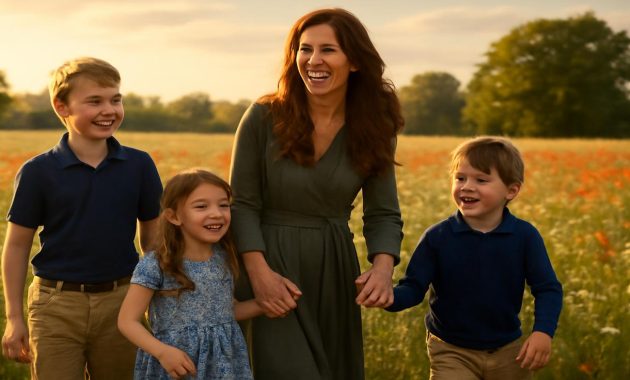
The winter light over London can be unforgiving. It lies low on the horizon, silvery and sharp, picking out every line, every shadow, every truth. Yet there are some people who seem to meet that light with a steadiness that feels almost like its own kind of glow. On this birthday, as the Princess of Wales quietly turns another page of her life amid one of the most historic royal transitions in modern memory, the question hanging in that pale sky is simple: how does someone stay so human, so steadily present, when the world insists on seeing her as symbol, story, and destiny all at once?
A Birthday in a Changing Palace
Imagine the scene, not as a palace press release might frame it, but as it might actually feel.
The morning begins softly, somewhere behind those ancient walls and heavy curtains. Perhaps there’s the muffled sound of small feet skimming along a hallway, the rustle of wrapping paper, the conspiratorial whispers of three children trying very hard to keep a surprise secret. The air in the room is still cold with winter, though the radiators hum patiently. A tray appears at the bedside: tea, toast, maybe a small vase with a single bloom carefully chosen by little hands.
This is the side of the Princess of Wales that the public doesn’t really see: the woman before the makeup chair, before the tiara, before the speech notes are smoothed and folded into a clutch. She is Catherine, the devoted mother who crouches on the floor to tie shoelaces, who kneels in the grass to catch a ball, who remembers which child likes which bedtime story. Before she is future queen, she is simply “Mummy.”
But on this particular birthday, the walls themselves seem to be listening a little more closely. The royal household is in motion; the country is still adjusting to a new monarch; the world still reflexively compares every royal chapter to the last. The crown, in all its invisible weight, is shifting from one generation to the next, and she is standing directly in that shaft of transforming light.
The Ordinary Girl Who Walked into an Extraordinary Life
There’s a photograph from her childhood that people like to share: a dark-haired girl with rosy cheeks, bundled up in a simple coat, the wind catching her hair just so. She looks like any girl you might see at the edge of a playing field on a Saturday morning, waiting for her turn, half-shy, half-curious.
That is part of the enduring fascination with the Princess of Wales. She was not born into palaces or pageantry. She grew up with school shoes and family holidays, part-time jobs and school projects. Her story, on paper, is one that could belong to many: meet at university, fall in love, weather the early-twenties storms, find your way together.
But in her case, the university was St Andrews. The young man was the future King. The path from normal to never-again-normal was sharp and sudden, drawn under the watchful eyes of cameras.
It is easy, in hindsight, to paint this as inevitable, as if some fairy-tale script had been waiting for her name. It wasn’t. It was a series of choices, of “yes” after “yes” in the face of scrutiny, expectation, and sacrifice. She did not just marry a man; she married a role, a responsibility, a nation’s gaze. And she has been steadily, determinedly growing into it ever since.
The Moment the World Exhaled
Transfers of royal power are never just about the crown. They are about memory, age, change, and the strange way national identity wraps itself around the lives of just a few families. When the late Queen’s era ended and a new one began, the world watched with a mix of nostalgia and curiosity. Where, in all this, would the Princess of Wales stand?
In that moment, what people seemed to want—almost more than spectacle—was reassurance. Reassurance that continuity wasn’t an empty word. That the compassion, restraint, and carefully learned steadiness, honed over decades by the late monarch, were not about to vanish into history.
And there she was: by the King’s side, by the Prince’s side, by her children’s side, absorbing the flash of thousands of cameras and the ache of millions of onlookers. Her posture: upright but not rigid. Her expression: composed but never cold. She did not try to be the star of the scene, and that was precisely what allowed people to breathe again. This was not a family collapsing under the weight of new expectation; it was a family quietly, visibly, doing its duty together.
A Modern Mother in an Ancient Institution
If you strip away the gilded titles and ceremonial outfits, the Princess of Wales’s most compelling role might actually be her most relatable: mother.
It is in the small, unscripted gestures that people see it most clearly. The way she instinctively bends down to her children’s eye level on the balcony. How she gently corrects a restless hand during formal events, not with embarrassment but with a whisper and a smile. The way her palm rests, just for a second, on the small of a child’s back when passing through a crowd.
For parents watching from living rooms far removed from palace courtyards, there is a simple recognition: she is juggling, too. Juggling duty with school runs, state dinners with science projects, official tours with bedtime routines.
Raising the Future While Living in the Present
History will remember her children as heirs, spares, working royals, perhaps monarchs in their own right. Yet for now, they are still children who get muddy in gardens, who giggle at inside jokes, who occasionally tug at a sleeve at the least convenient moment.
One of the quiet revolutions she has helped bring to the monarchy is this insistence on childhood as something sacred, something that should be preserved from the blinding glare of public hunger. Carefully curated glimpses, yes. But always, always, the line held between the public’s curiosity and her children’s right to just be.
It is a delicate dance: allowing the country to feel it is watching a family grow, while firmly protecting those private, sleepy, silly, tearful moments that are the real glue of family life. In that balance, she sends a message to millions of parents: you can protect what matters, even when the world wants everything.
| Role | What the World Sees | What Often Goes Unseen |
|---|---|---|
| Princess of Wales | Elegant public figure, future Queen Consort | Private preparation, constant learning, emotional resilience |
| Wife | Partner at state events and royal tours | Quiet support, shared decision-making, protecting family space |
| Mother | Photographs on balconies and at school events | Bedtime stories, school runs, guiding young hearts through scrutiny |
| Public Figure | Speeches, charity visits, official portraits | Research, listening to experts, emotional toll of hearing difficult stories |
The Quiet Power of Purpose
One of the most revealing measures of any modern royal is how they use their platform. The days when a title was enough are long gone; the public expects focus and depth. For the Princess of Wales, that focus has crystallized around a simple but profoundly consequential idea: the earliest years of a child’s life shape everything that follows.
Rather than scatter its energy across dozens of unrelated causes, her work has increasingly tightened around early childhood development, mental health, and the unseen, often unspoken struggles of families trying to do their best under strain. She has visited nurseries and community centers, clinics and research institutions, sitting cross-legged on tiny chairs, crouching down on classroom carpets, listening.
Listening as Leadership
What sets her apart in this space is not a grand, headline-catching declaration, but a slow, deliberate accumulation of understanding. She has convened experts—psychologists, educators, scientists—and pressed for a cultural shift that treats those first five years of life not as a blur to get through but as the foundation for everything that follows.
In a world that often measures influence in social media metrics and soundbites, her approach can seem almost old-fashioned in its patience. But that is also its strength. She has become a kind of bridge between cutting-edge research and the everyday worries of parents who simply want to know: “Am I doing this right? Does this moment matter?” Her message is steady and reassuring: yes, these small moments matter enormously—and no, you are not alone in finding them overwhelming.
A Future Queen Shaped by the Present
The title “future Queen” can feel heavy, remote, grand to the point of abstraction. How do you picture someone in a role that still belongs to a different era, while she’s standing in jeans in a school garden, helping a child plant seeds?
Perhaps the answer is that the modern idea of queenship is being rewritten, gently but visibly, in front of us. It is no longer just about crowns and state carriages; it is about emotional intelligence, adaptability, and the capacity to be both symbol and person without losing yourself entirely to either.
She steps into state banquets in shimmering gowns, but also into church halls with bare shoulders under the weight of a simple coat. She speaks with world leaders and with young parents pulling crumpled notes from pockets to share their worries. And that duality—one hand in tradition, one hand firmly on the present—offers a glimpse of what monarchy might look like in the decades to come.
A Different Kind of Strength
Historically, strength in royal women was often portrayed as stoic silence, as the ability to stand, unsmiling, through storms. The Princess of Wales has inherited some of that steadiness, but she has layered it with something visibly different: a willingness to be warm, to laugh, to show, through body language and tone, that connection is not weakness.
We see it in the way she engages with shy children, with veterans, with community volunteers who never expected a princess to ask them detailed questions about their work. Her eye contact is steady, her questions simple but thoughtful. These are not grand gestures; they are, instead, a thousand small human ones.
In a time when institutional trust has eroded around the world, that matters. The monarchy cannot be only pageant; it must be presence. And on this birthday, as the institution itself continues to evolve, she stands as one of the most persuasive arguments for its relevance: not because of what she represents on paper, but because of how she shows up in person.
An Inspiration Woven from Imperfect Humanity
It is tempting, on occasions like birthdays, to slip into the language of flawless admiration. To polish every rough edge until we are left with something gleaming, but ultimately hollow. Yet the Princess of Wales’s influence comes not from perfection, but from visible growth.
Look back at those early public appearances, the slightly tense shoulders, the practiced smiles, the learning curve of someone who never quite asked for this scale of visibility but accepted it nonetheless. Trace the line forward: the speeches delivered with increasing confidence, the effortless ease with crowds, the stronger sense of purpose in her chosen causes. This is not a static fairy-tale princess; this is a woman learning in public, sometimes stumbling, always course-correcting.
For many, that is the inspiration: not that she is untouchably superior, but that she is demonstrably human, working very hard to meet an extraordinary job with as much grace as she can find.
A Birthday Wish Carried Beyond Palace Walls
So what does it mean, really, to say “Happy Birthday” to the Princess of Wales this year, in the midst of historic change?
It means acknowledging the invisible work behind the visible life. The long evenings spent reading briefings and research reports. The emotional load of hearing difficult stories from families and communities, and then carrying them home in her thoughts. The parenting challenges that don’t vanish just because a title sits before your name.
It means recognizing that while the crown itself will never sit on her head in the same way it will on her husband’s, the moral and emotional burden of queenship already rests, in part, on her shoulders. How she carries that weight—the mixture of tradition and empathy, duty and genuine connection—will shape not only her own legacy but the very idea of monarchy for a generation that will grow up never having known another structure.
And perhaps, most of all, it means extending to her the same quiet wish we might offer any parent, any partner, any person standing at the crossroads of personal life and public responsibility: may you find enough joy in the small, private hours to sustain you through the long, demanding public ones.
FAQ
Why is the Princess of Wales considered a key figure in the royal transition?
She stands at the intersection of continuity and change: wife to the heir-turned-King, mother to the next generation, and a modern public figure shaping how the monarchy connects with people. Her visibility, compassion, and calm presence help reassure the public during a period of adjustment.
How has she modernized the role of a royal consort-in-waiting?
She has focused on depth over breadth in her charitable work, especially around early childhood and mental health, and embraces genuine, informal interactions with the public. Her approach blends traditional duty with modern values like openness, listening, and evidence-based advocacy.
What makes her especially admired as a mother?
People relate to the way she balances high-profile duties with clear efforts to give her children as normal a childhood as possible. Her hands-on involvement, protective boundaries, and small affectionate gestures resonate with parents everywhere.
In what ways does she support early childhood development?
She has championed research, convened experts, and visited frontline services to highlight the critical impact of the first years of life. Her work encourages governments, communities, and families to treat early development as a priority, not an afterthought.
Why is her birthday seen as symbolic this year?
Her birthday falls at a time when the monarchy itself is evolving under new leadership. Celebrating her now is not just about personal milestones; it is about recognizing her growing role in shaping the next chapter of the royal family’s story and its relationship with the public.