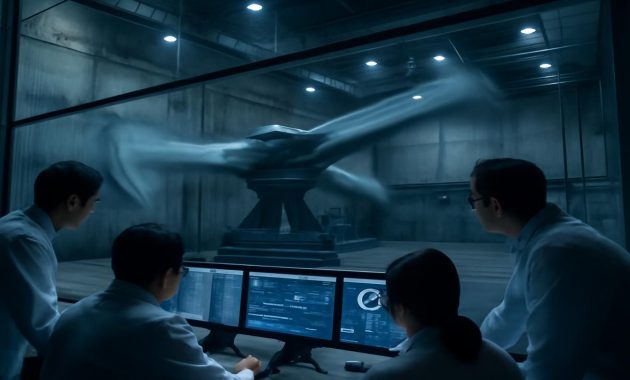
The room hums like a trapped storm. Metal, concrete, and mathematics hold their breath as the centrifuge begins to spin—slowly at first, then with a will of its own. Somewhere behind thick blast doors in western China, a machine is winding itself up to claw at the fabric of time and space. Engineers watch on screens, fingers twitching near emergency stops. Numbers climb—velocities, pressures, g-forces—each digit another step into the unthinkable. If you squint at the data, it almost feels like watching gravity itself being negotiated, pixel by pixel.
The Machine That Wants to Bend Reality
It doesn’t look like a portal to another dimension. At a distance, China’s new ultra-high-speed centrifuge is all pipes, cables, and armored housing—a cross between a subway tunnel and the skeleton of a rocket. But the plans on the wall tell a different story: this is a machine built to stretch the ordinary rules of reality in a controlled space, to make moments behave like years and distances shrink into laboratory-sized ghosts of themselves.
At its core, the centrifuge is terrifyingly simple in concept, like a children’s ride designed by a physicist on too little sleep. Spin something fast enough and you can fake gravity. Spin it even faster and you can simulate worlds that don’t exist yet: a Jupiter-like pull crushing materials, or the killing acceleration of a hypersonic vehicle tearing through the edge of the atmosphere.
But China’s newest centrifuge doesn’t stop at “fast enough.” The numbers involved feel like the fevered dreams of a science fiction novelist. Speculation from open reports and physics modeling points toward g-forces in the tens of thousands, edge speeds that flirt with the limits of what solid matter can endure, and internal environments where heat, pressure, and velocity tangle together to create little pockets where time and space behave like they do nowhere else on Earth.
In the glow of control-room monitors, researchers speak a language of equations and simulations. To the outside world, though, the story is cruder and more primal: somewhere in China, a centrifuge is spinning hard enough to make reality wobble—just a little.
The Dizzying Numbers Behind the Spin
Numbers are cold on the page, but here they carry a strange heat. Imagine a spinning arm longer than a city bus, its tip moving at several kilometers per second. At those speeds, every fraction of a second is a small act of defiance against structural failure. Most metals would scream, then tear.
Slip into the frame of reference of a tiny sensor riding at the outer edge. The outside world slows down. Not enough to notice with your eyes, but enough to matter if you are a piece of experimental hardware meant to survive the hell of re-entry, or a new material designed for hypersonic flight. The centrifuge can simulate the violence of a high-speed atmosphere without leaving the ground, folding long, dangerous flight profiles into controlled, repeatable bursts of testing time.
The dizzying part isn’t just velocity—it’s density. As the rotor spins, air and test gases are flung outward, compressing into heavy, invisible shells. Molecules crowd together, the pressure climbs, and temperatures spike. It’s like forging a new planet’s atmosphere inside a metal tube.
In the controlled chaos of these trials, researchers can tweak gravity-like forces, air density, and thermal stress independently, building a library of what-if worlds. What if we had to fly through a Martian sandstorm at Mach 10? What if a spacecraft had to survive an atmosphere denser than Venus’s, moving faster than any jet ever built? The centrifuge becomes a question machine—and the answers come in the language of data, failed materials, and the occasional hairline fracture.
| Parameter | Conventional Facilities | China’s Ultra Centrifuge (Concept Range) |
|---|---|---|
| Simulated g-force | Up to hundreds of g | Tens of thousands of g |
| Edge speed | Hundreds of m/s | Several km/s |
| Test duration per run | Seconds to minutes | Milliseconds to seconds (extreme loads) |
| Simulated environment | High-g flight, basic materials testing | Hypersonic flight, dense exotic atmospheres, re-entry |
| Primary purpose | Aerospace, biomedical | Advanced aerospace, defense, planetary & extreme physics |
When Microseconds Become a Universe
The centrifuge’s strangest trick is temporal, not spatial. By forcing conditions to extremes, it squeezes meaningful physics into almost nothing on the clock. A component that would take hours of brutal flight to fail can be pushed to its breaking point in a slice of time thinner than a blink.
From the outside, a run might last a heartbeat. Inside the data, though, it’s vast. High-speed cameras and sensors carve that moment into tens of thousands of frames, each frame a tiny world of stress lines, shock waves, and molecular chaos. Researchers scroll through the captured milliseconds as if surfing an alternate timeline—rewinding, freezing, zooming in on a single fracture initiating inside a piece of metal, like watching the first crystal of winter form on a pond.
In that sense, the centrifuge doesn’t just compress space by squeezing kilometers of flight into a circular track; it compresses time by letting microseconds stand in for hours. The lab becomes a kind of time lens, turning the briefest of events into sprawling archives of cause and effect.
It is an unsettling inversion of our usual sense of scale. The more violently the machine spins, the smaller the window of time it actually uses—yet the more information it yields about things that, in the wild, would stretch out over the long, lethal distances of upper atmosphere or interplanetary travel.
China’s Quiet Race With the Future
In modern technology, some of the loudest moves happen behind the quietest doors. China’s centrifuge appears as one more data point in a pattern: a deep push into testing grounds that blur the line between the possible and the purely theoretical. Hypersonic gliders, scramjet engines, next-generation re-entry vehicles—these are not technologies you perfect in the open air, one prototype at a time. They are born in tunnels, vacuum chambers, and machines like this centrifuge.
The strategic implications are obvious to any defense analyst, but the human angle is stranger and more intimate. Somewhere, a materials scientist is coaxing new alloys into existence—metals that shrug at temperatures that would melt steel, ceramics that crack only at pressures like those near gas giant cores. Somewhere else, a fluid dynamicist is watching how shock waves behave in crushing artificial atmospheres, building models of what might happen to a vehicle skimming the edge of space at Mach 15.
In a sense, the centrifuge is a rehearsal studio for futures that haven’t arrived yet. Want to know how a craft might behave flying low through the thick air of an exoplanet? Or how a high-speed drone might survive its own speed in the thin upper streaks of Earth’s atmosphere? Before we risk the real sky, we test the idea of the sky here, bolted to a spinning arm anchored in concrete.
Nature Bent But Not Broken
There is a fragile line between using nature’s laws and trying to outrun them. The centrifuge is a monument to how far we can push without crossing into outright fantasy. Despite the sci-fi aura, nothing inside it actually violates physics. It just takes the ordinary rules—gravity, inertia, gas dynamics—and dials them to levels that evolution never had a reason to prepare us for.
Air acts differently when shoved against its own kind at hypersonic speeds. Heat flows along new paths; shock fronts wrap and fold like origami. Materials slip from solid to semi-liquid behavior under rapid strain. But in the equations, it’s all the same physics you’d use to describe a falling apple—just pushed into corners of parameter space where we rarely look.
That’s the deeper, quieter magic happening in the spinning chamber: it gives us a glimpse of nature under duress, but not defeated. You can almost imagine the universe raising an eyebrow and saying, “Ah, so you want to see what happens if you twist my dials all the way to the right?”
Smaller Worlds, Bigger Questions
To understand why this matters beyond missiles and space capsules, think about what it means to recreate worlds in miniature. For decades, high-speed wind tunnels and shock tubes have been humanity’s way of staging the sky in cramped rooms. The centrifuge is like their wild cousin—capable of overlaying gravity-like forces on top of high-speed airflows, or layering crushing pressures onto violent acceleration.
That gives scientists an eerie sort of creative power. They can summon conditions no planet offers naturally. Simulate the crushing lower atmosphere of a super-Earth exoplanet. Recreate the breakup of meteors in alien skies. Explore how dust, ice, and gas might dance near a fast-spinning, dense object like a neutron star’s distant cousin—within limits, but still far beyond the familiar envelope of Earth weather.
Each run becomes a story about “what if.” What if a future probe had to plunge deep into the atmosphere of Saturn before firing its engines? What if human-made habitats someday hang low in the skies of Venus, needing heat shields that can tolerate a cauldron of chemistry and pressure? Before such ideas leave the sketchpad, something like this centrifuge lets us interrogate reality’s willingness to cooperate.
Listening to the Data Storm
Inside control rooms, the poetry of these experiments is lost in a flood of raw numbers. Terabytes of sensor data stream in: strain gauges, pressure taps, thermal couples, high-speed video, laser diagnostics. The centrifuge hums; software translates the violence into colored graphs and flickering models.
There’s a peculiar intimacy to this work. You build a tiny object—a fragment of wing, a tile of heat shield, a sliver of composite—and then hurl it into an artificial apocalypse to see how it copes. If it survives, you learn a little about where the future might be generous. If it fails, the fracture lines write you a quiet letter explaining exactly how and where your optimism was misplaced.
Somewhere in that loop of building, spinning, breaking, and rebuilding, a new landscape of engineering is unfolding. Vehicles that can cross half the planet in an hour. Craft that slip from atmosphere to orbit like stones skipping across water. Instruments that can stare calmly into the plasma sheath of re-entry and keep sending home data while everything around them roars at several thousand degrees.
Human Limits in an Inhuman Machine
There is a reason the most extreme tests in this centrifuge don’t involve living bodies. Human flesh is exquisitely tuned to the quiet, one-g lull of Earth’s surface. We start to gray out at a handful of g’s, pass out not long after. The tens of thousands of g’s swirling inside this machine are the territory of dead metal and abstract thought.
Still, the echoes reach us. Every new alloy that survives its trials might one day go into a spaceship hull. Every thermal barrier that refuses to crack could line the outside of a crewed capsule. Even if we don’t strap astronauts to the centrifuge arm, their safety may hang on what we learn there.
There’s also a philosophical undertow. At what point does the urge to simulate and accelerate reality become a kind of hubris? We are, in places like this, trying to outpace the slow, cautious rhythm that nature has imposed on experiment for billions of years. Instead of waiting for rare conditions—a meteor strike, a freak atmospheric event—we summon them in compressed, industrial bursts. Nature unfolds over eons; we demand our answers between 9 and 5.
And yet, there is something deeply human about this impatience, this refusal to let the universe reveal itself only at its own pace. The centrifuge is one more symptom of a species that won’t stop asking, “What happens if…?”
Time, Space, and the Stories We Tell
When people say this centrifuge “compresses time and space,” they are, of course, speaking metaphorically. No wormholes open inside its armored shell. Relativity is present only in the mildest ways, nudged by high velocities but far from starship drama.
What does compress is our ability to explore. We squeeze oceans of possibility into a bucket of time, pull entire atmospheres into a chamber the size of a train car, stretch microseconds into months of analytical work. The machine becomes a translator between the normal pace of reality and the frantic tempo of human curiosity.
In doing so, it continues an old tradition. Telescopes compress light-years into tiny discs of glass. Microscopes compress cellular jungles into flat slides. Particle accelerators compress the violence of the early universe into rings under farmland. Now, centrifuges like this one do something similar for motion, pressure, and heat—concentrating the drama of extreme environments until we can sit at a desk and scroll through it.
The numbers are dizzying, yes. But the real vertigo comes when you step back and recognize what they represent: not just speed and pressure, but a new way of folding the edges of the possible inward until we can reach them with our hands.
FAQ
Does this centrifuge actually bend time and space like in science fiction?
No. The phrase “compressing time and space” is metaphorical. The centrifuge doesn’t create wormholes or warp fields. It creates extremely intense conditions—very high accelerations, pressures, and temperatures—that allow scientists to simulate long, dangerous real-world events in very short, controlled tests.
What is the main purpose of China’s ultra-high-speed centrifuge?
Its primary purpose is to test materials, components, and designs under extreme conditions relevant to hypersonic flight, spacecraft re-entry, advanced aerospace systems, and other high-stress environments. It lets researchers study how things behave and fail without having to fly full-scale vehicles every time.
How is this different from a regular centrifuge used in labs or medicine?
Conventional centrifuges usually spin small samples at high speeds to separate liquids or cells, reaching hundreds or thousands of g. China’s advanced centrifuge is on a vastly different scale, spinning large test articles and simulating tens of thousands of g, hypersonic airflow, and exotic atmospheric conditions.
Can humans be tested in this kind of centrifuge?
No. The forces involved at the highest settings would be instantly lethal to humans. While there are human-rated centrifuges for pilot and astronaut training, they operate at far lower g-levels and are designed with entirely different safety standards and goals.
Why is this technology strategically important?
It accelerates the development of high-speed aircraft, missiles, re-entry vehicles, and space systems by allowing rapid, repeatable testing. Countries that can simulate extreme conditions more effectively can refine their designs faster, gaining technological and potentially military advantages.
Does this kind of research have peaceful uses?
Yes. The same knowledge and materials that help build advanced defense systems can improve space exploration, planetary science, satellite design, and even high-performance civilian aviation. It also deepens our understanding of physics in extreme regimes.
Is China the only country building such extreme test facilities?
No. Other major powers also operate advanced wind tunnels, shock facilities, and high-g centrifuges. What makes China’s efforts notable is the reported scale and performance of its newest machines, which appear to push the envelope of what’s currently possible in ground-based testing.