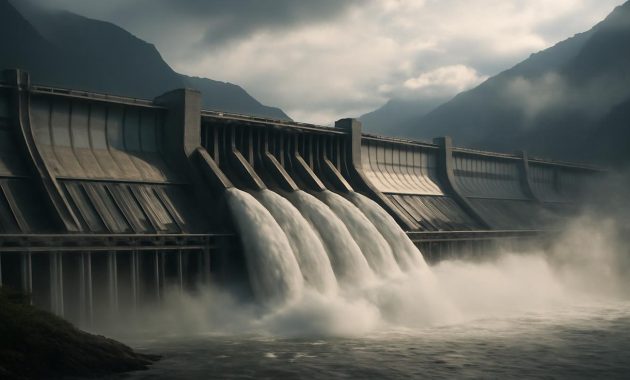
The first thing you notice is the feeling that the world itself is humming. Not in a poetic, stand-on-a-mountain kind of way, but in a literal, mechanical vibration that starts in the soles of your feet and works its way up your bones. You’re standing on concrete the color of wet ash, staring at billions of tons of trapped water pressing against a wall so vast it chops a river clean out of the landscape and holds it, briefly, in the human hand. Somewhere beyond the white roar and mist, a current that once flowed wild for millions of years is now paused, modulated, turned into numbers, megawatts, schedules. This is the Three Gorges Dam—so big, so heavy, that physicists say its reservoir has shifted enough water to nudge the Earth’s rotation by fractions of a fraction of a second.
When a Dam Quietly Tugs on a Planet
It sounds like myth, the kind of fact you’d expect to find on the back of a trivia card: a single dam, slowing the spin of a planet. But the science is dry, careful, and oddly humbling. When the Three Gorges Reservoir filled, billions of tons of water moved from low-lying areas downstream into a mountainous gorge, lifting the mass of water higher above the Earth’s center. It’s the same principle as a figure skater extending their arms to slow their spin. Spread the mass out, and the rotation eases, just a little.
No one walking along the dam’s curved spine can feel that change, of course. You feel only the wind and the soft spray on your face. Somewhere underfoot, turbines the size of houses chew the river into power—enough to light tens of millions of homes. The engineers around you speak in gigawatts and grid stability. Tourists speak in phone photos and superlatives. And quietly, the planet turns a hair more slowly, every sunrise lagging behind by a scatter of microseconds you will never notice.
Yet for all its size, for all its planetary-scale consequences, Three Gorges is beginning to feel like yesterday’s miracle in a country that has taught itself to think in megaprojects. China has already built a dam that can tug on the Earth. Next, it is reaching for something even more audacious—an experiment in bending natural power that doesn’t just rearrange water, but tries to choreograph the forces that have shaped mountains and skies for eons.
The New Giant: A Project You Cannot See from Space
The thing about the next great project is that you can’t stare at it the way you can stare at a dam. There is no towering wall of concrete to lean on, no photogenic spillway, no visitor center with guide maps. In many ways, the new ambition is less about an object and more about a network—a web of control and influence stretched over raw nature.
China’s latest undertaking is a sweeping attempt to harness energy and geography at a continental scale: a mesh of ultra-high-voltage transmission lines, sprawling renewable “energy bases” in deserts and plateaus, pumped-storage reservoirs hidden in mountain valleys, and experimental concepts that sound almost like science fiction. It is less a single project than a planetary lever: a system meant to pull electricity from wherever the sun is brightest, the wind is strongest, and the water falls hardest, and move it—almost frictionlessly—to the places where people live and demand never sleeps.
If the Three Gorges Dam is a fist gripping a single river, this new project is a nervous system, feeling and responding to weather, seasons, and demand across thousands of kilometers. It is designed to bend time and space around energy itself—turning noon in the Gobi Desert into light over a kitchen table in the humid dusk of Shanghai, or the night gales of Inner Mongolia into the hum of an elevator in Guangzhou at breakfast.
The Desert That Glitters Like a Sea
To imagine part of it, place yourself in the Kubuqi Desert, in northern China. The land is a palette of gold and rust, shaped by wind, sparse shrubs gripping the sand where they can. The air is so dry it seems to drink water out of your lungs. In the distance, though, the desert stops looking like desert. The dunes flatten and darken into regimented lines, an almost military geometry of glass and silicon. Here, the sand has been tamed into an ocean of solar panels—hundreds of millions of them—each quietly catching sunlight that left the sun eight minutes ago and will be turning into light in someone’s apartment in under a second.
The panels don’t shout the way a dam does. They whisper, silently, in glints and reflections. If you walk between them, you hear only the wind and the occasional buzz of inverters. The scale hits you only when you climb a high dune and realize they stretch out far enough that the curvature of the Earth eventually takes them away.
This is one node in a network of “mega energy bases” China is planting in its sunniest, windiest, least populated regions. In Qinghai, blue lakes and salt flats give way to solar fields that shimmer like oil slicks. In Xinjiang and Inner Mongolia, some of the world’s largest wind farms howl under skies that feel twice as big as anywhere else. The numbers are measured in tens of gigawatts, a vocabulary of power once reserved for entire countries, now applied to single clusters of desert and steppe.
The Grid That Stretches Like a Nerve
Energy is only as useful as your ability to move it. A solar farm without power lines is just glitter on the ground. So the second act of this project unfolds far away from any single landscape, in corridors that thread across mountains, deserts, and river valleys. These are the ultra-high-voltage (UHV) transmission lines—tower after tower marching toward a hazy distance, carrying electricity at voltages so high they begin to feel almost abstract.
Stand under one of these lines on a damp day, and you may hear a faint crackling, a soft static hiss, like a distant swarm of insects. It is the sound of air itself being nudged by enormous electrical forces. The pylons look like steel calligraphy drawn against the sky—sometimes shaped like latticed tripods, sometimes like gates connecting horizons. From high above, from an airplane window, they appear as silver scars across forests and farmlands, each one a promise that a gust of wind in the northwest or a bright morning in the highlands will feed a factory or a city thousands of kilometers away.
China’s UHV network is being built with a clear ambition: to become the backbone of a “super grid” that treats the entire country as a single, synchronized organism. Night and day, wet season and dry, north and south—balanced not just by local power plants, but by long-distance rivers of electrons. It is the opposite of the single-point dominance of the Three Gorges Dam. Instead of one colossus on a river, it is many hands lifting, catching, and passing power in an intricate relay.
| Feature | Three Gorges Dam | New Energy & Grid Project |
|---|---|---|
| Primary Element | Single massive hydropower dam | Network of renewables and UHV lines |
| Scale | One stretch of the Yangtze River | Nationwide, spanning deserts, plateaus, coasts |
| Environmental Impact | Reservoir flooding, river ecosystem changes | Land use for solar/wind, grid footprints, less direct river impact |
| Symbolism | Concrete monument to control over a river | Invisible web trying to choreograph nature’s variability |
| Relationship to Earth’s Rotation | Mass redistribution measurably slows rotation | Distributed; smaller local effects, larger systemic reach |
Pumped Lakes in the Mountains
There is another, quieter piece to this project, often hidden in the folds of mountains. Imagine hiking in a range of green peaks, the air thick with the scent of pine and wet stone. On one side of a ridge, a natural river cuts through the valley. On the other, a lake sits high, its edges too clean, too symmetrical to be entirely wild. Below it, further down the slope, a second body of water gleams. Between them: pipes, tunnels, turbines.
This is a pumped-storage hydropower station—a giant rechargeable battery disguised as a pair of lakes. When the desert sun is blazing and solar farms produce more power than cities need, electricity is used to pump water uphill into the upper reservoir. When night falls or demand spikes, the water is released downhill through turbines, sending electricity back into the grid.
Walk along the shore of the upper reservoir on a quiet afternoon and you won’t see anything dramatic. The surface ripples softly; dragonflies zigzag above the water. But the elevation, the stored height of that water, is a kind of coiled spring, a promise. In the logic of this vast system, hills become energy banks, geography itself enlisted as an ally in taming the wild, lurching rhythms of sun and wind.
Bending Nature Without Breaking It?
All of this—the deserts turned mirror-bright, the silver spines of UHV lines, the hidden twin lakes in the mountains—emerges from a restless, double-edged impulse. Humans are no longer content to simply sit beside rivers, forests, or winds and take what they offer; we want predictability, control, knobs we can turn, forecasts we can depend on. Yet every attempt to control nature leaves a fingerprint on the places we touch.
The Three Gorges Dam is a case study etched deep into the landscape. Reservoir waters swallowed ancient towns, displaced communities, rearranged sediment and fish migrations, and altered the rhythm of floods downstream. The planetary-scale trivia fact—that it slowed Earth’s rotation by a sliver—is, in a way, the most benign of its impacts. The real story is written in relocated villages and reengineered riverbanks.
The new project aims, at least in principle, to be gentler. Solar farms don’t flood valleys. Wind turbines don’t drown forests. But they do occupy land that once belonged to steppe grasses, wild shrubs, migrating birds. Transmission lines fragment habitats. Pumped-storage reservoirs reshape mountain slopes. The drama is more spread out than that of a colossal dam, but it is no less real.
There is a deep irony here: in order to stabilize the climate, to lessen our fossil-fueled push on the atmosphere, humanity is building systems that press more deeply into landscapes than ever. The question is not whether there will be impact, but what kind—and whether we can learn from the blunt force of the dam era to design this new age of infrastructure with some measure of humility and grace.
The View from a Village Rooftop
To feel the trade-offs up close, imagine a small village on the edge of one of these vast energy bases. Perhaps it lies at the transition between loess hills and desert, where the soil turns from stubborn, dusty yellow to loose, restless sand. People here have spent generations wrestling with scarcity—of water, of good soil, of opportunities for their children.
Now, when they climb a rooftop at dusk, they see, far off, the dark geometry of panels, the blinking red eyes of turbines, the trim lines of new roads. Some villagers now work as maintenance staff or security guards at the solar farms; others lease land; a few resent the fences and the quiet expansion of a world they feel they have little say in.
The sparkle of city lights on national holidays is powered, in part, by the landscape these villagers call home. Somewhere in Shanghai, someone presses an elevator button and thinks nothing of it. Somewhere here, a farmer squints at the new horizon and wonders whether their grandchildren will stay or go. The energy web does not float above human life; it runs through it, knotting together strangers whose only meeting place is a line on a utility map.
Bigger Than a Dam, Smaller Than a Planet
So is this new project “more impressive” than a dam that can slow the Earth’s rotation? On a certain level, the comparison misses the point. The dam is a spectacle—concrete so heavy it ripples through planetary physics. The new network is an achievement of a different kind: not a single overwhelming blow, but a vast coordination, an attempt to teach a complex, unruly system to move in rhythm with human wants.
If you think of the Earth as a body, the Three Gorges Dam is like a great scar—visible, striking, full of stories about injury and healing. The new project is more like a nervous system implant, a series of threads meant to steer impulses and responses, to channel the energy rushing through the world in thousands of subtle ways. It may not slow the planet’s spin, but it could, in the long run, slow the rate at which we heat its air and seas.
And yet, no amount of cable and concrete can completely domesticate something as large and unruly as weather, water, and sunlight. There will always be days when the wind lies down, when clouds camp stubbornly over solar farms, when reservoirs run thin. The dream of total control over nature is old—and always, in the end, a little delusional. What projects like this can offer is not domination, but a better conversation: a way to listen to the planet’s moods and lean with them instead of against them.
Back at the Three Gorges, mist still rises from the churning outflow, filmed with the faint smell of algae and engine oil. Tourists buy postcards that show the dam from space, a clean line across a blue ribbon. Children run their fingers along a relief map where the reservoir is a smooth slab of turquoise plastic. No one mentions microseconds or shifts in the planet’s axis. The Earth turns, a little slower than it once did, while somewhere beyond the hills, new lines go up, new panels gleam, new reservoirs quietly fill.
In that sense, China’s new project is not just larger in ambition than a single dam; it is part of a deeper shift in how we inhabit the planet. Less about standing in one place and commanding a river, more about moving across vast distances and weaving together sun, wind, water, and stone into something that can sustain billions of human lives without burning the future. It is messy, imperfect, and fraught. It is also, for better or worse, the scale at which we now think.
FAQ
Does the Three Gorges Dam really slow the Earth’s rotation?
Yes, but the effect is extremely small. By redistributing a massive volume of water into a higher-elevation reservoir, the dam slightly increases the Earth’s moment of inertia, which in turn lengthens the length of a day by a tiny fraction of a second. This change is measurable with precise instruments but completely imperceptible in daily life.
How is the new project different from building another big dam?
Instead of focusing on a single river or location, the new project is a distributed system that combines huge solar and wind bases, pumped-storage hydropower, and ultra-high-voltage transmission lines. Its power comes from coordination and scale across many regions rather than from one colossal piece of infrastructure.
Is this new energy network better for the environment?
It reduces reliance on fossil fuels and avoids the large-scale flooding associated with major dams, which is a major environmental benefit. However, it still affects ecosystems through land use, habitat fragmentation, and visual and noise impacts. “Better” is relative; it’s less destructive in some ways, but far from impact-free.
Why does China invest so heavily in ultra-high-voltage lines?
Large renewable resources in China are often far from major population centers. Ultra-high-voltage lines allow power to be transmitted over long distances with lower losses, linking remote deserts, plateaus, and windy regions to coastal cities and industrial hubs.
Could this kind of project be replicated in other countries?
In principle, yes. Many regions with large territories and varied climates could benefit from integrated renewable energy bases and long-distance transmission. But it requires enormous investment, political will, careful planning, and public acceptance, so the path will differ for each country.