The first time you notice your hips are tight, it’s rarely in some serene yoga studio. It’s usually in a parking lot, or bending down to tie your shoe, or trying to sit cross-legged on the floor with a friend’s toddler—and realizing it feels like your body is made of cardboard. The hips, those quiet hinges that carry us through every step of every day, don’t complain loudly at first. They just tighten, slowly, like a door that hasn’t been oiled in years. Then one day, sitting feels stiff, walking feels short, and your legs no longer seem to swing, they shuffle.
The Quiet Story Your Hips Are Telling
Most of us live the kind of life that invites tight hips. We sit in cars, sit at desks, sit at tables, sit on the couch. Even when we move, we tend to move in straight lines—forward, back, maybe a tentative side step in a crowded train. The hip joint, though, was built for more. It is a ball-and-socket joint, capable of rotation, flexion, extension, abduction, adduction—a whole vocabulary of movement that modern life rarely asks us to speak.
When the muscles around the hips—hip flexors in the front, glutes and deep rotators in the back, adductors on the inner thighs, abductors along the outer hips—get tight or weak, the whole neighborhood feels it. Tight hip flexors can tug on the low back. Stiff outer hips can change the way your knees track over your feet. A grippy psoas can make standing up straight feel strangely effortful, like your body forgot what “tall” means.
Yoga doesn’t rush in with sirens and quick fixes. It sidles up quietly and says, “What if we try softening here?” The poses that help open tight hips are not about forcing your way into impressive shapes. They are about building a more honest relationship with your own range of motion—today’s range, not the fantasy of what you think it “should” be. And along the way, mobility improves: steps lengthen, sitting feels easier, and the body begins to move more like a flowing river than a rusty gate.
Below are fourteen poses that, practiced with attention and care, can help coax space back into your hips and ease back into your stride.
1. Child’s Pose: The First Softening
Imagine kneeling at the edge of a forest clearing, the ground cool and steady beneath you. That’s the feeling Child’s Pose (Balasana) aims for: a gentle bow toward the floor, a beginning more than a stretch.
Start on hands and knees, then sink your hips back toward your heels. Your knees can stay together or open wide, like a book you’re easing apart. Let your arms extend forward or drape alongside your body. Notice the first whisper of sensation across your hips and lower back. There’s no need to push; this is a pose of gravity and time doing the work for you.
For many people, tight hips show up here as a gap between seat and heels or a mild ache across the front of the hips. Slide a folded blanket or cushion between your hips and heels if that gap feels like too much. In this shape, the hip joints are flexed, the surrounding muscles slowly surrendering their grip. This isn’t a fireworks stretch—it’s more like a dimmer switch being eased down, inviting your nervous system to trust that it is safe to let go.
2. Low Lunge & Lizard: Meeting Your Hip Flexors
Low Lunge (Anjaneyasana)
From hands and knees, step your right foot forward between your hands. Walk your foot far enough ahead that your front knee stacks over your ankle, not jutting past it. Slide your left knee back until you feel a stretch along the front of your left hip and thigh—the hip flexors waking up like someone turned on the light.
You can keep your fingertips on the floor, rest your hands on blocks, or lift your torso and place your hands on your front thigh. Imagine sending your breath into the front of that back hip, where hours of sitting tend to collect like unprocessed stories.
Lizard Pose (Utthan Pristhasana)
From Low Lunge, walk your right foot slightly to the right edge of your mat. Place both hands inside the front foot. You might stay on your hands, or lower down onto your forearms if that’s accessible and doesn’t make your breathing tight. The outer right hip and inner groin begin to wake up here, joined by the hip flexors of the left leg still stretched behind you.
There’s a wildness to Lizard—a sense that you’re closer to the ground, closer to something more primal. This pose doesn’t ask for straight lines; it asks for presence. Shift slightly forward and back, side to side, and you’ll notice how the hip joint responds differently to each subtle angle. Stay long enough to notice not just the stretch, but the way resistance shows up: in your muscles, and maybe in your thoughts.
3. Pigeon & Figure Four: Depth Without Force
Pigeon Pose (Eka Pada Rajakapotasana, prep)
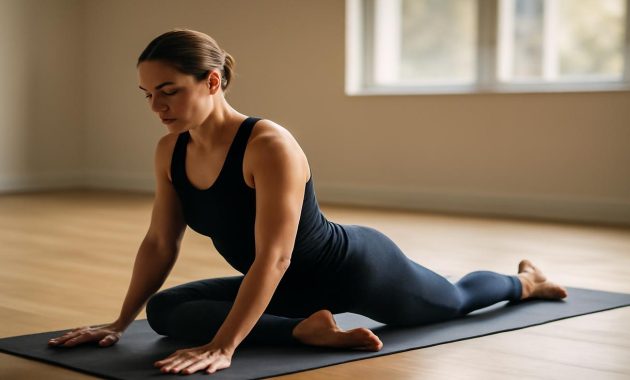
Pigeon is one of those poses that can look serene from the outside but feel like a negotiation on the inside. From Downward Dog or hands and knees, bring your right knee forward toward your right wrist, laying your shin on the ground at an angle that feels safe for your knee. Extend your left leg straight back, toes pointing behind you, hips facing roughly forward.
As you fold your torso over your front leg, sensation moves deep into the outer right hip and glute, where so many of us store tightness. The key here is not heroics; you’re not trying to flatten yourself to the floor. You’re trying to find a threshold of sensation that feels strong but breathable, where your body can gradually soften rather than brace.
Pigeon dives into the deep rotators around the hip, the small but mighty muscles that influence how our thighs rotate in and out. When these muscles are tense, the whole leg can feel clunky; when they begin to release, walking and squatting often feel smoother, less effortful.
Supine Figure Four
If Pigeon is too intense or cranky on the knees, Supine Figure Four offers a kinder path to similar territory. Lie on your back with your knees bent, feet on the floor. Cross your right ankle over your left thigh, just above the knee, making a “4” shape. You can stay here, or lift your left foot, threading your right hand through the space between your legs to gently draw your left thigh toward your chest.
The outer right hip will likely speak up quickly. Here on your back, supported, it’s often easier to relax the muscles of the neck and jaw, which oddly enough can influence how much the hips are willing to let go. Breathe, unclench your teeth, and notice how your body slowly grants permission.
4. Frogs, Butterflies & Wide Folds: Opening the Inner Groves
Bound Angle (Baddha Konasana)
Sit on the floor, or on a folded blanket if your lower back rounds like a turtle shell when you sit upright. Bring the soles of your feet together and let your knees fall out to the sides. Hold your ankles or shins, and sit as tall as you comfortably can, sternum gently lifting.
The inner thighs and groins—the body’s quieter corridors—come into focus here. If the stretch feels too strong, place blocks, cushions, or folded blankets under your outer thighs so gravity doesn’t yank them down. The idea is to invite, not demand, openness. Over time, Bound Angle can help ease stiffness that makes sitting cross-legged feel impossible.
Wide-Legged Forward Fold (Upavistha Konasana)
From a seated position, open your legs out wide, like a “V” pointed toward the horizon. Flex your feet, toes pointing up, and place your hands on the floor in front of you. With each inhale, lengthen your spine; with each exhale, gently walk your hands forward, only as far as your body allows without losing that sense of length.
The inner thighs, hamstrings, and low back all join the conversation. This pose reflects how mobility is rarely isolated. You might come to it thinking “tight hips,” but your hamstrings will quickly remind you they share the same real estate.
Frog Pose (Mandukasana, variation)
For a more intense inner-hip opening, come onto hands and knees, then slowly slide your knees apart, keeping them in line with your hips. Flex your feet, inner edges of the feet pressing into the floor. Lower onto your forearms if that’s available. You may feel a deep, almost startling stretch in the groins and inner thighs.
This pose can be a lot. Think of it like visiting a powerful river—you don’t walk straight into the current. Approach slowly, use props under your hips or chest as needed, and stay only as long as the breath feels reasonably smooth. There’s extraordinary potential for mobility here, but it’s unlocked with respect, not force.
5. Twists, Chairs & Standing Poses: Hips in Motion
Garland Pose (Malasana)
Malasana brings us closer to the way humans have squatted for millennia—to cook, to gather, to rest. Stand with your feet a bit wider than hip-width, toes turned slightly out. Bend your knees and sink your hips down into a squat, bringing your hands to prayer at your chest. Use your elbows to gently press your knees outward, creating space across your inner hips.
For many modern bodies, the heels pop up off the ground like they’re in a hurry to leave. Place a folded blanket or rolled towel under your heels to offer support. The hips, ankles, and lower back are all in play here, rediscovering a range of motion they may not have visited since childhood.
Chair Pose (Utkatasana) with a Twist
From standing, bend your knees and sink your hips back as if reaching for an invisible chair behind you. Bring your palms together at your heart. Lengthen your spine, then twist your torso to the right, hooking your left elbow outside your right thigh if that’s comfortable. Keep your knees roughly level with each other, not letting one knee surge far ahead of the other.
The outer hips and glutes will feel the challenge of holding you upright, while the twist encourages your torso and hips to talk to each other. Mobility isn’t just about how wide you can open your legs; it’s also about how well your body coordinates strength and rotation around the hip joint.
Warrior II (Virabhadrasana II)
Step your feet wide apart. Turn your right toes to face the front of your mat and your left toes slightly inward. Bend your right knee so it stacks above your ankle, and extend your arms out to the sides, gaze over your right fingertips.
Warrior II activates the outer hips and glutes of the front leg, while the inner thighs and stabilizing muscles around the back hip work quietly in the background. Holding this pose builds strength where we often only look for stretch, which is crucial: flexible hips without strength can feel unstable, while strong, mobile hips feel reliable, like a bridge you trust to cross every day.
6. Reclining Twists & Happy Baby: Hips at Ease
Reclined Twist with Crossed Legs
Lie on your back and draw your knees toward your chest. Cross your right thigh over your left like you’re sitting in a chair, then gently lower both knees to the left, arms extended out in a “T” or cactus shape. Your right hip will feel a mix of stretch and release, the tissues spiraling subtly as gravity does the work.
Twists like this help unwind tension not just in the hips, but in the low back that so often compensates for tightness below. The message to the body is clear: you are allowed to soften in more than one direction at a time.
Happy Baby (Ananda Balasana)
Bend your knees toward your chest and hold the outer edges of your feet with your hands, or hold behind your thighs if that’s more comfortable. Gently draw your knees toward your armpits, soles of the feet facing the ceiling. Let your tailbone sink toward the floor without forcing it.
There’s a playful vulnerability here, a reminder that mobility doesn’t have to be serious to be effective. The inner hips open, the low back broadens along the floor, and the deep hip flexors get a rare chance to lengthen while your spine is fully supported. Rock a little side to side if it feels good, like you’re carving smooth arcs into the mat beneath you.
Putting It All Together: A Simple Hip-Opening Flow
You don’t need an hour-long class or a perfect studio to start. A few minutes, practiced regularly, can shift the entire landscape of your hips. Here’s a gentle sequence that weaves many of these poses together. Stay in each posture for 5–8 slow breaths, or longer if you like:
| Pose | Focus Area | Suggested Duration |
| Child’s Pose | Low back, gentle hip flexion | 1–2 minutes |
| Low Lunge → Lizard (right) | Front of left hip, right outer hip | 1–2 minutes total |
| Low Lunge → Lizard (left) | Front of right hip, left outer hip | 1–2 minutes total |
| Pigeon or Supine Figure Four (right) | Right outer hip & glute | 1–3 minutes |
| Pigeon or Supine Figure Four (left) | Left outer hip & glute | 1–3 minutes |
| Bound Angle | Inner thighs, groins | 2–3 minutes |
| Malasana (with support if needed) | Hips, ankles, low back | 1–2 minutes |
| Reclined Twist (both sides) | Hips, low back, spine | 1–2 minutes per side |
| Happy Baby | Inner hips, low back release | 1–2 minutes |
This isn’t a checklist to rush through; it’s more like a quiet walk through a landscape you’re just beginning to really see. Some days, certain poses will feel inviting. Other days, they’ll feel like too much. That’s not failure; it’s information. You can always swap Pigeon for Figure Four, Frog for a gentler Bound Angle, or Warrior II for a simple standing lunge. The goal isn’t to master the poses—it’s to listen to what they reveal.
Living With Hips That Actually Move
Over time, these shapes begin to seep into the rest of your life. You may notice that getting out of the car feels smoother, that climbing stairs no longer lights a tiny fire in your hip sockets, that sitting cross-legged on the floor feels less like a performance and more like a choice.
Perhaps more subtly, your relationship with your own body shifts. Instead of seeing tight hips as a problem to be fixed, you start to see them as a part of your story: years of sitting, old injuries, unspoken stress, all held in layers of tissue that respond, slowly but surely, to curiosity and care.
Mobility isn’t about chasing extreme flexibility; it’s about reclaiming the natural movement your body was designed for. Fourteen yoga poses won’t rewrite everything overnight, but they can be very good company on the journey. Step onto the floor, find your breath, and let your hips begin to tell a different story—one of space, ease, and the simple joy of moving like you belong in your own body.
Frequently Asked Questions
How often should I practice these hip-opening poses?
Consistency matters more than duration. Practicing 10–20 minutes, three to five times per week, is usually enough to notice improvement in mobility over a few weeks. It’s fine to sprinkle a few poses into your day rather than doing them all at once.
Can hip-opening yoga help with lower back pain?
Often, yes. Tight hips can contribute to low back discomfort by limiting movement and asking the back to compensate. Gentle hip-opening, combined with core and glute strength, frequently eases back strain. If you have a history of back issues, move slowly and consult a professional for personalized guidance.
What if I feel pain in my knees during hip openers?
Sharp or pinching pain in the knees is a clear signal to back out or modify. Use props (blankets, blocks, cushions), reduce the depth of the pose, or switch to a supported alternative like Supine Figure Four instead of Pigeon. The sensation should be in the muscles around the hips, not inside the knee joint.
How long will it take to loosen my tight hips?
Everyone’s timeline is different. Some people feel changes within a week or two of regular practice; for others, it’s more gradual. Factors like age, past injuries, daily habits, and stress levels all play a role. Think in terms of months, not days, and celebrate small shifts—an easier squat, a more comfortable seat, a little less stiffness upon waking.
Do I need to be flexible to start these poses?
No. These poses are designed to meet you exactly where you are. Use props, smaller ranges of motion, and lots of breath. Flexibility is not a prerequisite for yoga; it’s one of its possible outcomes. Your only real requirement is patience with yourself as you begin.