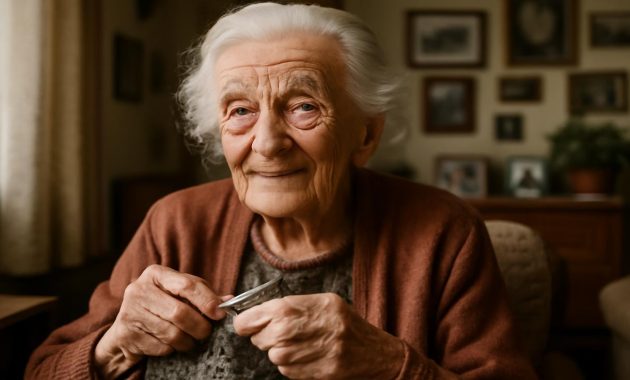
The first thing you notice about Edith is that she moves like someone who still has things to do. Not in a hurry, not rushed—but with a quiet efficiency that makes you straighten your own spine without realising it. At 102 years old, she grips the arms of her weathered wooden chair, eases herself up, and pads across the kitchen tiles in woolen socks to check on the soup simmering gently on the stove. Outside, late afternoon light slides across the hedges, turning each leaf into a small, shining coin. The house smells of bay leaves, old books, and freshly brewed tea.
“I Refuse to End Up in Care”
“People keep telling me I’m a miracle,” Edith says, easing herself back into her chair, her fingers wrapped around a mug decorated with fading violets. “I’m not a miracle. I’m stubborn.”
Her voice has that particular clarity older people sometimes have—thin but precise, as if every word has been weighed before release. Her hearing aids flash a tiny red light when she laughs.
“I told my daughter years ago,” she says, “I refuse to end up in care. Not if I can help it. My body may not always cooperate, but my habits are my business.”
Outside the window, a blackbird hops across the low stone wall as if on cue, cocking its head toward the glass, listening. Edith watches it for a moment, then smiles. “He comes every afternoon. I call him Harold. We have an arrangement: I talk, he listens, and neither of us complains.”
It would be easy to dismiss her longevity as luck, genetics, or “good bones,” as people like to say. But spend a day in her small cottage at the edge of the village, and another truth emerges. Edith has quietly built her life around a set of daily habits—uncomplicated, consistent, fiercely protected. Together, they form a kind of invisible scaffolding that keeps her standing, thinking, cooking, walking…living.
The Morning Ritual: “I Greet the Day Before It Notices Me”
“I like to get up before things start happening,” Edith says. “Before the lorries roar past, before the postman, before the news.”
Her day begins at 6:15 a.m., without an alarm. “My body is my clock now,” she says. “It’s had plenty of practice.” The room at that hour is pale with the first suggestion of light. It’s quiet enough to hear the creak of the old beams settling in the roof, the distant call of wood pigeons from the copse beyond the garden fence.
She swings her legs slowly over the side of the bed and pauses, hands on her knees, breathing deeply. “I do a little inventory,” she explains. “Toes, ankles, knees, hips. We check in with each other. I ask, ‘Can we do this today?’ So far, the answer has always been yes. Occasionally, it’s ‘Yes, but gently.’”
There is no dramatic workout waiting for her—no treadmill, no dumbbells, no yoga mat rolled out in the living room. Instead, there is the ritual of ordinary movement repeated, carefully, every single morning.
The Quiet Power of Small Movements
In the narrow hallway, she runs her fingers along the painted wall to guide herself toward the kitchen, the boards cool under her bare feet. She does ten slow heel raises as the kettle comes to a boil, lifting herself up, holding, and lowering, her hands lightly resting on the countertop for balance.
“These are my non-negotiables,” she says. “If I can still stand on my own two feet, I have a say in my life.”
As the tea steeps, she holds the edge of the sink and slowly lifts each knee, one at a time, up toward her chest. “I imagine I’m stepping over a fallen tree in the woods,” she says. “It makes it easier somehow, less like exercise, more like play.”
Breakfast is always simple: porridge with a handful of berries if she has them, or chopped apple if she does not. “Oats and I are old friends,” she says, spooning a modest portion into a plain white bowl. “We’ve been through a lot together.” A small saucer holds a scattering of chopped walnuts. “For my brain,” she says, tapping her temple lightly. “And because they’re crunchy. Life should always have something crunchy in it.”
| Time of Day | Habit | Her Reason |
|---|---|---|
| Early Morning | Joint “inventory” and gentle standing exercises | “To know what kind of day my body is giving me.” |
| Breakfast | Oats, fruit, nuts, hot tea | “Slow fuel, nothing too fancy, but plenty of fibre.” |
| Late Morning | Short walk and light housework | “If you can still potter, you can still live alone.” |
| Afternoon | Rest, reading, simple hobbies | “Your body likes pauses, your mind doesn’t like boredom.” |
| Evening | Light supper, phone calls, reflection | “End the day knowing at least one good thing happened.” |
“Use Your Legs, Use Your Head, Use Your Hands”
Later that morning, the village lane is bright with washed-out sunlight. Damp earth smells rise from the hedgerows, rich and green and faintly metallic. Edith locks her front door, tucks the key into the right pocket of her cardigan—always the right pocket—and sets off with her walking stick.
“People think walking is just about your legs,” she says, carefully placing each step. “But it’s about your eyes and your ears and your balance and your pride. When you walk, you’re telling the world, ‘I’m still here, and I’m coming through.’”
She doesn’t walk far—“Half an hour on a good day, twenty minutes if my hip mutters at me”—but she does it almost every day, unless the weather is truly vicious. A light drizzle is not a deterrent; it’s part of the texture of life.
Routines as Invisible Independence
Back at home, movement threads through her tasks. She washes her own dishes, even though her daughter has offered to buy her a dishwasher. “My sink is my little gym,” she says. “Stand, reach, rinse, dry. Bend a little, stretch a little. A machine can’t get that sort of exercise for you.”
She folds laundry slowly, smoothing each piece with methodical hands. She waters the plants on the windowsill with a chipped blue jug, leaning in close to touch each leaf. “I talk to them,” she admits. “It’s nice to have someone to tell secrets to who never interrupts.”
These small acts—insignificant on their own—add up to something profound. They keep her life stitched together with purpose. “If someone comes in to do everything for you,” she says quietly, “you stop needing yourself. I’m not ready for that. I like being needed by my own life.”
Food as Quiet Medicine
Lunch with Edith is a study in restraint and colour. On the table: a bowl of homemade vegetable soup, irregular cubes of carrot and potato bobbing beside shreds of cabbage, flecks of parsley. A slice of dense, dark bread waits on a small plate, the butter spread thinly but thoroughly, reaching every edge. An apple gleams in the fruit bowl, half red, half yellow, a small coin of sunlight.
“I grew up in a time when wasting food was practically a sin,” she says. “But we also didn’t eat the way people do now. There weren’t crisps in every cupboard, or biscuits in plastic towers. We ate what was there—mostly plants, sometimes meat, never too much.”
The Rule of “Enough”
Her eating philosophy is disarmingly simple. “Not too little, not too much, and not all at once.” She eats three modest meals a day, with a small snack in the afternoon if she feels like it—often a handful of nuts or a piece of fruit, rarely anything packaged.
“I’ve never been on a diet,” she says. “I don’t even like the word. It sounds like ‘die’ with a ‘t’ on the end. I prefer ‘habit.’ Habits sound friendlier.”
On her shelf, jars of lentils and beans stand in a neat row like well-behaved schoolchildren. She buys fish once a week. Meat is rare now, reserved for Sundays or visits from family. “I don’t tell other people what to eat,” she says. “But I know what works for this old machine.” She pats her chest gently.
Above all, she refuses to be “fed” by anyone. “The day I can’t manage a spoon is the day I accept help,” she says, “but until then, this hand” — she lifts it, veined and surprisingly steady — “knows very well how to feed this mouth.”
Companionship, Boundaries, and the Art of Saying “Not Yet”
After lunch, the house settles into its softer, slower afternoon mood. A clock ticks steadily on the mantelpiece. Light moves across the bookshelves in slow stripes. The world outside seems to lean back a little.
This is when Edith reads. There is always a book open, face-down on the armrest, its spine gently broken by repetition. Today it is a collection of nature essays; tomorrow it might be a detective story. The television stays mostly dark. “It shouts too much,” she says. “People on it are always upset.”
But being alone is not the same as being lonely. Edith has visitors—a neighbour who stops by with eggs, the postman who lingers to tell her about his grandchildren, her daughter who drives over twice a week. Friends from the village call her on the phone, their voices crackling over the line, filling the corners of the room.
The Boundary That Keeps Her Free
What she is careful about, almost fiercely so, is the boundary between help and takeover.
“My daughter would happily do everything for me,” she says with affection. “She worries. She loves me. But I told her, ‘If you wrap me up in cotton wool, I’ll suffocate. Let me do the things I can still do, even if they take me longer.’”
So they have an agreement. Her daughter helps with the heavy lifting: changing curtains, dealing with complicated paperwork, driving Edith to medical appointments, carrying bags of compost for the garden. But the daily pulse of life—the cooking, dressing, washing, tidying—remains firmly in Edith’s hands.
“I am not pretending I will never need care,” she says. “I’m not foolish. But I won’t drift into it because I stopped using my body or my mind when I still could. I will fight for my independence right up until the moment I genuinely cannot manage. And when that moment comes, I hope I’ll be tired enough to accept it gracefully.”
Mind Habits: The Inner Weather Forecast
As the day thins into evening, another of Edith’s rituals appears, almost invisibly: the way she tends her mind.
“I pay attention to my inner weather,” she says. “You can’t stop old age, but you can stop yourself becoming a permanent thunderstorm.”
She keeps a small notebook on the table by her chair. Each evening, she writes down three things: one thing she did for her body, one thing she did for her mind, and one thing she did for someone else.
“Today,” she says, peering at the page, “I walked to the post box. That’s for my body. I read two chapters of my book. That’s for my mind. And I phoned my neighbour to ask about her doctor’s appointment. That’s for someone else.”
Sometimes, the list is humbler still. “Some days the ‘for my body’ bit is, ‘I had a proper glass of water instead of another cup of tea.’ That still counts. Not every day can be grand.”
The Decision Not to Complain
It would be dishonest to pretend she does not feel pain, or fear, or the disorienting ache of outliving almost everyone she has ever loved. There are bad nights. There are hospital visits. There are days when the weight of 102 years sits solidly on her chest.
“But I made a decision in my seventies,” she says, fingers tracing the rim of her mug. “I said to myself, if I’m lucky enough to grow very old, I do not want to be the person everyone dreads visiting. You know the sort—only complaints, only bitterness, everything is someone else’s fault.”
So she practices a kind of mental pruning. When a thought arrives heavy and dark, she doesn’t ignore it, but she doesn’t let it take over either.
“I say to myself: ‘All right, Edith, you’re scared. That’s human. Have a little cry if you must. But then what’s one small thing we can still enjoy today?’ Maybe it’s the light on the wall, or the taste of my soup, or Harold the blackbird making a racket in the garden. There is always something small, if you’re willing to notice it.”
This, perhaps more than anything, is the habit that keeps her from slipping quietly into the passivity of “being cared for” rather than “living.” She insists on participating, even in her own sadness.
“I Don’t Want to Live Forever. I Want to Live Properly Now.”
As darkness gathers at the windows and the lamp above the table spills a warm oval of light, Edith prepares for bed with the same deliberate efficiency that shaped her morning.
She lays out tomorrow’s clothes—a soft blouse, comfortable trousers, thick socks—in a neat stack on the chair. “I like to give tomorrow a running start,” she says. “If I wake up, I’m ready. If I don’t wake up, well, the chair won’t mind.” There is no drama in her voice, only acceptance.
She doesn’t chase sleep with pills, unless her doctor insists. Instead, she relies on routine: a warm drink, a few pages of reading, a short stretch by the bed. “I thank my legs,” she says softly, demonstrating. “I say, ‘You did well today. Let’s see what we can manage tomorrow.’ It sounds silly, I know, but it helps.”
When asked what she thinks people misunderstand about aging, she doesn’t hesitate.
“They think it’s something that happens to you, like weather,” she says. “Of course, some of it is. Illness, accidents, genes—that’s all a sort of weather. But a great deal of it is how you walk through that weather each day. Do you wrap yourself in blankets and stop moving at the first sign of rain? Or do you put on a good coat and keep going to the shop?”
She leans back, her eyes clear and steady. “I don’t want to live forever. That sounds exhausting. I want to live properly now, right up until I can’t. And for me, ‘properly’ means I wash my own face, I stir my own soup, I choose my own bedtime. It means I keep my habits sharp so my life doesn’t dull around the edges.”
Before she turns out the light, she pauses by the window, looking out into the dark garden. Somewhere out there, Harold the blackbird is tucked into a hedge, feathers fluffed against the night. Streetlights reflect faintly off damp leaves. The world feels both vast and very, very close.
“People ask me for the secret,” she says quietly. “There is no secret. There is only today. What did you do with it? Did you move your body, even a little? Did you feed yourself something real? Did you talk to someone, or read something, or notice beauty? Did you choose, even once, not to complain?”
She smiles, a small, tired, triumphant smile that carries a century in it.
“Do that most days,” she says, “and maybe, if you’re lucky, you’ll be old enough to annoy your children by refusing to go into care. And you’ll be able to say, as I do, ‘I’m still here. And while I’m here, I’m living on my own terms.’”
Frequently Asked Questions
Does Edith live completely on her own without any support?
Edith lives independently in her own home, but she does have a support network. Her daughter visits a couple of times a week, neighbours check in, and professionals handle medical needs. The key is that she still manages her daily personal routines—washing, dressing, eating, light housework—herself.
What kind of exercise does she do at her age?
Her “exercise” is mostly built into everyday life: gentle standing exercises in the kitchen, short walks outdoors with a stick, light housework, stretching before bed. She focuses on balance, leg strength, and keeping her joints moving rather than intense workouts.
Does she follow a strict diet?
No complicated diet, just consistent, simple eating: plenty of vegetables, oats, beans, fruit, some fish, and occasional meat. She avoids overeating, limits highly processed foods, and prefers home-cooked meals. Her main rule is “enough, but not too much.”
How does she cope with loneliness and the loss of friends?
She keeps regular contact with neighbours and family, enjoys phone calls, and fills her days with reading and small routines. She allows herself to feel sadness but deliberately looks for at least one small thing to enjoy or appreciate each day, which helps her stay emotionally balanced.
Can anyone follow her habits, or are they only for older people?
Her habits are simple enough for most ages: daily gentle movement, mindful eating, small acts of independence, mental stimulation, and regular social contact. Starting earlier in life may make it easier to maintain those habits into older age, but they can be adapted at almost any stage.