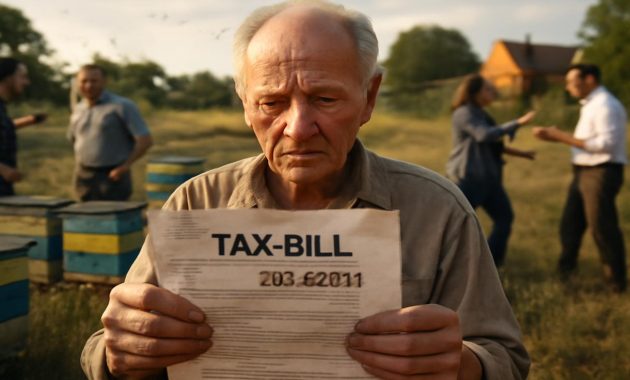
The first thing you notice is the hum. A low, velvety thrum that seems to rise up out of the clover and wild thyme at the edge of the old man’s field. On warm days, the air shivers with it—thousands of honeybees stitching invisible paths from wooden hives to blossoms and back again. The retiree, whose name is Martin, leans on his walking stick and watches them with a kind of quiet pride. He does not own the bees. He does not bottle their honey. He does not see a cent of profit from the honeycomb rich with gold and sunlight. And yet, this year, a stern envelope arrived bearing a very different kind of buzzing: a notice from the tax office informing him that he now owes agricultural tax on his land.
A Quiet Act of Kindness
For years, Martin’s life followed a simple rhythm. After four decades working as a mechanic in a small town, he retired with a modest pension and a creaky back. His children had moved to the city; his wife had passed away. What remained was his little house and a few acres of land, the fields his parents once used for potatoes and wheat but which had long since gone fallow, grown over with grasses and wildflowers.
“It felt wrong to just let it sit there,” he tells a neighbor one afternoon, the smell of earth and cut grass drifting on the breeze. “But I don’t have the strength to farm it. I just wanted it to stay alive, you know?”
Then, two springs ago, the beekeeper appeared. A friend of a friend, a woman in her forties with sunburned cheeks and a van that smelled faintly of wax and smoke, she came to ask a favor. She explained how bees were struggling, how farmland and monoculture had squeezed out the variety of flowers they needed, how pesticides and disease were thinning their ranks.
“Your field is perfect,” she said, gesturing to the dandelions and clover. “I’d like to put a few hives here. I’ll take care of everything. You don’t have to do a thing. I can pay you a small rent or give you honey as thanks.”
Martin waved her offer away. “Keep your money,” he insisted. “I’m not doing this to earn anything. Just put your bees out there. I like the idea of them.”
And just like that, the deal was struck. No contract. No bill of sale. Just an old man’s handshake and the soft promise of buzzing summer afternoons.
The Letter That Changed Everything
The first year, everything felt quietly beautiful. Wooden hives, painted in fading blues and greens, appeared along the edge of the field. On cool mornings, little clouds of bees poured from their entrances like smoke. The beekeeper came regularly, sometimes early, sometimes at dusk, in a white suit that creaked when she moved, gently lifting frames heavy with honey and brood. She brought Martin jars filled with thick amber honey, still warm from the late-summer sun.
He would sit on his back step, spooning it onto toast, tasting wildflowers and clover and the sharp, bitter whisper of dandelion. To him, it felt like nothing more than good fortune—a way for his neglected land to play a small part in something larger, quieter, and necessary.
Then the letter arrived.
It came in a crisp white envelope, stamped with the emblem of the local tax authority. Inside, precise black type laid out the facts: his land, previously classified as non-productive, was now being used for agricultural activity. Specifically, the keeping of bees. The land, therefore, no longer qualified for favorable non-agricultural status; it fell under agricultural use, which came with a different tax rate and obligations.
At first, he thought it must be a clerical error.
“But I’m not doing anything,” he muttered, holding the letter under the kitchen light as if the words might rearrange themselves. “I’m not farming. I’m not selling honey. I’m not making any money from this.”
Yet to the office that sent the letter, it did not matter. The law, as far as they were concerned, was clear.
The Law’s Unforgiving Simplicity
In many regions, the tax code draws a hard line: land that is used for agricultural purposes is taxed in one category; land that is not, is taxed in another. Bees—like cows, sheep, or crops—are often squarely defined as agricultural use. It doesn’t matter that the landowner never touches a hive, never sees a cent from the beekeeper’s sales, never signs a formal lease agreement. What matters is function: what is happening on the land.
In Martin’s case, the mere presence of the hives triggered a reclassification. The tax office, following its internal procedures, reviewed satellite images, cross-checked local agricultural registries, and concluded that his once-fallow field had become part of an apiary operation, however informal.
From a bureaucratic perspective, it was tidy. From a human perspective, it felt brutal.
“They say I’m running a farm,” he told his next-door neighbor, waving the letter with a shaky hand. “I’ve never sold a single carrot in my life. My back won’t let me shovel snow, let alone run a farm. But because I let some bees onto my land for free, I’m suddenly a businessman?”
Great Injustice or Legal Necessity?
News of the case spread quickly in the small town, then beyond. Someone posted about it online; a local journalist wrote a short piece. Soon the story took on a life of its own, splitting public opinion like a fault line.
On one side were those who saw the ruling as outrageous. “We’re always hearing about the importance of bees,” they argued. “We’re told to plant wildflowers, to support local beekeepers, to be part of the solution. Now a pensioner who lets someone put hives on his land out of the goodness of his heart is punished for it?” To them, the situation was nothing less than a moral failure of the system, a signal that kindness and ecological responsibility were liabilities instead of virtues.
On the other side were those who said, perhaps with less emotion but with equal conviction, that the law must be consistent to be fair. If Martin’s land was being used for an economic activity—even if he personally earned none of the profits—then that activity placed demands on infrastructure, markets, and oversight. If exceptions were made for him, why not for everyone else? Where would you draw the line between a true hobby and a disguised business?
Between these two positions, Martin sat at his kitchen table, the air thick with the smell of old wood and honey, caught in the crossfire of a debate he never wanted.
A Simple Arrangement Becomes a Complex Problem
From a distance, his agreement with the beekeeper had seemed harmless, even noble. No money changed hands. No contracts, no paperwork. Just a gentle understanding: “You can use my land, and in return, I get to enjoy seeing your bees.”
But systems of law and tax rarely tolerate vagueness. The very informality that made the arrangement feel human is what made it invisible to the structures that might have protected him. There was no declaration that the hives were part of a nonprofit conservation project, no special designation for ecological stewardship, no advisory note to the local authorities.
In the eyes of the tax office, it looked simple: beehives are an agricultural activity. Agricultural activity goes in the agricultural box. Agricultural box equals agricultural tax. Case closed.
To them, it wasn’t personal. To Martin, it was deeply so.
What’s Really at Stake?
The argument around Martin’s field is not just about whether one retiree should pay more tax. It asks a larger, more uncomfortable question: how should our laws treat the people who open their land for ecological benefit when money isn’t their goal?
As the climate warms and biodiversity shrinks, public campaigns urge citizens to turn lawns into meadows, to plant native trees, to welcome pollinators. Governments host programs praising “nature-friendly landowners,” while NGOs release glossy brochures with photos of wildflower-rich fields buzzing with life.
But when those fields intersect with existing tax codes, zoning laws, and agricultural regulations, the story can turn sour. What began as a gesture of goodwill can be reinterpreted as a taxable activity, a regulatory headache, or even a potential violation.
For small landowners, the stakes can be painfully tangible. A shift in tax status may not mean a minor increase—it can signify hundreds, sometimes thousands, in extra costs each year. For a retiree on a fixed income, that difference can be the tipping point between stability and anxiety.
Meanwhile, the benefits of those ecological decisions—more pollinators, healthier local crops, richer biodiversity—are shared by everyone, from fruit growers miles away to children who will never know that their apples are sweeter because a stranger once said yes to some bees.
How the Numbers Can Turn Against Goodwill
When the tax notice arrived, one of the first things Martin did was ask a friend to help him figure out what this actually meant for his budget. They sat down at the table with a calculator, the hum of the bees drifting faintly through the open window.
They made a simple comparison:
| Item | Before Beehives | After Beehives |
|---|---|---|
| Land classification | Non-productive / low-use | Agricultural use |
| Annual land tax | Low, fixed amount | Significantly higher, based on agri status |
| Income from land | None | Still none (honey is a gift) |
| Obligations | Basic property duties | Possible reporting, inspections, higher tax |
On paper, the bees had turned his land into something more “productive.” In reality, their presence had only produced extra financial weight for him.
“If I’d known it would cost me this much,” he said quietly, “I might have thought twice. Not because I don’t want the bees. Because I can’t afford to do the right thing.”
Drawing the Line Between Use and Responsibility
At the heart of the controversy is a stubborn knot of questions: When does simply allowing something to happen on your land become an economic activity? Where is the line between generosity and legal responsibility?
For the beekeeper, the land is part of her livelihood. The hives produce honey, beeswax, maybe even pollination services for other farmers. She invests her time, skills, and money into maintaining them, and she bears the risk of disease, drought, or low yields. In that sense, her operation looks every bit like what it is: a small agricultural business.
For Martin, the land is home. It is memory, inheritance, and place. When he said “yes” to the hives, he understood it as neighborly assistance, something closer to letting a friend park their car in your driveway for a while. He did not see paperwork. He saw wildflowers and wings.
Yet the law often doesn’t distinguish between the intentions of those involved. It sees the physical reality: hives on land. And because it cannot read minds, it takes a one-size-fits-all approach. That approach, while administratively efficient, can feel deeply unfair in edge cases like his.
Some argue that this rigidity is the price we pay for order. If the authorities had to consider intention in every case—was this for profit or for love of nature?—they would quickly be overwhelmed, and loopholes would open for those looking to exploit any ambiguity.
Others counter that in an age where we desperately need more people to use their land for the public ecological good, we cannot afford to punish the very volunteers we most rely on. We need nuance, creativity, and, above all, a willingness to see that not every hive, or hedgerow, or wildflower patch, is a profit-making scheme in disguise.
The Emotional Toll of a Technical Decision
For the officials who processed the decision, it may have been a routine reclassification, a few keystrokes in a database. For the lawyers debating the case, it may be an interesting test of where agricultural law meets environmental reality. But for the man at the center of it, the consequences are far more intimate.
Since the letter came, the hum of the bees no longer feels entirely peaceful. On some days, it sounds like a reminder—of the bill he cannot easily pay, of the calls he has to make, of the unsettling awareness that his kindness slipped into a world of rules he does not fully understand.
He has thought, more than once, about asking the beekeeper to move the hives. He imagines the field empty again—no boxes, no low roar, just wind in the grass. It would hurt, but it would also be simpler. No more tax surprises. No more letters in official envelopes.
“But then I think of them,” he says, pointing out toward the busy, golden air. “They don’t know about any of this. They’re just doing what they’ve always done. And it feels wrong to make them pay the price for our rules.”
In that quiet conflict—between financial survival and a sense of moral duty—you can glimpse the core of the dilemma many small landowners face today.
Between Principles and Pragmatism
So is this a great injustice or a legal necessity?
Legally, the tax authority can make a strong case: the land is being used in a way that fits their definition of agriculture. If they ignore that, they risk inconsistency, favoritism, and lost revenue. A system that bends too freely to emotion can become unpredictable, and unpredictability is dangerous when it comes to something as foundational as tax law.
Morally and practically, though, the picture is messier. If encouraging ecological cooperation between citizens and small producers is a genuine social goal, then the rules around land use and taxation need to recognize scenarios where money is not the motive. Without that recognition, the message that reaches people like Martin is simple and stark: “If you help, you might pay for it.”
That message travels fast. Neighbors hear about it over fences and in grocery store lines. Beekeepers find it harder to place hives. Land that could have blossomed with pollinator-friendly plants gets mowed short and left “safely” unused. A chilling effect settles over the very kind of informal cooperation that our ecosystems quietly depend on.
There are possible paths forward—special exemptions for non-commercial ecological use, simplified registration for “conservation partnerships,” caps on tax increases for low-income landowners engaging in recognized environmental efforts. None of these are simple to design or implement. But without some form of accommodation, more retirees like Martin will think twice before saying yes when a beekeeper—or a conservation group, or a school garden project—comes knocking.
In the end, his story is less about one man and his bees than about what kind of relationship we want between people, land, and law. Are we willing to accept some complexity, some administrative effort, in order to nurture small acts of stewardship? Or will we insist that everything fit cleanly into pre-defined boxes, even when those boxes were designed for a very different world than the one we’re rapidly entering?
Out in the field, the bees keep working, oblivious to the debate. They visit clover and apple blossoms, blackberries and wild mustard, exchanging pollen in a quiet economy older than any tax code. They are, in a sense, perfect citizens: tireless, cooperative, essential. No one sends them a bill.
Standing at the edge of his land, Martin watches them and wonders if there is a way for human rules to be even half as wise.
FAQ
Why did the retiree have to pay agricultural tax if he wasn’t earning money?
Because tax systems usually classify land based on how it is used, not on who profits. Once beehives were placed on his land, authorities considered it agricultural use, triggering different tax rules, even though he personally made no income from the bees.
Could the beekeeper, not the landowner, be held responsible for the tax?
Typically, land taxes are tied to the property owner, not the user. The beekeeper may have her own tax responsibilities for honey sales or business income, but the classification of the land itself usually falls on the owner’s shoulders.
Is this situation common for people who allow beehives or conservation projects on their land?
Cases like this are not everyday occurrences, but they are becoming more visible as more people open their land to ecological uses. Much depends on local laws, how strictly they’re enforced, and whether there are exemptions for small-scale or non-commercial projects.
Are there legal ways to avoid tax reclassification in such situations?
In some regions, landowners can register their participation in recognized conservation or non-commercial initiatives, which may offer special tax treatment or exemptions. The options are highly local, and professional legal or tax advice is usually necessary.
What does this case mean for others wanting to support bees or biodiversity on their land?
It highlights the importance of checking local regulations before making informal agreements. While the desire to help nature is admirable, understanding potential tax and legal consequences can prevent unpleasant surprises and help shape better, more supportive policies over time.