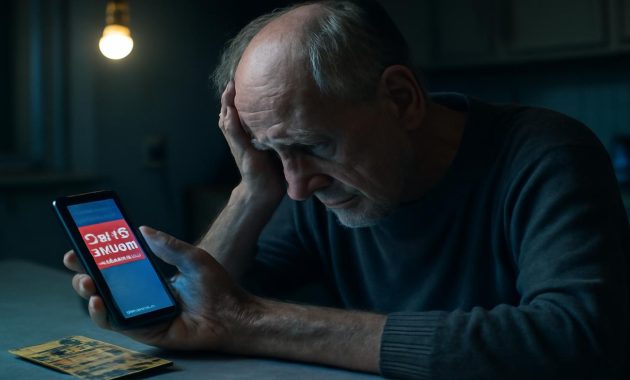
On the morning the numbers changed his life, the sky over the village was low and gray, the kind of sky that presses sound down close to the ground. In the small kitchen that still smelled faintly of last night’s fried onions and coffee, Karl sat at the table with the old iPad his daughter had given him three Christmases ago. The tablet wore a crack in one corner like a scar, but it worked. It held his weather app, his chess app, and—most recently—his lottery app.
He had not meant to download it. It appeared after some ad on a recipe site, a soft blue logo that promised “instant checking” and “secure play.” His fingers were clumsy, the way fingers get when the world moves a little faster than you do. One tap led to another. Suddenly he had an account and a password scribbled on the back of a supermarket receipt.
Still, it was practical. No more standing in line at the tobacco shop. No more lost slips of paper. Everything in one flickering, glowing place.
That morning, the village was quiet. A tractor hummed somewhere beyond the fields, and a crow called once from the naked apple tree. The central heating clicked and sighed. Karl slid his chair closer to the table, joints protesting, and opened the app.
The numbers appeared like they always did—white circles on a dark background, like moons caught in ink.
He blinked. Then he blinked again, bringing the iPad closer until his breath fogged the glass.
The little sound the app made—three soft rising notes, like a digital sigh of surprise—seemed oddly small for what it was telling him. But there it was, in gray and blue and plain sans-serif type, a sentence that did not belong in his kitchen.
Congratulations, you have won €71,500,000.
The Week the World Turned Golden
For a while he just sat. The refrigerator rattled to life in the corner. A car passed outside, tires hissing on damp road. The ordinary world kept moving, unbothered.
For seventy-two years, money had been something that arrived in thin slices. A pension check. A few coins in a jam jar. A careful list on a scrap of paper: bread, milk, potatoes, something small for the grandchildren if the supermarket had a special offer. Money was a trickle you cupped your hands under, hoping it would last till the end of the month.
Now, all at once, it was an ocean.
Karl stood up slowly, as if afraid he might break something merely by moving. He opened the drawer where he kept his paper tickets, out of some old instinct, then closed it again. This was all inside the glass now. Inside the app.
“Hanna?” His voice sounded strange, even to himself.
His wife shuffled in, tightening her cardigan at the waist. Her hair, once the sharp yellow of winter wheat, had faded to the color of the sky outside.
“Please don’t tell me it’s the sink again,” she said. “We just had that man in—”
He turned the iPad around.
There are moments when faces learn new shapes. Hers did it then. For a second she went utterly blank, as if someone had wiped her clean. Then everything rushed back at once—eyes wide and wet, mouth half laugh, half cry. One hand flew to her throat, fingers worrying the thin gold chain she’d worn since they married.
“No.” It was almost a whisper, the protest of someone who has learned, over a long life, not to expect miracles. “No, Karl, that’s… that must be a joke. A scam. It’s… how much is that?”
He told her. He told her again. And by the third time, the number sat between them, a third presence in the kitchen, as real as the table and the cracked tile and the plant on the windowsill that refused to die.
They did what people do. They called their daughter, who thought he was having a stroke until he sent a screenshot. They called their son, who went quiet and then said, very firmly, “Don’t click anything else, Papa. Don’t press any buttons. I’ll come over.”
By lunchtime, the house buzzed like a disturbed hive. The grandchildren, home “sick” from school, paced the hallway, peeking into the kitchen as if something might explode there. The television in the living room stayed off. Who needed other people’s stories, other people’s news, when one single image on an old tablet had cracked open the universe?
There is a sound money makes when it hasn’t arrived yet but you know it’s coming. It’s not the crinkle of notes or the click of coins. It’s quieter. It’s the rustle of catalogs pulled from drawers, the whisper of post-it notes slapped onto fridge doors—“New car?”, “Roof?”, “Venice???”—the hushed arguments about taxes and gifts, about what’s decent, what’s safe, what’s enough.
That week, the whole house filled with that sound.
Dreams Measured in Small Things
Richness didn’t come to them first as yachts and mansions. It came as corrections to all the little indignities they’d learned to live with.
The dentist for Hanna’s back molar that had been hurting since August, the one she “could manage a bit longer.” New shoes for the youngest granddaughter, whose soles had worn nearly through. Replacing the washing machine that needed a kick on its lower right corner to work properly. Fresh paint in the bedroom, finally covering the nicotine-yellow ceiling from when they’d been foolish and young and smoked indoors.
“We’ll get the attic insulated,” Hanna said that first afternoon, standing under the drafty hatch and staring up as if she could already see warm air pooling there. “No more cold in the winter. We’ll be snug as mice.”
“We can help the kids with their mortgage,” Karl added. It came to him before any thought of himself. “They shouldn’t have to worry like we did.”
He did, however, allow one selfish daydream: a small camper van. Not one of those gleaming palaces on wheels, no. Just something sturdy and compact, with a bed and a little stove. He pictured parking by the North Sea, listening to the waves rattle the windows, making coffee in the kind of silence that only exists when you’re far from everything familiar.
His son was less romantic. “We’re talking about serious money, Papa,” he insisted, pacing the living room with the iPad in hand, the lottery app open. “We need a lawyer. An accountant. We need to talk to the bank. To make sure it’s all…” He struggled for the right word. “Safe.”
Safe. As if money could be a wild animal that needed taming.
They booked an appointment at the local bank branch. The manager, a woman in her forties with perfect hair and a tired smile, shook their hands a little longer than usual and slid them quickly into a private office, as if hiding a rare and skittish bird from the public.
“First of all, congratulations,” she said. Her eyes flicked to the iPad, to the sum displayed there, then back to Karl with a new kind of respect, almost deference. “It’s a life-changing amount.”
She spoke of structured payouts, tax considerations, the importance of not making big public displays that might invite unwelcome attention. “You’d be surprised how many relatives you suddenly have,” she joked, though her eyes didn’t quite join in.
“The good news is that, since you played through the official app, everything is already linked to your bank details. Once the prize is confirmed, the transfer is automatic.”
Automatic. It sounded smooth, easy. Like gliding.
He signed some forms. He nodded at words he half understood. There would be a cooling-off period, they said—time to verify the ticket, to ensure everything was legitimate. Seven days, maybe eight. After that, the balance in his account would shift from modest to astronomical.
“Don’t worry,” the bank manager added, as if sensing some flicker of anxiety beneath his politeness. “The app is secure. You’re in good hands.”
The App in His Pocket
Security, to Karl, had always meant physical things: a solid door, a lock that clicked, the familiar sound of Hanna moving about in the next room. But the new world measured safety in passwords and encryption, in dots that turned to asterisks and keys that never fit any lock you could see.
The app followed him through his days like an invisible companion. He woke in the night, heart suddenly thudding, and padded to the kitchen to check it again: yes, the numbers were the same, the message still there. Congratulations.
He took to charging the iPad twice a day, terrified the battery might die and pinch off this new connection to the future. At the supermarket, he found himself staring at other people’s screens, wondering how many secret lives were hidden behind those pieces of glass. How many quiet windfalls, how many catastrophes, just one log-in away.
He noticed things he’d glossed over before. The way apps updated themselves without asking, suddenly changing their colors or their behavior. The endless little pop-ups requesting permission: allow tracking, allow notifications, allow access to this, to that. The world asking, constantly, silently: may we watch you more closely?
His grandson, twelve and forever tapping at his phone, laughed when Karl mentioned this. “Opa, that’s just how it works. It’s all automatic. It’s smart.”
Smart. Another of those flattering words. Smart devices, smart homes, smart televisions. Everything smart, which implied, in some small shaming way, that if you were confused, it was you who were not.
Still, throughout that long, bright week, the app did only what he asked: it held his winnings. It showed him the number when he tapped. It waited, patient, a glowing promise in his pocket.
On the sixth day, a notification appeared that was not like the others.
Important security update available. Please update your lottery app now to ensure continued access to your account and winnings.
The message looked official. Same colors, same logo, same neat font. Below it, two buttons: Update Now and Later. The first was a friendly blue. The second a timid gray.
He hesitated just long enough to feel silly for hesitating. Their son had said not to click anything strange, but this wasn’t strange. This was the lottery, wasn’t it? The very same app he’d been staring at all week. He pressed Update Now.
The Vanishing Act
The progress bar inched across the screen like a caterpillar. At ninety percent, the iPad froze.
He frowned, tapping the glass with one knuckle as if trying to wake a sleepy animal. Nothing.
He waited. The rain ticked at the window, soft and persistent. Somewhere a dog barked twice, then fell silent.
Finally, he did the thing his grandson had taught him: held down the power button until the screen went black, then pressed it again. The tablet vibrated once, a faint shiver, and lit up with the familiar home screen.
Where the blue lottery icon had once been, there was now a pale square with a grid of dots, labeled simply: “Games.”
It was a small thing, the kind of change that happens all the time in the plastic, shifting world behind the glass. Apps rebrand, companies merge, logos soften and harden again. He told himself not to worry. Companies liked to rename things. It made the same old tricks feel new.
He tapped the new icon.
A login screen appeared he had never seen before.
Please enter your username and password to access your account.
He blinked. The old app had kept him signed in. His details were “remembered.” Now, absurdly, he had to remember them.
He went to the drawer and retrieved the folded supermarket receipt, edges softened from being taken out and put back a dozen times. Carefully, he typed the email address. Then the string of numbers and letters he’d chosen: part of his granddaughter’s birthday, part of his old car’s license plate. It had felt, at the time, like a secret code only he could decipher.
Incorrect password. Try again.
His chest tightened. He tried again, slower. The same error.
He pressed the little “Forgot password?” link. A spinning wheel appeared, then a message:
No account found with this email address.
He stared at it for a long time, as if the words might rearrange themselves into something more reasonable if he only gave them a chance.
When he called his son, his voice shook. “It’s gone,” he said. “The app is… it’s different. I can’t get in.”
Within half an hour, the living room had turned into a war room. His son and daughter perched on the sofa, phones out, thumbs flying. “Don’t worry,” they both said, almost in unison, which only made him more anxious. People repeated don’t worry when they had no idea what to do.
They tried everything. Different passwords. Different email addresses. They searched app stores, comparing icons and developer names. They called the lottery’s helpline, where a gentle-voiced woman confirmed, after checking Karl’s ID and some long number from the original confirmation email, that yes, he was indeed the holder of the winning numbers for last week’s draw.
“But,” she added, her voice changing just enough to chill the room, “I don’t see any claim having been processed on your account.”
“I filed it on the app,” Karl said. “The app said it was automatic. The bank…”
There was a quiet rustle on the other end of the line, the sound of someone reading, searching, choosing their next words with care.
“Our official app didn’t receive any update this week,” she said slowly. “And we haven’t sent out any security notifications. Could you perhaps send us a screenshot of what you’re seeing now?”
But it was too late for screenshots that mattered. In the time between his pressing “Update Now” and that phone call, something had happened in a server rack in some far-off, air-conditioned room. Some line of malicious code had run its course. Somewhere, an account had been quietly emptied into another, in a chain of commands that took less than the time it took his kettle to boil.
The lottery confirmed, days later, that the prize had been “paid out” to the account on file in his app’s records. The app, as it turned out, was no longer the app he’d first downloaded. Somewhere along the way, in some unnoticed update, it had become a quiet imitation—a skin stretched over someone else’s program.
The law, when it arrived in the form of tight-lipped officials and long forms, was sympathetic but narrow. The real lottery, the one run by the state and regulated and audited, had done what it was supposed to do: it had paid the prize to the claimant attached to the ticket. The fact that the claimant’s details had been altered, stolen, rerouted by strangers halfway across the world was, in legal terms, tragic but not their fault.
In less than a week, he had become rich enough to change the course of his family for generations—and then, just as quickly, he had become something modern and new: not simply poor, but digitally robbed.
Counting What Was Left
Grief for money is a peculiar thing. It doesn’t have the sharp edges of losing a person or a home. It’s more like a ghost limb, an ache where something should have been but never quite materialized.
The village felt smaller after the story spread. People stared at him in the bakery, eyes bright with the terrible hunger for gossip. Some clapped him on the shoulder and muttered about “damn computers” and “these scammers.” Others kept their distance, as if his misfortune might be contagious.
Journalists called. One from a glossy magazine wanted to photograph him at his kitchen table, the iPad in front of him like a criminal, the cracked screen reflecting the lines of his face. “You’re a symbol,” she said on the phone. “This is about all of us, you know? Our trust in technology. Our vulnerability.”
He declined. He had no interest in becoming a symbol. Symbols did not help pay dentists or insulate attics.
At night, he lay awake listening to the house: the tick of the hot-water pipes cooling, the faint whistle of air slipping under the door. They were the same sounds he’d always heard. The same modest life, the same worn furniture, the same pile of bills in the tray by the door. Nothing had changed, and yet everything had.
“We never really had it,” Hanna said once, cradling her mug of tea between both hands. “Not really. It was a number on a screen.”
He looked at her, at the thin veins tracing blue paths along her wrists. “But we did,” he said. “In here.” He tapped his temple, then his chest. “We lived a whole other life this week.”
She smiled then, a sad and wry curve of the mouth. “A life of better washing machines and camper vans.”
“And Venice,” he added. They had, one evening, allowed themselves that extravagance: a gondola, a small hotel on a narrow street, the smell of salt and old stone.
Loss, he realized, was not measured only in euros. It was measured in might-have-beens. In routes the mind had traced across maps, in time spent imagining a version of yourself that walked more lightly through the world.
But there was something else, too, more elusive—the sudden shattering of trust in the very fabric of the world he’d been asked to inhabit. Not the village, with its cracked pavements and gossip. The other world, the invisible one, where money and messages and identities flowed in glowing rivers of code.
A Different Kind of Wealth
People told him, in the months that followed, that the story made them angry, or sad, or scared. Some became fierce about it: “There should be laws,” they said. “Protections. You did nothing wrong.” Others shook their heads in that human way that folds pity and self-protection together: better him than me, they thought, and then hated themselves for thinking it.
Karl returned, slowly, deliberately, to his old routines. Morning walks along the hedgerows, where blackbirds bounded from branch to branch like small, feathered commas. Afternoon naps in the sagging armchair by the window. Weekly visits to the market, where he haggled gently over apples and potatoes, not because the extra fifty cents mattered so much, but because the ritual of it anchored him in something older and sturdier than any app.
He stopped buying lottery tickets. It wasn’t bitterness, exactly. It was more a quiet acknowledgment that chance had come to him once and, in its strange, modern way, had shown him both sides of its face. That was enough.
The iPad stayed in a drawer for a long time. When he finally pulled it out again, months later, the battery had died, the glass dark and leaden. He plugged it in, waited, watched the little symbol of an empty battery slowly turn red, then green.
He deleted things. Games he never played. Shopping apps he’d downloaded for some coupon that had long expired. The icon that had once been the lottery, and then something else, was gone for good.
In its place, he installed only a handful of small, quiet tools: a bird-song identifier that delighted his grandchildren, a weather app that showed not just temperatures but wind speed and cloud type. Things that helped him notice the world that existed beyond the screen rather than trying to replace it.
Sometimes, on evenings when the light stretched thin and golden over the fields, he imagined that other life again. The camper van parked by some lonely shore, the sound of the sea rattling in its thin metal skin. The dentist, the attic insulation, the gifts he would have given his children not as obligation but as generosity.
But the imagining was softer now, less like an accusation and more like a story you tell yourself before sleep.
“We have enough,” Hanna would say, whenever his thoughts turned too stern. “We always managed. We still do.”
He would look around—at the chipped mugs, the well-worn table, the small plant on the windowsill that refused to die—and feel, in some small, defiant corner of himself, that she was right.
The world had offered him a fortune in glittering digits, then snatched it back through the very same glass. Yet when he stepped outside and felt the raw wind on his face, watched the starlings flock and twist like smoke above the fields, none of that belonged to any app. No scammer could reroute the smell of rain-soaked earth or the rough comfort of his granddaughter’s hand in his.
He had been rich, for a week, in a way the world could easily measure. Now, in the long ordinary stretch that followed, he learned to count a different currency: mornings, meals, shared jokes, the simple, stubborn fact of still being here when so many others were not.
On certain nights, when the house was quiet and the glow from the streetlamp painted a pale rectangle on the ceiling, he would think again of that sentence on the screen—Congratulations, you have won €71,500,000—and feel a small, surprising gratitude.
For one brief, improbable week, the future had opened like a window. He had looked through, seen what might have been, and then the window had slammed shut, fingers intact but smarting.
He knew now just how little—how terrifyingly little—stood between what you have and what you lose when so much of life lives behind passwords and progress bars. He knew, too, how much remained stubbornly outside those fragile systems.
In the years that followed, when his grandchildren asked him about the story, their eyes wide, their own phones warm in their palms, he would always end it the same way.
“The money?” he’d say, shrugging. “It was never really mine. Not for long enough. But the week…” He’d smile, remembering the crowded kitchen, the lists on the fridge, the way the air had tasted different, as if the very oxygen had changed. “The week was. They can’t take that.”
Summary of Karl’s Week of Fortune and Loss
| Day | Key Moment | Emotional State |
| 1 | Discovers he has won €71.5 million via the lottery app | Shock, disbelief, growing joy |
| 2–3 | Family gathers, plans and dreams begin | Excitement, hope, cautious optimism |
| 4–5 | Bank visit, discussions of security and future | Nervousness, sense of responsibility |
| 6 | “Security update” on the app; account access lost | Confusion, rising panic |
| 7 | Confirmation the winnings were stolen through the app | Grief, anger, slow acceptance |
FAQ
Was Karl’s lottery win real?
Yes. The win itself was genuine—the numbers were his, and the lottery confirmed he was the rightful winner of €71.5 million. The tragedy began only when a fake “update” to his lottery app hijacked his account details and redirected the payout.
How did an app make him lose all his winnings?
A malicious update, disguised to look like a normal security notification, replaced or modified the legitimate lottery app on his device. When he tapped “Update Now,” he effectively gave control of his account to criminals, who then changed the payout details before the prize was processed.
Could the lottery company have stopped this?
From a legal standpoint, the lottery paid the prize to the account registered in their system at the time of payout. Because the hackers had already altered those details via the compromised app, the company claimed it had fulfilled its obligation. Morally, it raises questions about how well companies protect less tech-savvy users from such sophisticated fraud.
What could Karl have done differently?
He might have:
- Verified any “update” by checking directly in the official app store rather than tapping the notification.
- Confirmed details in person or via the lottery’s official website before trusting changes to the app.
- Asked his children or bank to help double-check any security messages involving large sums.
But it’s important to recognize that the scam exploited trust and was designed to fool ordinary people like him.
How can others avoid similar app-related scams?
Some simple precautions can reduce the risk:
- Only update apps through the official app store, not through pop-up messages or links.
- Be extra cautious with any notification mentioning money, security, or logins.
- Enable two-factor authentication where possible, especially for financial apps.
- Check the official website or call official support if anything looks or feels different.
- Ask a trusted family member or friend to review changes if you’re unsure.
Did Karl recover any of the stolen money?
No. Once the payout was sent to the fraudulent account, tracing and recovering the funds became extremely difficult. Cross-border digital fraud often moves money through multiple accounts and currencies in minutes, making full recovery rare.
How did losing the money affect his life in the long term?
Financially, he returned to the modest pension life he had before. Emotionally, he carried both the sting of loss and the strange, bittersweet memory of that one week when every horizon seemed open. Over time he rebuilt trust in small, tangible things—family, routines, and the non-digital world—while remaining wary of the glowing screens that had briefly made him unimaginably rich and then emptied his future in a single tap.