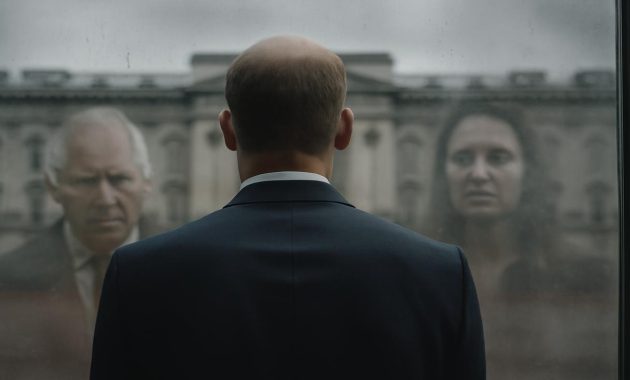
The spring light over Windsor feels softer this year, as if it, too, has learned to walk on tiptoe. On the Long Walk, the trees are just beginning to green, their buds shyly testing the air. Dog walkers murmur, children’s voices carry in brief flashes of laughter, and somewhere behind those famously guarded walls, a man who has never been allowed an ordinary life is learning what it means to carry something far heavier than a crown: the fear of losing the people he loves most.
A Prince in the Half-Light
For most of his life, Prince William has existed in a strange kind of half-light: always visible, never fully seen. We’ve watched him at school gates, at parades in scarlet uniforms, on palace balconies in the hard white glare of ceremony. Yet the version of him emerging now—son of a king with cancer, husband to a wife facing her own treatment—is less the polished heir and more a man caught between duty and dread.
There is an image that lingers from recent weeks: William stepping out of a dark car into a bright, chattering room at a public engagement. Cameras flash. People smile. He does, too—reflexive, courteous. But the light seems to fall a little differently these days, as though even it recognizes the strain tightening behind his eyes. When he bends to speak to a child or shake a hand, it is with the easy confidence of years in the job, yet just under the surface there’s a quieter story unfolding—a man learning, in real time, how to keep showing up while his world is being quietly, frighteningly rearranged.
This is the most turbulent royal year in decades, and the man at its center did not choose the timing. King Charles III, newly settled on the throne, now faces cancer treatment. Catherine, Princess of Wales—Kate to much of the world—has publicly confirmed her own cancer diagnosis after abdominal surgery. It is a double blow that has turned the royal narrative on its head. Suddenly, the sturdy, predictable rhythm of walkabouts and ribbon-cuttings feels fragile, almost theatrical, against the raw, private reality of hospital corridors and whispered medical briefings.
The Private Weight Behind Public Windows
Behind the railings and the clipped lawns, the royal palaces are not as silent as they look. They hold footsteps, echoes of raised voices, the barely audible murmur of difficult conversations late at night. For William, those conversations in recent months have included doctors, advisors, and members of his own family grappling with an uncomfortable question: what happens to the monarchy when its key figures are unwell at the same time?
He is, after all, doing several jobs at once. He is the son of a monarch whose health is now a matter of state as much as family. He is the husband of a woman the world has turned into an icon of composure, now undergoing treatment that will stretch over months, perhaps longer. He is also the father of three young children—George, Charlotte, and Louis—each of them old enough to sense that something serious has shifted in their household, even if they do not yet know its full weight.
In the evenings, after public engagements, after the briefings, after the motorcades and glassy stares of lenses, there is the smaller, more intimate theater of home. Children’s bedtime routines. Questions that land softly and then stay in the air: “Are you okay, Papa?” The way a child’s hand lingers in yours a beat longer than usual. In those moments, the titles fall away. He is not the Prince of Wales; he is just William, trying to be steady enough for all of them.
Yet the institution does not pause. The monarchy’s great machine moves forward with the ingrained muscle memory of centuries. Red boxes still arrive with documents; diplomatic receptions still need a royal presence; charities and causes still ask for attention. In recent months, more of that weight has slipped onto William’s shoulders, sometimes quietly, sometimes unmistakably. When his father’s doctors recommend rest, it is William’s diary that thickens.
Two Diagnoses, One Fragile Season
There is a strange symmetry to the facts: a father and a wife, both facing cancer, in the same year that was meant to be about stability after the upheaval of accession and the death of the late Queen. Instead of solidifying the new reign, 2024 has become a season of uncertainty—one where medical updates can alter the tone of a nation’s conversation overnight.
For those who follow royal life casually, the word “cancer” might land like a headline. For William, it lands like the echo of an earlier grief. The world remembers Diana as a global figure; he remembers her as the mother who kissed him goodnight, then vanished into flashbulbs and flight manifests. His adult life has been shaped by the question of how to protect those closest to him from that same voracious glare. Now, with Catherine’s diagnosis, that fear is no longer hypothetical.
The stakes feel sharper because Kate has come to symbolize something steady and reassuring in the British psyche: the composed, approachable princess with a hand on her child’s shoulder and laughter in her eyes. Her absence from public life, her careful words about preventive chemotherapy and privacy, have left a visible space in the royal tableau. It is not just a scheduling gap; it is an emotional one.
Charles’s diagnosis, too, has unsettled people in ways that are hard to articulate. Whatever one thinks of the monarchy, a king is, by design, a figure of endurance. The late Queen personified that quality so completely that it seemed almost heritable, something that would simply flow down the family line. Yet illness, in its unforgiving honesty, reminds everyone that even kings are bodies first, symbols second.
| Role | Person | Current Pressure |
|---|---|---|
| Monarch | King Charles III | Cancer treatment, reduced public duties, constitutional stability concerns |
| Heir Apparent | Prince William | Increased public role, supporting both father and wife, protecting young family’s privacy |
| Princess of Wales | Catherine | Cancer treatment, recovery, intense public interest |
| Royal Children | George, Charlotte, Louis | Emotional adjustment, need for normalcy and stability |
All of this funnels, in one way or another, through William. It is not simply the workload; it is the emotional geometry of being the pivot point between generations—the son who must support his father, the father who must steady his children, and the husband who must sit in quiet medical rooms holding his wife’s hand while the outside world speculates and scrolls.
The Tightrope Between Privacy and Presence
The modern monarchy survives on a fragile bargain with the public. It offers visibility, ceremony, and a sense of continuity in exchange for a kind of collective goodwill. But that bargain is harder to maintain in an age when every unverified rumor can explode across social media before breakfast, and every pause in public appearances invites commentary.
William’s instinct, honed over years of watching his mother hunted by cameras, is to guard his family’s private life fiercely. He and Catherine built a world at Adelaide Cottage and Anmer Hall that is deliberately unflashy: school runs, muddy boots, dogs sleeping under the table, the soft domestic mess that never appears in official photographs. That world is their shelter.
Illness, though, has its own ideas about privacy. Treatment schedules, hospital visits, and recovery periods restrict spontaneity. Absences must be explained. Speculation, when left to grow unchecked, quickly becomes invasive. And so, in carefully crafted statements and short video messages, the royals have begun sharing more about their health than any previous generation might have imagined necessary.
For William, each of these communications is a negotiation: how to say enough to soothe a watchful, sometimes anxious public without surrendering the small, sacred details that belong only to the family. The sound of a monitor in a hospital room. The way Catherine’s voice changes on the tired days. The flicker of fear in his father’s eyes when the conversation turns, as it must, to contingency plans.
The Human Story Behind the Institution
Strip away the uniforms, the titles, the ancient ceremonies, and what remains is a set of experiences so many people recognize: waiting for test results, rearranging work around treatment, trying to keep life “normal” for children who sense more than they’re told. Across Britain and far beyond its borders, families are navigating something similar this year. In that shared vulnerability, the royal story feels less remote, more tethered to ordinary living rooms and kitchen tables.
William’s challenge is that he must live the most personal version of that story under a magnifying glass. Even his coping mechanisms become subjects of analysis. When he appears at an event with an easy joke, it is dissected for signs of strain. When he takes time away from the spotlight, speculation blooms. There is almost no space for an unobserved breath.
And yet the glimpses that leak through—the way he squeezes a hand a fraction tighter, the brief shadows under his eyes, the moments when his voice softens while mentioning “Catherine” or “Pa”—are reminders that the royal family, for all its pageantry, is still, fundamentally, a family. It is a household where phone calls from doctors interrupt dinners, where someone sits awake at 3 a.m. scrolling through medical articles they know they should probably ignore, where laughter and fear collide in the same hour.
The Future Crown, Brought Forward
The monarchy thinks in long arcs; its timelines are measured in reigns and jubilees rather than election cycles. William has always known that one day he will be king. But knowing something in theory is different from feeling its breath on your neck. With both Charles and Catherine in treatment, the future has edged closer in ways both practical and psychological.
In the short term, the pressure is logistical. More investitures, more state functions, more handshakes in rooms that always smell faintly of polished wood and old history. Less margin for error, less space to retreat. His calendar is no longer simply his own; it is a living barometer of the monarchy’s health.
In the longer view, this turbulent year may shape the kind of king he becomes. William has often spoken about mental health, about the importance of acknowledging emotional burdens. He has worked with emergency responders, veterans, and those who live daily with trauma. Now those conversations are intersecting with his own private reality.
Illness in a family can shift its center of gravity. Roles recalibrate. Priorities reorder themselves. The future king who emerges from this season is likely to be one more marked by vulnerability than by invincibility. He will have sat in oncology waiting rooms and fielded his children’s questions about sickness and recovery. He will have felt, as many have, the strange dissonance of watching the person you love reduced to a patient number in a system of scans and schedules.
A Monarchy Reflecting a Changing Country
The United Kingdom itself is wrestling with uncertainty: political, economic, social. The royal family’s current crisis mirrors that wider mood. A once-seemingly immovable institution is facing a year where nothing feels entirely guaranteed.
And yet there is something quietly contemporary about this moment. For much of its history, the monarchy has thrived on distance—a curated mystery that kept human frailty out of sight. Now, it is being forced into a different posture: one where illness, aging, and vulnerability are part of the visible narrative.
This shift may ultimately humanize the crown in ways no PR strategy could. Seeing a king step back for treatment, a princess speak haltingly about her own cancer, and an heir shuttling between roles of son, husband, and representative of the state—these are not fairy-tale images. They are, instead, the raw material of real life, draped not in velvet but in hospital gowns and late-night kitchen conversations.
For some, this will reaffirm the monarchy’s relevance, precisely because it reflects the emotional fabric of the country more accurately than an unblemished fantasy ever could. For others, it will raise fresh questions about the fairness of asking one family to bear so much symbolic weight at all. Either way, William stands at the center of that debate, whether he wishes to or not.
In the Quiet Between Headlines
If you walk the paths around Windsor or Sandringham on a weekday afternoon, you might, with luck and no cameras around, catch a glimpse of William as very few see him: unguarded, moving quickly, shoulders slightly hunched against a wind that has nothing to do with the weather. Perhaps he has just come from a call with a doctor. Perhaps he is replaying a moment with his children in his mind, or thinking about the next public engagement where he will once again be asked, indirectly, to represent stability.
There is a particular kind of courage required to keep stepping into the light when your personal life is shadowed by uncertainty. It is not the grand, battlefield courage of legends; it is quieter, more repetitive. Show up. Smile. Listen. Absorb. Then go home and sit, at last, in the small pool of lamplight over a kitchen table, where no one is asking for anything, and allow yourself to exhale.
This is, in many ways, the story of Prince William right now: a man walking a narrow path between the public and the private, between his roles and his relationships, between the expectations of a nation and the needs of a very real, very vulnerable family. The turbulence of this royal year is not just a chapter in constitutional history; it is a lived season in the life of a husband, son, and father trying to hold multiple worlds together.
In time, the headlines will move on. The treatment cycles will conclude; outcomes will clarify. New crises, royal and otherwise, will vie for attention. What will remain, quietly woven into the man who will one day be king, is the memory of these months when the crown, though not yet on his head, pressed its weight more heavily against his shoulders than ever before.
FAQs
Is Prince William now acting as regent for King Charles III?
No. While Prince William has taken on a greater share of public engagements and responsibilities during King Charles’s treatment, there has been no formal declaration of a regency. The King remains the reigning monarch and continues to perform duties as his health allows.
How has Catherine’s cancer diagnosis affected Prince William’s schedule?
William has adjusted his public schedule to balance royal duties with family needs. He has reduced or reshaped some engagements to be more present with Catherine and their children, particularly during key stages of her treatment and recovery.
Are Prince George, Princess Charlotte, and Prince Louis aware of what is happening?
The children are believed to have been given age-appropriate explanations. William and Catherine have long prioritized giving them as normal a childhood as possible, so shielding them from unnecessary anxiety while being honest at their level is a likely approach.
Why doesn’t the royal family share more medical details?
Like anyone else, they are entitled to medical privacy. The family has shared enough information to address public concern and speculation, but they draw a line at details that would expose intimate aspects of treatment or prognosis that belong first and foremost to them.
Could this period change how Prince William reigns in the future?
Very likely. Living through a season marked by dual cancer diagnoses in his closest circle may deepen his empathy and shape his priorities as a future king—particularly around health, mental well-being, and the balance between institutional duty and family life.