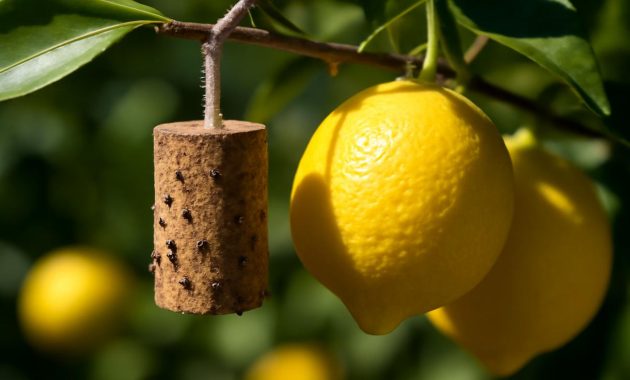
The first time I saw them, they looked like tiny, beige lanterns swaying in the sunlight—small cork stoppers dangling from the glossy branches of a lemon tree. A warm afternoon breeze slid through the garden, making the corks tap gently against the leaves with a patient, wooden clink. It was such a simple, quiet scene that I almost missed it. But once I noticed them, I couldn’t look away. Why on earth, I wondered, would anyone hang wine corks in a lemon tree?
The Curious Sight of Floating Corks
If you’ve ever wandered through an old Mediterranean backyard, or a rural garden somewhere sun-drenched and humming, you might have seen it: lemon trees heavy with fruit, their boughs speckled not only with yellow orbs but with suspended cork stoppers. Some dangle from thin twine, others tied with scraps of faded ribbon or fishing line. They seem whimsical, like garden jewelry, or perhaps remnants of some forgotten celebration.
But stay a little longer, and you’ll notice something else. Birds approach, hesitate, then veer off. A cat stalking lazily beneath the branches flicks an ear at the faint clicking sounds. A curious insect lands on a cork, then withdraws as it spins slowly. These tiny cylinders of bark and air are not decor—at least, not only that. They are part signal, part shield, part story.
In a world where synthetic solutions arrive in bright plastic bottles, the sight of a reused wine cork repurposed as a guardian of lemons feels almost rebellious. It’s a return to something older, quieter, and more observant: the kind of wisdom that comes from watching trees for decades, instead of reading labels for minutes.
The Secret Language Between Gardeners and Their Trees
Ask three gardeners why they hang cork stoppers on lemon branches, and you will likely get three slightly different answers. That’s the beauty of old garden practices: they’re not always written down in neat bullet-point lists. They’re whispered over fences, passed along at markets, or discovered by watching what your neighbor has been doing successfully for years.
Yet, beneath all these variations, a pattern emerges. The corks are there to protect, to remind, and to gently interfere with the invisible dramas unfolding among leaf, fruit, air, and beak. Each cork, light as a memory, has a job to do.
1. A Gentle, Rustic Bird Deterrent
One of the most common reasons gardeners hang corks in lemon trees is to keep birds at bay—politely. Not to terrify them or drive them from the garden entirely, but to nudge them away from the ripest fruits. When the wind moves through the branches, the corks swing and knock against the twigs. The soft, irregular clacking sound and the flicker of movement create just enough disturbance to make cautious birds reconsider their landing spot.
Unlike reflective tape or harsh noise-makers, corks feel like a compromise. The birds aren’t banished from the garden; they simply learn that the lemon tree is not the quietest or easiest buffet in town. So they turn to other, less guarded snacks. In this way, the gardener becomes more mediator than conqueror—sharing space with wildlife while still defending their harvest.
It’s not perfect, of course. Some bold birds figure it out and learn to ignore the dangling defenders. But many gardeners will tell you that a few rows of corks can noticeably reduce pecked, pierced, or partially eaten lemons, especially in smaller gardens where every fruit matters.
2. A Subtle Shield for Growing Fruit
Look closely at a cork hung near a cluster of ripening lemons and you’ll see another quiet advantage: spacing. When fruits grow thickly together, leaves and lemons rub, bump, and press. Sometimes that friction leaves tiny scars or weak spots in the skin of the fruit, making an easy target for fungus, moisture, or curious insects.
The corks, gently jostling between stems and fruits, can act as tiny bumpers. They shift the angle of a twig here, prevent a lemon from grinding against another there. It’s a small physical nudge that can keep bruises from forming, almost like slipping a cushion between glass ornaments.
Some gardeners even use corks to slightly prop up and support heavier fruit clusters. A cork tied to a higher branch, then looped under a sagging stem, can help redistribute weight so branches don’t snap under a sudden flush of lemons. It’s low-tech engineering, the kind you work out with your hands and eyes rather than a blueprint.
Recycled Corks, Old Wisdom, and Quiet Sustainability
There’s another layer to this habit, one that speaks to our relationship with waste and value. The corks hanging from lemon trees weren’t manufactured for gardening. They had a first life—often resting in the necks of wine bottles, sparkling beverages, or homemade liqueurs at family gatherings. When their initial job was done, they could have gone straight to the trash bin. Instead, they entered a second story.
In a world where almost everything seems engineered to be discarded, gardeners are often master improvisers. A broken crate becomes a trellis. A chipped mug becomes a seedling pot. A wine cork becomes a small, swinging guardian for citrus fruit. These are not grand gestures, but they add up to a different way of thinking—one where objects are seen less as single-use and more as potential tools waiting for a new role.
Standing under a tree bristling with cork stoppers, you can almost read the seasons and celebrations in their faded logos and stained sides. A birthday dinner. A wedding toast. A quiet evening shared with a friend. Each cork that now twirls among lemon leaves once popped with laughter or conversation. The tree wears them like memories, sun-bleached and repurposed.
3. A Homemade Insect Warning System
Not all the battles in a lemon tree are fought with beaks and claws. Many are microscopic or hidden: caterpillars tucked under leaves, sap-sucking insects quietly draining the tree’s energy, tiny borers seeking shelter. Some gardeners use corks as part of their watchful routine—a subtle alarm system rather than a powerful pesticide.
How does that work? Sometimes, a gardener will coat a cork lightly with a natural repellent—such as a mixture of garlic, soap, or strong herbal infusions—and hang it near vulnerable clusters of leaves. As the corks move, that scent disperses gently around the tree. In other cases, corks are used simply as markers. A suspicious branch, once tied with a cork, becomes easier to relocate in the dense foliage. Over time, the gardener learns: this is where scale insects tend to show up; that is where ants like to travel; here is where a leaf miner left its telltale track.
Because cork is light, porous, and weather-resistant, it holds faint traces of these treatments or scents longer than, say, a scrap of paper. It doesn’t dissolve in the first rain or rust like a metal tag might. The cork remains, weathered but useful, quietly participating in the ongoing observation that is the heart of organic gardening.
Stories in the Branches: Culture, Habit, and Aesthetics
Not every cork in a lemon tree is there for strictly practical reasons. Gardens are emotional spaces as much as functional ones. They hold grief, celebration, idiosyncrasy, and whims. Sometimes an older gardener teaches a younger one to hang corks without ever explaining exactly why. “It’s what my father did,” might be the only explanation. Tradition, even when detached from strict necessity, has its own power.
In some regions, it’s said that corks on fruit trees bring good luck for the next harvest, or that they remind the gardener of a year well lived and well shared. Others see them almost as amulets—small, natural charms that keep the energy of the garden lively and watched over. Whether or not you believe in such things, there is a quiet intimacy in choosing to keep a token from a special bottle and gift it to a tree that feeds you.
And then there’s the simple fact: corks look beautiful among lemon branches. The matte tan cylinders set against the waxy, dark green leaves and bright, glossy fruit create a kind of found art. On a bright afternoon, they cast tiny, rotating shadows on the lemons; on a still morning, they rest quietly like punctuation marks in a green sentence. Many gardeners, when pressed, will smirk and admit: “I like how they look. The tree feels dressed up.”
4. A Memory Chain Between Table and Tree
There is a lovely circularity at work when we hang corks in lemon trees. Consider this: lemons are harvested, carried into kitchens, sliced into glasses of water or squeezed into marinades and desserts. Some end up brightening sauces served at gatherings where wine is poured and shared. Later, when the conversation is over and the bottle is empty, the cork doesn’t disappear. It goes back outdoors, to the very sort of tree that helped flavor the evening.
In that sense, each cork becomes a bead on a memory chain linking soil, tree, table, and back again. The garden is no longer just a place that quietly produces food in the background. It is woven into daily life, reflected in the objects we keep, reuse, and tie to branches with our own hands.
For people who live in cities, where nature often feels far away or compartmentalized, such rituals are especially precious. A balcony lemon tree with a few corks swinging from its branches can feel like a small defiance against the idea that everything must be efficient, sterile, and immediately understandable. It’s a whisper that says: something is happening here, something rooted and slow and full of story.
How Gardeners Actually Do It
Though the tradition is poetic, the method is plain and almost disarmingly simple. No manuals needed—just a bit of string, a handful of saved corks, and a willingness to experiment.
| Step | What Gardeners Do | Why It Matters |
|---|---|---|
| 1. Save corks | Keep natural cork stoppers after opening bottles. | Reuses a natural material and builds a small “cork bank.” |
| 2. Prepare string | Cut light twine or thread into short lengths. | Ensures the corks hang freely without weighing branches down. |
| 3. Tie the cork | Loop the string through or around the cork and secure a knot. | Creates a simple pendulum that can swing in the wind. |
| 4. Hang on branches | Attach corks where fruit clusters or bird visits are common. | Targets protection where it’s most needed. |
| 5. Observe and adjust | Move, add, or remove corks as the tree grows and seasons change. | Turns corks into part of an ongoing, responsive care routine. |
The rhythm is easy: in winter, you might hang fewer; in spring, as blossoms appear and young fruits form, you might add more. Each knot you tie is a tiny act of attention, a decision to be present with your tree rather than simply expecting it to perform.
5. A Quiet Alternative to Harsh Solutions
Behind this practice is often a quiet philosophy: solve problems with the gentlest effective touch. Many gardeners who hang corks on their lemon branches are also the ones who hesitate before reaching for strong pesticides or aggressive deterrents. They prefer to experiment with light, movement, sound, and scent—nudging nature rather than trying to overpower it.
Corks fit seamlessly into that approach. They cost nothing extra, harm no one, and break down slowly over time. If they fall to the soil, they become another small piece of organic matter returning to the earth. In the meantime, they have served as swinging sentinels, conversation starters, and memory keepers.
The Meaning Hidden in a Small, Swaying Object
Stand under a lemon tree on a late afternoon when the light is soft and golden. Listen. You might hear the faint tapping of corks touching bark, the rustle of leaves, the far-off chatter of birds deciding whether this tree is worth the trouble. Reach up and still one cork with your fingers. It will be warm from the sun, its surface slightly rough, dotted with tiny pits and scars. You might see the name of a vineyard, a vintage, a place you have never visited printed faintly along its side.
Now look at the lemon hanging beside it: its skin dimpled, its scent waiting, its flesh full of juice that will brighten a dish or a drink. Two lives intersecting—one from a bottle, one from a branch—tied together by a piece of string and a gardener’s choice.
That’s what makes this practice so quietly compelling. It’s not just about keeping birds away, or spacing fruit, or marking a problem branch. It’s about the way we choose to live with our plants: not as managers shouting instructions, but as collaborators working with what we already have. It’s about valuing small things—leftover corks, idle hands on a Sunday afternoon, the slow observation of a tree through the seasons.
So the next time you spot cork stoppers swaying from the branches of a lemon tree, you’ll know there’s more there than meets the eye. Somewhere behind those corks is a person who has chosen patience over quick fixes, who sees objects not just as packaging but as potential tools, and who cares enough about a tree to tie tiny, swinging guardians in its boughs.
In a noisy, hurried world, perhaps that’s the real reason gardeners hang cork stoppers on lemon branches: it is a way of slowing down, of noticing, of saying to the tree, “I’m here. I’m paying attention.” And in return, season after season, the tree quietly answers with a harvest of bright, fragrant suns.
FAQ
Do cork stoppers really keep birds away from lemon trees?
They can help, but they’re not a guaranteed solution. The movement and light tapping of the corks often make cautious birds think twice about landing, especially if they have other, easier food sources nearby. Some bolder birds may eventually ignore them, so corks work best as part of a mix of gentle deterrents.
Are synthetic corks okay to use, or should they be natural?
Natural cork is generally preferred. It’s lighter, biodegradable, and holds up well outdoors without breaking into hard plastic fragments. Synthetic corks won’t offer the same environmental benefits and might not weather as gracefully in the garden.
Can hanging corks harm the lemon tree?
If used properly, no. The key is to use light string or twine and avoid tying anything too tightly around young, delicate branches. Corks should hang freely and not weigh down or cut into the bark. Check them occasionally as the tree grows.
Do corks help with insects and pests as well as birds?
Indirectly, yes. Some gardeners use corks as markers for problem areas or lightly scent them with natural repellents. The movement may also disrupt a few flying insects, though corks aren’t a powerful insect control by themselves. They’re more about observation, gentle deterrence, and supplementing other eco-friendly practices.
Is this practice only for lemon trees, or can I use corks on other fruit trees?
You can try hanging corks on other small fruit trees—such as oranges, mandarins, or even young apple and pear trees. Anywhere birds and minor friction damage are an issue, corks can be a low-cost, low-impact experiment. Just remember that each tree and garden is different, so observe and adjust as you go.