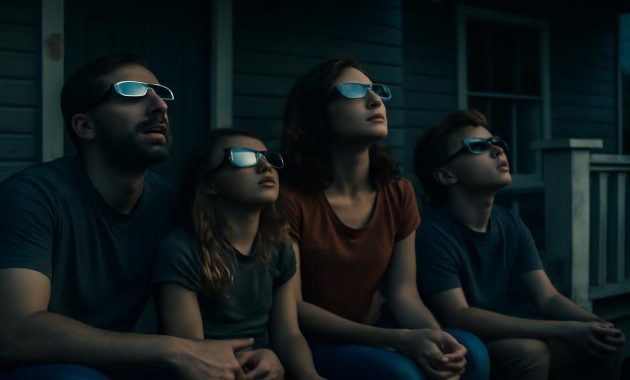
On an ordinary afternoon, the light will begin to feel wrong. Shadows will sharpen, then blur. The air may cool just enough that the tiny hairs on your arms lift in surprise. Birds will lose their script and fall strangely quiet. Somewhere in the distance, a dog will bark, then fall silent too, as if the world has pressed pause. In those long, tremoring seconds, you may feel—for the first time in a long time—very small, very awake, and very aware that you live on a moving rock in space.
When Noon Turns to Night
Ahead lies an event so rare, astronomers are already calling it a once-in-a-lifetime skyfall of darkness: a total solar eclipse plunging parts of Earth into almost six minutes of unnatural night. Six minutes does not sound like much, until you remember how quickly you usually lose a sunset. This will not be a gentle fade to evening. This will be a gulp of the sun.
During a total solar eclipse, the Moon steps directly between Earth and the Sun, perfectly aligned along a slim corridor known as the path of totality. For most eclipses, that moment of full coverage—totality—lasts only a couple of short, breathless minutes. This time, astronomers say, the geometry is nearly perfect: the Moon will appear large enough, close enough, and slow enough in our sky to blot out the Sun for up to six long, disorienting minutes in some lucky regions.
Then there is the catch: if you miss it, you may not get another chance anytime soon. In some areas, this will be the last total eclipse visible for decades. Astronomers are already mapping the next ones, their paths wandering to other continents, other oceans, other skies. The cosmos has no obligation to be convenient, and this particular alignment is generous and rare.
Imagine being a child during this eclipse and not seeing another in your homeland until you are old enough to send your own grandchildren messages about it. For once, the phrase “you had to be there” is not an exaggeration, but a simple statement of fact.
The Last Eclipse for a Generation
It helps to think of eclipses not as isolated spectacles, but as part of a long, slow choreography. The Moon is inching away from Earth every year, by about the rate your fingernails grow. That tiny drift changes everything. Over millions of years, it means that total eclipses—the ones where the Sun’s disk is completely covered—will eventually disappear from Earth’s story altogether. For now, though, we are living in the sweet spot of cosmic coincidence, when the Sun and Moon look nearly the same size in the sky.
But even inside that cosmic sweet spot, geography is picky. The path of totality for this coming eclipse will carve out a narrow ribbon across Earth, perhaps only a couple hundred kilometers wide, while the rest of the planet sees a partial nibble taken out of the Sun, or nothing at all. If your home lies under that ribbon, this year you’ve won the celestial lottery—and the prize expires fast.
Astronomers have traced the next several total eclipses, and their shadows favor other corners of the globe. For some regions, it will be 20, 30, even 40 years before the Moon’s shadow returns. Life can fit a lot of change inside that kind of span: moves, careers, deaths, children, revolutions, quiet decades. This is why you keep hearing the same phrase, whispered by scientists in interviews and shouted in headlines: now or never, at least for a while.
In observatories, on university campuses, in living-room group chats, the mood is the same: a blend of urgency and awe. Veteran eclipse chasers—people who plan entire lives around following these shadows—speak about this approaching event in reverent tones. “If this is your first,” one astronomer said at a public talk, “you’re starting with the good stuff.”
What Six Minutes of Darkness Actually Feels Like
It is easy to think of eclipse talk as abstract science until you hear people describe what it feels like. Almost no one talks about the perfect alignment first. They talk about their bodies, about the way the world changes around them.
In those final moments before totality, the light turns wrong. Not dimmer, exactly—sharper, bluer, like a filter has been drawn across the sky. Shadows appear double-edged, as if the Sun has grown nervous hands. The temperature drops, sometimes by several degrees in just a few minutes. A wind may pick up. Clouds, if there are any, turn into silent, glowing ships in a darkening sea.
Then, a gasp. People often cry out without meaning to. The Sun shrinks to a blazing sliver, then suddenly vanishes behind the Moon, leaving a ring and a halo. Around the black circle of the Moon, you see the Sun’s corona—its normally invisible atmosphere—streaming in ghostly feathers and hooks of light. The sky turns deep twilight; bright stars and planets wink on. It is not day, not night, but something else altogether, an in-between kingdom that exists only for a few stolen minutes.
Six minutes inside that kingdom is long enough for your heartbeat to settle, for the initial rush of adrenaline to become something quieter. Long enough to look around and notice how the people beside you are reacting. Long enough to hear your own thoughts, or the lack of them. Some people cheer; others grow strangely silent. There’s an old, almost ancestral fear that creeps in: the sun has gone out. No matter how many diagrams you’ve seen, the body recognizes an older, wilder story.
When the first diamond of sunlight explodes again at the edge of the Moon, the spell snaps. Birds return to their scripts, traffic noises swell, the world continues. You may find yourself blinking, trying to understand why your chest feels full, why you suddenly want to call someone you love and say, “Are you seeing this?”
Getting Ready for the Shadow
If you want those six minutes to live in your memory instead of passing as a chaotic blur, a bit of preparation helps. The best eclipse experiences, veteran skywatchers say, are a careful mix of planning and surrender: know what you need to do, then get out of your own way and feel it.
Start with where you will be. If the path of totality passes over your home, you have luck on your side. If not, you might be considering a trip into the zone of darkness. Think of that path like a moving campsite that the universe sets up for a few hours and then packs away. People will drive, fly, bus, and bike to stand in it. Hotels along the path book months, sometimes years, in advance. Small towns get ready for sudden crowds, lining up extra portable toilets, crowd-control ropes, and coffee, lots of coffee.
Weather is the wildcard. A thick blanket of cloud can turn your six minutes of darkness into an exercise in disappointment. That’s why astronomers and serious eclipse chasers haunt climate statistics and cloud-cover maps, studying which locations along the path historically offer the clearest skies. Some will make last-minute calls, driving hours overnight when forecast models hint that a neighboring region may catch the shadow under clearer skies.
Then there are the practicalities. Eclipse glasses, certified to filter out the Sun’s brutal glare, are non-negotiable for every moment except totality itself. Looking directly at the Sun, even when it’s mostly covered, can permanently damage your eyes. During those precious minutes when the Sun is completely hidden, and only the corona is visible, you can remove the glasses—but be ready to put them back on the moment the first bead of sunlight appears again.
Telescopes and cameras add another layer. Photographers sometimes discover, too late, that they spent their entire eclipse fiddling with settings, capturing the event but not really experiencing it. Seasoned observers advise: take a few photos if you like, but leave plenty of time just to be a mammal under a changing sky.
| What You Need | Why It Matters | Quick Tips |
|---|---|---|
| Eclipse glasses (certified) | Protects your eyes from permanent damage | Use for every phase except full totality |
| Clear viewing spot | Ensures you see the horizon and sky changes | Avoid tall buildings and dense trees |
| Weather check | Clouds can block the entire event | Monitor forecasts in the days before |
| Time plan | The key moments last only seconds | Arrive early; know local start and peak times |
| Simple gear (blanket, water) | Keeps you comfortable so you can focus | Treat it like a short, outdoor picnic |
On the day itself, give yourself more time than you think you’ll need. Traffic into the path of totality can swell into all-day jams. Phone networks strain; GPS apps lag. Many eclipse watchers trade highways for backroads and plan alternate routes. This isn’t just about logistics—it’s about arriving in a state of mind quiet enough to notice the subtle changes leading up to the main event.
Why Astronomers Are Excited (And a Little Emotional)
To scientists who spend their careers with their eyes in the sky, an eclipse is both research opportunity and personal pilgrimage. The Sun is a roiling, nuclear engine, and its corona still hides mysteries: how it becomes hotter than the Sun’s visible surface, how charged particles erupt and race outward, shaping the invisible weather of space.
During totality, the sudden dimming of the Sun transforms the sky into a laboratory. Instruments can pick up faint details impossible to see in full daylight. Astronomers will be chasing this shadow with cameras tuned to different wavelengths of light, with telescopes mounted on trucks, with small experiments attached to balloons, even with police-style body cameras strapped to tripods to capture the changing sky dome.
But listen closely when they talk, and you’ll hear something more tender than data: many of them still remember their first total eclipse in exquisite, sensory detail. They remember the emotional whiplash, the fragile hush of the crowd, the strange feeling that the Earth had briefly turned into another world. It changed their relationship with the sky from distant curiosity to something close to love.
That is why, when astronomers say “this may be the last for decades,” it sounds a little like they’re talking about a rare relative coming to town. They know the mathematics; they can recite the Saros cycles that govern eclipse patterns. But they also know that for the people standing under this particular shadow, the meaning will not be in the numbers.
A Shared Pause in a Noisy World
There is something quietly radical about an event that makes millions of people look up at the same moment. No algorithm arranged it. No exclusive ticket price can buy a better Sun. The eclipse will cross farm fields and skyscrapers, mountain towns and city rooftops, festival grounds and solitary hillsides. Everywhere, for a brief window, humans will share the same astonishment.
If you find your way into the path of totality, look not only at the sky, but at the people around you. Watch their faces as the light drains away; feel the crowd inhale together as the last sliver of Sun vanishes. Listen for the wave of exclamations sweeping across parks, terraces, beaches. These are the sounds of a species remembering, if only for a few minutes, that it lives in a vast, moving universe.
For children, this may be the story they tell decades from now, when the next total eclipse finally finds their region again. For elders, it may echo another eclipse they saw once, long ago, when the world was younger in different ways. Time folds funny under an event like this: people who lived through ancient eclipses scratched their shock into stone, onto animal bones, into myths of devoured suns and angry gods. And here we are, carrying solar-filter glasses and smartphones, but gasping the same way our ancestors did.
When astronomers warn that this may be the last visible such event for decades in some regions, what they are really saying is: do not sleep through this. Do not assume another will come soon to your doorstep. The universe will keep spinning, but its most astonishing alignments do not care about our schedules.
Making Your Own Six Minutes Count
So how do you actually live your six minutes of darkness well? Not perfectly—that’s impossible—but attentively. Before the eclipse, you might choose one simple intention: to notice the animals, or the way the light feels on your skin, or the sounds of the people around you. Maybe you want to share it with a child, or watch it quietly alone, or stand in a field with strangers who will never again be gathered in that exact same configuration.
As the Moon’s shadow approaches, take a moment to look at the world around you as it is in full daylight. Fix it in your mind: the color of the grass, the sound of traffic, the tenor of birdsong. Then watch how each of those things shifts. Notice the thin crescent-Sun projected in the dappled light under trees, where each tiny gap between leaves acts as a pinhole camera. Hear the pause in the insects’ chorus. Feel the changing air on your face.
When totality begins, if you are in its path, you can safely remove your eclipse glasses and simply look. You are staring at the shadow of a world on fire—our Sun, obscured by our smaller companion. It is both ordinary, in purely physical terms, and utterly outrageous in the way it looks and feels. Let your jaw drop. Let it be mythic, if that is how it lands in you.
And when those six minutes end—when the first diamond of light returns and day reasserts itself—take a breath. The world is still here. The dog resumes barking. The birds go back to being birds. But you may feel, quietly, that something has rearranged itself inside you, a small awareness of being part of a dance that goes on whether or not we are paying attention.
Decades from now, when the Moon’s shadow finally strolls back to your region, the world will have changed in ways we cannot begin to script. But this coming eclipse, with its generous stretch of darkness, belongs to you now. The countdown has already started. Somewhere in a quiet observatory, someone is fine-tuning a telescope; somewhere in a crowded city, a child is tracing the path of the Moon’s shadow on a classroom globe. The sky is making plans.
When the day comes, step outside. Look up safely. Let the universe, briefly, blow your circuits. Six minutes of darkness is not just the absence of light. It is the presence of everything else you’ve been too busy to notice.
Frequently Asked Questions
Is it really dangerous to look at a solar eclipse?
Yes, looking directly at the Sun without proper protection can permanently damage your eyes, even when most of the Sun’s disk is covered by the Moon. Only during the brief phase of totality, when the Sun is completely hidden, is it safe to look without eclipse glasses—and you must put them back on the moment any part of the bright Sun reappears.
Why is this eclipse considered once-in-a-lifetime in some regions?
Total solar eclipses follow predictable paths that rarely repeat over the same place in a short time. For some regions, the next total eclipse will not return for several decades, meaning many people will only have this one realistic chance to see totality where they live or can easily travel.
How long will totality last during this eclipse?
At certain points along the path of totality, the Moon will cover the Sun for close to six minutes. Most locations within the path will experience a shorter duration, but still significantly longer than the two to three minutes typical of many total eclipses.
Do I need special equipment to enjoy the eclipse?
You only truly need certified eclipse glasses and a reasonably clear view of the sky. Binoculars, telescopes with solar filters, and cameras can enhance the experience, but they are not essential and can be distracting if you spend the whole event adjusting them instead of watching.
What if it’s cloudy where I am?
Cloud cover can block your view entirely. That’s why many people plan to travel to areas with historically clearer skies and watch weather forecasts closely in the days before. Even under cloud, though, you may still feel the strange dimming, cooling, and the hush that washes over the landscape during totality.
Can children safely watch the eclipse?
Absolutely, as long as they use proper eye protection and are supervised. Many people describe seeing their first eclipse as children as a profoundly memorable experience. Explain the safety rules clearly beforehand and make a game of using eclipse glasses correctly.
Why do animals behave strangely during a total eclipse?
Many animals rely on light cues to know when to be active or to rest. When the sky suddenly darkens in the middle of the day, birds may roost, insects may quiet or chorus differently, and some animals may seem confused. They are responding to a rapid change that normally only happens at dusk, not at noon.