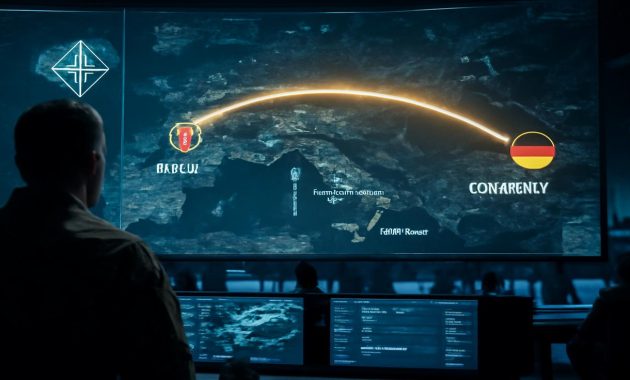
The morning mist over the Italian plain didn’t care about treaties or acronyms. It clung to the armored vehicles, softening their hard edges, turning the barrels of self-propelled howitzers into hulking shadows. A lark called somewhere beyond the tree line, thin and defiant, as if this were just another quiet dawn in the countryside. But inside a cramped metal box painted in camouflage, a German artillery officer waited for a single radio call that could redraw the map of how NATO fights a war.
Where War Plans Meet Real Landscapes
The exercise had a sterile name—something long, bureaucratic, and forgettable. On paper, it was just another NATO drill involving Germany and Italy, a chance to rehearse “interoperability” and “rapid response.” In reality, it was an experiment in something far more radical: the idea that a firing mission—an order to shoot, to unleash precision-guided steel onto a target—could move from one country’s soil to another’s as easily as a voice hops between radio channels.
Imagine this: a forward observer perched on a hillside, watching a simulated enemy convoy thread its way along a distant road. He speaks coordinates into his headset. Far away, that information is processed and packaged, accelerated through data links, encryption protocols, and command chains. In the old world, those coordinates would have been tied to a specific artillery unit, in a specific country, under a clearly defined national command.
In this new world, those coordinates are weightless. They’re a suggestion, not a destiny. They can land in an Italian artillery battery in the Apennines or a German one across the border. They can jump, mid-mission, from one nation’s guns to another’s—based on who is in the best position to fire, who has ammunition left, who can strike fastest and most accurately. It’s war by way of cloud computing, but the cloud is made of steel, propellant, and centuries of history.
Old Borders, New Fires
The idea seems simple: treat artillery, missiles, and long-range fires as a shared pool of capability, not a set of national islands. But nothing in Europe is ever that simple, especially when guns and borders meet.
Italy’s rolling hills and Germany’s dense forests hold more than pretty landscapes. They hold memories. Of invasions that came over passes and through valleys, of borders that moved not just on maps but in families and languages. When NATO planners speak about “seamless cross-border fires,” they’re not just fighting with physics and logistics. They’re wrestling with ghosts: sovereignty, public opinion, political red lines, and the stubborn human need to know who, exactly, is pulling the trigger in our name.
Spend time with soldiers in this exercise and you hear it in their voices. There is excitement—this is the cutting edge of alliance warfare. But there is also a kind of wary respect. They know that each firing mission, each digitally transmitted command, carries more than explosive force. It carries the weight of promises made in peacetime and tested in crisis.
The Heart of the Experiment
At the center of this Italy-Germany drill is a deceptively hard question: can NATO act like a single organism when it comes to firepower, or will it always be a patchwork of national reflexes?
The exercise sets up a scenario: targets appear rapidly, some deep behind a simulated adversary’s lines, others closer to NATO forces. Weather shifts. Roads clog. Ammunition stocks ebb and flow. Italian guns are well placed for one strike, German rocket artillery for another. The ideal solution—the militarily elegant one—is to let the mission roam, to send the firing order not to “Italian battery” or “German battery,” but to “whoever can do the job best in the next 90 seconds.”
Technically, NATO is closer than ever to pulling this off. Shared software, radios that speak the same digital language, standardized target formats, joint training—these are the invisible scaffolds beneath the exercise. But technology is the easy part. The real challenge is whether national command authorities will allow, in practice, what the software now makes possible.
When a Radio Call Crosses a Border
Picture a dusty tent at the edge of a training ground in Italy. Inside, a cluster of screens and a small forest of radio antennas form the nerve center of a multinational artillery command post. The air smells of coffee and cordite, and the quiet is constantly broken by bursts of English spoken in different accents—Italian, German, American, Polish. A young officer in front of a glowing screen receives a target request: hostile artillery position, time-sensitive, high priority.
He has options. Italian howitzers are within range, but currently repositioning. German rocket launchers are ready but sit across the border, where national caveats—the invisible fences around how forces can be used—loom large. On his console, the targets and firing units appear as colored icons, geometry marching across the map. The software can suggest the best shooter. It cannot decide what is politically acceptable.
This is where the “simple radio order” becomes anything but simple. If he treats the alliance like a single firepower network, he can swing the mission to the German unit with a single click and a short transmission. But that click rides on a wave of assumptions: that Berlin has authorized such cross-border missions in advance; that Rome is comfortable with foreign-fired shells streaking overhead from its soil; that any miscalculation or accident will be absorbed by the alliance and not land squarely on his career or his government.
| Dimension | Old Model: National Fires | New Model: Shared NATO Fires |
|---|---|---|
| Decision chain | Runs up and down one national hierarchy | Requires pre-agreed multinational authorities |
| Speed | Fast within nation, slower across borders | Potentially very fast if political rules allow |
| Sovereignty concerns | Clear: national guns, national call | Blurred: shared responsibility for effects |
| Use of terrain | Limited to national areas of operation | Optimized across allied borders and depth |
| Public perception | Easy to explain: “our forces, our fire” | Harder story: shared fires, shared political risk |
In Ukraine, the war has already shown how decisive long-range fires can be—and how complicated it is when foreign systems, foreign crews, and foreign political constraints intersect. Training missions in Italy and Germany try to internalize those lessons without saying them too loudly. The official language speaks of “deterrence,” “readiness,” and “flexibility.” The unofficial conversation is more blunt: if NATO ever faces a serious fight, can we afford to treat borders as speed bumps for artillery missions?
The Software of Trust
Behind every shared firing mission is something far more fragile than a satellite link: trust. The trust that data is correct. That allies will not hesitate when seconds count. That no one will hide behind national procedures when responsibility looms large.
Sit with the communications technicians, and they talk about latency and bandwidth, about encryption standards and frequency-hopping patterns. They can measure those things, tweak them, fix them. But what they cannot measure is whether a capital, hundreds of kilometers away, will be willing to let their guns serve another flag’s priorities for a moment.
In Italy, the local village near the training area hears the distant thump of guns and feels a faint tremor underfoot. To most residents, it is background noise, the price of living near a base. To a few, it stirs unease: whose war are we preparing for? In Germany, a similar exercise kicks up the scent of churned soil and burnt propellant on the edge of a quiet town. Europe remembers conscription, remembers massed forces. The idea of national armies is familiar; the idea of their firepower fusing into something bigger, less controlled by any single parliament, is newer and harder to grasp.
Yet the soldiers inside those metal boxes live in a different temporal scale. Targets appear and disappear in seconds. Drones hover and dart. A column of vehicles can vanish behind a ridgeline before a lawyer in a distant office even opens a file. For them, trust is not a theory. It’s whether the system answers when they press the transmit key, and whether an allied battery somewhere over the border reacts as if the request had come from its own headquarters.
Italy, Germany, and the Geography of Commitment
There is something symbolically potent about this particular pairing: Italy and Germany. One at Europe’s south, one nearer its center. Both central anchors in NATO’s integrated command structure. Both democracies with vivid debates about the use of force. Both countries that know, historically, what it means to be at the center of other people’s strategies.
On the Italian side of the exercise area, the light has a Mediterranean softness. Olive groves sit not far from training grounds. Farmers pause tractors to watch convoys roll past, the clash between ancient cultivation and modern maneuvering playing out in a single eyeful. On the German side, pine forests press closer, the air cooler, the light more filtered. There are echoes of Cold War map exercises, when the Fulda Gap and central European plains were imagined as the stage for tank battles that thankfully never arrived.
This new chapter in NATO planning overlays those older stories. It asks: if Italy’s guns can fire in support of German-led missions with a radio call, and German guns can do the same for Italian-led ones, what does that say about where one nation’s defense ends and another’s begins? The question is not merely geographic. It is moral and political. It probes the boundary between alliance solidarity and national accountability.
Commanders in the exercise use phrases like “cross-domain synergy” and “joint fires integration.” But watch them closely and you can see the calculation in their eyes. If this were real—if the targets on the screens were not simulated—how much authority would they really have? How quickly could they move a firing mission from one country to another without pausing to request permission that might arrive too late?
From Exercise Scripts to Real-World Stakes
Exercises are written with scripts. They have planned crises, expected surprises, and pre-arranged “injects” to test headquarters. In this Italy-Germany scenario, one such inject imagines that a critical bridge is about to be used by enemy forces. Multiple nations have artillery that can strike it in time. But each nation also has different rules about infrastructure, civilian risk, and escalation.
In the command post, the staff must decide: who fires? The answer, militarily, is “whoever has the best shot and can reload fastest.” Politically, it is “whoever is most willing to own the consequences if this goes wrong.” The challenge—and the purpose of the exercise—is to push these questions left in time. To force governments, in peacetime, to pre-negotiate the authorities that will be needed in crisis, so that a future young officer does not have to hold his breath waiting for a national answer while the bridge fills with enemy vehicles.
This is NATO’s most concrete challenge because it cannot be answered with communiqués alone. It must be rehearsed in mud and dust, with real vehicles, real crews, real friction. It must withstand the static on radios, the fatigue in human voices, the sudden downpour that turns a neat plan into a messy improvisation.
Learning to Fight as One Without Forgetting the Many
In the quiet moments between live-fire windows, when the guns are silent and the birds tentatively return to the training grounds, you can sense another kind of reflection. Soldiers, stripped of their ear protection and helmets, smoke cigarettes or cradle coffee cups, boots chalked with dust. Conversations slide between technical jargon and ordinary life—families, football, the taste of local bread.
Yet beneath the camaraderie sits an awareness that this experiment—this ability to shift a firing mission across borders with a simple radio order—carries a different kind of intimacy. If an Italian crew fires in support of German troops, the two nations share not just a tactical win, but also a joint moral ledger. If a German rocket battery delivers a mission requested by an Italian observer, their stories become intertwined in ways that cannot be easily unwound after the war game ends.
NATO, at its core, has always been about shared risk. What is new here is the immediacy of that sharing, compressed into seconds, digitized, routed through fiber and satellites. The old model of solidarity—reinforcements arriving over weeks, logistics ships crossing seas—still exists. But this newer model asks member states to accept something bolder: that in the first minute of a fight, an allied firing unit might be making decisions that history will attribute to their country as well.
For some, this is a natural evolution, the only way to defend a continent in an age of hypersonic weapons and precision strikes. For others, it is a step that must be taken carefully, with eyes wide open to the democratic questions it raises. Who authorizes this blending of fires? How are parliaments kept in the loop without slowing everything down to the point of irrelevance? Where is the line between useful integration and dangerous loss of control?
Back on the Italian plain, the exercise reaches one of its final scenarios. A complex, layered attack is simulated. Drones buzz over targets, relaying imagery. The multinational artillery network hums to life. Firing missions leap across screens, color-coded and time-stamped. In the control room, there is a moment when an operator, almost casually now, reassigns a mission from an Italian unit to a German one. The radio order is short, almost mundane. The guns respond. Steel flies. On the exercise map, icons disappear where targets once were.
From the outside, it looks like another step in making NATO more agile, more credible, more dangerous to any adversary who might misjudge its cohesion. From the inside, it feels like a quiet revolution delivered not with fanfare, but with a clipped radio voice and a burst of static.
When the last shot echoes away and the sun leans lower over the training area, the soldiers begin to pack up. The land will reclaim its sounds—wind in the trees, insects in the grass, distant traffic drifting in from ordinary roads. For the people who live near these ranges, life will slide back toward routine. For the planners and policymakers, however, the work is only starting. Because every successful cross-border firing mission in this exercise is a question thrown toward the future: when the time comes, will we really do this for real?
Somewhere between the Italian hills and the German forests, NATO is trying to learn how to fight as one without losing sight of the many. It is trying to turn the simple act of a radio order into something that crosses borders not just in physics, but in trust. That may be the most difficult maneuver of all—and the one that will matter most if the quiet of these landscapes is ever truly at risk.
Frequently Asked Questions
Why is this Italy-Germany exercise important for NATO?
Because it tests whether NATO can treat artillery and long-range fires as a shared pool of capability rather than separate national assets. Moving a firing mission from one country to another like a simple radio order is a practical test of political trust, technical interoperability, and shared responsibility.
Is this mainly a technical challenge?
No. The technology—shared software, compatible radios, standardized procedures—is advancing quickly. The harder part is political: agreeing in advance how much authority to delegate, how to handle sovereignty concerns, and how to share responsibility for the effects of cross-border fire missions.
How does this relate to current conflicts like the war in Ukraine?
The war in Ukraine has highlighted the decisive role of long-range fires, drones, and rapid targeting. NATO exercises in Italy and Germany are absorbing those lessons, exploring how an alliance can coordinate fires quickly across borders without being paralyzed by national caveats or slow decision chains.
What risks do cross-border firing missions create?
They raise questions about sovereignty, political control, and public accountability. If one country’s guns fire in support of another’s mission, both must own the outcome—militarily, legally, and morally. Miscalculations or civilian harm could strain alliances if responsibilities aren’t clearly agreed in advance.
Will this change how NATO responds in a real crisis?
If the political agreements keep pace with the military exercises, yes. NATO could respond faster and more flexibly, using the best-positioned units regardless of nationality. But the extent of that change will depend on how willing member states are to accept shared risk and grant pre-authorized powers to alliance commanders.