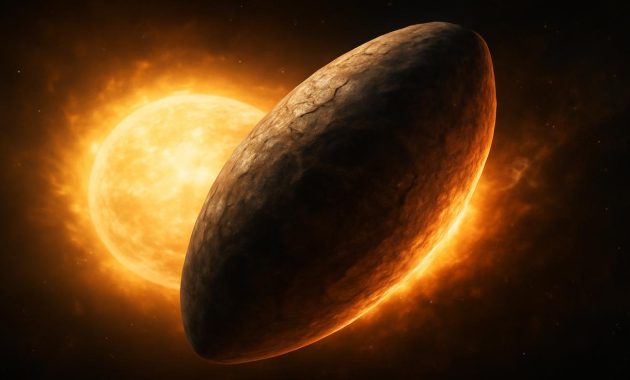
The astronomer on the night shift noticed it first—not with a gasp or a shout, but with a slow, disbelieving squint at the screen. There, glowing as nothing more than a tiny dip in a star’s light, was the hint of something that shouldn’t exist. Not here. Not like this. The data looked wrong, like a misprint in the universe’s instruction manual. But it wasn’t wrong. It was a planet. And it was breaking the rules.
A Planet That Refuses to Behave
Science thrives on patterns. Stars form in certain ways; planets tend to follow predictable paths. Big, heavy planets usually cling close to their stars, roasting in brutal heat. Smaller, rocky planets often hang out in cooler, quieter orbits. There are rules—unwritten, emergent, but solid enough that astronomers can usually guess what they’ll find when they point a telescope at a distant star.
But every so often, the cosmos tosses those rules into the stellar wind. This newly discovered world—let’s call it a “rule-breaker planet”—orbits its star in a way that defies the tidy models we’ve built. It might be where it “shouldn’t” be, or made of what it “shouldn’t” be made of, or surviving conditions that should have torn it apart long ago.
In the quiet hum of a control room, under the soft glow of computer monitors, that first anomalous signal traveled from starlight to sensor to human eyes. A tiny flicker in brightness. A telltale dip. A whisper from a distant system that said: you don’t know everything yet.
How Do You Even Find a World Like This?
Imagine staring at a single star for months, even years, waiting for the slightest hint that something is passing in front of it. That’s the transit method, the most common way we discover exoplanets. When a planet crosses its star’s face, it blocks a fraction of the light, like a fly drifting across a flashlight beam. The dimming is tiny—maybe one percent, often much less—but sensitive instruments can see it.
A normal planet leaves a kind of signature in the data: a regular, repeating dip of a predictable depth and duration. From that alone, astronomers can infer its size, its orbit, and even sometimes hints of its atmosphere. It’s like inferring the shape of a bird from its shadow sliding across the wall.
This planet’s shadow didn’t match the usual silhouettes.
Its orbit might be strangely tight or wildly elongated. Its size and density might not add up: perhaps it’s as big as a gas giant but curiously heavy, or as small as a rocky world but puffed up like cotton candy. It may circle its star so closely that its “year” lasts just a few Earth days—yet it somehow remains intact instead of being flayed into debris. Or perhaps it lies so far out that it freezes, and yet still holds an atmosphere that shouldn’t be there.
The data told astronomers one unmistakable thing: whatever this planet is, it doesn’t fit the conventional categories.
The Art of Reading Starlight
To make sense of such a strange find, scientists turn to the subtleties of light itself. When the planet passes in front of its star, a thin sliver of starlight filters through its atmosphere—if it has one. Each molecule in that atmosphere absorbs specific wavelengths of light, leaving faint fingerprints in the star’s spectrum.
By splitting that light into a rainbow and studying the missing pieces, astronomers can tell whether an atmosphere carries water vapor, hydrogen, helium, sodium, methane, or something more exotic. For a rule-breaker planet, those chemical clues can be startling. You expect a hot, close-in planet to have lost its lighter gases to space long ago—yet maybe this one still clings to them. Or you expect a small, cool planet to be rocky and dense, but the data suggests it’s more like a scaled-down gas giant.
In these mismatches between expectation and observation lies the thrill. Each discrepancy is a question mark burned directly into the sky.
When Planet Formation Theories Start to Sweat
To understand why this discovery is such a shock, you have to step back and look at how we think planets form. The basic story goes like this: a star is born from a collapsing cloud of gas and dust. Around it, leftover material flattens into a disk. Within that disk, dust grains collide, stick, grow into pebbles, then boulders, then planetary embryos. If one of those embryos grows fast and big enough, it pulls in gas and becomes a gas giant. Smaller ones stay mostly rock and metal. Their orbits tend to “freeze” into roughly stable patterns: close-in rocky worlds, more distant gas giants, and icy bodies far out.
It’s a neat picture—and it works most of the time. But this new world seems to have missed the memo.
Perhaps it’s a giant planet parked so close to its star that its atmosphere boils away like steam from a kettle, but mysteriously not all of it is gone. Or it might be a “super-Earth” or “mini-Neptune” living in a temperature zone where such worlds are supposed to be rare—a puzzling resident of a so-called planetary “desert” where current theory predicts few stable planets can exist.
That’s where things get interesting. When planets appear in regions they’re not “supposed” to occupy, astronomers suspect a tumultuous past: gravitational shoves, chaotic migrations, violent collisions. These aren’t quiet solar systems gently settling into place. They’re dynamic, messy, and perhaps more common than we imagined.
Worlds on the Move
Planetary migration sounds like science fiction, but it’s real. A planet forms in one part of the disk, then gradually spirals inward or outward over millions of years, influenced by the drag of gas or the gravitational dance with other planets. Our own solar system likely went through a version of this choreography. Jupiter, in some models, may have once wandered closer to the Sun before retreating, reshaping the fates of countless smaller worlds.
A rule-breaker planet is a loud hint that such migrations can be even wilder. Perhaps this world formed far from its star, cold and quiet, before being flung inward, skimming so close that its clouds turned into superheated storms. Or maybe it started life as a smaller body, then cannibalized siblings in a crowded system, growing unexpectedly massive for its location.
Every oddball planet forces theorists back to the chalkboard. The orbit doesn’t fit. The mass doesn’t fit. The atmosphere doesn’t fit. So maybe the story we’re telling about planet formation is missing key chapters.
What This Means for the Search for Life
Whenever a new exoplanet makes headlines, people inevitably ask: could it host life? With a planet that breaks the rules, the answer is complicated—but fascinating.
Life, at least as we know it, needs a few ingredients: a source of energy, stable conditions, and some form of liquid—often water. Many astronomers obsess over the “habitable zone,” the not-too-hot, not-too-cold band around a star where liquid water could exist on a planet’s surface. But a rule-breaker planet suggests that habitability might not be as simple as a neat ring drawn around a star in a textbook diagram.
This new world might be far outside the classic comfort zone, yet it could possess thick clouds that trap heat or internal tidal heating from a tortured orbit, creating pockets of warmth where chemistry can dance. It might be officially “too close” or “too far,” but nature doesn’t always care about our labels.
Even if this planet itself is too extreme to host anything we’d recognize as life, it teaches us something crucial: planetary systems are more diverse—and more inventive—than we imagined. If weird worlds are common, then so might be weird habitats. Subsurface oceans on icy moons. Cloud layers in gas giants. Atmospheres with unfamiliar chemistry but surprising stability.
The search for life isn’t just about ticking boxes on a checklist. It’s about expanding the list itself.
A New Kind of Cosmic Neighborhood
For decades, we imagined most planetary systems would roughly resemble our own: a sensible arrangement of inner rocky planets and outer gas giants. Instead, the exoplanet catalog now looks like a gallery curated by a wildly imaginative artist. We’ve found “hot Jupiters” hugging their stars, planets with years lasting mere hours, worlds on chaotic, tilted orbits, and planets dense enough to rival metal.
This new rule-breaker planet slots right into that eccentric gallery—but it also stands out. Its significance isn’t just that it’s strange. It’s that its particular brand of strangeness cuts directly across the predictions of long-standing models. It’s like discovering a bird that flies underwater or a fish that lives on mountaintops. It forces you to rethink what’s possible.
As we build better telescopes and refine our instruments, we’re going to find more of these misfits. Each one will nudge our theories toward a more flexible, more accurate view of planetary diversity. The universe, as it turns out, may be less like a tidy solar system diagram and more like a wild, sprawling forest where evolution has tried everything at least once.
Listening to the Planet’s Weather
One of the quiet revolutions in astronomy is that we no longer just detect exoplanets—we can start to characterize their weather. Not in the way you check a forecast on your phone, but close enough to feel uncanny.
If a planet orbits fast and close to its star, the same side might always face the light, like the Moon always showing us one face. That leads to unimaginable temperature differences between day and night. Astronomers can watch how the planet’s brightness shifts over an orbit and infer how heat is being moved around its atmosphere. On a rule-breaker planet, that heat transport might be unlike anything we’ve modeled.
Picture winds screaming at thousands of kilometers per hour, dragging metallic clouds around a world that never really cools off. Or consider a planet whose atmosphere appears thinner than expected, as if it’s in the middle of being stripped away, yet clings stubbornly to a vital layer. If the planet is too light or too hot for its type, its weather becomes a story of survival—how long can it hold itself together against the onslaught of its star?
A Table of the Unexpected
To see how deeply this planet violates expectations, astronomers often compare its properties with ordinary worlds. A simplified comparison might look like this:
| Property | Typical Planet | Rule-Breaker Planet |
|---|---|---|
| Orbital Distance | Matches expected range for its size and type | Too close or too far for its mass and composition |
| Planet Size | Consistent with mass (density fits usual models) | Unusual density: too puffy or too compact |
| Atmosphere | Follows predictions based on temperature and gravity | Contains gases or thickness that defy expectations |
| Orbit Shape | Mostly circular, stable over time | Highly eccentric, tilted, or unusually tight |
| Formation Story | Explained by standard planet formation models | Requires new ideas: extreme migration, collisions, or unknown processes |
Every cell in that right-hand column is an open question waiting for a new answer.
Why This Discovery Matters to You, Standing on Earth
It’s easy to think of exoplanets as abstractions: nameless, number-labeled worlds tucked into distant star catalogs. But the stakes of these discoveries reach all the way back to your own body, your own planet, this exact moment.
The rules we thought governed planetary systems shaped our ideas about how rare or common Earth-like worlds might be. If most systems were neat and orderly, maybe habitable planets had to arise within narrow conditions. But if planets are free to migrate, collide, and reconfigure, then nature has many more ways to build a world that can cradle complexity.
A rule-breaker planet is a reminder that Earth itself might be the outcome of cosmic improvisation—a lucky arrangement in a universe that is constantly shuffling its deck. The comfortable distance from our Sun, the protective presence of Jupiter, the stable tilt of our axis: these might be less inevitable and more hard-won than we once believed.
It also touches something deeper. For as long as humans have looked up, we’ve carved rules into the night sky. We drew constellations, told stories about gods and heroes, imagined perfection and order. Every new, unruly planet we find whispers a counter-story: the universe is not a crystal palace; it’s a living wilderness.
The Next Telescope, the Next Surprise
As more powerful observatories come online—space telescopes that can taste the chemistry of exoplanet atmospheres, ground-based giants that can pick apart tiny shifts in starlight—the catalog of rule-breaker planets will grow. Some will be mildly odd. Others will be outright baffling.
We’ll find planets that are stripped-down cores of former giants, scarred remnants of once-mighty worlds. We’ll see planets with rings wide enough to dwarf Saturn’s, or systems where multiple worlds are locked in tight gravitational resonances, like notes in a cosmic chord. We might even spot a planet mid-transformation, its atmosphere bleeding into space like a comet’s tail.
Each one will ask the same question: how willing are we to revise what we think we know?
Living With a Universe That Breaks Its Own Rules
There’s a quiet humbling in following the story of a planet that breaks the rules. You realize that our theories are not laws engraved into reality; they are maps drawn after the fact—helpful, beautiful, but incomplete. The cosmos doesn’t owe us simplicity.
An astronomer staring at the flicker of a distant star might spend years with that stubborn data, testing it against every known explanation. They will run models, tweak parameters, argue in conference halls, and write papers that begin with words like “unexpected” and “anomalous.” Somewhere in that process, a new understanding will emerge, and what was once a rule-breaker will become a new rule—or at least a new exception we know how to live with.
But in that in-between space, before the theory catches up, there’s a kind of wonder that feels almost childlike. The universe, massive and ancient as it is, can still surprise us. It can still show us something so out of place that our first reaction is simply: how?
Standing under your own patch of sky, you may never see that distant planet with your own eyes. But you can know that it’s there, circling its star, defying expectations, pulling at the boundaries of our knowledge. And you can feel, in some quiet corner of yourself, the thrill of living in a universe that still has the capacity to astonish.
Somewhere, right now, that planet is completing another impossible orbit. And somewhere, on Earth, someone is looking at the numbers, trying to rewrite the rules.
FAQ
What does it mean for a planet to “break the rules”?
In astronomy, “breaking the rules” usually means a planet doesn’t fit our current models. Its size, orbit, density, or atmosphere might contradict what standard planet formation theories predict for a world in its position.
How far away are planets like this from Earth?
Most known rule-breaking exoplanets are dozens to hundreds of light-years away. They’re incredibly distant, but modern telescopes can still detect their subtle signatures in starlight.
Can we ever visit a planet like this?
With today’s technology, visiting an exoplanet is far beyond our reach. Travel times would exceed many human lifetimes. For now, our “visit” happens through light—careful observation and interpretation of the signals those worlds send us.
Does a strange planet increase the chances of finding alien life?
Indirectly, yes. The more planetary diversity we discover, the more we realize that habitable environments could exist in many unexpected forms. That broadens the range of places where life might arise.
Will new telescopes help us understand these rule-breaker planets better?
Absolutely. Next-generation telescopes are designed to study exoplanet atmospheres, temperatures, and orbits in far greater detail. They will help determine how such unusual worlds formed, how they evolve, and what they can teach us about our own place in the cosmos.